

What makes one email campaign outperform another for an American ecommerce brand? Marketers know the challenge of predicting which message will drive more clicks and sales. Split testing offers a proven way to remove guesswork by delivering concrete data from real customer interactions. With a focus on testing single variables like subject lines or sender names, brands gain clear insights into performance and unlock the power of incremental improvements that directly impact engagement and revenue.
Table of Contents
- Split Test Email Campaigns Defined Clearly
- Key Variables You Should Always Test
- How Split Testing Improves Campaign Performance
- Real-World Examples For Ecommerce Brands
- Common Pitfalls And How To Avoid Them
Key Takeaways
| Point | Details |
|---|---|
| Effective Split Testing is Crucial | Split testing allows marketers to make data-driven decisions, enhancing email campaign performance by systematically comparing different email versions. |
| Focus on Key Variables | Testing elements such as subject lines, sender information, and call-to-action design is essential for optimizing engagement and conversions. |
| Emphasize Statistical Significance | Ensuring a statistically significant sample size and isolating variables is vital for drawing meaningful conclusions from split tests. |
| Continuous Improvement is Key | Regularly implementing split testing fosters incremental improvements, allowing brands to better understand and meet customer preferences. |
Split Test Email Campaigns Defined Clearly
Split testing represents a strategic approach for ecommerce marketers to systematically improve email campaign performance by comparing different versions of marketing communications. Email split testing allows brands to make data-driven decisions that incrementally enhance engagement and conversion rates.
At its core, split testing involves creating multiple variations of an email and sending them to different segments of your audience to determine which version generates superior results. The process focuses on testing single variables to understand precisely what drives better performance. Key elements marketers typically test include:
- Subject line wording and length
- Sender name and email address
- Email content design and layout
- Call-to-action button color and placement
- Send time and frequency
- Personalization techniques
The scientific method behind split testing eliminates guesswork by providing concrete data about what resonates with your specific audience. Incremental improvements become possible when marketers systematically analyze open rates, click-through rates, and conversion metrics for each email variation.
Precise targeting transforms split testing from a generic marketing technique into a powerful optimization strategy. By understanding nuanced audience preferences, ecommerce brands can craft more compelling communications that directly speak to customer motivations.
Pro tip: Start your split testing by selecting one clear, measurable variable and establish a statistically significant sample size before drawing conclusions about email performance.
Key Variables You Should Always Test
Understanding which email elements to test is crucial for ecommerce marketers seeking to optimize campaign performance. Strategic email testing requires a methodical approach that isolates specific variables to reveal precise audience preferences.
Marketing experts recommend focusing on several critical variables that can significantly impact email engagement and conversion rates. These key testing areas include:
-
Subject Line Optimization
- Length of headline
- Use of personalization
- Inclusion of urgency language
- Emoji or symbol usage
-
Sender Information
- Personal name vs. brand name
- Email address format
- Professional vs. casual tone
-
Email Content Elements
- Copy length and style
- Image placement and quantity
- Font and color selections
- Social proof incorporation
-
Call-to-Action (CTA) Design
- Button color and size
- Text variations
- Placement within email
- Action-oriented language
The email testing process demands rigorous methodology. Successful marketers test one variable at a time, ensuring statistically significant sample sizes to draw meaningful conclusions. This approach allows for precise understanding of what resonates with your specific audience.
Performance measurement goes beyond simple metrics. Tracking open rates, click-through rates, and ultimate conversion numbers provides a comprehensive view of how small changes can dramatically impact campaign effectiveness.
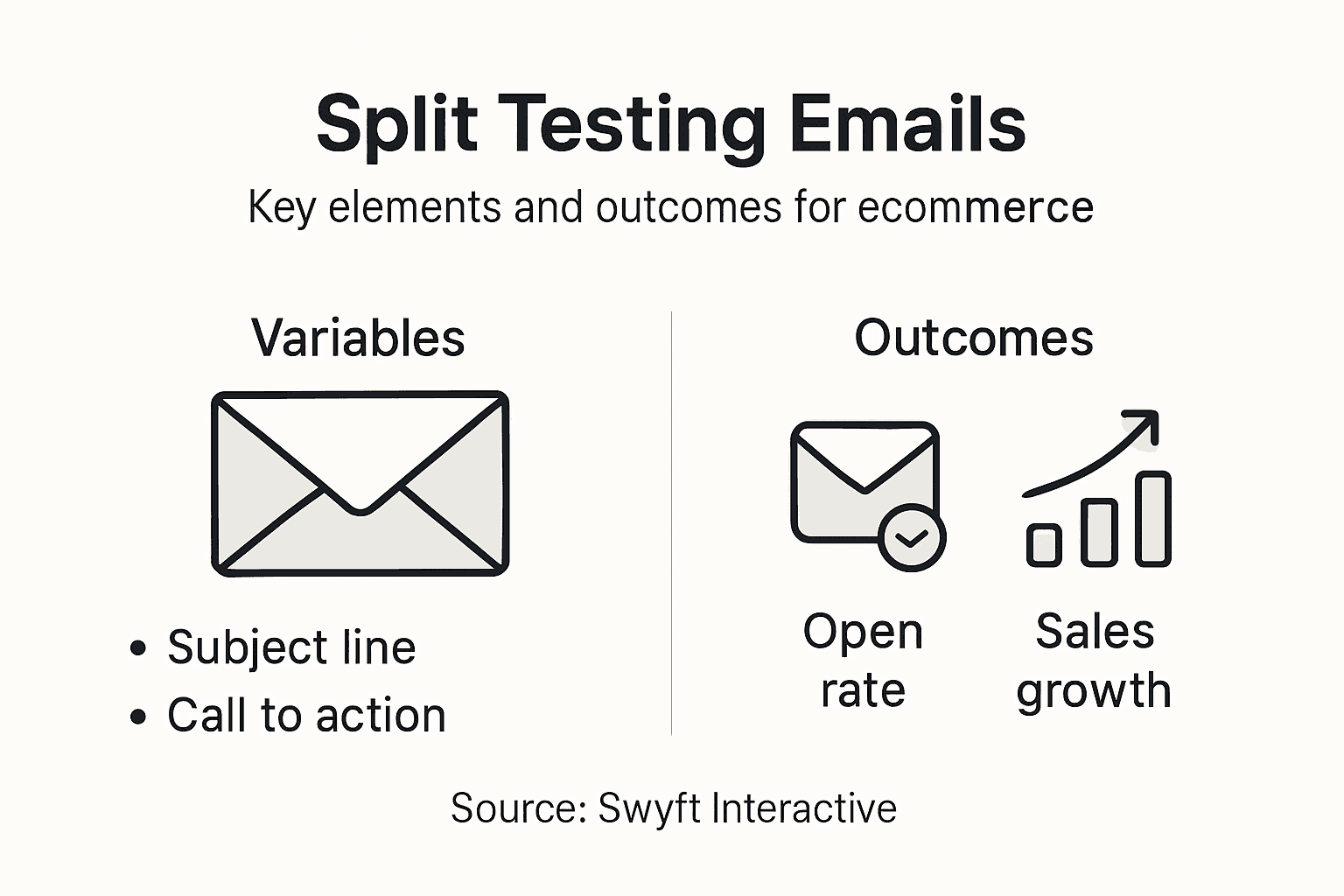
Here’s a summary of how testing different email elements can impact your campaign goals:
| Email Element Tested | Main Benefit | Typical Outcome |
|---|---|---|
| Subject Line | Boosts open rates | More recipients open emails |
| Sender Information | Builds trust | Reduces unsubscribes |
| Content Design | Improves readability | Higher click-through rates |
| CTA Button | Drives action | Increased conversions |
| Send Time | Optimizes reach | Better engagement rates |
Pro tip: Create a systematic tracking spreadsheet to document each test variable, its performance metrics, and potential insights to build a comprehensive optimization strategy over time.
How Split Testing Improves Campaign Performance
Split testing transforms email marketing from guesswork into a precise science, enabling ecommerce brands to systematically enhance their campaign performance. Email engagement metrics reveal the critical importance of continuous optimization in driving meaningful marketing results.
The performance improvements from split testing manifest across multiple key dimensions of email marketing effectiveness:
-
Conversion Rate Optimization
- Identify highest-converting email elements
- Reduce wasted marketing spend
- Pinpoint exact customer preferences
- Minimize conversion barriers
-
Audience Understanding
- Uncover nuanced customer behaviors
- Develop more targeted messaging
- Understand psychological triggers
- Refine segmentation strategies
-
Resource Efficiency
- Minimize unproductive marketing efforts
- Allocate budget to proven strategies
- Reduce customer acquisition costs
- Maximize return on marketing investments
Marketing teams leverage split testing as a strategic tool to make data-driven decisions. By systematically experimenting with different email components, brands can incrementally improve their communication effectiveness, turning small optimizations into significant performance gains.

Continuous improvement becomes the hallmark of successful email marketing strategies. Each test provides insights that compound over time, creating a sophisticated understanding of customer engagement dynamics.
Pro tip: Implement a structured testing calendar that schedules regular email campaign experiments, ensuring consistent performance monitoring and optimization.
Real-World Examples for Ecommerce Brands
Ecommerce brands continually demonstrate the powerful impact of strategic split testing through remarkable conversion improvements. Practical split testing examples reveal how methodical experimentation can transform marketing performance across multiple dimensions.
Successful split testing strategies have generated impressive results across different ecommerce scenarios:
-
Mini Cart Page Optimization
- Added prominent call-to-action button
- Created clearer item removal options
- Enlarged checkout button design
- Resulted in twofold purchase quantity increase
-
Email Campaign Refinement
- Tested subject lines with/without emojis
- Varied email layout configurations
- Experimented with personalization tactics
- Improved open rates and click-through metrics
-
Conversion Rate Enhancement
- Identified highest-performing design elements
- Reduced friction in purchasing process
- Streamlined customer journey
- Minimized potential buying barriers
Marketing teams leverage these insights to create increasingly sophisticated communication strategies. By systematically testing and analyzing different elements, brands transform raw data into actionable optimization techniques that directly impact revenue generation.
Incremental improvements become the cornerstone of successful ecommerce marketing. Each carefully designed experiment provides nuanced insights into customer preferences, enabling brands to craft more resonant, high-converting communications.
Pro tip: Document and archive every split testing experiment, creating a comprehensive knowledge base that tracks performance improvements and helps predict future marketing strategies.
Common Pitfalls and How to Avoid Them
Split testing best practices require careful navigation to ensure accurate, meaningful results. Ecommerce marketing teams must understand the most common mistakes that can undermine their testing efforts and potentially lead to misguided strategic decisions.
The most critical pitfalls in email split testing include:
-
Testing Multiple Variables Simultaneously
- Obscures individual element impact
- Prevents clear performance attribution
- Complicates result interpretation
- Reduces statistical reliability
-
Insufficient Sample Size Errors
- Generates statistically unreliable conclusions
- Leads to premature decision-making
- Risks misinterpreting random variations
- Undermines overall testing credibility
-
Neglecting External Contextual Factors
- Ignoring seasonal market trends
- Overlooking industry-specific events
- Failing to account for holiday impacts
- Misreading temporary performance fluctuations
Successful split testing demands a disciplined, methodical approach. Marketing professionals must isolate single variables, ensure robust sample sizes, and maintain awareness of broader contextual influences that might skew experimental results.
Statistical significance becomes the cornerstone of meaningful split testing. Rigorous methodology transforms random experiments into precise, actionable insights that can dramatically improve email marketing performance.
Compare split testing mistakes and the consequences to be aware of:
| Common Mistake | Why It Happens | Potential Negative Impact |
|---|---|---|
| Testing multiple variables | Lack of testing structure | Unclear results, wasted efforts |
| Too small sample size | Rushed experiment | Misleading conclusions |
| Ignoring outside factors | Overlooking context | Misattributed campaign changes |
Pro tip: Create a standardized testing protocol document that outlines your methodology, ensuring consistent, reliable split testing across all marketing campaigns.
Unlock the Full Potential of Your Ecommerce Email Campaigns
Struggling to turn your email lists into reliable revenue streams is a common challenge among ecommerce brands. This article highlights the power of split testing as a solution to the guesswork in email marketing. By focusing on key variables like subject lines, sender details, and call-to-action design you can dramatically enhance open rates, click-throughs, and conversions. If you want to harness the true value of strategic email experiments and sophisticated automation, expert guidance makes all the difference.
Discover how Swyft Interactive combines tailored, data-driven email marketing strategies with high-converting website development to drive measurable ecommerce growth. Explore insights in our Email Marketing Archives, sharpen your approach with expert digital tactics from Digital Strategy Archives, and master Klaviyo automation through our You Suck At Klaviyo Archives. Ready to transform your ecommerce results with proven split testing and full-funnel optimization? Visit Swyft Interactive now and start building an email campaign that converts consistently.
Frequently Asked Questions
What is split testing in email campaigns?
Split testing, also known as A/B testing, involves creating multiple versions of an email and sending them to different segments of your audience to determine which version performs better. This helps in making data-driven decisions to enhance engagement and conversion rates.
Why is it important to test email variables?
Testing email variables such as subject lines, sender information, and call-to-action design is crucial for understanding audience preferences. This systematic approach helps marketers identify which elements significantly impact open rates and conversions.
How do I start a split test for my email campaigns?
Begin by selecting one measurable variable to test, such as the subject line or design layout. Make sure you establish a statistically significant sample size to draw accurate conclusions and track the performance metrics of each version.
What are some common mistakes to avoid in split testing?
Common mistakes include testing multiple variables simultaneously, using insufficient sample sizes, and neglecting external contextual factors that can influence results. Following a disciplined methodology can improve the reliability of your split testing results.