
Over 60 percent of American consumers say they are more likely to engage with personalized email offers. For Ecommerce marketing managers, this shift is reshaping how brands nurture relationships and drive conversions. Mastering email segmentation in Klaviyo means speaking to every American customer on a level that feels relevant and timely, transforming one-size-fits-all messaging into targeted interactions that spark loyalty and sales.
Table of Contents
- Email Segmentation Fundamentals And Core Concepts
- Key Types Of Ecommerce Email Segments
- Understanding How Segmentation Works In Klaviyo
- Real-World Ecommerce Use Cases And Benefits
- Common Segmentation Mistakes To Avoid
- Best Practices For Optimizing Segmentation Strategies
Key Takeaways
| Point | Details |
|---|---|
| Email Segmentation Importance | Segmentation enhances marketing effectiveness by tailoring communications to specific customer attributes, leading to higher engagement and conversion rates. |
| Types of Segmentation | Utilize demographic, geographic, behavioral, and psychographic criteria to craft personalized email marketing strategies that resonate with distinct audience segments. |
| Dynamic Segmentation in Klaviyo | Klaviyo enables real-time audience segmentation, adapting to customer behaviors for relevant messaging and improved campaign performance. |
| Common Mistakes to Avoid | Avoid over-segmentation, outdated data usage, and lack of clear objectives to maintain effective and insightful email marketing strategies. |
Email segmentation fundamentals and core concepts
Email segmentation is a strategic approach that transforms generic marketing communications into precision-targeted messaging by dividing your subscriber list into distinct, meaningful groups. Advanced marketing strategies reveal that this technique enables businesses to deliver highly personalized content that resonates with specific audience subsets, dramatically improving engagement and conversion potential.
At its core, email segmentation involves categorizing subscribers based on multidimensional criteria such as demographic information, purchase history, engagement levels, browsing behavior, and specific customer interactions. By breaking down your audience into granular segments, you create opportunities for hyper-relevant communication that feels individualized and intentional. For instance, an athletic apparel brand might segment customers into groups like competitive runners, casual fitness enthusiasts, and performance gear collectors, allowing for messaging that speaks directly to each group’s unique motivations and interests.
The strategic benefits of email segmentation extend far beyond simple personalization. Businesses that implement sophisticated segmentation strategies often experience significant performance improvements, with research indicating potential returns of up to $36 for every dollar invested in targeted email marketing. By understanding and responding to the nuanced preferences of different customer groups, brands can create more meaningful connections, reduce unsubscribe rates, and foster long-term customer loyalty.
Pro tip: Start your segmentation journey by analyzing existing customer data and identifying 3-5 core segments that represent meaningful differences in customer behavior or preferences.
Key types of ecommerce email segments
Ecommerce email marketing success relies on sophisticated segmentation strategies that transform generic communications into targeted, personalized experiences. Sophisticated segmentation techniques enable brands to craft messaging that speaks directly to specific customer characteristics and behaviors, driving meaningful engagement and conversion rates.
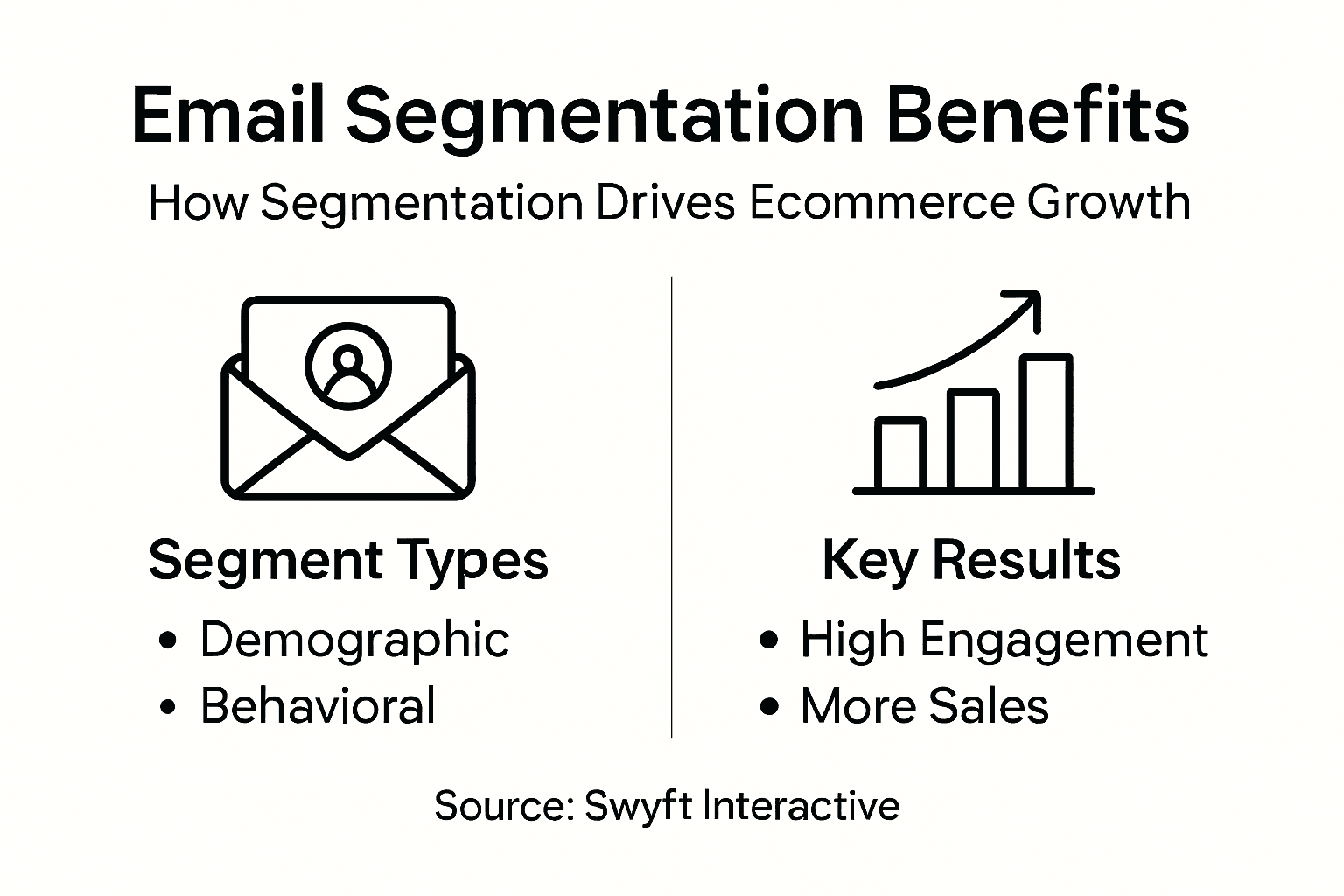
The primary types of ecommerce email segments include demographic, geographic, behavioral, and psychographic categories. Demographic segmentation focuses on quantifiable personal characteristics like age, gender, income level, and occupation. Geographic segmentation considers location-based factors such as region, climate, and urban versus rural environments, allowing businesses to customize messaging based on regional preferences and contextual relevance. Behavioral segmentation goes deeper by analyzing customer interactions, including purchase history, product browsing patterns, cart abandonment rates, and previous email engagement levels.

Psychographic segmentation represents the most nuanced approach, diving into customers’ values, lifestyle preferences, interests, and motivational drivers. This advanced segmentation method allows ecommerce brands to create emotionally resonant messaging that connects beyond transactional relationships. For example, an outdoor gear company might segment customers into adventure enthusiasts, weekend warriors, professional athletes, and casual recreational users, tailoring communications to each group’s unique motivations and aspirations.
Here’s a comparison of key ecommerce email segmentation types and when to use each:
| Segmentation Type | Best Used For | Example Use Case |
|---|---|---|
| Demographic | Targeting by age, gender, income | Promos for young professionals |
| Geographic | Location-based campaigns | Weather-based apparel offers |
| Behavioral | Action-triggered communications | Cart abandonment recovery |
| Psychographic | Appeals to values or lifestyles | Eco-conscious product launches |
Pro tip: Leverage your customer data management platform to create dynamic segments that automatically update based on real-time customer behavior and interactions.
Understanding how segmentation works in Klaviyo
Klaviyo’s segmentation approach revolutionizes email marketing by offering dynamic, intelligent contact management that adapts in real-time to customer behaviors. Dynamic segment creation enables ecommerce businesses to build fluid, responsive audience groups that automatically update based on specific criteria, ensuring marketing messages remain consistently relevant and targeted.
Segment builders in Klaviyo provide marketers with granular control over contact grouping, allowing them to establish complex, multi-dimensional conditions that define audience segments. These segments can be constructed using combinations of behavioral triggers, demographic information, purchase history, email engagement metrics, and custom properties. Unlike traditional static lists, Klaviyo’s segments continuously evaluate contacts, automatically moving them in or out of specific groups as their characteristics and interactions change.
The platform’s sophisticated segmentation methodology delivers remarkable performance improvements, with data showing that segmented campaigns can generate over three times the revenue per recipient compared to broad, unsegmented communications. This dynamic approach enables ecommerce brands to create highly personalized customer journeys, trigger automated workflows, and deliver precisely timed, contextually relevant marketing messages that resonate with individual customer profiles and preferences.
Pro tip: Regularly audit and refine your Klaviyo segments by testing different condition combinations and monitoring performance metrics to optimize your targeting strategy.
Real-world eCommerce use cases and benefits
Email segmentation transforms traditional marketing approaches by enabling highly targeted, personalized customer interactions across diverse ecommerce landscapes. Advanced customer segmentation methods have revolutionized how businesses understand and engage with their audience, moving beyond generic mass marketing strategies to create meaningful, individualized experiences.
In practical applications, ecommerce brands leverage segmentation across multiple strategic scenarios. Abandoned cart recovery becomes laser-focused when segmented by precise customer behaviors, allowing businesses to craft recovery messages that speak directly to specific customer hesitations. Post-purchase engagement segments can distinguish between first-time buyers, repeat customers, and high-value clients, enabling tailored communication that nurtures long-term loyalty. Apparel retailers might create segments based on size preferences, past purchase styles, or seasonal shopping patterns, while electronics brands can segment customers by technology adoption levels or previous product categories.
The performance implications of effective segmentation are substantial. Targeted campaigns can dramatically improve key performance metrics, including conversion rates, average order value, and customer lifetime value. By understanding granular customer characteristics such as purchasing frequency, product preferences, and engagement history, ecommerce businesses can create hyper-personalized marketing strategies that feel less like advertisements and more like curated recommendations. This approach transforms generic email blasts into precision-engineered customer communication tools that resonate on an individual level.
Pro tip: Implement a continuous learning approach by regularly analyzing segment performance and adjusting your targeting criteria to maintain maximum relevance and engagement.
Common segmentation mistakes to avoid
Email segmentation seems straightforward, but numerous pitfalls can dramatically undermine marketing effectiveness. Essential email segmentation strategies require nuanced understanding to prevent common errors that can render entire campaigns ineffective or potentially damage customer relationships.
One critical mistake is over-segmentation, where marketers create so many narrow segments that campaigns become fragmented and resource-intensive. While granular targeting sounds appealing, segments must be large enough to generate meaningful insights and deliver statistically significant results. Another frequent error involves using stale data, where customer segments are not regularly updated to reflect current behaviors, preferences, and interactions. This can lead to irrelevant messaging that feels disconnected from a customer’s actual journey and current interests.
Additionally, many ecommerce brands fail to establish clear segment objectives or establish meaningful differentiation between segments. Effective segmentation requires more than simple demographic categorization. Instead, marketers must develop segments that reveal genuine behavioral patterns, purchase motivations, and potential future actions. Segments should not just describe customers but predict and influence their next interactions. Failing to incorporate multiple data points like engagement history, purchase frequency, product preferences, and lifecycle stage can result in overly simplistic segmentation that misses critical nuanced customer insights.
Below is a summary of common segmentation mistakes and how to avoid them:
| Mistake | Impact on Campaigns | Solution |
|---|---|---|
| Over-segmentation | Small, fragmented audiences | Limit to a few meaningful groups |
| Outdated data usage | Irrelevant messages sent | Regularly refresh segment criteria |
| Lacking clear objectives | Unfocused communications | Define specific goals for each segment |
| Too-simple segmentation | Missed deep insights | Combine multiple data points and behaviors |
Pro tip: Conduct quarterly segment performance audits to validate segment relevance, combining quantitative metrics like conversion rates with qualitative customer feedback.
Best practices for optimizing segmentation strategies
Successful email segmentation requires a sophisticated, multi-dimensional approach that goes beyond basic demographic categorization. Advanced segmentation best practices demand a holistic strategy that combines multiple data points, predictive analytics, and continuous performance optimization.
The foundation of effective segmentation lies in data integration and comprehensive analysis. Successful ecommerce brands don’t rely on single-dimensional data points but create rich, dynamic segments by combining behavioral metrics, purchase history, engagement levels, and predictive indicators. This means tracking not just what customers have purchased, but understanding their browsing patterns, interaction frequencies, time spent on site, abandoned cart behaviors, and potential future purchase propensities. Sophisticated segmentation transforms raw data into actionable customer insights that enable hyper-personalized marketing communications.
Critical to maintaining segment effectiveness is implementing a robust continuous refinement process. This involves regular segment performance audits, A/B testing different targeting approaches, and dynamically adjusting segmentation criteria based on real-time customer behavior shifts. Marketers must develop a flexible segmentation framework that can quickly adapt to changing customer preferences, technological innovations, and emerging market trends. Predictive analytics play a crucial role, allowing brands to anticipate customer needs and create proactive, anticipatory marketing strategies that feel intuitive and personalized.
Pro tip: Create a quarterly segmentation review process that includes analyzing segment performance metrics, conducting customer feedback surveys, and recalibrating your segmentation criteria to maintain maximum relevance and engagement.
Unlock Ecommerce Growth with Precision Email Segmentation
Understanding the power of email segmentation is just the first step toward transforming your ecommerce marketing. The real challenge lies in creating dynamic, data-driven segments that engage customers with the right message at the right time. If you are struggling with over-segmentation, stale data, or ineffective targeting, Swyft Interactive can help you harness Klaviyo automation to build highly personalized email journeys that drive conversions and boost customer loyalty.
Explore our Email Marketing Archives – Swyft Interactive to see how our tailored segmentation strategies create measurable results. Visit Swyft Interactive to learn how integrating your website and email campaigns with expert automation delivers scalable ecommerce growth. Ready to put your email marketing on autopilot with proven Klaviyo solutions? Start optimizing your segments today and watch your revenue soar.
Frequently Asked Questions
What is email segmentation?
Email segmentation is the practice of dividing your subscriber list into distinct groups based on various criteria such as demographics, purchase history, and engagement levels. This allows businesses to send more targeted and personalized emails to different audience segments.
How does email segmentation drive ecommerce growth?
Email segmentation enhances engagement by delivering relevant content to specific customer groups, which can significantly improve conversion rates and reduce unsubscribe rates, ultimately leading to increased sales and customer loyalty.
What are the key types of email segments for ecommerce?
The primary types of email segments for ecommerce include demographic segments (age, gender), geographic segments (location), behavioral segments (purchase patterns, engagement), and psychographic segments (values, lifestyles), each allowing for more tailored marketing strategies.
What are some common mistakes to avoid in email segmentation?
Common mistakes in email segmentation include over-segmentation, using outdated data, lacking clear segment objectives, and overly simplistic categorization, all of which can compromise the effectiveness of your campaigns.
Recommended
- Email Campaign Strategy Guide for eCommerce Growth
- A Comparison on using Lists VS Segmentation for Email Marketing
- 7 Must-Know Types of Ecommerce Emails for Growth
- Industry Terms in Email Marketing: Boosting eCommerce ROI
- 7 Data-Driven Hacks That Drive CEU Program Results – CEU Builder
- Industry Insights & Strategy – CEU Builder Blog