

Every American ecommerce marketing manager knows the frustration of tracking endless email numbers in Klaviyo, only to find conversions staying flat. Cutting through the noise starts with a clear understanding of what true engagement looks like beyond surface-level metrics. By focusing on behavioral, cognitive, and emotional engagement rather than chasing vanity data, you can finally connect your metrics to actual revenue growth and actionable insights that drive results.
Table of Contents
- Defining Email Engagement Metrics And Myths
- Key Types Of Email Engagement Metrics
- How Klaviyo Tracks Engagement Performance
- Comparing Metrics: Benchmarks And Industry Standards
- Common Pitfalls And Errors To Avoid
- Optimizing Email Engagement For Revenue Growth
Key Takeaways
| Point | Details |
|---|---|
| Email Engagement Metrics Matter | Focus on metrics like conversion rate and revenue per email to measure true engagement rather than vanity metrics. |
| Misconceptions Around Metrics | Open rates and click rates do not always correlate to successful email strategies; prioritize insights that connect to business outcomes. |
| Segmentation is Key | Utilize customer segmentation for tailored messaging, enhancing engagement and driving revenue growth effectively. |
| Continuous Testing and Optimization | Implement systematic testing of email elements while tracking performance to ensure strategies align with revenue goals. |
Defining Email Engagement Metrics and Myths
Email engagement metrics measure how your subscribers actually interact with the emails you send. These go far beyond simple open or click rates. Real engagement encompasses what people believe about your brand, their emotional response to your content, and the specific actions they take. When you start tracking engagement properly, you discover that behavioral metrics like opens and clicks tell only part of the story. Subscribers might open your emails without ever buying, or they might delete messages without opening them but still visit your website through another channel. Understanding that engagement includes beliefs, attitudes, and behaviors helps you interpret data accurately instead of chasing vanity metrics.
Here’s where most eCommerce marketers get it wrong: they assume that collecting more data automatically leads to better insights. You cannot grow your email ROI by tracking every possible metric and hoping something sticks. In reality, aligning metrics with business outcomes matters far more than data volume.pdf). Some metrics lead your results (leading indicators like click-through rate or add-to-cart events), while others lag behind (like revenue generated or customer lifetime value). A leading indicator predicts future behavior. A lagging indicator confirms what already happened. Your Klaviyo account tracks both types, but confusing them creates false impressions about campaign performance. For example, a high unsubscribe rate might look negative initially, but it actually signals that your list quality is improving because unengaged subscribers are leaving.
Most common myths damage your email strategy without you realizing it. The first myth: higher open rates always mean better emails. This ignores the fact that subject lines, sender names, and send times influence opens more than content quality. A subject line that promises urgency gets opens, but if your email fails to deliver value, subscribers tune out. The second myth: clicks equal conversions. Someone clicking a link toward the bottom of an email might be leaving out of frustration rather than interest. The third myth: bounce rates and unsubscribe rates are failures. Both actually represent data cleanliness. Hard bounces remove invalid addresses. Unsubscribes eliminate people who will never buy from you. Removing dead weight from your list improves metrics across the board and reduces your Klaviyo send costs since you only pay for contacts you actually email. The fourth myth: you need to track everything. You don’t. Pick metrics that connect directly to your revenue goals, whether that’s using lists versus segments to organize campaigns or analyzing which email sequences drive actual purchases.
Your engagement metrics should answer one simple question: are my subscribers moving closer to buying or further away? That’s it. Ignore the metrics that don’t answer this. Stop obsessing over open rates if your conversion rate is terrible. Stop celebrating clicks if they don’t lead to cart additions. Choose 3 to 5 metrics maximum that track actual progress toward revenue. For most eCommerce brands using Klaviyo, this means: conversion rate (percentage of emails that result in a purchase), revenue per email (total revenue divided by emails sent), unsubscribe rate (watch this for list health, not judgment), and click-to-open rate (how many people who opened the email actually clicked a link). These metrics create a clear picture of what’s working without overwhelming you with data.
Pro tip: Before diving into Klaviyo’s reporting dashboard, write down the one business outcome you want to improve this quarter, then identify only the 2 to 3 metrics that directly prove you’re winning or losing on that outcome.
Key Types of Email Engagement Metrics
Email engagement metrics fall into three distinct categories that work together to paint a complete picture of subscriber behavior and satisfaction. Behavioral metrics track the tangible actions subscribers take: opens, clicks, conversions, and purchases. Cognitive metrics measure whether subscribers understand and process your message, though these are harder to quantify directly in email. Emotional metrics capture how subscribers feel about your brand, reflected in sentiment signals like replies, shares, or complaints. Understanding how behavioral, cognitive, and emotional dimensions interact helps you move beyond surface-level reporting. Most eCommerce marketers focus exclusively on behavioral metrics because they’re easy to track in Klaviyo. But if your cognitive and emotional metrics are weak, your behavioral wins won’t last. A subscriber might click your link today but unsubscribe tomorrow if they felt your message was irrelevant or manipulative.
Behavioral metrics are your bread and butter in email marketing. Open rate shows the percentage of subscribers who opened your email. It tells you if your subject line worked, but nothing about whether they cared about the content. Click-through rate (CTR) measures what percentage of email recipients clicked a link. This is more valuable than opens because it shows active interest. Click-to-open rate (CTOR) divides clicks by opens, revealing how compelling your content was to people who actually saw it. This metric matters because an email with a 15% open rate and 2% CTR might actually have stronger engagement than an email with a 25% open rate and 2% CTR, assuming the 25% open rate reflects a misleading subject line rather than genuine interest. Conversion rate tracks the percentage of emails that resulted in a purchase or desired action. Revenue per email divides total revenue by emails sent, showing your actual financial output. Bounce rate reveals how many emails never reached subscribers’ inboxes. Hard bounces indicate invalid addresses. Soft bounces suggest temporary delivery issues. High bounce rates damage your sender reputation and should trigger a list cleanup immediately.

Cognitive and emotional metrics require a different approach because they don’t generate automatic Klaviyo reports. List growth rate reflects whether people want to hear from you. Rapid growth signals cognitive clarity (they understand what you offer) and emotional resonance (they want more). Unsubscribe rate works the same way in reverse. People leave because your messaging confuses them, or because your emails don’t match what they expected. Rather than seeing unsubscribes as failures, recognize them as cognitive feedback. Reply rate and spam complaints directly indicate emotional health. High reply rates mean subscribers feel heard. High complaint rates mean they feel wronged. You can also assess cognitive engagement by testing whether different subscriber segments respond differently to your emails. For instance, new customers might need educational content before promotional content. Repeat customers might crave exclusive deals. Using email segmentation to customize messaging helps you measure whether subscribers in different groups show stronger or weaker engagement across behavioral, cognitive, and emotional dimensions.
The key mistake most managers make is picking one metric and obsessing over it. Open rate becomes your north star. You twist subject lines into clickbait. Subscribers get annoyed and unsubscribe. Your open rate goes up, but revenue goes down. Instead, treat metrics as a system. Track behavioral metrics (opens, clicks, conversions) weekly. Monitor cognitive signals (reply rate, list growth) monthly. Watch emotional indicators (complaints, unsubscribe feedback) continuously. Create a simple dashboard that shows all three together. When behavioral metrics rise while emotional metrics drop, you have a problem worth investigating. When cognitive metrics stay flat while behavioral ones climb, your content works but subscribers don’t truly understand your value. The goal isn’t to maximize individual metrics. The goal is to grow revenue while keeping your list healthy and happy.
To better understand which email metrics matter for different business goals, see this comparison:
| Metric Type | Main Focus | Business Impact |
|---|---|---|
| Behavioral Metrics | Actions (open, click, buy) | Reveal subscriber behaviors |
| Cognitive Metrics | Understanding & clarity | Indicate message effectiveness |
| Emotional Metrics | Sentiment & brand feeling | Reflect brand perception |
Pro tip: Set up a Klaviyo dashboard that displays your three weakest behavioral metrics alongside one cognitive metric and one emotional metric, reviewed weekly, to catch engagement problems before they tank your ROI.
How Klaviyo Tracks Engagement Performance
Klaviyo operates as a centralized data collection and analytics engine for your email marketing. Every time a subscriber opens an email, clicks a link, abandons a cart, or completes a purchase, Klaviyo captures that data point and stores it in your account. The platform works by placing tracking pixels in your emails and integrating with your eCommerce store to monitor the complete customer journey. When you send a campaign through Klaviyo, each recipient receives a uniquely tracked version of your email. That pixel fires when they open it. The links you include contain tracking parameters that identify which subscriber clicked what. Klaviyo tracks clicks, conversions, and subscriber behaviors in real time to connect email engagement directly to revenue outcomes. This real-time tracking is why Klaviyo is so powerful for eCommerce brands. You do not have to wait days to see how campaigns performed. You can watch engagement and revenue data populate within hours of sending.
The platform collects engagement data across multiple touchpoints. Email opens register when a subscriber loads your message, though this only works with image-enabled clients. Subscribers who disable images or use text-only readers might open your email without triggering the open pixel. Link clicks fire when subscribers click tracked links in your email. Unsubscribes register when someone clicks your unsubscribe link. Bounces get recorded when an email cannot reach an inbox. Conversions track when a subscriber completes the action you wanted, whether that is a purchase, form submission, or account signup. Revenue attribution connects specific purchases back to the email that drove them. Klaviyo also captures behavioral data from your store integrations. If you have Shopify, WooCommerce, or BigCommerce connected, Klaviyo sees every product viewed, cart abandoned, purchase made, and refund processed. This allows the platform to segment subscribers by purchase history, browsing behavior, and customer lifetime value. The data collection aligns with privacy regulations, so subscribers retain control over their information, and you maintain compliance with email marketing laws.
Klaviyo converts raw engagement data into actionable performance metrics through its reporting dashboard. You can view individual campaign performance showing open rate, click rate, revenue generated, and return on ad spend. The platform calculates these metrics automatically, so you don’t have to do spreadsheet math. You can also create automated reports that show performance trends over time. Did your campaigns perform better in January than December? Klaviyo shows you. Are your welcome sequences converting better than your post-purchase sequences? The data reveals this. You can segment performance by subscriber source, location, device type, or any custom property you track. This granularity matters because it reveals which campaigns work for specific audience groups. A promotional email might bomb with new customers but crush it with loyal repeat buyers. Without segmented reporting, you would never know. Email campaign strategies succeed when built on performance data from multiple angles rather than intuition. Klaviyo also lets you set up custom events. If you want to track when someone visits a specific page, uses a discount code, or watches a product demo, you can create those events and have Klaviyo monitor them. This expands engagement tracking beyond opens and clicks into behaviors that matter to your specific business.
The real power emerges when you move from tracking to optimization. Klaviyo provides A/B testing functionality built right into the platform. Test different subject lines, send times, or email content, and Klaviyo automatically tracks which version performs better. You can set up automated workflows that respond to engagement signals. If someone clicks a link but doesn’t buy, send them a follow-up. If someone opens your last three emails without clicking anything, move them to a winback campaign. These automations run on Klaviyo’s engagement data, so your marketing adapts in real time based on what subscribers actually do. The platform also benchmarks your metrics against industry standards. You can see if your 22% open rate is excellent, average, or concerning for your industry. Over time, this data becomes your competitive advantage. Brands that carefully track and optimize engagement metrics grow their email revenue significantly faster than those who ignore the numbers.
Pro tip: Connect your eCommerce store to Klaviyo and verify that product purchases, cart abandonment, and customer data are flowing correctly before launching major campaigns, so your engagement tracking captures the complete customer journey and not just email interactions.
Comparing Metrics: Benchmarks and Industry Standards
Your email metrics mean nothing in isolation. A 20% open rate sounds decent until you learn that your industry average is 28%. A 2% click-through rate seems respectable until you discover competitors average 4.5%. Benchmarks give your numbers context. They answer the critical question: am I winning or losing? Industry benchmarks vary dramatically by sector, list quality, and email type. Fashion retailers typically see higher open rates than B2B software companies. Flash sale emails outperform educational content. Abandoned cart reminders convert better than newsletters. When setting performance targets, you must compare yourself against brands in your vertical, sending similar email types, with similar list sizes. Comparing your metrics to a competitor with five times your subscriber base or a completely different product category wastes your energy. Benchmarks relevant to specific industries and contexts.pdf) allow you to set realistic targets and interpret your data meaningfully rather than against irrelevant standards.
Here are typical email benchmarks for eCommerce brands in the United States, based on aggregated industry data:
Open Rates by Email Type
- Welcome series: 45% to 60%
- Promotional campaigns: 18% to 28%
- Transactional emails (receipts, shipping updates): 40% to 60%
- Newsletter content: 12% to 20%
- Abandoned cart reminders: 30% to 45%
Click-Through Rates by Email Type
- Welcome series: 8% to 15%
- Promotional campaigns: 1.5% to 3%
- Abandoned cart reminders: 4% to 8%
- Post-purchase follow-ups: 3% to 6%
- Newsletter content: 0.5% to 1.5%
Conversion Rates by Email Type
- Welcome series: 2% to 5%
- Abandoned cart reminders: 3% to 5%
- Promotional emails: 0.5% to 2%
- Post-purchase upsell sequences: 1% to 3%
Other Critical Metrics
- List growth rate: 2% to 5% monthly growth indicates healthy acquisition
- Unsubscribe rate: Anything below 0.5% is solid; above 1% signals content problems
- Bounce rate: Hard bounces above 2% mean your list quality is deteriorating
- Spam complaint rate: Below 0.1% is acceptable; above 0.3% damages your sender reputation
These benchmarks serve as your baseline. If you perform below these ranges consistently, your strategy needs adjustment. If you exceed them, dig deeper to understand why so you can replicate success. The mistake most managers make is assuming their metrics are either good or bad without context. Your 25% open rate might be excellent for your industry or mediocre, depending on factors you control and factors you cannot.
Understanding What Moves Your Metrics
Your email list quality shapes every metric. A brand-new list with subscribers who actively chose to receive emails will outperform a scraped list or a list filled with inactive subscribers. List age matters too. Subscribers who joined three years ago engage less than those who joined three months ago. Segmentation dramatically changes benchmarks. If you send one email to everyone, your metrics suffer. If you segment by purchase history, engagement level, or product interest, your metrics improve significantly. A welcome email sent only to brand-new subscribers will outperform a promotional blast sent to your entire list. Send frequency also impacts results. Sending one email weekly generates different metrics than sending five emails weekly. More sends can increase revenue but tank your open and click rates if subscribers feel overwhelmed.
Leading Indicators Versus Lagging Indicators
Realizing that leading and lagging indicators serve different purposes.pdf) transforms how you evaluate performance. Open rates and click rates lead your results. They show subscriber interest before conversions happen. If your open rates drop 15% from last month, that warns you that conversions will drop soon. Revenue and customer lifetime value lag behind. They confirm what already occurred. You cannot change last month’s revenue, but you can improve this month’s opens and clicks to drive next month’s revenue higher. Focus on leading indicators to predict future performance. Monitor lagging indicators to confirm whether your efforts worked.
Pro tip: Identify three eCommerce competitors in your exact category, research their email performance if public data exists, then set your quarterly targets 10% above their benchmarks rather than against generic industry averages to create realistic stretch goals.
Common Pitfalls and Errors to Avoid
Most email marketing failures trace back to preventable mistakes in how you collect, track, and interpret engagement data. Your Klaviyo account pulls data from multiple sources: your eCommerce platform, email interactions, subscriber forms, and third-party integrations. Each connection creates opportunities for errors to creep in. A corrupted data import. A tracking pixel that fails silently. A subscriber list that contains duplicates or invalid emails. These mistakes compound over time, making your metrics unreliable and your optimization efforts pointless. You cannot improve what you cannot accurately measure. Common sources of data errors include missing data, inconsistent responses, and entry mistakes that distort the accuracy of your engagement measurements. Understanding where errors originate helps you prevent them before they damage your campaign performance analysis.
The first major pitfall involves importing or managing contaminated data. This happens when you upload a list without cleaning it first. Duplicate email addresses inflate your subscriber count without adding real people. Invalid emails create bounces. Unformatted phone numbers or addresses create data inconsistencies. When you eventually segment by purchase history or location, the corrupted data skews your results. Another version of this mistake happens during integrations. If your Shopify store connects to Klaviyo but the product catalog fails to sync, Klaviyo cannot attribute purchases to specific products. Revenue reports become useless because the platform cannot connect which email drove which sale. Before launching any email program, audit your data. Check for duplicates. Validate email addresses using a verification tool. Ensure your store integration actually sends transaction data to Klaviyo. Test by making a test purchase and confirming it appears in your Klaviyo account within minutes. The second major pitfall involves misinterpreting metrics due to tracking failures. If your tracking pixels do not load correctly, opens go unreported. If your tracking links break, clicks disappear from your data. Subscribers might click and convert while your metrics show nothing. You look at your dashboard, see low engagement, and assume your content is bad. The reality is your tracking is broken. Check your email rendering across devices. Test every link before sending. Verify that Klaviyo can track conversions from your store by reviewing your analytics settings. A few hours of setup work prevents months of bad decisions based on false data.
The third major pitfall is comparing metrics across incompatible segments. You send a welcome email to new subscribers and get a 55% open rate. You send a promotional email to your entire list (including inactive subscribers) and get an 18% open rate. You conclude that welcome emails work better than promotions. But you are comparing different segments. New, engaged subscribers will always outperform inactive ones. The email type is not the variable. The audience is. When testing campaigns, keep variables isolated. Send welcome emails only to new subscribers. Send promotional emails to engaged subscribers. Measure promotional performance on new subscribers separately. This reveals whether the email type or the audience drives results. The fourth pitfall involves chasing vanity metrics instead of revenue. Your open rate climbs to 30%. Your click rate hits 3.5%. But your conversion rate stays flat at 0.7%. You are celebrating metrics that do not drive business value. The only metric that ultimately matters is whether the email grew revenue. Everything else is supporting evidence. If your opens and clicks improve while conversions decline, something is wrong. Your subject line might be misleading, attracting unqualified clicks. Your email content might promise something the landing page does not deliver. Your call-to-action might confuse subscribers. High engagement metrics masking poor conversions waste your time and damage your sender reputation because engaged-but-not-converting subscribers eventually unsubscribe or mark you as spam.
The fifth pitfall involves security vulnerabilities that compromise your data integrity. While less common in legitimate Klaviyo use, fraudulent emails and phishing tactics can distort email performance metrics or compromise data integrity if your account credentials are compromised. Always use strong, unique passwords for Klaviyo. Enable two-factor authentication. Verify that any third-party tool requesting Klaviyo access is legitimate before approving integrations. Monitor for unusual sending activity. If someone gains access to your account and sends campaigns under your brand name, your metrics become meaningless and your sender reputation collapses.
The sixth pitfall is failing to account for seasonality and external factors. Your email performance dips in December. You panic and change your entire strategy. But December always sees lower engagement due to holiday shopping chaos and inbox overload. Your performance is actually normal. Similarly, a major product launch or sale event will skew your metrics. Do not compare December email performance to July performance. Compare December this year to December last year. Adjust your benchmarks for known external factors so you do not overreact to predictable fluctuations.
Pro tip: Run a monthly data audit by exporting a sample of 100 subscribers from Klaviyo and manually verifying that their engagement records match their actual behavior, which catches tracking errors before they damage your entire reporting.
Here is a summary of common email marketing pitfalls and how to avoid them:
| Pitfall | Typical Cause | Best Prevention Step |
|---|---|---|
| Contaminated Data | Unclean imports, duplicate emails | Audit lists before importing |
| Tracking Failures | Pixel or link issues | Test links and renderings first |
| Incompatible Segment Comparison | Mixing new/inactive recipients | Isolate tests by segment |
| Vanity Metrics Focus | Prioritizing opens/clicks, not sales | Use revenue as main success metric |
| Security Risks | Weak passwords, bad integrations | Enable 2FA, verify integrations |
| Ignoring Seasonality | Not adjusting for external events | Benchmark by time period/context |
Optimizing Email Engagement for Revenue Growth
Optimizing email engagement is not about crafting the perfect subject line or achieving the highest open rate. It is about creating a system where every email moves subscribers closer to a purchase decision. Revenue grows when engagement metrics connect directly to business outcomes. Optimizing email engagement through targeted campaigns, personalization, and content relevance drives customer responses and conversion rates, ultimately increasing revenue and customer lifetime value. This means your email strategy must align with where subscribers are in their journey. A new subscriber needs to understand your brand value before receiving a 40 percent discount code. A repeat customer needs to know you appreciate their loyalty, not just their money. An abandoned cart subscriber needs urgency and reassurance, not another generic sale pitch. When you match email content to subscriber context, engagement metrics improve and so does revenue.
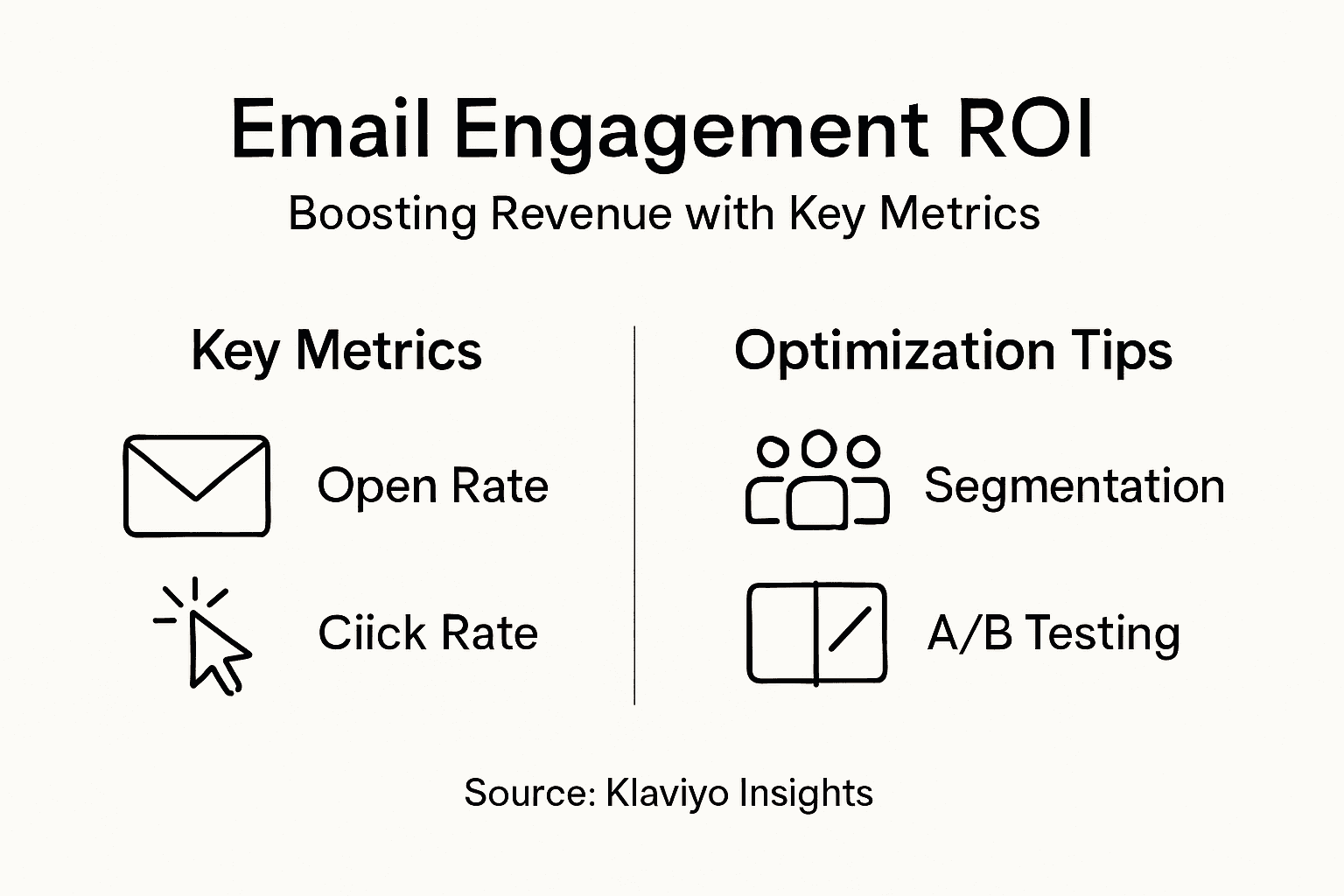
The path to revenue growth starts with segmentation and personalization. Most eCommerce brands send one email to thousands of subscribers. Everyone gets the same message, the same offer, the same call-to-action. This approach generates low engagement because the email does not speak to anyone specifically. It speaks to everyone generally. Segmentation fixes this by dividing your list into smaller groups based on shared characteristics. New customers, repeat customers, high-value customers, and inactive customers each need different messaging. Segmentation also enables personalization. Instead of “Dear Subscriber,” your email says the person’s actual name. Instead of a generic product recommendation, you recommend products they viewed or products similar to their purchase history. Customer engagement strategies succeed when they include proper customer selection and relevant interaction opportunities, not scattered messaging to broad audiences. Klaviyo makes segmentation straightforward. You can segment by purchase history, email engagement level, browse behavior, location, or any custom property you track. Start with simple segments: customers who purchased in the last 30 days, customers who purchased between 30 and 90 days ago, and customers who have not purchased in over 90 days. Send each group emails tailored to their situation. Your revenue per email will climb because you are not wasting sends on irrelevant messaging.
Building Your Optimization System
Revenue growth requires systematic testing and iteration, not random changes. Here is your framework: track one metric, test one variable, measure the result, and implement the winner. Do not test subject lines and send times simultaneously. You will not know which change drove the result. Start by identifying your weakest conversion metric. If your abandoned cart email converts at 2 percent but your industry benchmark is 4 percent, that is your priority. Test a single element. Change the subject line. Keep everything else identical. Send to a small segment first, typically 10 to 20 percent of your list. Measure whether the new subject line improves your click rate and conversion rate. If it wins, implement it for the remaining 80 percent. If it loses, try a different approach. This process takes discipline because you will want to make multiple changes at once. Resist that impulse. Isolation reveals truth. Testing without isolation wastes time on incorrect conclusions.
Personalization extends beyond names and past purchases. It includes timing, content depth, and offer relevance. Subscribers in your first 30 days after signup have high motivation to engage. Send them educational content about your products and how customers use them. Subscribers who engaged with product pages but never purchased have high intent. Send them social proof, customer reviews, and limited-time incentives. Subscribers who receive five emails without clicking anything signal low engagement. Move them to a different cadence or content strategy before they unsubscribe. Different email types drive different engagement levels, so your promotional emails, educational emails, and transactional emails should each serve a specific purpose in moving subscribers toward revenue. Your Klaviyo automations should reflect this logic. When someone abandons their cart, trigger a sequence. Email one arrives within one hour with gentle reminder and free shipping offer. Email two arrives 24 hours later with urgency messaging. Email three arrives after 72 hours with product reviews and final incentive. This staged approach respects subscriber preferences while maximizing conversion opportunity. Over time, you can test this sequence. Does two emails outperform three? Does a higher discount in email one reduce the need for email two? Your data answers these questions. Your revenue grows as you optimize.
The final component involves measuring progress toward revenue goals, not just engagement metrics. Your abandoned cart emails now convert at 3.2 percent. Good. But did that improve your overall revenue? Calculate revenue per email by dividing total revenue by total emails sent. If your revenue per email climbs month after month, your optimization is working. If engagement metrics improve but revenue per email stays flat, something else needs attention. Maybe your landing page experience is poor. Maybe your product prices are too high. Maybe your email traffic goes to the wrong products. Track revenue per email alongside engagement metrics. When both climb together, you have genuine progress. When only engagement climbs, you have vanity metrics.
Pro tip: Pick your lowest-converting email type this month, run three A/B tests over the next six weeks testing subject line, send time, and offer value in isolation, and measure revenue per email before and after to quantify whether your optimization actually drove ROI.
Unlock True Klaviyo ROI with Data-Driven Email Engagement Strategies
Struggling to turn your email metrics like opens and clicks into real revenue? This article reveals the challenge of focusing on vanity metrics rather than meaningful engagement that drives purchases. If you are grappling with interpreting Klaviyo data, managing list quality, and aligning behavioral metrics with business goals you are not alone. The key to growth lies in understanding cognitive and emotional signals alongside your behavioral stats. At Swyft Interactive we specialize in helping eCommerce brands build high-converting websites paired with Klaviyo email automation that turns engagement into measurable sales. Our expertise in targeted segmentation, personalized flows, and full-funnel growth strategies ensures your email campaigns move subscribers closer to buying.
Ready to stop guessing and start scaling your email revenue? Explore our Email Marketing Archives – Swyft Interactive to learn advanced tactics that complement this knowledge. See how we transform scattered data into clear insights that power smarter campaigns by visiting our You Suck At Klaviyo Archives – Swyft Interactive. Take the next step toward optimized engagement and exceptional ROI with comprehensive digital solutions from Swyft Interactive. Contact us today to build a scalable online sales engine that grows your revenue while keeping your email list healthy and engaged.
Frequently Asked Questions
What are email engagement metrics?
Email engagement metrics measure how subscribers interact with your emails. This includes actions like opens, clicks, conversions, and purchases, as well as subscribers’ cognitive and emotional responses to your brand.
How can I improve my email engagement with Klaviyo?
To boost email engagement in Klaviyo, focus on segmentation and personalization. Tailor your email content to specific subscriber groups, ensuring messages resonate with their needs and preferences. Regularly track and optimize engagement metrics to align with your revenue goals.
What is the difference between leading and lagging indicators in email marketing?
Leading indicators, like open and click rates, predict future subscriber behavior and can help you adjust strategies proactively. Lagging indicators, such as revenue and customer lifetime value, confirm past performance but can’t be changed retrospectively.
Why should I avoid focusing solely on open rates?
Focusing solely on open rates can be misleading. A high open rate may not translate to conversions if your content does not meet subscriber expectations. Instead, prioritize metrics that directly drive revenue, such as conversion rates and revenue per email.