For most online retailers, a tiered-plus-points hybrid is the strongest starting model: it rewards every purchase while giving customers a reason to climb toward status they do not want to lose. High-frequency, predictable-repurchase brands (think consumables, beauty, or coffee) get better mileage from a paid or subscription model. Referral and cashback mechanics work best as acquisition levers layered on top, not as the core structure.
Loyalty program members spend more annually than non-members, and the single most predictive operational metric is not enrollment count but Active Member Rate: the share of enrolled customers who complete a qualifying action within 30–90 days. If that number is healthy, revenue follows. If it is not, no amount of sign-up volume will save the program.
For a 90-day pilot, the right model depends on two variables: purchase cadence and gross margin. High-cadence, lower-margin stores should start with a points program that rewards non-discount behaviors (reviews, referrals, social). Higher-margin, lower-frequency stores should pilot a tiered structure with experiential perks at the top tier.
Quick picks:
- Tiered + points hybrid — best for most mid-market ecommerce brands with 2–6 annual purchase cycles
- Paid/subscription loyalty — best for high-frequency verticals (beauty, food, pet supplies) where the fee offsets reward costs
- Referral-first — best as a launch-phase acquisition layer when you have a small but passionate customer base
Swyftinteractive helps ecommerce brands design, integrate, and automate all three models with Klaviyo and Shopify.
Table of Contents
- Which loyalty program type fits your store?
- Why loyalty programs move the revenue needle
- How each loyalty model actually works
- What the best retail programs actually do differently
- How to choose the right loyalty platform
- Your 90-day launch roadmap
- How to measure whether your program is actually working
- How an ecommerce agency implements loyalty programs
- Key Takeaways
- The part most loyalty articles skip
- Swyftinteractive builds loyalty programs that actually retain customers
- Useful sources
- FAQ
Which loyalty program type fits your store?
| Best for | Program model | Key features | Integrations required | Ease of launch | Typical cost shape |
|---|---|---|---|---|---|
| High-frequency, low-AOV (beauty, food) | Points-based | Earn/redeem on every order, non-transactional earning | Shopify, email (Klaviyo), checkout | Low (native apps) | Per-active-member or flat monthly |
| Mid-market, 2–6 purchases/year | Tiered | Status tiers, loss-aversion perks, early access | Shopify/Magento, CRM, email | Medium (4–8 weeks) | Flat monthly + reward liability |
| Subscription/replenishment brands | Paid/subscription | Annual or monthly fee, instant perks, free shipping | Subscription billing, Shopify, email | Medium-high | Fee revenue offsets reward cost |
| DTC with strong word-of-mouth | Referral | Dual-sided incentives, fraud controls, share links | Checkout, email, analytics | Low-medium | Per-referral or flat |
| Price-sensitive, commodity verticals | Cashback/value-based | Store credit or cash return, simple redemption | Checkout, email | Low | Highest reward liability |
| Established brands scaling retention | Hybrid (tiered + points + referral) | All mechanics combined, gamification, personalization | CDP, Klaviyo, POS, API-first platform | High (8–14 weeks) | Enterprise pricing |
Fastest to launch: points-based (native Shopify apps) and referral programs. Both can go live in under two weeks with minimal custom development.
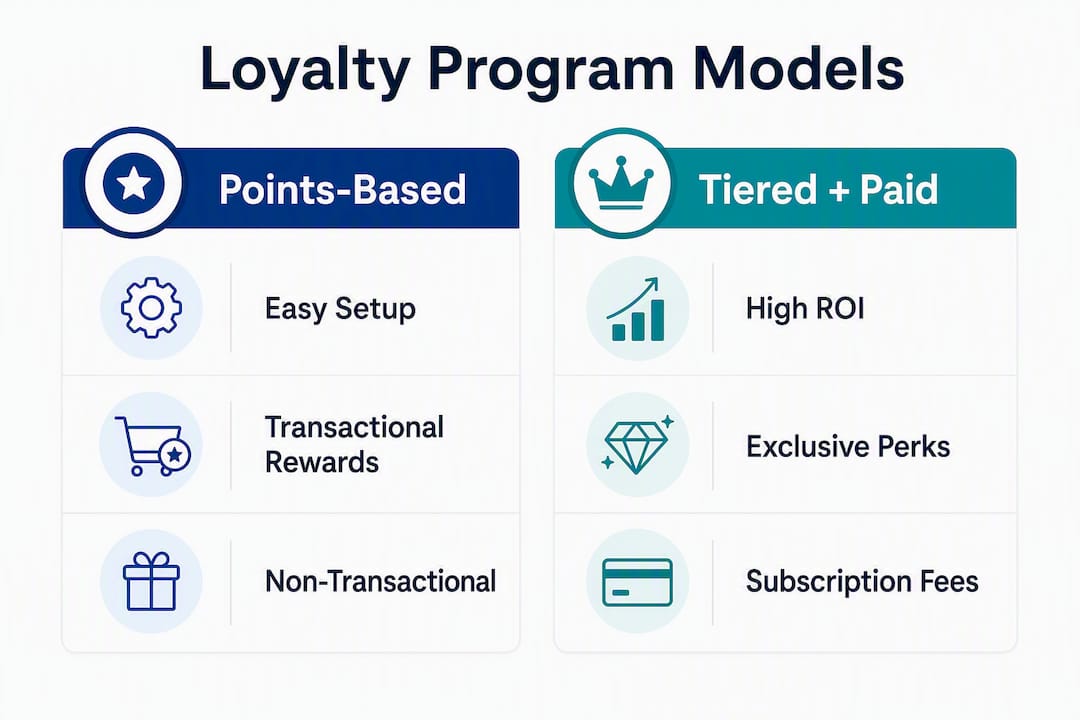
Highest ROI potential: tiered hybrids and paid/subscription models. Top programs can lift annual revenue among active participants by 15–25% when incrementality is measured via cohorts, not aggregate sign-ups.
Margin watch: discount-heavy cashback programs carry the highest reward liability and the weakest brand-building effect. Experiential perks (early product access, free shipping, exclusive events) preserve margin while creating emotional attachment that a percentage-off never will.
Why loyalty programs move the revenue needle
The commercial case is straightforward: it costs significantly more to acquire a new customer than to retain an existing one, and loyal customers are worth up to 10 times their first purchase value over their lifetime. A well-designed loyalty program accelerates that compounding.
Direct business benefits:
- Higher customer lifetime value (CLV): Members who engage with a program consistently outspend non-members. The annual spend lift cited above is a floor, not a ceiling, for well-run programs.
- Improved repeat purchase rate: Earning points or protecting tier status gives customers a concrete reason to return before they would naturally.
- Higher average order value (AOV): Threshold-based rewards (“spend $150 to earn double points”) pull AOV upward without blanket discounting.
- Lower customer acquisition cost (CAC) via referrals: A member who refers two paying customers effectively subsidizes their own acquisition cost.
- Predictable revenue: Paid loyalty models convert variable purchase behavior into a recurring fee stream.
The minimum KPI set to justify investment includes enrollment rate, Active Member Rate over a 30–90 day activity window, redemption rate of issued points, and member vs. non-member revenue lift measured by cohort. Industry benchmarks show members spend 12–18% more annually than non-members.
Pro Tip: Treat the program as a capital deployment, not a marketing line item. Invite your finance team into the design phase to model reward liability, payback periods, and incremental revenue tracking. A program that looks great on enrollment numbers but bleeds margin on redemptions is a liability, not an asset. Involving finance early is one of the clearest separators between programs that scale and programs that get quietly shut down.
For SMBs, a well-configured points program can show measurable repeat-rate lift within a few months of launch. Enterprise programs with tiered structures and omnichannel integration often require a longer pilot to generate statistically meaningful cohort data.
How each loyalty model actually works
Points-based programs
Points programs are the most common entry point for a reason: they are easy to explain, easy to earn, and easy to redeem. The design risk is also the most common failure mode: setting point values so low that redemption feels pointless, or so high that reward liability becomes unmanageable.
A sound points economy starts with a target redemption rate within a moderate range of issued points. Below that, members disengage. Above it, margins compress. An effective points redemption rate is often designed to balance margin protection with meaningful rewards for customers. That is low enough to protect margin and high enough to feel tangible.
Non-transactional earning is where points programs get interesting. Rewarding reviews, social engagement, and quizzes keeps the brand present between purchases and builds habitual engagement without requiring a transaction. A customer who earns points for leaving a product review is also generating social proof. That is two outcomes from one mechanic.
Tiered structures
Tiers work because of loss aversion. Once a customer reaches Gold status, the psychological cost of dropping back to Silver is more motivating than the reward of reaching Gold was in the first place. VIP perks that must be maintained are more binding than one-off discounts, which is why tiered programs consistently outperform flat structures on retention.

Design the top tier around experiential perks: early product access, free shipping, exclusive events, or dedicated customer service. These cost less than percentage-off discounts and create emotional attachment that a discount never will. Reserve percentage-off rewards for lower tiers where the goal is activation, not retention.
Threshold logic matters. Set tier thresholds carefully to balance attainability and exclusivity; for example, lower tiers might be reachable within a few purchases and top tiers within a consistent buying period.
Paid and subscription loyalty
Amazon Prime is the canonical example, but the model works at every scale. The core mechanic: customers pay an upfront fee in exchange for guaranteed perks (free shipping, exclusive pricing, early access). The fee revenue offsets reward costs, and the act of paying creates commitment that free programs cannot replicate.
Paid loyalty makes sense when your customers buy frequently enough that the perks deliver obvious value relative to the fee. For a brand where customers order monthly, a $49/year membership that covers free shipping on every order is a straightforward value proposition. For a brand with one or two annual purchases, the math rarely works for the customer.
Pricing heuristics suggest setting the annual fee to reflect a substantial portion of the annual shipping cost for a typical member. That makes the value proposition clear without giving away too much margin.
Referral and advocacy mechanics
Referral programs are acquisition tools dressed as loyalty mechanics. The dual-sided incentive (both referrer and referee get a reward) is the most effective structure. Single-sided programs that only reward the referrer see significantly lower conversion on the referee side.
Fraud controls are non-negotiable. Self-referrals, fake accounts, and coupon abuse are common enough that any referral program without IP-level or email-domain controls will bleed reward budget within weeks of launch. Most entry-level platforms include basic fraud detection; enterprise programs need custom rules.
The growth math is simple: if your customer refers new customers and your referral reward costs a certain amount per successful conversion, you need a customer lifetime value that exceeds the total referral cost to break even. Most mid-market ecommerce brands clear that threshold comfortably.
Cashback and value-based programs
Store credit is almost always better than cash back. Cash back trains customers to expect a discount on every purchase. Store credit keeps the value inside your ecosystem and requires a return visit to redeem. Target Circle runs on this mechanic effectively.
The margin risk with cashback is real. A 5% cashback rate on a 40% gross margin product leaves 35% before any other costs. Stack that with acquisition costs and you are quickly underwater. Use cashback as a short-term activation lever or a competitive response, not as the permanent program structure.
Hybrid models and sequencing
Start simple. A points program with a single earning rate and a clear redemption threshold is easier to communicate, easier to operate, and easier to measure than a hybrid at launch. Add tiers after you have 90 days of redemption data. Add gamification (progress bars, bonus point events, streaks) after tiers are stable. Add a paid tier only when you have a clear value proposition and the operational infrastructure to deliver on it.
Pro Tip: The single most common design mistake is launching with too many rules. If your program requires a FAQ page to explain how points work, simplify before you launch. Complexity kills activation rates. A program members understand on first read will always outperform a sophisticated one they ignore.
Statistic to watch: Top-performing programs incorporate personalization (82%), gamification (67%), and experiential rewards (74%) according to industry guides. If your program has none of these, it is competing on discount alone.
What the best retail programs actually do differently
The programs worth studying are not just big-budget executions. Each one solves a specific retention or acquisition problem in a way that mid-market ecommerce brands can adapt. Here are the replicable lessons, alongside what not to copy.
Starbucks Rewards
Model: Points (Stars) with tiered earning rates, mobile-first redemption, and gamified bonus challenges.
Why it works: The Starbucks app is the program. Earning and redeeming happen in the same interface where customers order, which eliminates friction at every step. Bonus Star challenges (earn 50 Stars by ordering a new drink three times this week) drive trial of new products without discounting the core menu.
Steal this: Build time-limited bonus point events tied to specific SKUs or categories you want to move. A “double points on new arrivals” weekend costs less than a sitewide sale and drives the same urgency.
Don’t copy: The complexity of the Star-to-reward conversion math confused customers for years. Keep your point-to-reward ratio simple enough to calculate mentally.
Sephora Beauty Insider
Model: Three-tier points program (Insider, VIB, Rouge) with experiential perks at the top tier and non-transactional earning through reviews and quizzes.
Why it works: Rouge members ($1,000+ annual spend) get early access to new products, exclusive events, and dedicated service. Those perks cost Sephora far less than equivalent discounts and create a community identity that drives social sharing. Loss aversion keeps Rouge members spending to protect their status.
Steal this: Design your top tier around access, not discounts. Early product drops, private sales, or a dedicated support line cost less than 10% off everything and feel more exclusive.
Don’t copy: The three-tier structure requires significant operational overhead. Start with two tiers and add a third only after you have clear data on where customers plateau.
Amazon Prime
Model: Paid subscription with guaranteed perks (free shipping, streaming, exclusive pricing).
Why it works: The annual fee creates commitment. Prime members spend significantly more than non-members because they have already paid for the privilege of shopping. The program also bundles non-retail perks (video, music, reading) that increase daily touchpoints with the Amazon brand.
Steal this: If your customers order frequently, model a paid tier with free shipping as the anchor perk. The fee revenue alone can fund the reward program.
Don’t copy: The bundled media content is a moat only Amazon can build. Focus your paid tier on perks directly tied to your product category.
Target Circle
Model: Free cashback program (1% back as store credit) with personalized offers and non-transactional earning through voting on community causes.
Why it works: A low cashback rate can protect margin while still providing a tangible reward for customers. The community voting mechanic creates emotional engagement that pure discount programs never achieve. Personalized offers based on purchase history drive category trial.
Steal this: Add a cause-based or community mechanic to your program. Letting members direct a small donation to a cause they choose costs almost nothing and generates genuine brand affinity.
Don’t copy: Target’s personalization engine runs on massive transaction data. Start with simple segmentation (new vs. returning, category preference) before attempting real-time personalization.
Walmart+
Model: Paid subscription ($98/year) anchored on free delivery, fuel discounts, and Paramount+ streaming access.
Why it works: The fuel discount is a daily-life perk that keeps Walmart+ top of mind even between grocery orders. Bundling with Paramount+ mirrors the Amazon Prime playbook of increasing non-retail touchpoints.
Steal this: Identify one perk outside your product category that your customers value daily. A partnership with a complementary brand can deliver that perk without building it yourself.
Don’t copy: The fuel discount requires physical infrastructure. Focus on digital perks (early access, free shipping, exclusive content) that you can deliver without logistics overhead.
Nike Membership
Model: Free tiered membership with experiential rewards: exclusive product drops, training content, community events, and early access to limited releases.

Why it works: Nike’s program is built around identity, not discounts. Members earn access to things money cannot buy (limited sneaker drops, athlete events), which creates scarcity and social currency. The program also collects rich behavioral data through the Nike app that feeds product development and personalization.
Steal this: Reward non-transactional behaviors like app engagement, workout logging, or content interaction. Every non-purchase touchpoint is a data point and a brand impression.
Don’t copy: Nike’s product scarcity is a brand asset built over decades. Artificial scarcity on commodity products reads as manipulation.
For a deeper look at how these examples translate into ecommerce revenue, the proven loyalty program examples guide maps each model to specific DTC outcomes.
How to choose the right loyalty platform
Platform selection is where most programs stall. The right choice depends on your tech stack, purchase volume, and how much custom logic your program requires.
Platform tiers at a glance
| Best for | Program model support | Key features | Integrations | Ease of setup | Pricing shape | Scalability | Analytics |
|---|---|---|---|---|---|---|---|
| Shopify SMBs (under $5M revenue) | Points, referral, basic tiers | Native checkout sync, email triggers, widget | Shopify, Klaviyo, basic POS | Low (days to weeks) | Flat monthly | Limited at high volume | Basic dashboards |
| Mid-market DTC ($5M–$50M) | Tiered, hybrid, referral | Custom earning rules, segmentation, API access | Shopify/BigCommerce, Klaviyo, CDP | Medium (4–8 weeks) | Per-active-member or tiered | Good with configuration | Cohort reporting |
| Enterprise ($50M+) | All models + paid tiers | Full API, CDP integration, omnichannel POS sync | Magento, Salesforce, custom CDP, POS | High (8–20 weeks) | Custom/enterprise contract | Built for scale | Advanced attribution |
LoyaltyLion
LoyaltyLion is a mid-market platform built for Shopify and BigCommerce merchants. It supports points, tiers, and referrals with native Klaviyo integration, which means loyalty events (tier upgrade, points earned, reward redeemed) can trigger automated email flows without custom development. The analytics dashboard surfaces member vs. non-member revenue comparisons, which is the right starting point for cohort measurement.
Smile.io
Smile.io targets SMB Shopify merchants who need a points or referral program live quickly. The setup is genuinely fast, often under a day for a basic points program. The trade-off is limited customization: complex tier logic or custom earning rules require a higher-tier plan or a platform switch. For a brand under $2M in revenue testing its first loyalty program, Smile.io is a low-risk starting point.
Yotpo Loyalty
Yotpo bundles loyalty with reviews, SMS, and referrals in a single platform, which matters if you want non-transactional earning (review points, social sharing rewards) without stitching together multiple tools. The integration with Yotpo Reviews means a customer who leaves a review earns points automatically, and that review feeds your product pages. The pricing reflects the bundled scope: it is not the cheapest option for a brand that only needs points.
Integration checklist
Before committing to any platform, confirm these connectors exist and are maintained:
- Checkout sync: points earned and redeemed must update in real time at checkout, not in a nightly batch
- Order management sync: returns and cancellations must reverse points automatically
- Email platform (Klaviyo or equivalent): loyalty events must trigger flows, not just static campaigns
- CDP or CRM: member data must flow into your customer profiles for segmentation
- POS (if omnichannel): in-store and online points must sync; multi-channel programs outperform single-channel experiences on retention
- Analytics: you need raw event data exportable to a BI tool, not just platform dashboards
Native Shopify apps sync transactions and checkout more easily; enterprise setups require API-first platforms and CDP investment. Do not underestimate the data-synchronization cadence: a loyalty platform that updates points hourly will generate customer service tickets every time a member checks their balance between syncs.
For a full vendor shortlist, the top loyalty program software guide covers six platforms with integration notes for Shopify, Magento, and Klaviyo.
Your 90-day launch roadmap
A loyalty program launch has eight distinct phases. Skipping any one of them is the most common cause of post-launch operational failures.
Launch checklist
- Discovery and goal-setting: Define the primary KPI (repeat purchase rate, CLV, AOV) and the minimum success threshold for the pilot. Involve finance to model reward liability.
- Reward logic design: Set point values, tier thresholds, earning rules, and redemption mechanics. Calculate the effective discount rate and confirm it fits within gross margin.
- Platform selection: Match platform tier to revenue, tech stack, and program complexity. Confirm all required integrations exist before signing a contract.
- Data and analytics setup: Configure cohort tracking before launch. You need a clean control group (non-enrolled customers matched by purchase history) to measure incrementality.
- Email and lifecycle flows: Build the welcome series, points-earned notification, tier-upgrade trigger, and expiry reminder flows in Klaviyo before go-live. A loyalty email series should launch simultaneously with the program, not weeks later.
- QA and UAT: Test every earning and redemption scenario, including edge cases (returns, partial orders, gift cards). Test the email triggers with real transactions in a staging environment.
- Pilot segmentation: Launch to 20–30% of your customer base first. Use a matched control group from the remaining customers to measure lift.
- Rollback criteria: Define in advance what would trigger a pause: reward liability exceeding a set threshold, redemption rate above 40%, or a customer service ticket spike above baseline.
90-day pilot timeline
| Phase | Weeks | Milestones |
|---|---|---|
| Discovery and design | 1–2 | KPIs set, reward economics modeled, finance sign-off |
| Platform setup and integration | 3–5 | Platform live in staging, all integrations tested |
| Email flows and comms | 5–6 | Welcome series, earn/redeem triggers live in Klaviyo |
| QA and UAT | 6–7 | All earning/redemption scenarios tested, edge cases cleared |
| Pilot launch (20–30% of base) | 8 | Pilot cohort enrolled, control group defined |
| Measurement period | 8–12 | Cohort data collected, weekly KPI review |
| Decision point | 12 | Full rollout, iterate, or pause based on cohort lift |
Common launch triage:
- Redemptions not syncing: check order management webhook; most platforms require a fulfilled order status before points post
- Points miscalculation on returns: confirm the platform reverses points on refund events, not just cancellations
- Welcome email not firing: verify the Klaviyo trigger is set to enrollment event, not first purchase
How to measure whether your program is actually working
Aggregate membership numbers are the most misleading metric in loyalty. A program with 50,000 enrolled members and 3,000 active ones is failing. A program with 8,000 enrolled members and 5,500 active ones is healthy.
Core KPI set
| KPI | Definition | Healthy benchmark |
|---|---|---|
| Enrollment rate | Enrolled members / eligible customers | 20%+ of eligible base |
| Active Member Rate | Members with qualifying action in 30–90 days | 40–60% of enrolled |
| Redemption rate | Points redeemed / points issued | 20–30% |
| Member vs. non-member revenue lift | Revenue per member / revenue per matched non-member | 12–18% lift |
| Repeat purchase rate | % of members with 2+ purchases in 12 months | Varies by vertical |
| AOV change | Member AOV vs. non-member AOV | Positive delta |
| CLV:CAC ratio | Customer lifetime value / acquisition cost | Minimum 3:1 |
| Referral CAC impact | New customers from referrals / total referral reward cost | Below blended CAC |
Cohort testing prescription
Set up your measurement before launch, not after. Divide your customer base into two groups matched on recency, frequency, and monetary value (RFM). Enroll one group in the pilot; keep the other as a control. Measure the revenue delta between groups at 30, 60, and 90 days.
Measuring incrementality with cohort-based comparisons separates true program-driven lift from naturally loyal customers who would have repurchased anyway. Without a control group, you are measuring correlation, not causation.
Sample ROI calculation
Assume 1,000 enrolled members, average order value of $85, and a target repeat purchase rate lift of 15 percentage points (from 30% to 45%). That is 150 additional repeat purchases at $85 each, generating $12,750 in incremental revenue. If your reward liability (points issued at a 1% effective rate) totals $1,275, the net incremental margin before other costs is $11,475 on 1,000 members. Scale that to 10,000 members and the program pays for itself many times over.
Pro Tip: Ignore total enrollment as a headline metric. The number that predicts program health is Active Member Rate: members who complete a qualifying action within 30–90 days. If that rate is below 30%, fix the onboarding experience and the welcome flow before spending another dollar on acquisition.
How an ecommerce agency implements loyalty programs
The agency workflow for a loyalty program implementation follows a consistent arc, and the gaps it fills are almost always the same: clean first-party data, Klaviyo integration, and cohort measurement infrastructure.
Swyftinteractive’s implementation process:
- Discovery and KPIs: Map purchase cadence, gross margin, and existing customer segments. Define the primary KPI and the pilot success threshold.
- Reward economics and design: Model point values, tier thresholds, and reward liability against the P&L. Confirm the program is margin-positive before building anything.
- Platform selection and integration: Match the platform to the tech stack. For Shopify brands, configure native app integrations. For mid-market and enterprise, build API connections to Klaviyo, CDP, and POS.
- Lifecycle flows and comms: Build the full email automation stack in Klaviyo: welcome series, earn/redeem triggers, tier-upgrade flows, expiry reminders, and win-back sequences. This is where most DIY implementations fall short.
- Pilot and measurement: Launch to a segmented cohort with a matched control group. Measure cohort lift at 30, 60, and 90 days.
- Scale and iterate: Roll out to the full customer base after the pilot validates incrementality. Add gamification, non-transactional earning, or a paid tier based on data, not assumptions.
The Klaviyo integration is where loyalty programs generate their highest ROI. A tier-upgrade email sent within minutes of a customer reaching a new status converts at multiples of a standard promotional email. A points-expiry reminder sent 14 days before expiration drives urgency without discounting. These flows require clean event data flowing from the loyalty platform into Klaviyo in real time.
When to hire an agency:
- Your in-house team cannot guarantee clean first-party data flowing from checkout to your email platform
- You need cohort measurement infrastructure that your current analytics setup does not support
- You are launching a tiered or hybrid program that requires custom earning rules and multi-platform integration
- You have tried a DIY program and Active Member Rate is below 30%
Pro Tip: The most common reason loyalty programs underperform is not the program design. It is the email automation. A points program without a triggered welcome series, earn notifications, and expiry reminders is a program that members forget about. Klaviyo automation is what keeps the program visible between purchases.
[Author bio: insert Leon’s professional bio and credentials]
Key Takeaways
The most effective loyalty programs for online retailers combine a tiered structure with points earning, measure success through Active Member Rate and cohort-level revenue lift, and integrate directly with Klaviyo for lifecycle automation.
| Point | Details |
|---|---|
| Start with the right model | Match program type to purchase cadence: tiered-points hybrid for most retailers, paid subscription for high-frequency brands. |
| Active Member Rate is the key metric | Target 40–60% of enrolled members completing a qualifying action within 30–90 days. |
| Measure cohort lift, not enrollment | Compare enrolled vs. matched non-enrolled cohorts; members should show 12–18% higher annual spend. |
| Integrate Klaviyo from day one | Triggered flows (welcome, earn, tier upgrade, expiry) are what keep members engaged between purchases. |
| Swyftinteractive handles the full stack | Swyftinteractive designs reward economics, builds platform integrations, and configures Klaviyo automation for ecommerce loyalty programs. |
The part most loyalty articles skip
Most loyalty program guides focus on the program mechanics and stop there. The real failure mode is not a bad program design. It is a program that launches without the operational infrastructure to keep members engaged between purchases.
A points program with no triggered email flows is invisible. A tiered program with no tier-upgrade notification is a missed conversion moment. The loyalty platform is the engine; Klaviyo is the fuel delivery system. Without both working together, you are running a program that members sign up for once and forget.
Start small, measure cohort lift, and resist the urge to add complexity before the basics are working. The brands that get loyalty right are not the ones with the most sophisticated programs. They are the ones that execute a simple program consistently, communicate it well, and iterate based on data.
Expect operational hiccups in the first 30 days: points not syncing on returns, welcome emails firing late, tier thresholds miscalculating on edge-case orders. Build a triage checklist before launch and assign ownership for each failure mode. A program that recovers quickly from a technical issue retains member trust. One that leaves customers with missing points and no response does not.
Swyftinteractive builds loyalty programs that actually retain customers
Running a loyalty program on a disconnected stack is one of the most common reasons programs underperform. The platform earns points; the email tool sends generic campaigns; the analytics show enrollment numbers that mean nothing. Swyftinteractive closes that gap by building the full system: ecommerce growth strategy that connects loyalty mechanics to Klaviyo automation, site UX, and cohort-level measurement from day one.
For ecommerce brands that need more than a plug-in, Swyftinteractive handles platform selection and integration, reward economics modeling, Klaviyo lifecycle flow builds (welcome series, earn/redeem triggers, tier-upgrade sequences, expiry reminders), and 90-day pilot measurement. The result is a program members actually engage with, tied to revenue metrics your finance team can verify.
If your current program has an Active Member Rate below 30%, or you have not launched yet and want to get the integration right the first time, a Klaviyo lifecycle audit is the fastest way to identify the gaps. Reach out to Swyftinteractive to scope your loyalty program build.
Useful sources
These are the primary sources used for benchmarks, design guidance, and measurement frameworks in this article. Use them when building your own KPI baselines and program economics.
- The Value of Keeping the Right Customers (Harvard Business Review) — The foundational CLV argument for retention investment. Use when making the business case to leadership.
FAQ
What are the best loyalty programs for online retailers?
For most online retailers, a tiered-plus-points hybrid delivers the strongest combination of repeat purchase lift and margin protection. High-frequency brands (beauty, consumables) often get better results from a paid subscription model like Amazon Prime’s structure.
How do you measure whether a loyalty program is working?
Focus on Active Member Rate (40–60% of enrolled members completing a qualifying action within 30–90 days), redemption rate (20–30% of issued points), and member vs. non-member revenue lift measured via matched cohorts; members typically spend 12–18% more annually than non-members.
How long does it take to see ROI from a loyalty program?
SMB programs running on native Shopify apps typically show measurable repeat-rate lift within 60–90 days. Enterprise programs with tiered structures and omnichannel integration usually need a 90-day pilot to generate statistically meaningful cohort data.
Which loyalty platforms integrate with Klaviyo?
LoyaltyLion, Smile.io, and Yotpo Loyalty all offer native Klaviyo integrations that trigger automated flows on loyalty events (points earned, tier upgrade, reward redeemed). Swyftinteractive configures these integrations as part of its loyalty program build service.
What is the biggest mistake brands make when launching a loyalty program?
Launching without triggered email automation. A points program with no welcome series, earn notifications, or expiry reminders is a program members sign up for and forget. The Klaviyo integration is what keeps the program visible and driving repeat purchases between transactions.