
TL;DR:
- The best ecommerce website builders in 2026 include Shopify, BigCommerce, WooCommerce, Adobe Commerce, Squarespace, and Wix. Most brands should integrate Klaviyo automation during development to maximize revenue and tracking accuracy. Agency costs vary from $5K to over $250K, with early integration of automation and performance metrics key for growth.
The top ecommerce website builders for 2026 are Shopify / Shopify Plus, BigCommerce, WooCommerce, Adobe Commerce (Magento), Squarespace Commerce, and Wix eCommerce. For most scaling brands, the fastest path to measurable revenue is an agency-led build that pairs the right platform with Klaviyo automation baked in from day one, not retrofitted after launch.
A few things to set expectations early:
- Time to launch can vary widely, from a few weeks for a basic theme build to several months for a fully custom or headless project.
- Total first-year cost ranges from $5K–$25K for a basic Shopify customization to $150K–$500K+ for a fully custom build in 2026.
- Every build in 2026 must address PCI DSS compliance at checkout and a first-party data strategy, since third-party cookie deprecation has made server-side event tracking non-optional.
For brands under $5M GMV, a custom build is almost never the right call. The economics don’t work until platform constraints are causing measurable, specific revenue pain.
Table of Contents
- Best ecommerce website builders 2026: side-by-side comparison
- How do you choose the right builder and whether to hire an agency?
- Why Klaviyo integration must be part of your build, not an afterthought
- What does a realistic ecommerce build cost in 2026?
- What does an agency-led, integrated build actually deliver?
- Key Takeaways
- Why the platform-first mindset misses the point
- Swyftinteractive builds ecommerce sites and Klaviyo systems as one scope
- Useful sources
- FAQ
Best ecommerce website builders 2026: side-by-side comparison
| Dimension | Shopify / Shopify Plus | BigCommerce | WooCommerce | Adobe Commerce | Squarespace Commerce | Wix eCommerce |
|---|---|---|---|---|---|---|
| Best for | DTC, mid-market, enterprise | Multi-brand, B2B/B2C hybrid | Content-heavy, WordPress-native | Complex enterprise, global | Design-led small brands | Visual, low-code small stores |
| Pricing model | Subscription + 0–2% transaction fee; Plus from ~$2,300/mo | Subscription, no transaction fees | Free core + hosting + plugins | License + cloud hosting (high) | Subscription, no transaction fees | Subscription, no transaction fees |
| Scalability | High (Shopify Plus handles flash sales) | High (open SaaS, strong API) | Medium (hosting-dependent) | Very high (enterprise-grade) | Low–medium | Low–medium |
| Ease of use | High | Medium | Medium (WordPress familiarity needed) | Low (developer-required) | Very high | Very high |
| Klaviyo integration | Native, plug-and-play | Native | Plugin-based, reliable | Custom API work required | Limited | Limited |
| Headless / custom | Hydrogen + Storefront API | Strong native headless support | Possible, complex | Full headless support | Not practical | Not practical |
| Agency build cost | $5K–$150K | $25K–$150K | — | $75K–$250K+ | $3K–$20K | $3K–$15K |
| Time to launch | few weeks to several months | few weeks to several months | 3 weeks–5 months | several months | 1–4 weeks | 1–3 weeks |
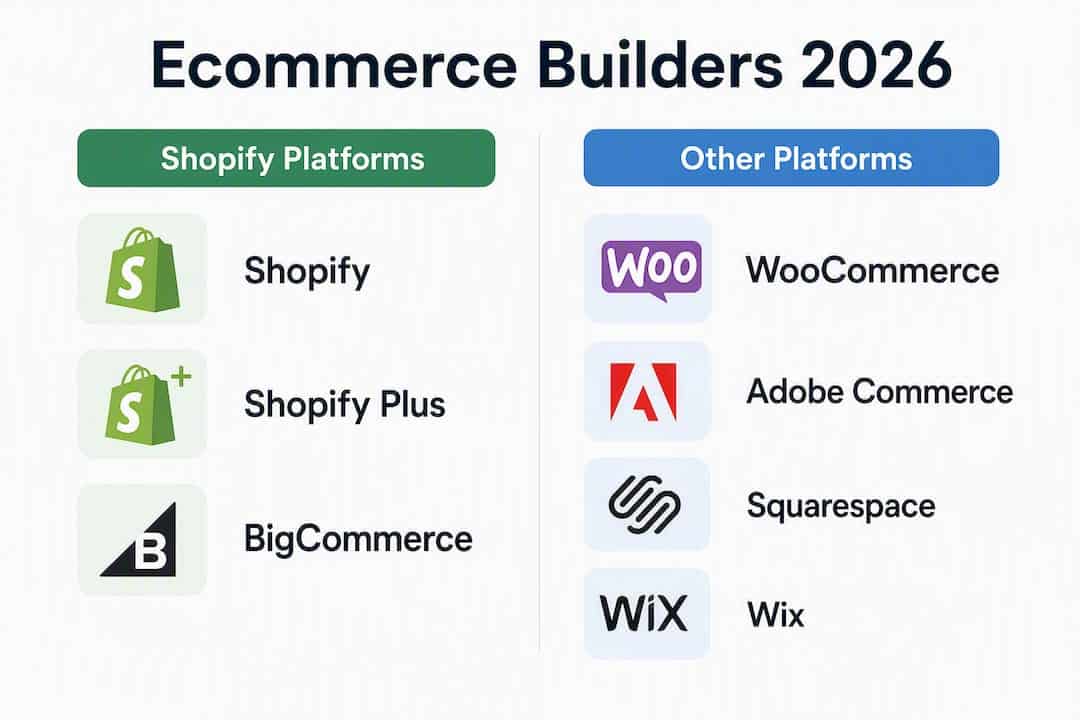
Shopify is the default for most DTC brands because it ships with checkout, inventory, payments, and a deep app ecosystem on day one. BigCommerce earns its place for hybrid B2B/B2C operations where native price lists and purchase orders matter. WooCommerce suits brands already deep in the WordPress ecosystem. Adobe Commerce is the right call only when you need granular, code-level control across 20+ international markets or complex data models. Squarespace Commerce and Wix eCommerce are genuinely good for design-led brands with modest catalog complexity.

How do you choose the right builder and whether to hire an agency?
The decision comes down to four variables: GMV, engineering capacity, feature dependencies, and opportunity cost of a long build.
- Assess your GMV and growth trajectory. Under $1M, any hosted platform works. Between $1M–$5M, Shopify or BigCommerce covers nearly every need. At $5M–$25M, evaluate whether platform constraints (checkout customization, data ownership, transaction fees) are costing real money. Above $25M, a headless or composable architecture often pays for itself within 18–24 months.
- Map structural feature dependencies. If your checkout roadmap is blocked by what the platform allows, that is a direct revenue limitation. If you need three plugins to cover one native feature and they break each other on updates, that is a compounding problem.
- Audit your engineering capacity. A custom build with no maintenance budget is worse than staying on a platform. WooCommerce and Adobe Commerce both require ongoing developer involvement; Shopify and BigCommerce do not.
- Estimate opportunity cost. A 9-month custom build delays every marketing experiment. For most brands, shipping on Shopify Plus in 8 weeks and iterating beats a bespoke build that launches in Q4.
- Select the platform cluster that matches your stage. Hosted default (Shopify, BigCommerce) for most; headless for specific structural constraints; fully custom only when you can name the exact revenue impact the platform is causing.
Questions to ask agency candidates:
- Which platforms do you hold certified or verified partner status with?
- How do you handle server-side tracking and conversion API setup?
- What does your Klaviyo integration scope include at launch?
- What is your post-launch SLA for bug response and performance issues?
- Who owns the theme files and template code after handoff?
- How do you measure success 90 days post-launch?
Red flags: no post-launch support plan, opaque monthly maintenance fees, proprietary section frameworks that lock you into their agency, and any agency that cannot explain LTV or COGS when scoping a build.
Pro Tip: An agency that asks about your customer lifetime value and gross margin before the first mockup understands growth. One that leads with design awards probably does not.
Why Klaviyo integration must be part of your build, not an afterthought
Email is a primary revenue asset and list growth is the most reliable recurring revenue engine for ecommerce brands. The mistake most brands make is treating Klaviyo as something to “add later.” Retrofitting automation after launch costs more and produces weaker results because the data architecture was never designed for it.
Good integration looks like this: checkout-level opt-ins that capture consent at the highest-intent moment, server-side events that fire reliably regardless of browser ad-blockers, and a clean event map so Klaviyo receives accurate purchase, browse, and cart data. Server-side events and conversion APIs are standard 2026 expectations, not advanced features.
Concrete flows that should be live at launch: abandoned checkout recovery, post-purchase thank-you and cross-sell sequences, browse abandonment, and a welcome series tied to the checkout opt-in. These are not nice extras. They are the baseline for a Klaviyo email marketing setup that generates revenue from week one.
Shopify and BigCommerce make these integrations straightforward. WooCommerce requires a plugin layer that works reliably when maintained. Adobe Commerce typically needs custom API work. Squarespace and Wix have limited event granularity, which constrains what Klaviyo can act on.
Pro Tip: Your agency should deliver a Klaviyo audit, pre-built core flows, and list-growth hooks as part of the development scope, not as a separate engagement after launch.
What does a realistic ecommerce build cost in 2026?
| Build type | Typical cost range | Time to launch | Best for |
|---|---|---|---|
| Basic theme customization | $5K–$25K | Weeks to a month | New stores, MVP launches |
| Shopify Plus full build | $25K–$150K | Few months | Growing DTC, mid-market |
| Headless (Next.js / Hydrogen) | $75K–$250K+ | Several months | Higher GMV with specific constraints |
| Fully custom build | $150K–$500K+ | Up to a year or more | Enterprise, complex needs |
| Monthly retainer (post-launch) | $2K–$15K/month | Ongoing | All tiers |
Cost ranges above reflect 2026 US market rates for agency-led builds. The fully custom range aligns with AHAeCommerce’s finding that custom builds typically run $180K–$450K in year one with $80K–$160K in ongoing costs.
Three practical notes on budgeting:
- Budget for post-launch from day one. Require performance benchmarks (page speed, Core Web Vitals, uptime, bug response time) in writing before signing. An agency that resists this is telling you something.
- Factor in the retainer. A $50K build with no ongoing support degrades. A $30K build with a $4K/month retainer covering performance, automation management, and A/B testing compounds.
- Opportunity cost is real. Every month a headless build runs over schedule is a month your competitors are running email experiments you are not.
What does an agency-led, integrated build actually deliver?
The clearest recommendation for growth-focused brands: hire one agency that owns both the site build and Klaviyo lifecycle automation, rather than two siloed vendors who blame each other when attribution breaks.
When development and lifecycle marketing share the same scope, list-growth hooks get built into the UX from the first sprint. Tracking is set up correctly before launch, not patched afterward. Experiments run faster because the team that built the checkout also controls the flows triggered by it.
Brands that scale fastest choose development partners who understand paid media and growth before the first mockup — and who stay involved after launch. A handoff-and-disappear agency model is the single biggest predictor of a stalled store six months post-launch.
What good agency proof looks like: conversion rate lift with a before/after baseline, email-attributed revenue as a percentage of total store revenue, list growth rate month-over-month, and repeat purchase rate improvement. If an agency cannot show you these metrics from a past client, ask why.
Key Takeaways
Shopify Plus is the default platform for most scaling brands in 2026, and integrating Klaviyo during the build, not after, is the single highest-leverage decision a growth-focused brand can make.
| Point | Details |
|---|---|
| Platform by GMV | Under $5M, use Shopify or BigCommerce; evaluate headless only above $5M with specific constraints. |
| Klaviyo at build time | Integrate checkout opt-ins, server-side events, and core flows during development, not post-launch. |
| Realistic cost range | Agency builds range from $5K–$25K (basic theme), $25K–$150K (Shopify Plus), $75K–$250K+ (headless), $150K–$500K+ (fully custom); retainers run $2K–$15K/month. |
| Agency selection | Require post-launch SLA, performance benchmarks, and Klaviyo scope in writing before signing. |
| Swyftinteractive | Delivers integrated site builds and Klaviyo lifecycle automation as a single scope for ecommerce brands. |
Why the platform-first mindset misses the point
The debate over which builder is “best” is usually the wrong question. Platform choice matters, but it is rarely the variable that separates a store doing $800K from one doing $4M. What separates them is whether the marketing automation was built into the site architecture or bolted on later, whether the agency understood LTV before writing a single line of code, and whether someone is accountable for performance after launch.
Most brands spend 80% of their decision energy on the platform and 20% on the partner. The ratio should be closer to the reverse. A great agency on WooCommerce will outperform a mediocre one on Shopify Plus every time, because the platform is a tool and the strategy is the product.
The other thing worth saying plainly: the build vs. buy decision is a spectrum, not a binary. Most brands land somewhere between platform-native and platform-extended, and that is the right answer for their stage. Chasing headless or custom because it sounds sophisticated is how brands burn $200K and launch 11 months late.
Swyftinteractive builds ecommerce sites and Klaviyo systems as one scope
Most agencies hand you a site and wish you luck with email. Swyftinteractive delivers both: a high-converting, fast-loading ecommerce build and a fully configured Klaviyo lifecycle system, scoped together so the tracking, opt-ins, and flows are live on day one.
The result is a store where every checkout interaction feeds your automation, every post-purchase flow is mapped to your margin profile, and your list grows from the moment traffic arrives. If you want to see exactly what that looks like for your platform and catalog, start with the ecommerce website checklist for Klaviyo or book a Klaviyo lifecycle audit to get a clear picture of what your current setup is leaving on the table.
Useful sources
- Web Development Agency Selection for DTC Brands in 2026 — EmberTribe
- How to Choose a Marketing Agency for eCommerce — Scale Growth Digital
- Custom-Built eCommerce: When It Actually Makes Sense — AHAeCommerce
- Custom Ecommerce Development: Build vs Buy Decision Guide — Conception Labs
- Top Ecommerce Agencies: How to Evaluate Partners — Filip Konecny
- Proven ecommerce growth strategies to scale your brand — Swyftinteractive
- Ecommerce automation and Klaviyo flows — Swyftinteractive
FAQ
Which ecommerce platform is best for most brands in 2026?
Shopify and Shopify Plus are the default for most DTC and mid-market brands because they offer fast time-to-launch, built-in checkout, and native Klaviyo integration. BigCommerce is the strongest alternative for hybrid B2B/B2C operations.
When does a custom or headless build make sense?
A headless build is worth evaluating between $5M–$25M GMV when specific platform constraints are causing measurable revenue or developer-velocity pain. Fully custom builds rarely make sense below $5M GMV given first-year costs of $150K–$500K+.
How much does an agency ecommerce build cost in 2026?
Agency build costs range from $5K–$25K for basic theme customization to $25K–$150K for a full Shopify Plus build, $75K–$250K+ for headless projects, and $150K–$500K+ for a fully custom build. Ongoing retainers typically run $2K–$15K per month.
Why should Klaviyo be part of the build scope, not added later?
Retrofitting Klaviyo after launch requires rebuilding the data architecture and often produces weaker event tracking. Integrating checkout opt-ins, server-side events, and core flows during development means automation is generating revenue from the first week of traffic.
What should I look for when hiring an ecommerce agency?
Prioritize platform-specific expertise, a clear Klaviyo integration scope, post-launch SLA in writing, and measurable outcomes from past clients (conversion lift, email-attributed revenue, list growth rate). An agency that asks about your LTV and COGS before scoping understands growth.