

Most ecommerce brands treat content as an afterthought, a box to check before launching products. Yet strategic content combined with personalized email automation generates 30 times more revenue per recipient than generic batch campaigns. The difference lies not in volume but in relevance. When you align content with buyer intent and deliver it through Klaviyo’s intelligent automation, you transform passive browsers into committed buyers. This guide reveals how content drives conversions and how Klaviyo multiplies that impact across your entire customer journey.
Table of Contents
- How Content Builds Trust And Drives Ecommerce Conversions
- Leveraging Klaviyo For Personalized Email Automation And Revenue Growth
- Testing And Measuring Content Impact For Ongoing Ecommerce Optimization
- Enhance Your Ecommerce Growth With Swyft Interactive’s Klaviyo Services
- Frequently Asked Questions
Key takeaways
| Point | Details |
|---|---|
| Strategic content builds trust | Content aligned with buyer intent guides purchase decisions and increases conversion rates |
| Klaviyo automation multiplies revenue | Personalized email flows deliver up to 30x more revenue per recipient than batch campaigns |
| Testing drives optimization | A/B testing content elements can boost product page conversions by up to 28% |
| Visual content converts | Including UGC and video in ecommerce content can increase conversions by 74 to 80% |
| Segmentation requires discipline | Avoid oversegmentation and stale automation through ongoing optimization and feedback loops |
How content builds trust and drives ecommerce conversions
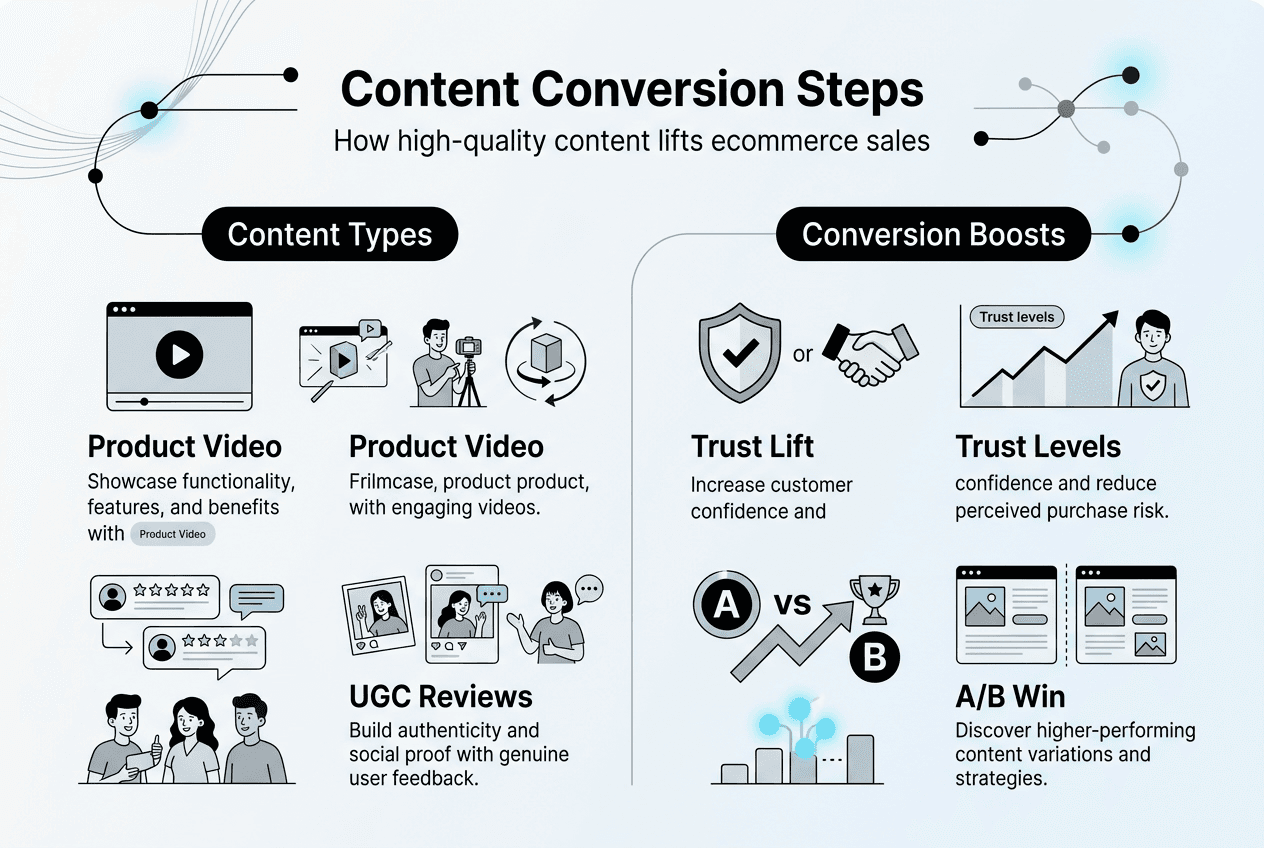
Content drives ecommerce conversions by building trust, addressing buyer intent, and guiding purchase decisions through formats like product descriptions, blogs, UGC, and short-form video. Each format serves a distinct purpose in your conversion funnel. Product descriptions answer transactional questions when buyers are ready to purchase. Blog content addresses informational queries earlier in the journey, establishing your authority before purchase intent crystallizes. User-generated content provides the social proof that transforms skepticism into confidence.
The psychology behind content’s conversion power is straightforward. Buyers need reassurance before committing money to unfamiliar brands. Written product details reduce perceived risk by answering questions proactively. Educational blog posts demonstrate expertise and build familiarity over time. Customer reviews and photos validate claims with third-party perspectives that carry more weight than brand messaging alone.
Video content accelerates this trust-building process dramatically. Short-form videos showing products in use, unboxing experiences, or customer testimonials create emotional connections that text cannot match. The visual format reduces cognitive load, making information processing effortless. When buyers see real people using your products successfully, conversion resistance melts away. Research shows UGC and video boost conversions by 74 to 80%, a lift that justifies the investment in content creation.
Your content strategy must align with the three buyer awareness stages. Informational content targets problem-aware prospects researching solutions. Commercial content serves solution-aware buyers comparing options. Transactional content converts product-aware shoppers ready to purchase. Mapping content types to these stages ensures you deliver the right message at the right moment, maximizing relevance and conversion probability.
Pro Tip: Refresh your UGC and video content quarterly to maintain authenticity. Stale testimonials from 2024 signal neglect, while recent content demonstrates active customer satisfaction and product evolution.
Implementing conversion rate tips requires understanding how content quality intersects with site experience. Even compelling copy fails when buried in poor layouts or slow-loading pages. The role of design in ecommerce amplifies or undermines your content’s effectiveness, making integration essential for conversion success.
Leveraging Klaviyo for personalized email automation and revenue growth
Klaviyo transforms static content into dynamic revenue engines through intelligent automation and personalization. The platform uses behavioral data, purchase history, and predictive analytics to deliver content that feels handcrafted for each recipient. Dynamic content blocks swap product recommendations, messaging tone, and offers based on individual customer profiles. This relevance drives the dramatic performance gap between automated flows and batch campaigns.

Automated email flows with personalized content via Klaviyo generate 30 times more revenue per recipient than batch campaigns. The difference stems from timing, relevance, and behavioral triggers. While batch emails interrupt customers with generic messages, automated flows respond to specific actions like cart abandonment, browse behavior, or purchase milestones. This contextual delivery makes content feel helpful rather than intrusive.
Segmentation powers Klaviyo’s personalization capabilities. Customer lifetime value segmentation separates high-value buyers who warrant premium content and offers from price-sensitive shoppers requiring different messaging. Behavioral segments group customers by engagement patterns, product preferences, or purchase frequency. Each segment receives content calibrated to their demonstrated interests and value potential.
Core email flows form the foundation of Klaviyo automation:
- Welcome series introduces new subscribers to your brand story, value proposition, and product range through a sequenced narrative
- Abandoned cart flows recover lost sales by reminding shoppers of items left behind and addressing common purchase objections
- Post-purchase sequences build loyalty through order confirmations, shipping updates, product education, and replenishment reminders
- Browse abandonment flows re-engage visitors who viewed products without adding to cart, offering assistance or incentives
- Win-back campaigns reactivate dormant customers with compelling reasons to return and shop again
Ongoing A/B testing separates good automation from exceptional performance. Test subject lines to improve open rates. Experiment with email content blocks, product positioning, and call-to-action copy to boost click-through and conversion rates. Small improvements compound across thousands of automated sends, generating substantial revenue lifts over time.
Pro Tip: Collect zero-party data through quizzes, preference centers, and surveys to enable hyper-personalization beyond behavioral tracking. When customers explicitly share their goals, preferences, and challenges, you can deliver content that feels psychic in its relevance.
Avoid pitfalls like oversegmentation with segments containing fewer than 50 people and set-and-forget flows lacking feedback loops. Tiny segments create management overhead without meaningful performance gains. Stale flows that never receive updates or testing gradually lose effectiveness as customer expectations and competitive standards evolve. Successful automation requires ongoing optimization informed by performance data.
The strategic advantage of personalized emails in ecommerce extends beyond immediate revenue. Personalization builds customer relationships that increase lifetime value through repeat purchases and referrals. Our comprehensive email marketing automation guide details implementation strategies, while exploring the advantages of Klaviyo automation reveals platform-specific capabilities that drive ecommerce growth.
Testing and measuring content impact for ongoing ecommerce optimization
Systematic A/B testing transforms content from educated guesses into data-driven conversion assets. Testing content elements like headlines, CTAs, and product descriptions yields 12 to 28% product detail page conversion lifts. These improvements require no additional traffic, making testing one of the highest ROI optimization activities available to ecommerce marketers.
The math behind testing ROI is compelling. An average ecommerce conversion rate is 2.3%, meaning improving CVR by 1% equates to 10 times traffic return on investment. A store converting 2.3% of 10,000 monthly visitors generates 230 orders. Increasing conversion to 3.3% produces 330 orders from identical traffic, a 43% revenue increase without spending more on acquisition. This leverage makes conversion optimization essential for sustainable growth.
Content elements worth testing include:
- Headlines that emphasize different benefits, address specific pain points, or use alternative emotional appeals
- Product descriptions varying length, format, feature emphasis, or storytelling approach
- Call-to-action copy testing urgency, value proposition, or action verbs
- Email subject lines experimenting with personalization, emojis, questions, or benefit statements
- Product images comparing lifestyle shots, detail views, or user-generated content
- Social proof placement testing reviews, ratings, testimonial quotes, or trust badges
Effective A/B testing follows a disciplined process:
- Define your goal with a specific metric like click-through rate, add-to-cart rate, or purchase conversion rate
- Hypothesize why a variation might outperform the control based on customer psychology or behavior data
- Test variants simultaneously to eliminate timing bias, running tests until statistical significance is achieved
- Analyze results considering both primary metrics and secondary effects like average order value or return rates
- Implement the best performer and document learnings to inform future tests and content creation
The following table illustrates typical conversion lifts by content element tested:
| Content Element | Baseline CVR | Optimized CVR | Lift Percentage |
|---|---|---|---|
| Product headlines | 2.3% | 2.9% | 26% |
| CTA button copy | 2.3% | 2.6% | 13% |
| Product description format | 2.3% | 2.8% | 22% |
| Email subject lines | 18% open rate | 23% open rate | 28% |
| Product image type | 2.3% | 2.6% | 13% |
These lifts compound when applied across multiple touchpoints. A 13% improvement in email open rates combined with a 22% lift in product page conversions creates multiplicative revenue gains. Testing becomes a systematic process of incremental improvements that accumulate into substantial competitive advantages.
Small brands often assume testing requires massive traffic volumes. Reality proves otherwise. Statistical significance arrives faster with larger samples, but even modest traffic supports meaningful tests when you focus on high-impact elements and accept slightly lower confidence thresholds. A 90% confidence level still provides actionable insights for stores with limited visitors.
Implementing robust conversion rate optimization for ecommerce requires balancing testing discipline with execution speed. Our guide on how to optimize ecommerce website conversions provides frameworks for prioritizing tests and implementing winners efficiently.
Enhance your ecommerce growth with Swyft Interactive’s Klaviyo services
Transforming content strategy into revenue requires expertise in both ecommerce psychology and technical implementation. Swyft Interactive specializes in Klaviyo email marketing services that turn your content into personalized automated flows generating measurable revenue growth. We build segmentation strategies aligned with your customer data, create dynamic content blocks that adapt to individual behaviors, and implement A/B testing programs that continuously improve performance.
Our ecommerce growth strategy automation approach integrates content creation, Klaviyo setup, and ongoing optimization into a cohesive system. We have helped dozens of ecommerce brands scale their email revenue through data-driven personalization and strategic automation. Whether you are launching your first automated flows or optimizing existing campaigns, our team delivers the technical expertise and strategic guidance needed to maximize Klaviyo’s revenue potential. Our comprehensive email marketing automation guide demonstrates our depth of knowledge and commitment to client success. Contact Swyft Interactive today to unlock your brand’s ecommerce potential in 2026.
Frequently asked questions
How does content influence ecommerce sales?
Content builds trust by answering buyer questions, demonstrates expertise through educational material, and provides social proof via reviews and testimonials. Strategic content aligned with buyer intent stages guides prospects from awareness through consideration to purchase, increasing conversion rates at each funnel stage.
Why is personalization in Klaviyo email flows more effective than batch emails?
Personalization delivers content matched to individual buyer behavior, preferences, and purchase history rather than generic messages sent to entire lists. Klaviyo’s behavioral triggers ensure emails arrive at contextually relevant moments, making content feel helpful rather than interruptive. This relevance drives the 30 times revenue advantage over batch campaigns.
What content elements should I A/B test to improve conversions?
Prioritize testing headlines, call-to-action copy, product descriptions, and email subject lines for maximum impact. These elements directly influence click-through and conversion decisions. Secondary tests should examine product image types, social proof placement, and content length to refine the complete customer experience.
How often should I refresh content in automated campaigns?
Review automated flow performance monthly and update underperforming content quarterly based on testing data and customer feedback. Seasonal refreshes ensure messaging stays current with trends and inventory. Annual overhauls prevent automation stagnation by incorporating cumulative learnings and evolving customer preferences.
Can UGC and video significantly improve ecommerce conversions?
Yes, adding user-generated content and video can boost conversions by up to 80% by providing authentic social proof and reducing cognitive load. Videos demonstrate products in use more effectively than text, while customer photos and reviews validate brand claims with third-party perspectives that overcome buyer skepticism.
How do I personalize email campaigns for ecommerce without overwhelming my team?
Start with behavioral segmentation based on purchase history and engagement levels, then implement core automated flows like welcome series and abandoned cart recovery. Use Klaviyo’s dynamic content blocks to swap product recommendations automatically rather than creating separate emails for each segment. This approach delivers personalization at scale without manual effort for each send.