
TL;DR:
- Most loyalty programs fail within two years due to poor setup and management.
- Clear objectives, simple mechanics, and consistent promotion are key to success.
- Ongoing optimization based on outcome metrics increases loyalty program ROI.
Most loyalty programs promise big retention wins, yet 77% of loyalty programs fail within their first two years due to poor setup and weak management. That’s a staggering waste of budget, time, and customer trust. The good news is that failure is almost always preventable. The brands that win with loyalty aren’t doing anything magical. They’re simply building on a clear foundation, choosing the right mechanics, and optimizing based on real outcome data. This guide walks you through every phase of loyalty program setup, from goal-setting and platform configuration to launch, promotion, and ongoing improvement, so your investment actually pays off.
Table of Contents
- Clarifying your objectives and prerequisites
- Designing your loyalty program: mechanics and structure
- Configuring, testing, and launching your program
- Launching, promoting, and optimizing your program
- Our perspective: Why most programs fail and how you can succeed
- Supercharge your ecommerce growth with expert guidance
- Frequently asked questions
Key Takeaways
| Point | Details |
|---|---|
| Start with clear goals | Defining retention and revenue targets ensures your loyalty program aligns with business outcomes. |
| Simple earns more | Programs with straightforward earning and redemption rules encourage participation and boost results. |
| Non-transactional rewards matter | Recognize reviews, referrals, and milestones to increase engagement beyond purchases. |
| Track redemption and CLV | Success hinges on members redeeming rewards and higher lifetime value, not just enrollments. |
| Continuous optimization | Regularly test, analyze, and refine your program to stay ahead of changes and maximize ROI. |
Clarifying your objectives and prerequisites
Before you touch a single platform setting, you need to know exactly what you want your loyalty program to do. This sounds obvious, but it’s where most brands stumble. Are you trying to increase customer lifetime value (CLV)? Improve retention rates? Drive higher purchase frequency? Or lift average order value (AOV)? Each goal points to a different program structure, reward mechanic, and success metric. Without this clarity, you’re building blind.
Understanding loyalty program basics will help you connect your business goals to the right program format from the start. Once you’ve nailed your primary objective, you can move on to prerequisites.
Here’s what you need in place before setup begins:
- An integrated ecommerce platform (Shopify, BigCommerce, WooCommerce) with order and customer data flowing cleanly
- A CRM or customer data platform (CDP) to segment your audience and personalize rewards
- Clear customer segmentation so you know who your best customers are and what motivates them
- A defined budget for reward costs, platform fees, and promotional spend
- Email and SMS capabilities to communicate program updates and reward notifications
As program implementation guides confirm, defining objectives and choosing the right structure are the two most critical setup steps. Skip them and everything downstream becomes guesswork.
Here’s a quick-reference table to match business goals with program types:
| Business goal | Recommended program type | Primary metric |
|---|---|---|
| Increase purchase frequency | Points-based | Repeat purchase rate |
| Improve retention | Tiered membership | Churn rate |
| Lift AOV | Spend-threshold rewards | AOV per member |
| Grow referrals | Hybrid with referral bonuses | New customer acquisition |
Reviewing your options for loyalty program tools early helps you match the right platform to your chosen structure before you invest time in configuration.
Pro Tip: Resist the urge to launch a complex, multi-tier program right away. A simple points program with one clear reward is far easier to measure, optimize, and explain to customers. Complexity is the enemy of early traction.
Designing your loyalty program: mechanics and structure
With your objectives set and prerequisites ready, it’s time to shape the actual program. The four most common structures are points-based, tiered, hybrid (points plus tiers), and experiential. For most ecommerce brands starting out, a hybrid model offers the best balance of simplicity and motivation.
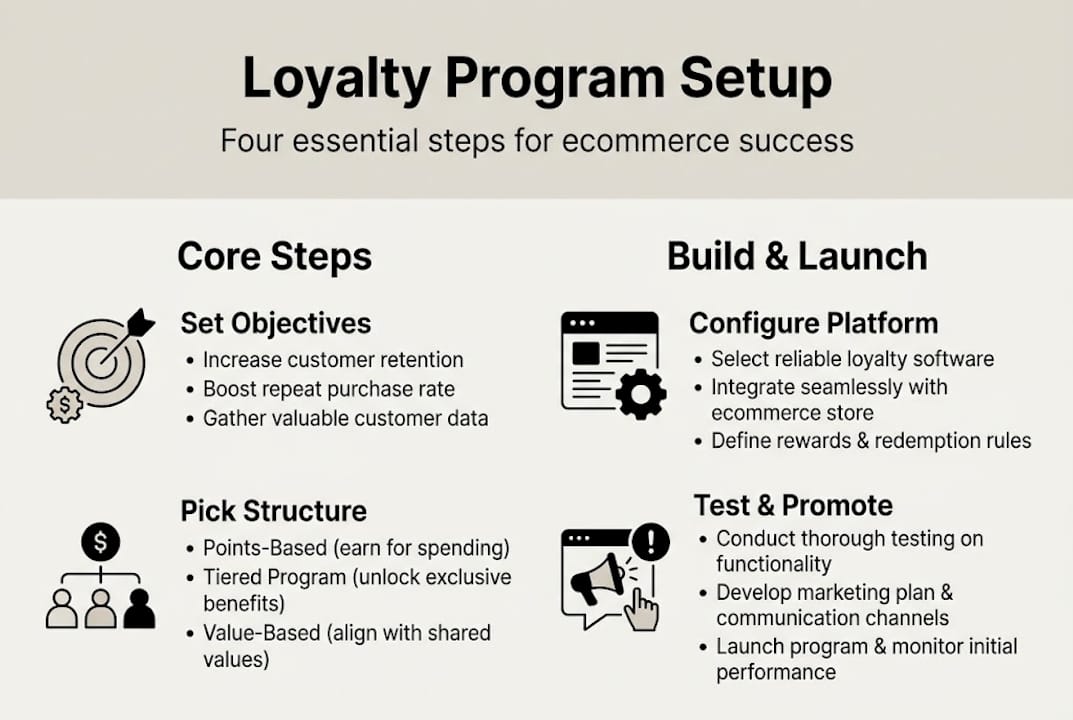
Hybrid programs with earn-to-burn ratios in the 3 to 7% discount range are the most common format among high-performing programs. That means for every dollar spent, customers earn roughly 3 to 7 cents in reward value. A practical starting point: 1 point per $1 spent, with 100 points equal to a $5 reward. That’s a clean 5% return that’s easy for customers to understand and easy for you to model financially.
Here’s a comparison of the main program types:
| Program type | Best for | Complexity | Customer motivation |
|---|---|---|---|
| Points only | New programs, simple catalogs | Low | Moderate |
| Tiered only | Premium brands, high AOV | Medium | High |
| Hybrid | Most ecommerce brands | Medium | Very high |
| Experiential | Lifestyle or community brands | High | Very high |
Beyond purchases, smart programs also reward non-transactional actions like reviews, referrals, social shares, and account creation. These behaviors build brand equity and deepen engagement without requiring another purchase.
Here’s a recommended starter setup for a brand with a $40 to $100 AOV:
- Award 1 point per $1 spent on purchases
- Award 25 points for a verified product review
- Award 50 points for a successful referral
- Set 100 points as the minimum redemption threshold
- Offer a $5 reward at 100 points (5% return)
- Add a Silver tier at 500 points with a 10% bonus earn rate
To avoid margin erosion, model your reward cost as a percentage of revenue before you go live. If your gross margin is 40%, a 5% reward rate leaves you with 35% before other costs. That’s sustainable. A 15% reward rate is not.

Pro Tip: Design your first reward threshold so customers can reach it within one or two purchases. For a $60 AOV, that means 100 points is achievable in two orders. Early wins keep customers engaged and coming back for more.
Exploring the best loyalty program platforms will help you find a tool that supports your chosen mechanics without requiring custom development.
Configuring, testing, and launching your program
After designing your mechanics, it’s time to bring your loyalty program to life. The good news is that modern platforms allow setup in as little as 2 to 4 hours for standard Shopify stores. Here’s a practical walkthrough:
- Create your program in your chosen platform (Smile.io, Yotpo, LoyaltyLion, or similar)
- Configure earning rules for purchases and non-transactional actions
- Set redemption rules including minimum thresholds and reward types
- Build a branded program page that explains how to earn, redeem, and tier up
- Integrate with your email and SMS tools so reward notifications fire automatically
- Set up fraud and abuse rules to cap point earning per day and flag unusual activity
- Connect your CRM or CDP so customer segments stay current
Before you go live, run these critical tests:
- Place a test order and confirm points are awarded correctly
- Redeem points and verify the discount applies at checkout
- Trigger a review reward and check that points post within the expected window
- Simulate a referral and confirm both parties receive their rewards
- Test edge cases: returns, partial refunds, and order cancellations
Well-executed programs deliver results. Studies show that 90% of program owners report positive ROI when the program is properly configured and promoted. The setup phase is where that ROI is either protected or lost.
For post-purchase loyalty tactics that complement your program, automated email sequences triggered by reward milestones are one of the highest-converting tools available.
Pro Tip: Before a full public launch, run a two-week pilot with your top 10 to 15% of customers by purchase frequency. Their feedback will surface UX issues and edge cases that internal testing misses every time.
Launching, promoting, and optimizing your program
With configuration complete, proper launch and ongoing optimization will ensure your loyalty program delivers its full potential. A strong launch isn’t just flipping a switch. It’s a coordinated push across every customer touchpoint.
Your pre-launch and launch promotion checklist:
- Email campaign to your full list announcing the program, how it works, and the first reward
- SMS blast to opted-in subscribers with a direct link to the program page
- On-site banners and popups highlighting the program on the homepage and product pages
- Social posts showing real reward examples and customer benefits
- Post-purchase email that enrolls new buyers automatically and explains their first points balance
Once live, track these metrics weekly:
- Redemption rate: Are members actually using their rewards? Low rates signal poor program awareness or unattractive rewards.
- Repeat purchase rate: Are enrolled members buying more often than non-members?
- CLV lift: Is the average lifetime value of loyalty members growing versus non-members?
- Enrollment rate: What percentage of buyers are joining the program?
“A 5% increase in retention can drive up to 95% more profit.”
That stat is why retention profit strategies deserve as much attention as acquisition. Loyalty programs are your most direct lever for moving that retention needle.
As loyalty benchmarks show, members spend 12 to 18% more per transaction and buy 33% more frequently than non-members. But those results don’t happen passively. You need to optimize based on redemption and CLV lift, not just enrollment numbers.
Use email marketing for launch sequences to re-engage dormant members with personalized reward reminders and limited-time bonus point events.
Pro Tip: Watch for loyalty fatigue, the point where enrolled members stop engaging even though they haven’t churned. If redemption rates drop two months in a row, it’s time to introduce a bonus earn event or a new reward option to reignite interest.
Our perspective: Why most programs fail and how you can succeed
Here’s the uncomfortable truth: most loyalty programs don’t fail because of bad technology or stingy rewards. They fail because brands overcomplicate them, under-promote them, and then measure the wrong things. Over 50% of programs fail due to complexity and poor focus on true retention metrics. Brands obsess over enrollment counts while ignoring redemption rates, which is like celebrating email open rates while ignoring revenue.
The programs that consistently outperform have three things in common. They’re simple enough that any customer can explain how they work. They’re promoted relentlessly across every channel, not just at launch. And they’re optimized based on outcome metrics like CLV lift and redemption rate, not vanity numbers.
We’ve seen brands with modest budgets outperform enterprise programs simply because they stayed focused. One clear reward, one consistent communication cadence, and one metric to improve each quarter. That discipline compounds over time.
If you want a practical cheat sheet: at launch, focus on enrollment and first redemption rates. At 90 days, focus on repeat purchase rate. At six months, focus on CLV lift versus non-members. Reviewing modern loyalty program solutions that support these metrics natively will save you significant reporting headaches down the road.
Supercharge your ecommerce growth with expert guidance
Setting up a loyalty program that actually moves the needle takes more than a platform subscription. It takes a clear strategy, the right automation, and ongoing optimization based on real data. That’s exactly where Swyft Interactive comes in.
We help ecommerce brands build and scale loyalty programs as part of a full-funnel growth system, from customer journey mapping that identifies the right moments to reward, to email automation for growth that keeps members engaged long after launch. Whether you’re starting from scratch or fixing a program that’s underperforming, our team brings the strategy, tools, and execution to turn customer retention into a measurable revenue driver. Let’s build something that actually works.
Frequently asked questions
What is the best earn and burn ratio for a loyalty program?
A 5% return rate (1 point per $1 spent, 100 points equal to a $5 reward) balances customer motivation with profitability for most ecommerce brands.
How long does it take to set up a basic loyalty program?
Most modern loyalty platforms allow setup within 2 to 4 hours, especially for standard Shopify stores with existing customer and order data.
What are the main reasons loyalty programs fail?
Programs most often fail due to excessive complexity and poor promotion, along with a lack of clear objectives and low reward redemption rates that go unaddressed.
What results can I expect from a well-run loyalty program?
Successful programs typically yield 12 to 18% higher order values and 33% more purchases per member, with a 5% retention lift potentially driving up to 95% more profit over time.