
Generic emails often get lost in crowded inboxes, leaving customers feeling overlooked. For American eCommerce marketing managers seeking stronger connections, moving to truly personalized email automation with Klaviyo can be a game changer. Research shows that personalized emails enhance engagement and drive more conversions compared to standard campaigns. You will learn how using segmentation and dynamic content lets your brand deliver relevant messages that actually resonate with every customer.
Table of Contents
- Personalized Emails Defined For ECommerce Brands
- Strategy Types: Segmentation And Dynamic Content
- How Klaviyo Automation Powers Personalization
- Measurable Impact: Engagement And Revenue Metrics
- Risks, Pitfalls, And Data Compliance Issues
Key Takeaways
| Point | Details |
|---|---|
| Personalized Emails Enhance Engagement | Utilizing customer data for personalized emails significantly boosts open and click-through rates compared to generic messages. |
| Segmentation and Dynamic Content are Key | Implementing segmentation and dynamic content allows eCommerce brands to send highly relevant messages tailored to individual customer preferences. |
| Automation Increases Efficiency | Tools like Klaviyo enable behavior-triggered emails, which automate personalized messaging, increasing engagement without extensive manual effort. |
| Measurable Impact on Revenue | Personalized emails lead to six times higher transaction rates, underscoring the direct financial benefits of personalization in email marketing. |
Personalized Emails Defined for eCommerce Brands
Personalized emails are messages crafted specifically for individual customers using their unique data, behaviors, and preferences. For eCommerce brands, this means moving beyond “Hi [First Name]” to create genuinely relevant communications that speak directly to each shopper’s needs.
The difference between generic and personalized emails is measurable. Research shows that tailored customer communications enhance performance metrics for eCommerce brands by increasing engagement and driving conversions. Rather than sending the same message to everyone, you’re delivering content that resonates with where each person is in their customer journey.
What Makes an Email Truly Personalized?
Personalization goes beyond inserting a customer’s name into the subject line. Real personalization uses multiple layers of customer data to create relevance:
- Purchase history — emails recommending products similar to past purchases
- Browsing behavior — messages featuring items the customer viewed but didn’t buy
- Customer lifecycle stage — different messaging for new subscribers versus repeat buyers
- Demographic and preference data — content matched to customer interests and characteristics
- Engagement patterns — timing and frequency adjusted based on how customers interact with your emails
When you implement personalized subject lines and content, open rates and click-through rates improve because the message feels relevant rather than mass-produced.
Why eCommerce Brands Need This Now
Your customers expect personalization. They receive dozens of emails weekly, and generic messages get deleted immediately. Personalized emails stand out because they acknowledge customer preferences and past interactions.
Mid-sized eCommerce brands see the biggest wins with personalization because you have enough customer data to segment effectively, but you’re nimble enough to implement changes quickly. You’re not trapped in legacy systems that resist change.
Personalized emails that use recipient-specific data like purchase history and preferences deliver higher engagement than one-size-fits-all campaigns—directly impacting your bottom line.
The tactical advantage is clear: personalized emails convert better, reduce unsubscribe rates, and increase customer lifetime value. When customers feel understood, they shop more often.

Pro tip: Start with your best-performing segments (repeat customers or high-value buyers) when testing personalization; measure the results against your current email performance to prove ROI before scaling to your entire list.
Strategy Types: Segmentation and Dynamic Content
Two core strategies power personalized emails: segmentation and dynamic content. Both work together to deliver the right message to the right person at the right time. Understanding how each works separately, then how to combine them, transforms your email program from broadcast to conversation.
Segmentation: Dividing Your Audience Into Relevant Groups
Segmentation is the foundational step. You’re splitting your email list into smaller groups based on shared characteristics, behaviors, or preferences. Rather than treating 50,000 subscribers as one audience, you’re creating dozens of targeted groups.
Customer segmentation methods in eCommerce range from simple to sophisticated. Your strategy depends on the data you’re collecting and how much you want to automate the process.
Common segmentation approaches include:
- Purchase-based — grouping customers by what they’ve bought, spending level, or product category
- Behavioral — organizing by clicks, page visits, cart abandonment, or email engagement
- Demographic — separating by location, age, customer type (new versus returning)
- Lifecycle — distinguishing where customers are in their journey (prospect, customer, loyal repeat buyer)
Segmentation lets you avoid sending winter coat promotions to customers who bought them last month. It stops irrelevant messages that damage engagement.
Dynamic Content: Changing the Message Based on Each Person
Dynamic content takes personalization deeper. Within a single email, different sections display different information based on the recipient’s profile. One customer sees product recommendations for running shoes; another sees winter jackets.
Dynamic content delivery based on customer profiles enhances relevance and engagement in personalized emails. The same email template serves your entire segment, but each person’s version looks different because content blocks change based on their data.
How dynamic content works in practice:
- Subject lines that reference a customer’s location or first name
- Product recommendations pulling from their browsing history
- Discount codes varying by customer segment
- Image blocks showing products in colors they’ve previously purchased
- Call-to-action buttons linking to category pages they’ve visited
Segmentation creates the framework; dynamic content fills it with relevance. Together, they transform generic emails into personalized conversations at scale.
When you combine both strategies, you’re not just sending more targeted emails—you’re creating completely customized experiences within the same campaign. A single email send reaches thousands of people, but each person receives a different message tailored to their needs.
Here’s a quick comparison of segmentation versus dynamic content in email personalization:
| Approach | Main Benefit | Typical Use Case | Implementation Challenge |
|---|---|---|---|
| Segmentation | Increased targeting accuracy | Seasonal campaigns, new arrivals | Requires detailed audience data |
| Dynamic Content | Higher individual relevance | Product recommendations, offers | Complex template setup and logic |
Pro tip: Start with segmentation first—identify 3-4 high-value customer groups you can reach immediately—then layer dynamic content into those segments once you see the engagement lift from segmentation alone.
How Klaviyo Automation Powers Personalization
Klaviyo is built specifically for eCommerce brands. It’s not a generic email platform adapted for retail—it’s designed from the ground up to capture customer behavior data and trigger personalized messages automatically. This distinction matters because it means personalization happens at scale without manual work.
Behavior-Based Triggers: The Engine of Automation
The core power of Klaviyo lies in behavior-triggered automation. Rather than sending campaigns on a schedule, you’re setting up messages that fire when customers take specific actions. A customer abandons a cart at 2 PM on Tuesday? A recovery email lands in their inbox within hours.
Behavior-based triggers send timely emails aligned with individual purchase behaviors and preferences, boosting engagement. These aren’t generic reminders—they’re personalized messages arriving at the exact moment a customer is most likely to act.
Common trigger scenarios:
- Cart abandonment — customer leaves without buying
- Browse abandonment — customer views products but doesn’t add to cart
- Post-purchase — automated follow-ups, reviews requests, or complementary product recommendations
- Re-engagement — messages targeting inactive customers based on their previous activity
- Birthday or anniversary — personalized offers tied to customer milestones
Each trigger pulls data about that specific customer to personalize the message. A cart recovery email shows the exact product left behind. A post-purchase email recommends items based on what they bought.
Customer Data Integration and Profile Building
Klaviyo connects to your eCommerce store and builds rich customer profiles automatically. Every purchase, click, email open, and website visit feeds into Klaviyo’s system. This creates a complete picture of who each customer is and what they care about.
The data collected includes:
- Purchase history and order value
- Product categories browsed
- Email engagement (opens, clicks, purchases from email)
- Customer lifecycle stage
- Geographical and demographic information
- Custom data you define (loyalty tier, VIP status, referral source)
This consolidated profile means your dynamic content pulls from real, updated information. When an email sends with “Products you might like,” Klaviyo is actually looking at what that person browsed last week.
Automation eliminates the gap between customer action and email response, creating relevance through timing and data accuracy that manual campaigns cannot match.
The result is campaigns that feel personal because they’re built on actual customer behavior, not guesswork. You’re not hoping your message is relevant—you know it is because it’s tailored to their specific actions.
Pro tip: Map out your top 3 customer behaviors (cart abandonment, post-purchase, browse abandonment) first, then build Klaviyo workflows for each; measure conversion rates against your non-automated emails to demonstrate ROI before expanding to more complex automation sequences.
Measurable Impact: Engagement and Revenue Metrics
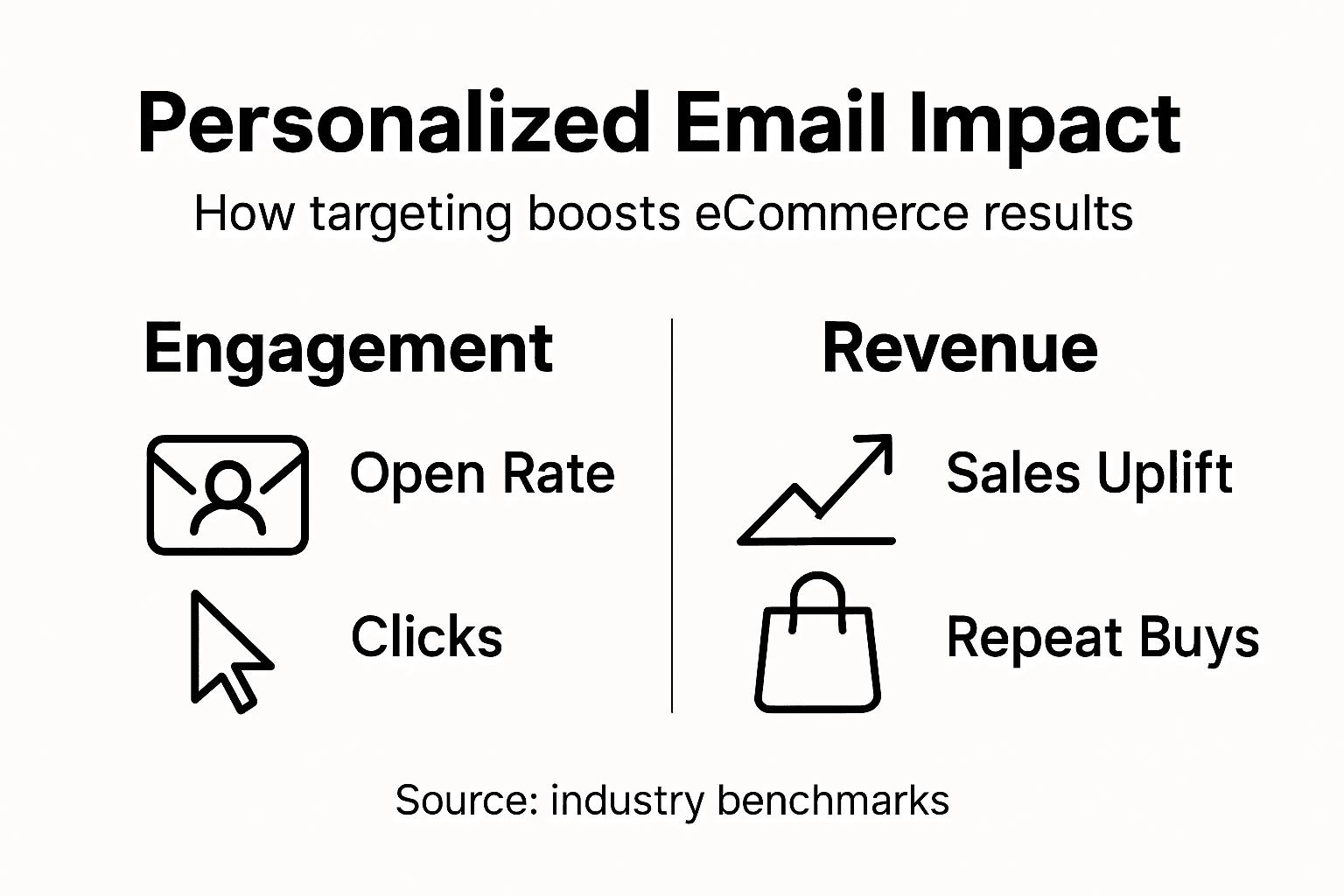
Personalized emails aren’t just feel-good marketing. They produce measurable, quantifiable results that directly impact your bottom line. When you track the right metrics, you’ll see exactly how personalization drives engagement and revenue growth.
Engagement Metrics: The Leading Indicators
Engagement metrics show whether customers are actually paying attention to your emails. These are your early warning system—if engagement drops, revenue will follow.
Key engagement metrics to monitor:
- Open rate — percentage of recipients who opened your email
- Click-through rate (CTR) — percentage of opens that led to clicks
- Unsubscribe rate — percentage of recipients who opted out
- Spam complaint rate — percentage marked as spam
- Time-to-open — how quickly subscribers open emails after delivery
Personalized emails significantly improve these numbers. Research shows that personalized email strategies drive higher consumer interaction through better open rates and click-through rates. When your subject line mentions a customer’s name or references their browsing history, they’re more likely to open. When content matches their interests, they’re more likely to click.
The following table summarizes key email metrics and what they reveal for eCommerce brands:
| Metric | What It Indicates | Business Value |
|---|---|---|
| Open Rate | Subject line appeal and deliverability | Understands first impression impact |
| Click-Through Rate (CTR) | Content relevance and engagement | Measures content effectiveness |
| Conversion Rate | Purchases from email recipients | Ties email directly to revenue |
| Unsubscribe Rate | List fatigue or irrelevance | Tracks risk of audience loss |
Revenue Metrics: The Bottom Line Impact
Engagement matters only if it converts to revenue. That’s where the real power of personalization shows up. Revenue metrics connect email activity directly to sales.
Track these revenue-focused metrics:
- Conversion rate — percentage of email clicks that result in purchases
- Revenue per email (RPE) — total revenue divided by emails sent
- Average order value (AOV) — average amount spent per transaction from email
- Customer lifetime value (CLV) — total revenue from a customer over time
- Return on email investment (ROEI) — revenue generated divided by email program costs
Personalized emails produce six times higher transaction rates than non-personalized emails. That’s not incremental improvement—that’s transformational. The difference between generic and personalized messaging translates directly to six times more purchases from the same email volume.
Why the Numbers Matter for Your Brand
Mid-sized eCommerce brands often overlook metrics tracking, treating email as a guess-and-check channel. But when you measure properly, personalization becomes your competitive advantage. You see exactly what works and can replicate it.
Consumers themselves validate this approach. Research indicates that 76% of consumers value personalized messages as critical to brand consideration. Your customers aren’t just accepting personalization—they’re expecting it and rewarding brands that deliver it.
When personalized emails generate six times higher transaction rates than generic emails, the ROI isn’t theoretical—it’s immediate and measurable.
The practical outcome: a small investment in personalization infrastructure (like Klaviyo automation) pays for itself through improved metrics within months. Your email list becomes a revenue engine rather than a cost center.
Pro tip: Establish baseline metrics for your current non-personalized campaigns first, then implement personalization on one segment (like repeat customers), and compare the metrics month-over-month to quantify your exact ROI before scaling.
Risks, Pitfalls, and Data Compliance Issues
Personalization requires collecting and using customer data. That power comes with serious responsibility. Get this wrong, and you face legal penalties, damaged reputation, and lost customer trust. Getting it right protects your brand while delivering the personalization customers expect.
Data Privacy and Regulatory Compliance
The United States has multiple data protection laws governing how you collect, store, and use customer information. Your eCommerce business operates under strict compliance requirements.
Key regulations affecting personalized email:
- GDPR — applies if you have European customers; requires explicit consent and data handling transparency
- CCPA — California law giving consumers rights to know, delete, and opt-out of data sales
- CAN-SPAM Act — US federal law regulating commercial email; requires clear unsubscribe options
- State-level laws — multiple states have enacted their own consumer privacy regulations
- Industry-specific rules — healthcare, finance, and other sectors have additional requirements
Ethical data handling and transparent consent processes mitigate compliance pitfalls while implementing personalization strategies. This means getting explicit permission before collecting data, clearly explaining how you’ll use it, and honoring unsubscribe requests immediately.
The Over-Personalization Trap
There’s a line between relevant personalization and creepy surveillance. Cross it, and customers feel violated rather than understood. Knowing someone browsed your store is useful. Knowing their exact location or private browsing history feels invasive.
Over-personalization risks include:
- Using data that feels too invasive (location tracking, behavioral patterns)
- Personalizing in ways that reveal you’re watching customer behavior
- Frequency and timing that feels like harassment
- Personalizing beyond customer consent or expectations
Customers need to feel their privacy is respected, not that you’re following them. The balance is critical. Data privacy and ethical use of customer data maintain customer trust while deploying personalized campaigns. Transparency about what data you collect and why builds confidence rather than suspicion.
Common Compliance Mistakes
Mid-sized eCommerce brands often make preventable errors. These happen not from bad intent, but from unclear processes or inadequate documentation.
Avoid these pitfalls:
- Purchasing third-party lists without verifying consent was obtained
- Failing to maintain consent records that prove customers opted in
- Not providing easy unsubscribe options that work immediately
- Collecting data without clear disclosure of how it will be used
- Sharing customer data with third parties without permission
- Keeping data too long beyond your stated retention period
Compliance isn’t a burden limiting personalization—it’s the foundation that makes personalization trustworthy and legal.
The practical reality: brands with strong compliance practices build stronger customer relationships. Transparency creates trust. Clear data practices reduce legal risk. Your customers reward brands that respect their privacy.
Pro tip: Conduct a data audit with your legal team, document exactly what data you collect and why, ensure all consent is documented, and implement automatic unsubscribe processing to eliminate compliance gaps before scaling personalization.
Unlock the Full Power of Personalized Emails for Your eCommerce Growth
If you want to move beyond generic email blasts that get ignored and start delivering truly relevant messages that increase customer engagement and boost revenue the expert team at Swyft Interactive can help. We understand the challenge of turning customer data into meaningful emails that speak directly to individual preferences and behaviors using advanced segmentation and dynamic content strategies discussed in this article. Our services combine high-converting, fast-loading eCommerce website development with Klaviyo-powered email marketing automation to create seamless, personalized customer journeys.
Explore how our targeted email marketing solutions can transform your campaigns with smarter automation and measurable results today by visiting our Email Marketing Archives – Swyft Interactive. Ready to master Klaviyo and maximize your email’s impact? Check out our You Suck At Klaviyo Archives – Swyft Interactive for proven strategies. Don’t wait to turn your email list into a powerful revenue engine. Start your journey with Swyft Interactive now and watch personalized emails drive real growth for your online store.
Frequently Asked Questions
What are personalized emails in eCommerce?
Personalized emails are tailored messages that use individual customer data, behaviors, and preferences to create relevant communications, going beyond just inserting a customer’s name.
How can personalized emails increase engagement for eCommerce brands?
Personalized emails enhance engagement by delivering relevant content that resonates with customers based on their purchase history, browsing behavior, and preferences, leading to higher open rates and click-through rates.
What strategies can eCommerce brands use to implement email personalization?
Two core strategies for email personalization are segmentation, which involves dividing the email list into targeted groups, and dynamic content, which allows different content to display in an email based on individual customer profiles.
How does Klaviyo support personalized email marketing for eCommerce?
Klaviyo enables personalized email marketing through behavior-based automation, allowing brands to send timely, relevant messages based on specific customer actions, enhancing engagement and driving conversions.