

Every online retailer knows the sting of watching visitors leave without completing a purchase. For American ecommerce managers, conversion rates often remain below 5 percent, leaving massive untapped revenue on the table. Conversion rate optimization combines data-driven web improvements with Klaviyo-powered email automation, guiding customers from first click to repeat sale. Discover how defining conversions clearly and optimizing across channels drives sustainable business growth without inflating your marketing budget.
Table of Contents
- Defining Conversion Rate Optimization For Ecommerce
- Types Of Optimization: Web And Email Automation
- How Klaviyo Enhances Conversion Rates
- Revenue Impact And Business Growth Potential
- Common CRO Mistakes And How To Avoid Them
Key Takeaways
| Point | Details |
|---|---|
| Definition of Conversion Rate Optimization (CRO) | CRO focuses on enhancing an ecommerce store to boost the percentage of visitors completing desired actions, primarily associated with sales. |
| Impact of Conversion Rates on Growth | Most ecommerce stores operate below a 5% conversion rate; optimizing this rate can significantly increase sales without additional traffic costs. |
| Systematic CRO Process | A structured approach involving analysis, hypothesis formulation, testing, and iteration is essential for effective optimization efforts. |
| Integration of Web and Email Optimization | Combining web optimization with email automation enhances customer journey engagement, yielding higher conversion rates and faster business growth. |
Defining conversion rate optimization for ecommerce
Conversion rate optimization (CRO) is the practice of improving your ecommerce store to increase the percentage of visitors who complete a desired action. That action could be a purchase, email signup, phone call, or form submission—whatever matters most to your business.
For most ecommerce managers, conversion means sales. But CRO applies to any measurable action that moves customers closer to revenue. Understanding this distinction shapes how you approach optimization across your entire funnel.
What counts as a conversion?
Your conversion definition depends on your business model and goals. Common examples include:
- Completed purchases
- Email list signups
- Add-to-cart actions
- Product page visits from specific traffic sources
- Download completions
- Account creation
- Customer reviews submitted
The key is defining what actions represent progress in your customer journey. Without clarity, you’ll optimize for the wrong metrics.
Why conversion rates matter for your growth
Most online stores operate with conversion rates below 5 percent. That means roughly 95 out of 100 visitors leave without converting. CRO directly addresses this gap.
Improving your conversion rate compounds your growth. A store generating 10,000 monthly visitors at 2% conversion makes 200 sales. Double that conversion rate to 4%, and you hit 400 sales—without spending more on traffic.
Conversion rate optimization generates revenue growth without requiring additional marketing spend, making it one of the highest-ROI initiatives for mid-sized retailers.
This efficiency is why conversion optimization sits at the core of sustainable ecommerce growth.
The CRO process framework
Effective optimization follows a structured approach rather than random experiments. Research shows the most successful strategy involves preliminary analysis, hypothesis development, testing, results review, and continuous iteration—all aligned to your business objectives.
The process looks like this:
- Analyze your current performance data and customer behavior
- Form a specific hypothesis about what will improve conversions
- Test your hypothesis with controlled experiments
- Review the results and measure impact
- Implement winning changes and repeat
This systematic method prevents guesswork and creates accountability around your optimization efforts.
Core elements that influence ecommerce conversions
Research identifies seven critical variables that shape whether visitors convert. Each element plays a specific role in the customer decision process:
- Catalyst – What triggers initial interest or urgency
- Persuasion – How convincingly you communicate value and benefits
- Usability – How easily visitors navigate and find products
- Interactivity – Engagement features like reviews, filters, and live chat
- Trust – Security signals, social proof, and brand credibility
- Aesthetics – Visual design quality and professional presentation
- Marketing mix – Pricing, promotions, and messaging strategy
Optimizing even one element moves the needle. Improving multiple areas compounds the impact.
Pro tip: Start by analyzing your current conversion funnel to identify which of these seven elements shows the weakest performance—that’s your highest-leverage optimization opportunity.
Types of optimization: web and email automation
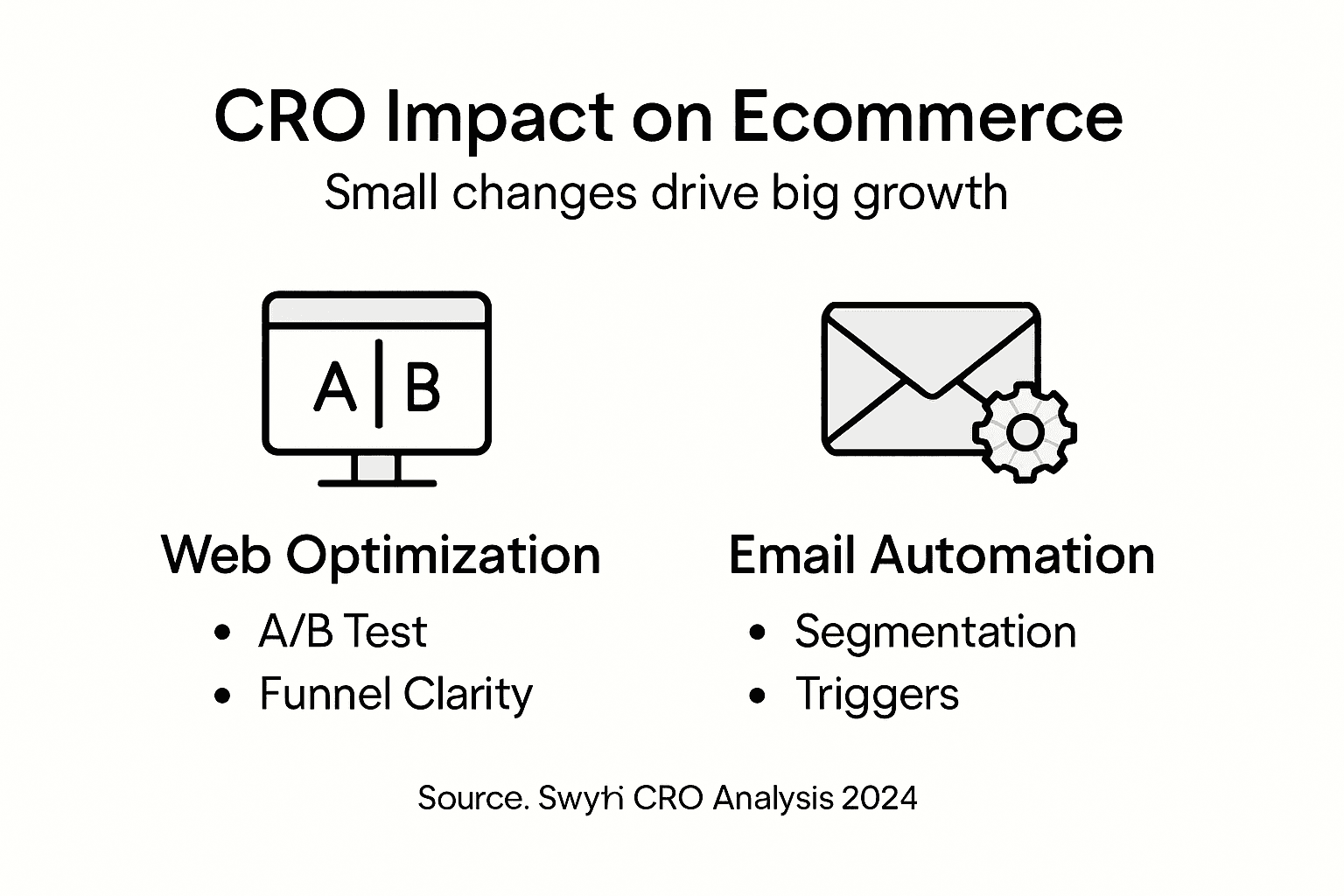
Conversion rate optimization splits into two complementary categories: web optimization and email automation. Both tackle the same goal—increasing conversions—but they focus on different parts of your customer journey and require distinct strategies.

Thinking about CRO as a one-dimensional effort misses massive growth opportunities. The most successful ecommerce managers optimize across both channels simultaneously, creating a cohesive system that guides visitors from first click to repeat purchase.
Web optimization: where visitors become customers
Web optimization focuses on the actual experience visitors have on your site. This includes landing pages, product pages, checkout flows, and navigation. The goal is removing friction and clarifying value so more people convert on their first visit.
Effective web CRO techniques include:
- A/B testing – Compare two versions of a page to see which converts better
- Multivariate testing – Test multiple page elements simultaneously to understand interactions
- Layout changes – Reorganize content, buttons, or product information
- Copy optimization – Refine headlines, descriptions, and calls-to-action
- Visual improvements – Enhance product images, videos, or design elements
Systematic experimentation on web interfaces reveals which design changes move the conversion needle. Small improvements compound—a 10% increase in landing page conversions combined with a 5% checkout improvement creates compounding gains across your entire funnel.
Email automation: nurturing conversions over time
Email automation delivers targeted messages to visitors at the right moments in their journey. Unlike web optimization (which happens in seconds), email works over days and weeks to build trust, address objections, and encourage action.
Common email automation sequences for ecommerce include:
- Welcome series for new subscribers
- Cart abandonment recovery campaigns
- Post-purchase follow-ups and upsell offers
- Win-back campaigns for inactive customers
- Loyalty and referral programs
Email automation optimizes the entire customer journey beyond the initial visit, capturing conversions from people who weren’t ready to buy on day one.
Email allows you to segment audiences and deliver personalized messages based on behavior, purchase history, or interests. This targeting precision drives higher engagement and conversion rates than one-size-fits-all approaches.
How web and email work together
Web optimization brings visitors through your funnel. Email automation nurtures them across multiple touchpoints. Together, they create a complete conversion system.
A visitor might not convert on their first website visit, but a strategic email automation sequence keeps your brand top-of-mind and provides reasons to return. This integrated approach is why mid-sized retailers who optimize both channels typically see 2-3x faster growth than those focusing on web alone.
Both strategies rely on testing and data. Testing conversions systematically through A/B testing, segment analysis, and performance tracking reveals what actually works for your audience.
Pro tip: Start with your highest-traffic channel—usually web—to identify quick wins, then layer in email automation to capture conversions from visitors who needed additional nurturing.
Here’s a summary of how web optimization and email automation differ and complement each other:
| Aspect | Web Optimization | Email Automation |
|---|---|---|
| Main Focus | On-site user experience | Ongoing customer communication |
| Timing | During initial site visit | After visit, over time |
| Typical Goal | Immediate conversion | Nurture, recovery, repeat purchase |
| Impact Example | Reduces checkout friction | Recovers abandoned carts |
| Data Use | Real-time visitor interactions | Behavioral and historical data |
| Testing Approach | A/B and multivariate testing | Segmentation and sequence timing |
This table highlights how each method contributes uniquely to improving ecommerce conversions.
How Klaviyo enhances conversion rates
Klaviyo is an email marketing platform built specifically for ecommerce brands. It transforms raw customer data into targeted email campaigns that drive conversions at every stage of the customer journey.
Unlike generic email tools, Klaviyo integrates directly with your ecommerce platform, capturing behavioral data that fuels smarter automation. This data-driven approach is what separates high-performing brands from the rest.
Smart segmentation powers personalization
Klaviyo’s core strength is its ability to segment audiences based on real behavior. Instead of sending the same email to everyone, you target specific groups with tailored messages.
You can segment by:
- Purchase history and product categories
- Cart abandonment status
- Email engagement level
- Customer lifetime value
- Browse behavior and page visits
- Geographic location or demographics
Personalized emails convert 2-5x higher than generic broadcasts. When customers receive messages relevant to their interests, they act on them. Klaviyo automates this relevance at scale.
Automation that captures every opportunity
Automation sequences handle repetitive tasks while delivering timely messages. Data-driven segmentation and automation via email tools nurture leads, re-engage customers, and drive significant conversion improvements.
Klaviyo’s most effective automations include:
- Welcome series – Introduce new subscribers and capture first purchase discount
- Cart abandonment – Recover lost sales within hours of abandonment
- Post-purchase flow – Drive reviews, repeat purchases, and loyalty
- Winback campaigns – Re-engage inactive customers with incentives
- Product recommendations – Suggest items based on purchase history
Each automation runs 24/7 without manual work, capturing conversions from every segment simultaneously.
Behavioral triggers drive immediate action
Klaviyo doesn’t just send emails on a schedule. It responds to customer actions in real time through behavioral triggers. When a customer browses a product, adds to cart, or visits your site, Klaviyo activates relevant automations instantly.
This responsiveness matters. A customer browsing winter jackets receives a jacket-specific email within minutes, not days. The conversion probability drops dramatically if you wait.
Behavioral triggers transform passive waiting into active engagement, capturing customers at peak interest moments.
Integration creates a unified system
Klaviyo connects with your website, ecommerce platform, and other marketing tools. This integration means customer data flows seamlessly, eliminating manual data entry and ensuring accuracy.
Your website tracks visitor behavior, feeds it to Klaviyo, and triggers automated responses. You gain complete visibility into which emails drive which conversions, which products sell together, and which customers need re-engagement.
Pro tip: Build your first automation around cart abandonment—it typically recovers 10-15% of abandoned carts with minimal setup, delivering immediate ROI that justifies deeper Klaviyo investment.
Revenue impact and business growth potential
Conversion rate optimization isn’t just a marketing tactic—it’s a revenue engine. Every percentage point improvement in your conversion rate translates directly to more sales without requiring additional advertising spend.
For mid-sized retailers operating on tight margins, this efficiency matters enormously. You’re scaling revenue from the traffic you already have.
The compounding effect of conversion improvements
A 1% conversion increase on 10,000 monthly visitors means 100 additional sales. At a $75 average order value, that’s $7,500 in new monthly revenue. Over a year, one percentage point improvement generates $90,000 in incremental revenue.
Now compound that effect. Improve conversion by 2%, and you’re at $180,000. Add a 15% average order value increase through better product recommendations, and the numbers accelerate further.
Small, incremental changes build momentum:
- 1% conversion lift = $90,000 annual revenue
- 2% conversion lift = $180,000 annual revenue
- 3% conversion lift = $270,000 annual revenue
- Plus upsell improvements multiply these gains
This is why retailers with mature CRO programs scale faster than those relying solely on customer acquisition.
Customer lifetime value grows with optimization
CRO doesn’t stop at first purchases. Product ratings and reviews drive conversion increases up to 270 percent as products accumulate social proof. Higher-priced items benefit even more from this credibility boost.
When you optimize for customer lifetime value, the impact multiplies. A customer acquired for $30 might generate $300 over three years through repeat purchases, referrals, and upsells. Improving retention by even 5% dramatically extends that lifetime value.
Optimizing for lifetime value—not just initial conversion—transforms your unit economics and compounds profitability over time.
Email automation plays a critical role here. Post-purchase sequences drive repeat purchases, loyalty program enrollment, and referral generation. These ongoing conversions cost far less to acquire than new customers.
Business scalability unlocked
When you improve conversion rates, you remove a critical bottleneck in scaling. Many retailers hit growth ceilings because customer acquisition costs rise exponentially. Optimization lets you scale revenue without proportional cost increases.
Consider two retailers with identical monthly advertising budgets:
- Retailer A maintains 2% conversion
- Retailer B implements CRO and achieves 3% conversion
Retailer B generates 50% more revenue from the same ad spend. That efficiency gap widens as marketing budgets grow, creating significant competitive advantage.
Quantifying your optimization potential
Your actual revenue impact depends on three variables:
- Current traffic volume – More visitors means larger gains from conversion improvements
- Current conversion rate – Lower starting rates often see larger percentage lifts
- Average order value – Higher-value products create bigger revenue gains per conversion
A $100,000 traffic volume at 1.5% conversion with $50 average order value generates $75,000 monthly revenue. A 1% conversion improvement alone adds $50,000 monthly or $600,000 annually.
Pro tip: Calculate your specific revenue potential: (monthly visitors × current conversion rate × average order value) × projected improvement percentage = annual revenue impact. Use this number to justify CRO investment and set realistic improvement targets.
Common CRO mistakes and how to avoid them
Most ecommerce managers know CRO matters. But knowing and executing are different things. Common mistakes derail optimization efforts and waste months of testing without real results.
Understanding these pitfalls helps you avoid them and accelerate your conversion growth.
Mistake 1: Testing in isolation
Managers often test one element without considering how it affects the whole experience. Changing a button color, headline, or form field in isolation misses critical interactions.
A headline change might boost clicks but reduce trust signals. A form field removal increases submissions but lowers lead quality. You need to test holistically across multiple conversion elements to see real impact.
Comprehensive CRO models integrating catalyst, persuasion, and interactivity avoid typical pitfalls and enhance the decision-making process. Testing your entire funnel together reveals which combinations actually move conversions.
Mistake 2: Ignoring usability and trust factors
Many optimization efforts focus on persuasive copy and design while neglecting the foundation: does the site work? Is it trustworthy?
Common trust killers that get overlooked:
- Missing security badges or SSL indicators
- Slow page load speeds
- Broken links or outdated information
- No customer reviews or social proof
- Unclear return policies
- Poor mobile experience
Fix these basics before testing advanced persuasion techniques. You can’t convert visitors who don’t trust your site.
Mistake 3: Insufficient statistical rigor
Managers often declare winners too early or with too little data. Running a test for two days, seeing a lift, and implementing the change is a recipe for false positives.
Inefficient traffic allocation during testing and limited statistical evidence lead to selecting designs that don’t actually perform better. You need sufficient sample size and statistical significance before declaring a winner.
Run tests for at least one full business cycle (usually two weeks minimum) and reach at least 100 conversions per variation before calling results.
Mistake 4: Testing the wrong things
Not all elements drive equal impact. Testing micro-copy changes when your checkout abandons 70% of visitors wastes resources.
Prioritize tests by potential impact:
- High traffic, high impact – Checkout flow, product pages, add-to-cart
- High traffic, medium impact – Navigation, hero image, category filters
- Lower priority – Minor copy changes, button shades, footer elements
Focus testing energy on high-impact areas first. You’ll see results faster and justify further investment.
Mistake 5: Neglecting customer motivations
Optimization without understanding why customers buy fails. You might improve form completion without addressing the real objection: price, shipping time, or product fit.
Understand your customer decision drivers before testing:
- Price sensitivity
- Delivery speed concerns
- Product quality worries
- Brand recognition gaps
- Support availability needs
Test solutions addressing actual motivations, not assumed problems. Customer research beats guesswork.
Testing without understanding customer motivations wastes months of effort on peripheral changes.
Pro tip: Start with customer surveys or support ticket analysis to identify your top three conversion barriers, then design tests addressing those specific objections rather than testing random elements.
Below is a reference table outlining common CRO mistakes and how to avoid them:
| Mistake | Why It Happens | Better Approach |
|---|---|---|
| Testing in isolation | Ignores full customer journey | Test changes holistically |
| Overlooking usability/trust | Focus on persuasion over basics | Fix fundamentals before enhancements |
| Insufficient statistical rigor | Declaring winners too early | Use adequate sample size and tests |
| Testing low-impact elements | Chasing easy changes | Prioritize high-traffic, high-impact |
| Neglecting customer motivation | Guessing reasons for drop-off | Gather and address direct feedback |
This makes it easier to spot and address pitfalls in your CRO efforts.
Unlock Your Ecommerce Growth with Expert Conversion Optimization
Struggling to turn your website visitors into loyal customers is a common challenge for ecommerce brands looking to scale. This article highlights key issues like low conversion rates, neglected trust factors, and the need for a seamless blend of web optimization and email automation. If you want to master your conversion funnel and maximize revenue without increasing ad spend, understanding how to systematically improve your site’s usability and leverage targeted email sequences is essential.
At Swyft Interactive, we specialize in creating fast-loading, high-converting ecommerce sites paired with sophisticated Klaviyo email marketing automation. Our full-funnel approach addresses the critical elements—from persuasive design and trust signals to behavioral email triggers—helping you recover abandoned carts, nurture leads, and boost lifetime customer value. Discover actionable strategies and real success stories in our Email Marketing Archives and sharpen your skills with expert insights in the Digital Strategy Archives.
Ready to transform your ecommerce store into a scalable sales engine with proven conversion rate optimization techniques? Visit Swyft Interactive today to start building a data-driven growth system that unlocks sustainable revenue gains and keeps your customers coming back. Act now to capitalize on every visitor and turn browsing into buying.
Frequently Asked Questions
What is conversion rate optimization (CRO) for ecommerce?
CRO is the practice of enhancing an ecommerce store to increase the percentage of visitors who complete a desired action, such as making a purchase or signing up for an email list.
Why is it important to define what counts as a conversion in ecommerce?
Defining conversions is crucial as it shapes your optimization strategy. It helps clarify which actions reflect progress in your customer journey, ensuring you focus on the right metrics for improvement.
How can I improve my ecommerce conversion rates without increasing my marketing spend?
Improving conversion rates can be achieved through techniques like A/B testing, optimizing web usability, and implementing email automation. These strategies enhance user experience and engagement, leading to more sales from existing traffic.
What are the common pitfalls to avoid in conversion rate optimization?
Common mistakes include testing elements in isolation, neglecting usability and trust factors, insufficient statistical rigor, testing low-impact features, and not addressing customer motivations. Avoiding these can streamline your optimization efforts and enhance results.