

A 1-second delay in page load can reduce conversions by up to 7%, costing ecommerce stores thousands in lost sales. Yet many owners overlook website speed, focusing solely on pricing or product selection. Combining speed optimization with automated email marketing creates a powerful growth engine that increases conversions and customer lifetime value by up to 25%.
Table of Contents
- Why Website Speed Matters For Ecommerce Conversions
- Key Web Development Techniques To Boost Site Speed
- How Automated Email Marketing Amplifies Conversion Gains
- Common Misconceptions About Website Speed And Ecommerce Success
- Framework For Combining Speed Optimization And Email Marketing For Maximum Growth
- Case Studies: Real-World Ecommerce Brands Improving Conversions Through Speed And Email Automation
- Practical Steps To Implement And Measure Website Speed And Conversion Improvements
- Drive Ecommerce Growth With Expert Speed Optimization And Klaviyo Automation
- Frequently Asked Questions
Key Takeaways
| Point | Details |
|---|---|
| Website speed directly impacts conversion rates | Slow load times increase bounce rates by 50% and drive customers away. |
| Technical optimizations deliver measurable gains | Image optimization, CDNs, and caching can boost speed by 40%. |
| Email automation amplifies speed improvements | Klaviyo automation paired with fast sites raises email revenue by 20%. |
| Integrated strategy maximizes customer value | Combining speed and email tactics increases lifetime value by 25%. |
| Most owners underestimate speed impact | 65% attribute conversion issues to price alone, missing technical factors. |
Why Website Speed Matters for Ecommerce Conversions
Website speed fundamentally shapes how shoppers interact with your store. When pages load slowly, visitors abandon carts and seek faster alternatives. Research shows slow speeds cause bounce rates to spike by up to 50%.
Mobile shoppers are especially sensitive to delays. They convert twice as often when load times improve from 3 seconds to 1.5 seconds. With mobile traffic dominating ecommerce in 2026, mobile optimization isn’t optional.
Each additional second of delay reduces conversions by 7%. For a store generating $100,000 monthly, that single second costs $7,000 in lost revenue. Fast load speeds build trust and encourage purchases.
Speed improvements create compounding benefits when combined with optimize ecommerce website conversions strategies. Shoppers who experience seamless browsing are more likely to engage with post-purchase emails and become repeat customers.
Consider these speed impacts:
- Pages loading in under 2 seconds achieve optimal conversion rates
- Mobile users expect instant responses to taps and swipes
- Fast sites signal professionalism and reliability to new visitors
- Speed advantages compound across the entire customer journey
Pro Tip: Use real user monitoring tools to track actual customer experience, not just lab-based speed tests. Real data reveals where friction occurs in your sales funnel.
Google’s web performance optimization techniques provide technical frameworks for measuring and improving load times across devices.
Key Web Development Techniques to Boost Site Speed
Practical technical methods deliver measurable speed gains without requiring massive budgets. Image optimization stands as the single highest-impact tactic. Compressing images reduces file sizes by 60-80% without visible quality loss.
Content Delivery Networks (CDN) distribute your site across global servers, cutting response times by 50-70%. When a shopper in Vancouver loads your store, the CDN serves content from nearby servers rather than your origin location.

Browser caching stores static resources locally on visitor devices. After the first visit, returning customers load pages instantly because their browser already has images, styles, and scripts saved.
Minimizing third-party scripts eliminates unnecessary code bloat. Each tracking pixel, chat widget, or social plugin adds load time. Audit these tools quarterly and remove underperforming ones.
Optimizing images and leveraging browser caching can improve site speed by up to 40%, making these the priority tactics for immediate gains.
| Technique | Speed Impact | Implementation Ease | Cost |
|---|---|---|---|
| Image Optimization | High (30-40% faster) | Easy | Free to $50/month |
| CDN Implementation | Very High (50-70% faster) | Medium | $20-200/month |
| Browser Caching | Medium (20-30% faster) | Easy | Free |
| Script Minimization | Medium (15-25% faster) | Medium | Free to $100 |
Combining these approaches creates multiplicative effects. When you optimize ecommerce websites holistically, each improvement compounds the others.
Pro Tip: Start with image optimization and CDN setup for the fastest ROI. These two tactics alone typically deliver 60-70% of possible speed gains with minimal technical complexity.
The role of design in ecommerce extends to performance. Clean, efficient code reduces processing overhead and accelerates rendering. Google’s image optimization techniques detail compression methods and format selection.
How Automated Email Marketing Amplifies Conversion Gains
Automated email sequences transform one-time visitors into loyal customers. When integrated with speed improvements, email marketing drives compounded growth. Automated flows increase open rates by up to 30% compared to broadcast emails.
Klaviyo automation can boost email-driven revenue by 20% through behavioral triggers and personalization. Welcome series, abandoned cart recovery, and post-purchase flows nurture customers automatically.
Fast website experiences make email campaigns more effective. When recipients click from email to your store, instant page loads convert that interest into sales. Slow sites waste the traffic email generates.
The combination raises customer lifetime value by up to 25%. Speed gets shoppers to convert initially, while email automation brings them back for repeat purchases. This integrated approach builds sustainable revenue.
Key email automation benefits:
- Behavioral triggers respond to customer actions in real time
- Personalized product recommendations increase relevance and clicks
- Automated flows work 24/7 without manual intervention
- Segmentation targets messages based on purchase history and engagement
Pro Tip: Map email flows to match your site’s customer journey. Welcome emails should highlight your fastest-loading category pages, and abandoned cart emails need instant-loading checkout experiences.
An email marketing automation guide provides implementation frameworks. The benefits of email automation extend beyond revenue to include customer retention and engagement metrics.
Common Misconceptions About Website Speed and Ecommerce Success
Many ecommerce owners misunderstand how speed influences sales. The most prevalent myth: conversion problems stem solely from pricing or product issues. In reality, 65% of store owners overlook site speed when diagnosing poor performance.
Another misconception treats email marketing success as independent from website performance. Owners invest in sophisticated email campaigns but ignore that slow landing pages sabotage those efforts. The best email in the world fails if the linked page takes 5 seconds to load.
Some believe speed improvements are too technical or inconsequential. Data proves otherwise. A 0.1-second improvement can increase conversion rates by 8% for mobile shoppers. These gains directly impact revenue.
The belief that speed optimization requires expensive redesigns prevents action. Most impactful changes involve configuration adjustments and asset optimization, not complete rebuilds. You can achieve 40% speed gains without touching your site’s design.
Common false beliefs:
- “Our products sell themselves regardless of load time”
- “Email marketing and website performance are separate concerns”
- “Speed optimization costs tens of thousands of dollars”
- “Customers will wait for quality products”
“We assumed our conversion issues were pricing-related until we discovered our 4-second load time was driving away 50% of mobile traffic. Fixing speed increased sales by 15% without changing a single product or price.” – Mid-sized apparel retailer
Correcting these misconceptions unlocks growth opportunities. Understanding the speed-conversion relationship helps you prioritize investments that generate measurable returns.
Framework for Combining Speed Optimization and Email Marketing for Maximum Growth
A systematic framework helps you integrate technical improvements with marketing automation. This approach ensures speed gains and email tactics work together rather than in isolation.
Start by prioritizing speed tactics that align with email campaign goals. If abandoned cart emails drive significant traffic, optimize checkout page speed first. If welcome series highlight product categories, accelerate those pages.
Use customer journey data to trigger personalized email flows. When shoppers browse specific products but don’t purchase, automated sequences can follow up with relevant offers. Fast product pages convert those email clicks efficiently.
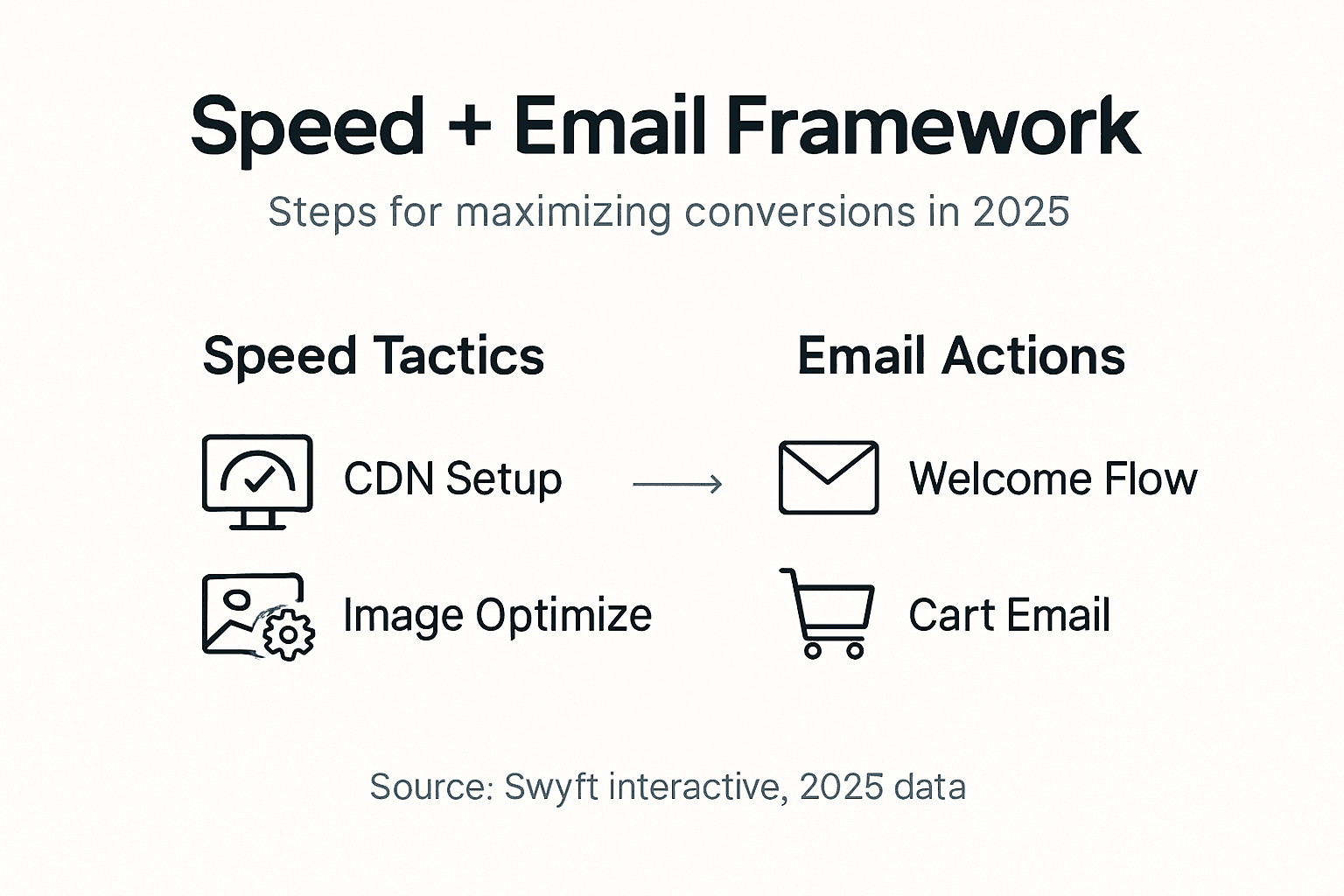
Measure key performance indicators across both domains. Track conversion rates, bounce rates, email open rates, click-through rates, and customer lifetime value. This comprehensive view reveals how improvements interact.
| Integration Approach | Complexity | Timeline | Expected ROI |
|---|---|---|---|
| Basic (Speed + Welcome Series) | Low | 2-4 weeks | 15-20% revenue increase |
| Intermediate (Speed + Cart Recovery) | Medium | 4-8 weeks | 20-30% revenue increase |
| Advanced (Full Optimization + Segmented Flows) | High | 8-12 weeks | 30-40% revenue increase |
| Expert (Speed + Predictive Personalization) | Very High | 12+ weeks | 40-50% revenue increase |
Implementation framework:
- Audit current site speed and email performance to establish baselines
- Implement priority speed optimizations based on traffic patterns
- Set up core Klaviyo automation flows aligned with improved pages
- Monitor metrics weekly to identify which combinations drive results
- Iterate based on data, scaling successful tactics and eliminating underperformers
Pro Tip: Connect Google Analytics to Klaviyo to track how email recipients interact with your newly optimized pages. This integration reveals which speed improvements generate the highest email conversion rates.
Customer journey mapping for ecommerce helps identify critical touchpoints where speed and email intersect. Map each stage from awareness through advocacy, noting where technical performance affects marketing effectiveness.
Case Studies: Real-World Ecommerce Brands Improving Conversions Through Speed and Email Automation
Real examples demonstrate how integrated strategies deliver measurable results. A home goods retailer reduced load times from 4.2 to 1.8 seconds through image optimization and CDN implementation. This speed improvement alone increased conversion rates by 7%.
They then layered Klaviyo email flows on top of the faster site. Abandoned cart sequences recovered 18% of lost sales, while post-purchase flows drove repeat purchases. The combined approach yielded 20% overall revenue growth within three months.
A mid-sized fashion brand faced similar challenges. Mobile traffic represented 70% of visits but converted poorly due to 5-second load times. After implementing browser caching and script minimization, mobile load times dropped to 2.1 seconds.
Integrating welcome series and browse abandonment emails with the improved mobile experience raised mobile conversion rates by 12%. Customer lifetime value increased 22% as faster experiences and automated nurturing encouraged repeat purchases.
Key outcomes across implementations:
- Speed optimizations consistently deliver 5-10% immediate conversion gains
- Email automation adds another 10-15% revenue increase on top of speed improvements
- Combined strategies support 20-30% total growth over 3-6 months
- Smaller stores with limited resources still achieve 15-20% gains focusing on high-impact tactics
These optimize ecommerce website conversions examples prove the framework works across store sizes and categories. Proven conversion rate tips derived from these case studies provide actionable insights you can implement immediately.
Practical Steps to Implement and Measure Website Speed and Conversion Improvements
Executing improvements requires a clear action plan. Begin by benchmarking current performance using tools like Google PageSpeed Insights and GTmetrix. These free tools identify specific bottlenecks slowing your site.
Document baseline metrics before making changes. Record current conversion rates, bounce rates, average load times, and email performance. This data proves ROI and guides optimization priorities.
Implementation sequence:
- Run speed audits on your five highest-traffic pages
- Compress all product images to WebP format for 60-80% size reduction
- Implement a CDN like Cloudflare or Amazon CloudFront
- Enable browser caching through your hosting control panel
- Remove unused third-party scripts and tracking codes
- Create core Klaviyo flows: welcome series, cart abandonment, post-purchase
- Align email content with your fastest-loading product categories
- Monitor metrics weekly for four weeks to measure impact
- Scale winning tactics and eliminate underperformers
- Repeat the cycle quarterly to maintain competitive advantages
Focus on quick wins first:
- Image optimization delivers results within days
- CDN setup takes 2-4 hours but provides immediate global speed gains
- Basic email flows can launch in one week
Pro Tip: Set up automated alerts when page load times exceed 3 seconds or email open rates drop below your baseline. Early detection prevents small issues from becoming revenue problems.
The 7-step ecommerce marketing checklist includes speed optimization and email automation as core components. Track performance monthly, comparing results against your documented baselines to quantify improvements.
Drive Ecommerce Growth with Expert Speed Optimization and Klaviyo Automation
You now understand how website speed and email automation work together to boost conversions. Implementing these strategies requires technical expertise and marketing knowledge to maximize results.
Swyft Interactive specializes in creating high-converting ecommerce experiences that combine lightning-fast websites with sophisticated Klaviyo automation. We’ve helped dozens of stores increase conversions by 20-40% through integrated ecommerce growth strategy with automation approaches. Our team handles technical optimizations while building email flows that turn visitors into loyal customers. Partner with us to implement the advantages of Klaviyo automation alongside speed improvements that drive measurable revenue growth for your store.
Frequently Asked Questions
What is the ideal website load time for maximizing ecommerce conversions?
Aim for load times under 2 seconds to achieve optimal conversion rates. Pages loading in 1.5 seconds or less see the highest sales and lowest bounce rates across both mobile and desktop traffic.
How does mobile site speed impact conversion rates compared to desktop?
Mobile shoppers double their conversion rates when load times improve from 3 to 1.5 seconds, showing greater sensitivity to speed than desktop users. Mobile optimization is critical since mobile traffic now exceeds 70% of ecommerce visits in 2026.
Is Klaviyo effective if my website is still slow?
Klaviyo emails drive traffic, but slow landing pages waste that opportunity by causing visitors to abandon before converting. Improving site speed amplifies email ROI by ensuring recipients who click actually complete purchases.
What are some quick technical fixes to improve website speed?
Compress images to WebP format for immediate 60-80% file size reduction without quality loss. Enable browser caching through your host’s control panel and remove unused third-party scripts to cut load times by 30-40% within days.
How do I measure the success of combined website speed and email marketing improvements?
Track conversion rate changes, bounce rate reductions, email open and click rates, and customer lifetime value growth before and after implementation. Weekly monitoring for 4-6 weeks reveals which integrated tactics deliver the strongest ROI and deserve scaling.