
Every American eCommerce manager knows the frustration of lost sales from unclear customer paths. Whether shoppers bounce after a website visit or abandon carts mid-checkout, each missed opportunity points to gaps in your journey mapping. By focusing on customer touchpoints and behavioral analytics, you can create smarter Klaviyo email automations that turn fragmented interactions into lasting conversions. This guide empowers you to pinpoint and optimize every stage, paving the way for email strategies that drive measurable sales growth.
Table of Contents
- Step 1: Define Customer Touchpoints For Your Ecommerce Funnel
- Step 2: Analyze Behavioral Data To Map User Interactions
- Step 3: Segment Audiences For Personalized Journey Flows
- Step 4: Visualize The Journey With Actionable Klaviyo Triggers
- Step 5: Test Optimization Strategies For Conversion Growth
- Step 6: Validate Outcomes Through Performance Analytics
Quick Summary
| Key Insight | Explanation |
|---|---|
| 1. Map Customer Touchpoints | Identify every interaction between customers and your brand for better personalization and optimization. |
| 2. Analyze User Behavior | Use behavioral data to find patterns and optimize the customer journey based on real interactions. |
| 3. Segment Your Audience | Break down your customer base into targeted segments to tailor marketing strategies and enhance engagement. |
| 4. Utilize Automation Triggers | Implement automated responses in your marketing strategies to engage customers at pivotal moments in their journey. |
| 5. Continuously Test Strategies | Regularly refine your optimization techniques through testing to improve conversion rates and customer satisfaction. |
Step 1: Define customer touchpoints for your ecommerce funnel
Defining customer touchpoints is a critical strategy for understanding and optimizing your ecommerce customer journey. By mapping out every interaction point where customers engage with your brand, you can create more targeted, personalized experiences that drive conversions and loyalty.
Customer touchpoints are diverse and span multiple channels. Tracking customer interactions involves identifying key engagement moments across digital and physical spaces. These touchpoints typically include:
- Website visits
- Social media interactions
- Email marketing campaigns
- Online advertisements
- Product page views
- Customer reviews
- Checkout process
- Post-purchase communication
To effectively map these touchpoints, start by chronologically tracking customer interactions from initial awareness through post-purchase support. This means documenting how customers discover your brand, evaluate products, make purchasing decisions, and experience your service afterward.
Understanding touchpoints helps you identify potential friction points and opportunities for improving customer experience.
Break down each stage of your ecommerce funnel and list specific interactions customers might have. Consider both digital and traditional channels, recognizing that modern shoppers often use multiple platforms during their buying journey.

Here’s how key touchpoints differ across the ecommerce funnel stages:
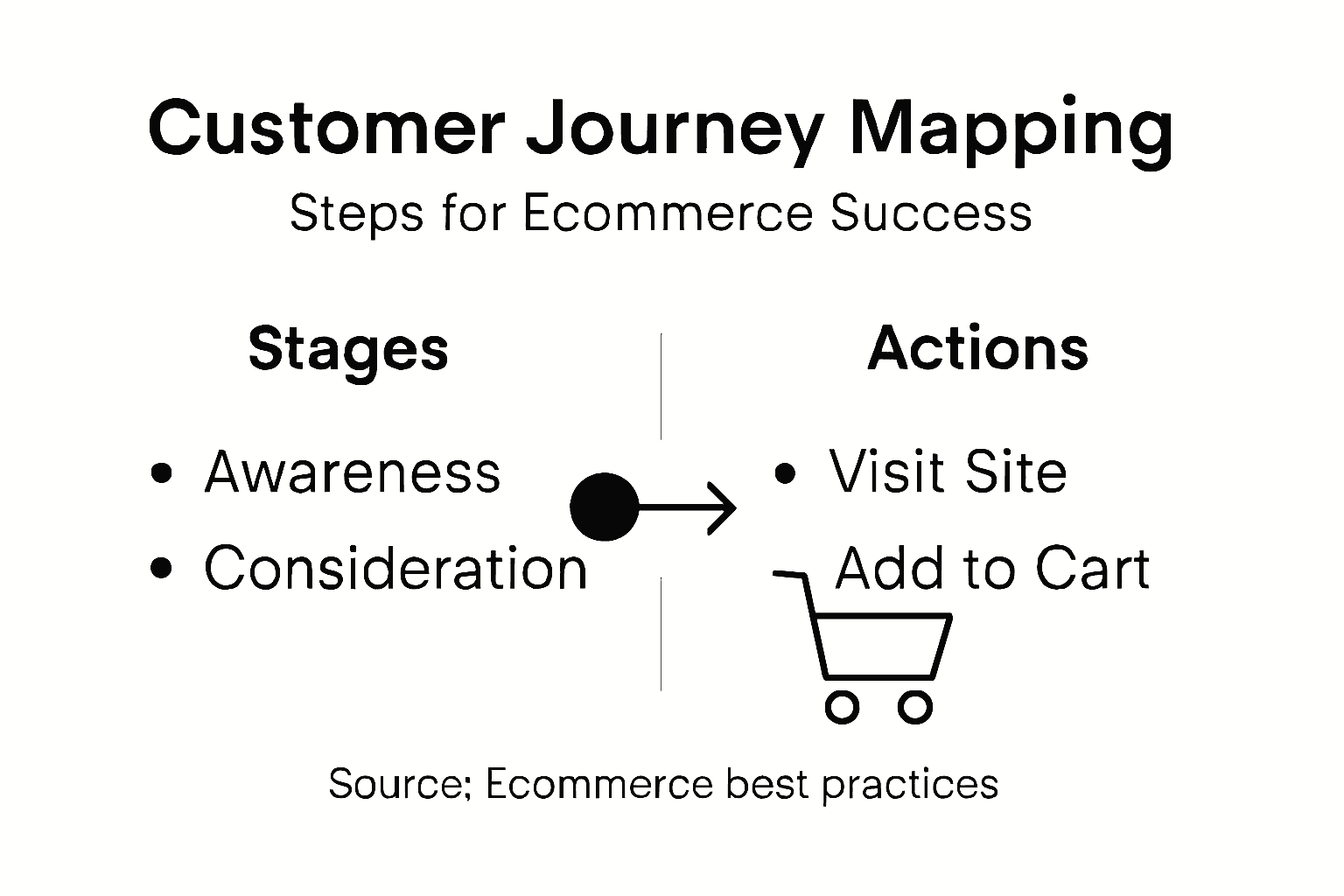
| Funnel Stage | Typical Touchpoints | Main Objective |
|---|---|---|
| Awareness | Social media, ads | Attract potential customers |
| Consideration | Product pages, reviews | Inform and persuade to proceed |
| Conversion | Checkout, payment process | Secure completed purchase |
| Post-Purchase | Follow-up emails, support | Build loyalty and repeat sales |
Pro tip: Use analytics tools to track and quantify interactions across different touchpoints, helping you prioritize optimization efforts.
Step 2: Analyze behavioral data to map user interactions
Analyzing behavioral data is crucial for understanding how customers interact with your ecommerce platform and uncovering insights that drive strategic improvements. By diving deep into user behavior, you can create more personalized and effective customer experiences.
Behavioral analytics allows you to transform raw user interaction data into meaningful insights. Key methods for analyzing user behavior include:
- Clickstream analysis
- Conversion funnel tracking
- Heatmap visualization
- User journey mapping
- Session recording
- A/B testing results
Start by collecting comprehensive data across multiple touchpoints. This means tracking everything from website navigation patterns to specific interactions like product views, cart additions, and purchase completions. Look for patterns that reveal how different customer segments move through your ecommerce funnel.
Understanding user behavior helps you identify friction points and optimize the customer journey in real time.
Pay special attention to drop-off points in your conversion process. Where are customers abandoning their shopping carts? Which pages have the highest exit rates? These insights can help you streamline your user experience and reduce potential barriers to purchase.
Here’s a comparison of popular ecommerce behavioral analytics methods:
| Method | Insight Provided | Best Use Case |
|---|---|---|
| Clickstream Analysis | Track user navigation flow | Optimize site structure |
| Heatmap Visualization | Show where users focus attention | Improve page design |
| Session Recording | Replay exact user sessions | Identify usability pain points |
| A/B Testing Results | Compare two versions’ performance | Validate design changes |
Pro tip: Combine quantitative data from analytics tools with qualitative feedback from customer surveys to get a more comprehensive view of user behavior.
Step 3: Segment audiences for personalized journey flows
Creating targeted audience segments is a powerful strategy for delivering personalized experiences that drive engagement and conversions in your ecommerce business. By breaking down your customer base into specific groups, you can craft more meaningful and effective marketing approaches.
Customer segmentation enables you to divide buyers into distinct groups based on critical characteristics. Your segmentation strategy should include multiple dimensions:
- Demographic information
- Purchase history
- Geographic location
- Product preferences
- Engagement levels
- Customer lifetime value
- Behavioral patterns
Start by analyzing your existing customer data to identify meaningful patterns. Look for common traits that distinguish different customer groups, such as frequent buyers, one-time purchasers, or customers with specific product interests. These insights will help you create targeted marketing strategies that speak directly to each segment’s unique needs.
Effective segmentation transforms generic marketing into personalized, compelling customer experiences.
Consider developing detailed buyer personas for each segment, which will help you understand their motivations, pain points, and preferred communication channels. This approach allows you to craft highly tailored messaging and product recommendations that resonate with specific customer groups.
Pro tip: Regularly update your customer segments as your business grows and customer behaviors evolve, ensuring your marketing remains relevant and precise.
Step 4: Visualize the journey with actionable Klaviyo triggers
Transforming your customer journey into a visual, actionable roadmap requires strategic use of marketing automation tools that can track and respond to specific customer behaviors. Klaviyo offers powerful capabilities for creating dynamic, personalized customer experiences that adapt in real time.
Marketing automation platforms enable you to design intricate customer journey maps with precise, event-triggered communications. Your trigger strategy should include multiple types of automated flows:
- Abandoned cart reminders
- Welcome series for new subscribers
- Post-purchase follow-up sequences
- Browse abandonment notifications
- Price drop alerts
- Replenishment reminders
- Winback campaigns for inactive customers
Start by mapping out key customer interactions and identifying the most critical moments where automated triggers can enhance engagement. Consider the emotional and practical needs of customers at each stage of their purchasing journey, designing triggers that feel helpful rather than intrusive.
Effective journey visualization transforms generic interactions into personalized, meaningful customer experiences.
Each trigger should be carefully crafted to provide value, offering relevant information, recommendations, or support that moves customers closer to their desired outcome. Pay close attention to the timing, tone, and content of your automated messages to ensure they align with your brand voice and customer expectations.
Pro tip: Test and refine your Klaviyo triggers continuously, using performance metrics to optimize your automation strategy and improve customer response rates.
Step 5: Test optimization strategies for conversion growth
Supercharging your ecommerce conversion rates requires a systematic approach to testing and refining your marketing strategies. By implementing targeted optimization techniques, you can transform casual browsers into committed customers.
Conversion rate optimization provides a structured method for incrementally improving your online performance. Your testing strategy should encompass multiple critical areas:
- Website user experience
- Checkout process design
- Product page layouts
- Call-to-action effectiveness
- Pricing presentation
- Mobile responsiveness
- Email campaign variations
Start by identifying key performance indicators and establishing baseline metrics. Develop hypotheses about potential improvements and design experiments that can quantifiably measure their impact. Focus on removing friction points that might prevent customers from completing purchases.
Small, incremental improvements can lead to significant increases in overall conversion rates.
Utilize A/B testing to compare different versions of your webpages, email templates, and marketing materials. Analyze the results carefully, looking beyond simple conversion numbers to understand the underlying user behaviors and preferences that drive your success.
Pro tip: Implement a continuous testing cycle where each experiment informs the next, creating an ongoing optimization loop that systematically enhances your ecommerce performance.
Step 6: Validate outcomes through performance analytics
Transforming raw data into actionable insights requires a strategic approach to measuring and interpreting your ecommerce performance metrics. By establishing a robust analytics framework, you can make informed decisions that drive continuous improvement.
Marketing performance analytics provide a comprehensive view of your business’s digital health. Your analytics dashboard should track critical key performance indicators:
- Conversion rates
- Average order value
- Customer acquisition cost
- Cart abandonment rate
- Website traffic sources
- Customer lifetime value
- Return on marketing investment
Begin by setting up comprehensive tracking across all customer interaction points. Integrate multiple data sources to create a holistic view of your performance, ensuring you capture nuanced insights that go beyond surface-level metrics.
Performance analytics transform raw numbers into strategic business intelligence.
Develop a consistent reporting rhythm that allows you to identify trends, anomalies, and opportunities for optimization. Compare your current performance against historical data and industry benchmarks to understand your relative market position.
Pro tip: Create a custom analytics dashboard that highlights your most critical metrics, allowing you to quickly assess performance and make data-driven decisions at a glance.
Elevate Your Ecommerce Success Through Expert Customer Journey Mapping
Mastering the customer journey requires more than just understanding touchpoints and behavioral data. The real challenge lies in seamlessly connecting these insights into a high-converting ecommerce funnel. If you want to reduce friction, personalize every interaction, and automate your email flows with precision, it is time to take your strategies to the next level. Key elements like Klaviyo automation triggers and performance-driven optimization can transform your generic marketing into tailored customer experiences that drive measurable revenue growth.
Discover how Swyft Interactive helps ecommerce brands by combining sophisticated website development with expert email marketing automation to deliver full-funnel growth solutions. Don’t wait to optimize your customer journey with data-driven segmentation and proven automation workflows shared in our You Suck At Klaviyo series. Visit https://swyftinteractive.com/ today to start building a scalable, automated ecommerce engine that turns browsers into loyal buyers.
Frequently Asked Questions
What are customer touchpoints in ecommerce?
Customer touchpoints in ecommerce are various interaction points where customers engage with your brand, including website visits, social media interactions, email campaigns, and more. To master your customer journey mapping, identify all possible touchpoints to better understand how customers discover and interact with your products.
How can I analyze behavioral data to improve the customer journey?
You can analyze behavioral data by tracking user interactions like clickstream patterns, conversion funnel activity, and session recordings. Start by collecting this data over a specific period, such as 30 days, and identify patterns that reveal customer behavior, allowing you to optimize your ecommerce platform effectively.
What is customer segmentation and why is it important?
Customer segmentation involves dividing your customer base into distinct groups based on characteristics like demographics, purchase history, or engagement levels. This process is important because it allows you to tailor marketing strategies that resonate with each segment’s specific needs, ultimately improving customer experience and sales.
How do I visualize the customer journey with Klaviyo triggers?
To visualize the customer journey with Klaviyo triggers, map out key customer interactions and identify moments for automated responses, such as abandoning a cart or signing up for a newsletter. Implement these triggers to enhance engagement, ensuring messages are relevant and timely to guide customers toward making a purchase.
What are effective optimization strategies for increasing ecommerce conversions?
Effective optimization strategies include improving website user experience, refining checkout processes, and utilizing A/B testing for various marketing materials. Focus on making one specific improvement at a time, such as enhancing your product page layout, and measure its impact over a few weeks to maximize your conversion growth.
How do I validate outcomes through performance analytics in my ecommerce business?
To validate outcomes through performance analytics, set up tracking for critical metrics like conversion rates, cart abandonment rates, and customer acquisition costs. Create regular reports to review these analytics, comparing them to previous periods to identify trends, and make data-driven decisions that will enhance your ecommerce performance.
Recommended
- 7 Essential Ecommerce Marketing Strategies for More Sales
- Ecommerce Funnel Explained: Boosting Conversions in 2026
- Email Marketing Automation Guide for Ecommerce Growth
- Ecommerce Growth Strategy: Driving Revenue with Automation
- Smart Workflow for Healthy Phone Use: Step-by-Step Guide
- Deliveries Happen. Chaos Is Optional. – Postal Solutions