
Managing an ecommerce brand often means juggling countless ways to drive customers from first glance to final purchase. The challenge is turning initial curiosity into real sales while avoiding potential drop-off at any stage. Understanding the core stages of the ecommerce funnel helps pinpoint where prospects hesitate and reveals targeted opportunities to increase conversions and repeat business. This guide uncovers practical strategies to refine each step, from brand awareness through post-purchase engagement.
Table of Contents
- What Is An Ecommerce Funnel? Core Concepts
- Critical Stages Of The Ecommerce Funnel Journey
- Optimizing Each Funnel Stage For Conversions
- Email Automation’s Role In Funnel Success
- Common Funnel Mistakes And How To Fix Them
Key Takeaways
| Point | Details |
|---|---|
| Understanding the Ecommerce Funnel | The ecommerce funnel outlines the journey from product awareness to purchase, helping businesses optimize each stage for conversions. |
| Strategic Stage-Specific Interventions | Each funnel stage requires tailored marketing strategies, from awareness through retention, to effectively engage customers. |
| Utilizing Email Automation | Email automation enhances customer engagement throughout the funnel, providing targeted communications that increase conversion rates. |
| Identifying and Addressing Common Mistakes | Businesses must recognize and rectify common funnel mistakes, such as poor segmentation and user experience, to improve overall performance. |
What Is an Ecommerce Funnel? Core Concepts
An ecommerce funnel represents the strategic pathway customers travel from initial product awareness to final purchase. This systematic model helps online businesses understand and optimize each critical stage of the customer journey, transforming casual browsers into committed buyers.
Originally derived from the classic marketing purchase model, the ecommerce funnel breaks down consumer interaction into progressive stages designed to guide prospects toward conversion. The core stages typically include:
- Awareness: Introducing potential customers to your brand and products
- Interest: Generating curiosity and engaging potential buyers
- Consideration: Helping customers evaluate your offerings
- Conversion: Motivating the final purchase decision
- Loyalty: Encouraging repeat purchases and brand advocacy
The funnel concept isn’t just theoretical—it’s a practical framework for tracking customer behavior and identifying potential drop-off points in the purchasing process. By understanding how customers move through these stages, ecommerce businesses can create targeted strategies that address specific customer needs and pain points.
Successful ecommerce funnels transform linear customer journeys into strategic, optimized experiences that maximize conversion potential.
Understanding each funnel stage allows marketers to develop precise interventions. For instance, during the awareness phase, businesses might use targeted social media advertising, while the conversion stage might require persuasive product descriptions and seamless checkout processes.

Pro tip: Track your funnel’s conversion rates at each stage to identify and address potential bottlenecks in your customer acquisition strategy.
Critical Stages of the Ecommerce Funnel Journey
The ecommerce funnel is a strategic roadmap that meticulously tracks customer progression from initial brand discovery to final purchase. Marketing funnel strategies provide businesses with a systematic approach to understanding and optimizing each critical interaction point.
The core stages of the ecommerce funnel represent a carefully designed customer journey:
- Awareness Stage: Introducing your brand to potential customers
- Interest Stage: Generating curiosity and initial engagement
- Consideration Stage: Helping customers evaluate product offerings
- Conversion Stage: Motivating and facilitating the purchase decision
- Retention Stage: Encouraging repeat purchases and brand loyalty
Each stage requires distinct marketing strategies and targeted interventions. During the awareness phase, businesses focus on broad reach through digital advertising, social media, and content marketing. As potential customers move through the funnel, messaging becomes more specific and personalized, addressing individual pain points and demonstrating product value.
Successful ecommerce funnels transform passive browsing into active purchasing by creating seamless, compelling customer experiences.
Understanding these stages allows marketers to develop precise, data-driven approaches. The consideration stage, for instance, might involve detailed product comparisons, customer reviews, and targeted email campaigns that nudge potential buyers toward conversion.
Pro tip: Implement detailed analytics tracking at each funnel stage to identify and quickly address potential drop-off points in your customer acquisition process.
Here’s a quick reference comparing key goals and success metrics across each stage of the ecommerce funnel:
| Funnel Stage | Main Business Goal | Key Success Metric |
|---|---|---|
| Awareness | Drive brand and product visibility | Unique website visitors |
| Interest | Capture and engage prospects | Email signup rate |
| Consideration | Increase purchase intent | Product view-to-cart ratio |
| Conversion | Maximize sales conversions | Cart-to-purchase rate |
| Retention | Sustain customer loyalty | Repeat purchase frequency |
Optimizing Each Funnel Stage for Conversions
Optimizing the ecommerce funnel requires a strategic, stage-specific approach that addresses unique customer needs and potential friction points. Ecommerce conversion funnel strategies demand precise interventions tailored to each customer journey phase.
Here’s a comprehensive breakdown of optimization strategies for each funnel stage:
-
Awareness Stage:
- Utilize targeted social media advertising
- Create engaging content marketing
- Develop brand storytelling campaigns
-
Interest Stage:
- Implement retargeting ads
- Develop interactive content
- Use email lead nurturing techniques
-
Consideration Stage:
- Provide detailed product comparisons
- Showcase customer testimonials
- Offer transparent pricing information
-
Conversion Stage:
- Simplify checkout processes
- Minimize form fields
- Offer multiple payment options
-
Retention Stage:
- Create personalized follow-up campaigns
- Develop loyalty programs
- Implement post-purchase communication strategies
Each funnel stage requires a nuanced approach that anticipates and addresses potential customer hesitations. The goal is creating a smooth, intuitive journey that guides prospects seamlessly from initial awareness to committed purchase.
Successful funnel optimization transforms casual browsers into loyal customers by understanding and addressing their specific needs at each interaction point.
Technological tools and analytics play a crucial role in funnel optimization. By tracking customer behavior, businesses can identify drop-off points, refine messaging, and create more targeted interventions that increase overall conversion rates.

Pro tip: Implement granular analytics tracking to understand exactly where potential customers disengage, allowing for precise, data-driven funnel improvements.
Email Automation’s Role in Funnel Success
Email automation has become a critical driver of ecommerce success, transforming how businesses nurture and convert potential customers throughout the sales funnel. Marketing funnel automation enables businesses to deliver personalized, timely communications that guide prospects seamlessly from initial awareness to committed purchase.
Key email automation strategies for funnel optimization include:
-
Awareness Stage:
- Welcome series for new subscribers
- Content-driven educational emails
- Brand storytelling campaigns
-
Interest Stage:
- Personalized product recommendation emails
- Triggered emails based on website behavior
- Segmented content matching user interests
-
Consideration Stage:
- Comparison and feature highlight emails
- Social proof and testimonial communications
- Targeted abandonment recovery sequences
-
Conversion Stage:
- Urgency-driven promotional emails
- Cart abandonment recovery campaigns
- Time-sensitive discount offers
-
Retention Stage:
- Post-purchase follow-up sequences
- Loyalty program engagement emails
- Personalized repurchase recommendations
Effective email automation goes beyond simple messaging. It requires sophisticated segmentation, behavioral tracking, and dynamic content that adapts to individual customer journeys.
Email automation transforms generic marketing communications into precision-targeted, personally relevant customer experiences.
Technological advancements have made email automation more powerful and accessible. Advanced platforms now enable real-time personalization, predictive content recommendations, and intricate trigger-based communication strategies that significantly enhance conversion potential.
Pro tip: Implement progressive profiling in your email automation to continuously gather and utilize customer data, enabling increasingly personalized and effective communication strategies.
Below is a table highlighting how email automation adapts to each funnel stage for increased marketing effectiveness:
| Funnel Stage | Email Automation Focus | Example Message Type |
|---|---|---|
| Awareness | Initiate engagement | Welcome sequence emails |
| Interest | Nurture with relevance | Personalized product picks |
| Consideration | Address objections | Competitive comparisons |
| Conversion | Prompt immediate action | Limited-time promo offer |
| Retention | Foster ongoing relationships | Loyalty program reminders |
Common Funnel Mistakes and How to Fix Them
Ecommerce businesses frequently encounter critical mistakes that can significantly undermine their conversion potential. Funnel analysis techniques reveal systematic errors that prevent optimal customer progression through the purchasing journey.
Key common funnel mistakes include:
-
Lack of Proper Segmentation:
- Treating all customers identically
- Ignoring customer behavior differences
- Using generic, non-targeted messaging
-
Insufficient Tracking:
- Not monitoring drop-off points
- Failing to analyze conversion rates
- Overlooking critical performance metrics
-
Poor User Experience:
- Complex checkout processes
- Slow website loading times
- Unclear product information
-
Inconsistent Messaging:
- Misaligned communication across stages
- Conflicting brand voice
- Irrelevant content recommendations
-
Neglecting Customer Retention:
- Focusing solely on acquisition
- Minimal post-purchase engagement
- Limited loyalty program development
Addressing these mistakes requires a comprehensive, data-driven approach. Businesses must continuously analyze funnel performance, identify bottlenecks, and implement strategic improvements that enhance the entire customer journey.
Successful funnel optimization is not about fixing individual stages, but creating a seamless, integrated experience that guides customers naturally toward conversion.
Technological advancements now provide sophisticated tools for detailed funnel analysis, enabling businesses to track, understand, and optimize every interaction point with unprecedented precision and insight.
Pro tip: Implement regular A/B testing across funnel stages to systematically identify and eliminate conversion barriers while continuously improving customer experience.
Unlock the Full Potential of Your Ecommerce Funnel Today
Struggling to convert browsers into loyal customers despite understanding the ecommerce funnel stages? The article highlights common roadblocks like insufficient tracking, poor user experience, and inconsistent messaging that can stall growth at every funnel stage. You need a strategic partner who can integrate high-converting website design with sophisticated email marketing automation to optimize awareness, consideration, and conversion within your customer journey.
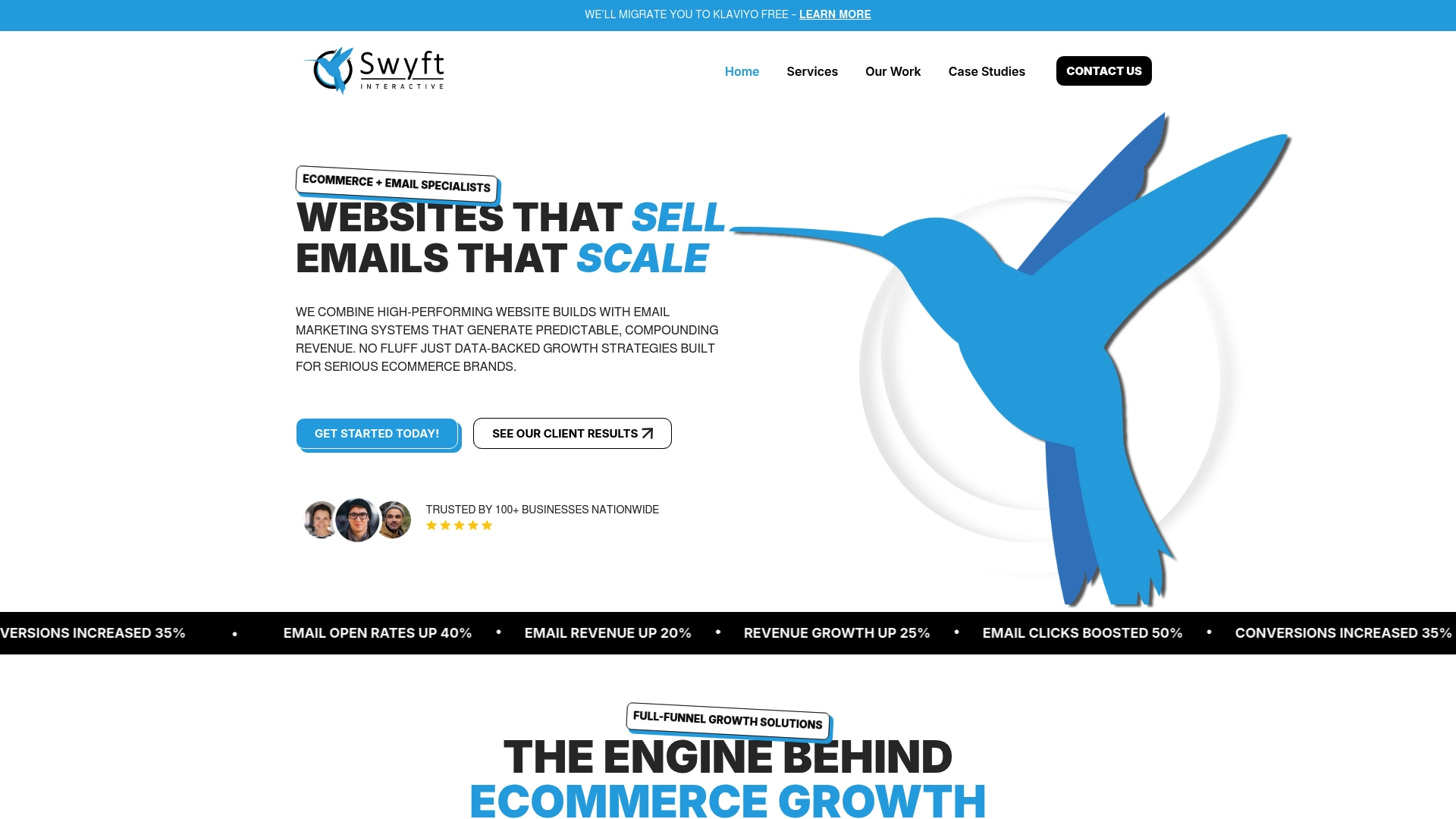
Discover how Swyft Interactive’s full-funnel growth solutions combine fast-loading ecommerce websites with powerful Klaviyo email automation to eliminate friction and boost conversions. Explore actionable insights and proven tactics in our Digital Strategy Archives. Ready to refine your email approach for ultimate impact? Our Email Marketing Archives dive deep into targeted email automation that nurtures and converts shoppers efficiently. Take the first step toward building a scalable sales engine built on measurable performance improvements at swyftinteractive.com. Your optimized ecommerce funnel awaits.
Frequently Asked Questions
What is an ecommerce funnel?
An ecommerce funnel is a strategic pathway that customers follow from initial awareness of a product to the final purchase decision. It helps businesses understand and optimize the customer journey to improve conversions.
What are the main stages of the ecommerce funnel?
The main stages of the ecommerce funnel include Awareness, Interest, Consideration, Conversion, and Retention. Each stage requires specific marketing strategies and interventions to guide potential customers toward making a purchase.
How can I optimize each stage of the ecommerce funnel?
To optimize each funnel stage, businesses can use various strategies: for Awareness, utilize targeted advertising; for Interest, implement retargeting and engaging content; for Consideration, provide product comparisons and testimonials; for Conversion, simplify the checkout process; and for Retention, develop loyalty programs and personalized follow-up campaigns.
What role does email automation play in the ecommerce funnel?
Email automation plays a crucial role in nurturing leads and guiding them through the funnel stages by delivering timely, personalized communications. It helps engage potential customers, recover abandoned carts, and foster loyalty post-purchase.