

Every fast-growing American ecommerce brand faces the challenge of turning site visitors into loyal customers while keeping marketing processes efficient. The demands for higher conversion rates and a seamless online experience continue to rise, making ecommerce website optimization essential for online retail success. This guide explores how you can leverage proven techniques and Klaviyo automation to create a user-friendly site that drives revenue and builds lasting trust with your customers.
Table of Contents
- Defining Ecommerce Website Optimization
- Types of Ecommerce Optimization Strategies
- Key Features That Drive Conversions
- Impact on Revenue and User Engagement
- Risks of Neglecting Website Optimization
- Comparing Automated vs. Manual Optimization
Key Takeaways
| Point | Details |
|---|---|
| Ecommerce Optimization is Essential | Implementing various optimization strategies is crucial for improving site performance, user experience, and ultimately, sales conversions. |
| Continuous Monitoring is Key | Regular audits and performance tracking can identify optimization gaps that may impact sales and user engagement. |
| Balancing Automation and Human Insight | A hybrid approach that combines automated tools and human expertise enhances strategic decision-making in ecommerce optimization. |
| Focus on User Experience | Prioritizing intuitive navigation, mobile responsiveness, and clear product information significantly drives user engagement and conversions. |
Defining Ecommerce Website Optimization
Ecommerce website optimization is a strategic approach to improving an online store’s performance, visibility, and user experience with the ultimate goal of increasing sales and revenue. Effective e-commerce SEO involves systematically enhancing various digital elements to attract more potential customers and convert website visitors into paying customers.
At its core, website optimization encompasses multiple interconnected aspects of an online retail environment. This includes technical improvements like site speed and mobile responsiveness, content optimization through strategic keyword integration, user experience design, and conversion rate enhancement techniques. High-quality website design directly impacts consumer trust and engagement, making it a critical component of successful online retail strategies.
The key components of effective ecommerce website optimization typically involve:
- Technical performance enhancements
- Search engine visibility improvements
- User experience design
- Conversion rate optimization
- Mobile responsiveness
- Page load speed optimization
- Clear and compelling product descriptions
- Intuitive navigation structures
Pro tip: Conduct a monthly website performance audit to identify and address potential optimization opportunities before they impact your sales conversions.
Types of Ecommerce Optimization Strategies
Ecommerce optimization strategies encompass a comprehensive approach to improving online business performance through multiple targeted techniques. Ecommerce SEO strategies involve systematic improvements across technical, content, and user experience domains to enhance website visibility and conversion potential.
The primary types of ecommerce optimization strategies can be categorized into distinct yet interconnected areas. Technical optimization focuses on site performance, including page load speeds, mobile responsiveness, and backend infrastructure improvements. Content optimization involves developing strategic product descriptions, enhancing keyword targeting, and creating engaging multimedia elements that attract and retain customer interest. Business optimization approaches also emphasize data analytics and technological integrations to streamline operational efficiency.
Key optimization strategies include:
- Search engine optimization (SEO)
- Conversion rate optimization (CRO)
- User experience (UX) design improvements
- Technical website performance enhancements
- Content marketing and keyword optimization
- Mobile responsiveness optimization
- Customer journey mapping
- Performance analytics and tracking
Successful ecommerce websites leverage these strategies synergistically, understanding that optimization is an ongoing process requiring continuous monitoring, testing, and refinement. By implementing a holistic approach, online retailers can create more compelling, user-friendly environments that naturally drive higher engagement and sales.
The table below summarizes how different ecommerce optimization types impact key business outcomes:
| Optimization Type | Main Focus | Primary Benefit |
|---|---|---|
| Technical | Site speed & stability | Reduced bounce rates |
| Content | Product details & keywords | Higher search rankings |
| User Experience | Navigation & interface | Improved engagement |
| Analytics | Data tracking & analysis | Smarter decision-making |
Pro tip: Implement A/B testing for each optimization strategy to quantitatively measure its impact on conversion rates and user experience.
Key Features That Drive Conversions
Conversion optimization is the critical process of transforming website visitors into paying customers through strategic design and functional improvements. E-commerce traffic analysis reveals that specific features can dramatically influence a website’s ability to convert potential customers, making each design element a potential revenue generator.
The most impactful features driving conversions include several key components. Website design quality plays a fundamental role, with elements like intuitive navigation, clear product presentations, and seamless user interfaces directly affecting customer engagement. Mobile optimization emerges as a crucial factor, with responsive design ensuring smooth experiences across different devices and screen sizes. Trust signals such as secure payment icons, customer reviews, and transparent return policies also significantly contribute to building user confidence.
Key conversion-driving features include:
- Fast page load speeds
- Mobile-responsive design
- Streamlined checkout process
- Clear product descriptions
- High-quality product images
- User-friendly navigation
- Visible security badges
- Simple cart management
- Multiple payment options
- Customer review integration
Successful online retailers understand that conversion optimization is an ongoing process of testing, measuring, and refining website elements. By continuously analyzing user behavior and implementing data-driven improvements, businesses can create more compelling online shopping experiences that naturally encourage purchases.
Pro tip: Implement heat mapping and user tracking tools to identify exactly where potential customers might be experiencing friction in their purchasing journey.
Impact on Revenue and User Engagement
User engagement represents the critical bridge between website traffic and actual revenue generation for online businesses. Big data analysis of e-commerce platforms reveals a direct correlation between enhanced user experience and financial performance, demonstrating that strategic optimization can significantly boost sales and customer retention.

The relationship between user engagement and revenue is multifaceted and deeply interconnected. Digital economy research indicates that businesses implementing sophisticated engagement strategies can transform casual website visitors into loyal customers. Key metrics like time spent on site, interaction depth, personalization quality, and smooth navigation directly influence conversion rates and long-term customer value.
Critical factors driving revenue through user engagement include:
- Personalized product recommendations
- Responsive customer support
- Seamless cross-device experiences
- Interactive product visualization
- Real-time inventory updates
- Targeted email marketing
- Loyalty program integration
- Dynamic pricing strategies
- Social proof elements
- Frictionless checkout processes
Successful online retailers recognize that user engagement is not a one-time effort but a continuous process of understanding, anticipating, and exceeding customer expectations. By leveraging advanced analytics and maintaining a customer-centric approach, businesses can create compelling digital experiences that naturally drive revenue growth.
Pro tip: Implement advanced customer segmentation strategies to create hyper-personalized experiences that increase both engagement and average order value.
Risks of Neglecting Website Optimization
Website neglect poses significant threats to online business sustainability and financial performance. Poor website management can rapidly erode customer trust, diminish search engine rankings, and create vulnerabilities that directly impact revenue generation.
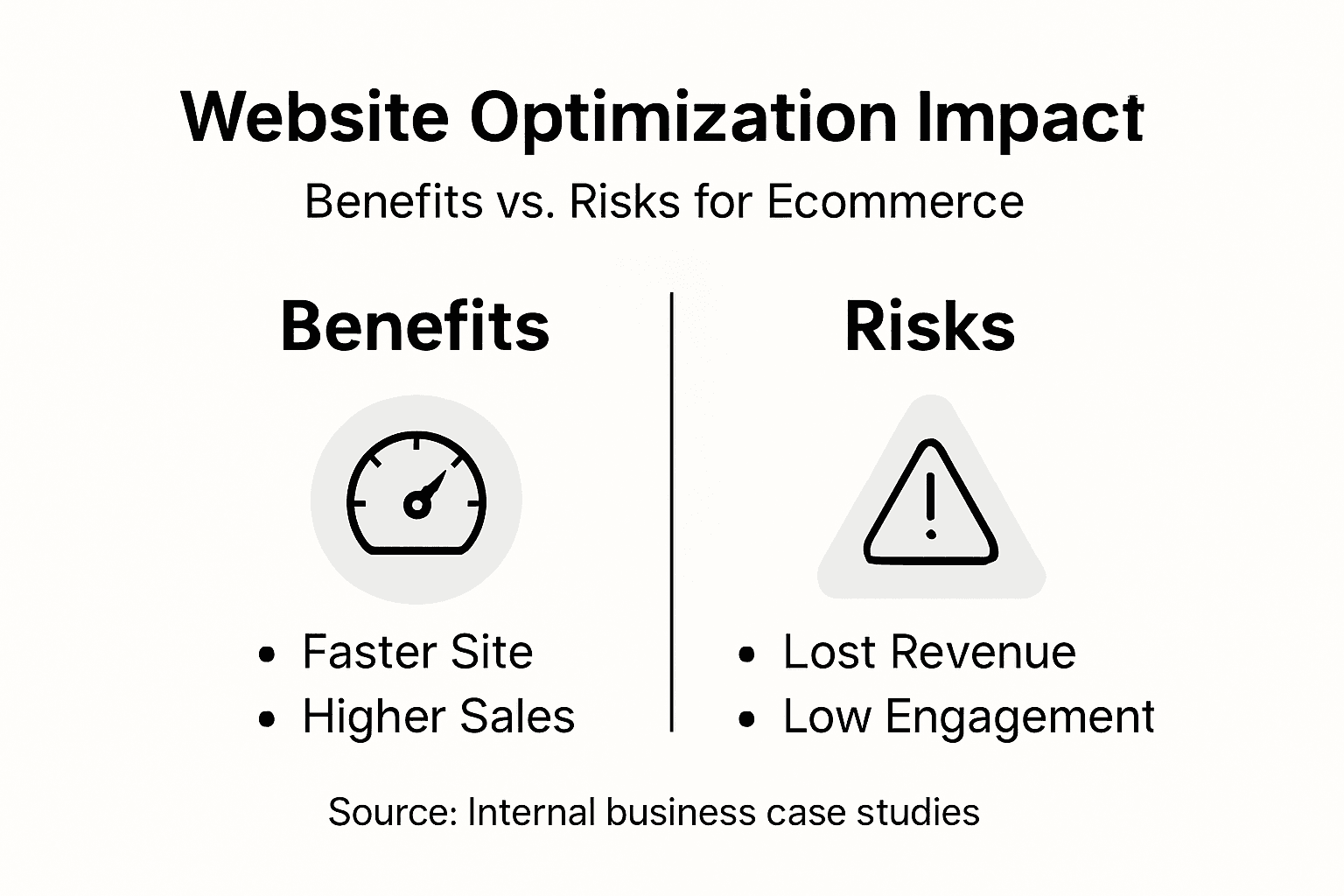
E-commerce technical vulnerabilities manifest through multiple critical risk dimensions that extend beyond simple performance issues. Security breaches, slow loading times, unresponsive design, and inconsistent user experiences can transform potential customers into permanent losses. These technical deficiencies not only discourage immediate purchases but also damage long-term brand reputation, creating a cascading effect of diminishing market credibility.
Specific risks of website optimization neglect include:
- Increased security vulnerabilities
- Higher customer abandonment rates
- Reduced search engine visibility
- Compromised data protection
- Lower conversion percentages
- Diminished user trust
- Negative brand perception
- Reduced competitive positioning
- Inefficient customer journey
- Potential financial losses
Successful online businesses understand that website optimization is not an optional enhancement but a critical, ongoing process of maintaining digital infrastructure. Proactive monitoring, continuous improvement, and responsive design represent the primary defensive strategies against potential technological and market risks.
Pro tip: Conduct quarterly comprehensive website audits to identify and address potential optimization gaps before they transform into significant operational vulnerabilities.
Comparing Automated vs. Manual Optimization
Optimization strategies in ecommerce represent a critical balance between technological efficiency and human insight. Automated optimization techniques have emerged as powerful tools that can dramatically transform how online businesses approach website performance and user experience improvements.
Optimization algorithm evaluation reveals that both automated and manual approaches offer unique strengths and limitations. Automated tools excel at rapid data processing, identifying patterns at scale, and implementing changes with unprecedented speed. Manual optimization, by contrast, provides nuanced understanding, contextual interpretation, and strategic decision-making that sophisticated algorithms might miss. The most effective approach often involves a hybrid model that leverages the computational power of automation while maintaining human strategic oversight.
Key differences between automated and manual optimization include:
- Speed of implementation
- Depth of strategic insight
- Cost-effectiveness
- Scalability
- Precision of data analysis
- Contextual understanding
- Adaptability to unique scenarios
- Error detection capabilities
- Complexity of problem-solving
- Customization potential
Successful ecommerce businesses recognize that optimization is not a binary choice between automated and manual methods, but a sophisticated integration of technological tools and human expertise. The goal is to create a dynamic, responsive optimization strategy that combines machine efficiency with strategic human intelligence.
Here’s a side-by-side comparison of automated vs. manual ecommerce optimization methods:
| Factor | Automated Approach | Manual Approach |
|---|---|---|
| Speed | Immediate adjustments | Incremental, varies by task |
| Contextual Insight | Limited to coded logic | Adapts to business nuances |
| Cost | Lower long-term labor | Higher expert involvement |
| Error Detection | Pattern-based alerts | Human-driven investigation |
Pro tip: Develop a hybrid optimization approach that uses automated tools for data collection and initial analysis, while reserving critical strategic decisions for human experts.
Unlock Higher Revenue Through Expert Ecommerce Optimization
Struggling to convert visitors into paying customers or worried about slow website speeds that drive buyers away You are not alone Ecommerce website optimization is crucial for boosting conversions and increasing revenue as highlighted in the article From fast page load speeds and mobile responsiveness to clear product descriptions and seamless checkout processes every element impacts your bottom line At Swyft Interactive we understand these challenges and specialize in creating high-converting ecommerce websites paired with powerful email marketing automation strategies specifically focused on Klaviyo to keep your customers engaged and returning
Ready to transform your ecommerce presence and maximize revenue Discover tailored solutions that combine expert website development with strategic email marketing by exploring our Digital Strategy Archives – Swyft Interactive and Email Marketing Archives – Swyft Interactive Our proven approach harnesses data-driven insights to optimize every stage of the customer journey Visit Swyft Interactive today and start building a scalable online sales engine designed to increase conversions and drive measurable growth now
Frequently Asked Questions
What is ecommerce website optimization?
Ecommerce website optimization is the process of improving an online store’s performance, visibility, and user experience to increase sales and revenue. It involves technical enhancements, content optimization, and user experience design.
How can optimizing my ecommerce website improve its search engine visibility?
By implementing effective search engine optimization (SEO) strategies, you can enhance your website’s visibility in search results. Key practices include using relevant keywords, improving site speed, and ensuring mobile responsiveness, all of which help attract more potential customers.
What are some essential features that drive conversions on ecommerce websites?
Key features that drive conversions include fast page load speeds, mobile-responsive design, clear product descriptions, high-quality images, user-friendly navigation, and visible security badges to build trust with customers.
Why is neglecting website optimization risky for ecommerce businesses?
Neglecting website optimization can lead to increased security vulnerabilities, higher customer abandonment rates, reduced search engine visibility, and lower conversion rates, all of which negatively impact revenue and brand reputation.