TL;DR:
- Integrating paid ads with organic and earned media maximizes advertising impact and builds a sustainable marketing system.
- Paid advertising delivers immediate visibility and precise targeting, but it is most effective when combined with other channels to reinforce brand trust and reduce costs.
Integrating paid ads means combining paid advertising with organic and earned media channels to maximize reach, targeting, and measurable results across every stage of the customer journey. The question of why integrate paid ads is not academic. Digital ad costs rose around 20% in recent years, and 70–80% of users now ignore paid ads when they appear in isolation. That combination forces a clear conclusion: paid advertising only delivers sustainable ROI when it works as part of a broader, connected marketing system, not as a standalone spend.
Why integrate paid ads into your marketing strategy?
Paid advertising is the fastest way to put your brand in front of buyers who are ready to act. Paid ads provide immediate visibility and targeted reach with measurable results, making them effective for launching new products, running promotions, and driving conversions at speed. Organic content builds authority over months. Paid ads can generate traffic within hours of going live.

The benefits of paid advertising go well beyond speed. Modern platforms offer targeting by behavior, interest, keyword, and purchase intent, which means your budget reaches people who are already in a buying mindset. Behavioral targeting increases conversion probability by matching your message to where a shopper is in their decision process. That precision is simply not available through organic search or social alone.
Repeated ad exposure also builds brand trust over time. Brand image mediates purchase intention through digital communication including paid ads, according to research published in the Future Business Journal in may 2026. A shopper who sees your ad three times before visiting your site is more likely to convert than one who finds you cold through a search result.
Key advantages of integrating paid ads include:
- Immediate audience reach at scale, without waiting for organic rankings to build
- Precise targeting using behavioral, interest-based, and keyword parameters
- Measurable performance with real-time data on clicks, conversions, and cost per acquisition
- Brand recognition built through consistent ad exposure across platforms
- Flexible budget control that lets you scale spend up or down based on results
Pro Tip: Set up conversion tracking before you launch any paid campaign. Without it, you are spending money with no way to know what is working.
How does paid ad integration improve marketing outcomes?
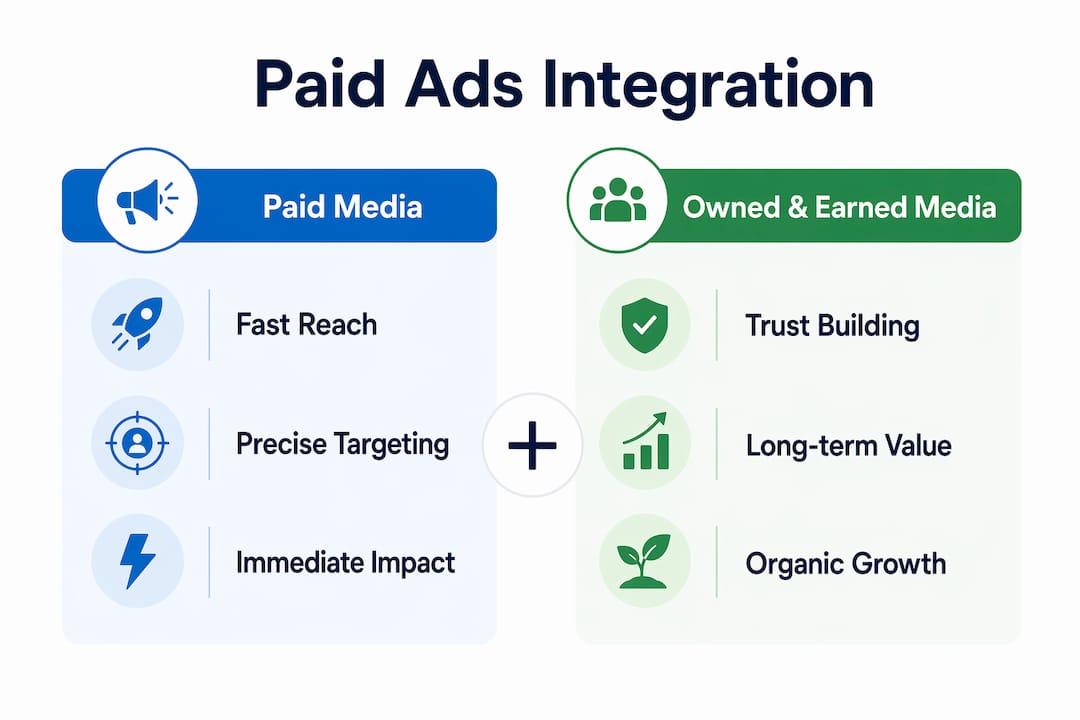
The most effective marketing uses paid, owned, and earned media together. Owned media is your website, email list, and content. Earned media is press coverage, reviews, and organic social sharing. Paid media is your advertising spend. Paid, earned, and owned media working together produces stronger customer relationships and better overall marketing effectiveness than any single channel alone.
The table below shows how each media type contributes to an integrated strategy.
| Media type | Primary role | Limitation without integration |
|---|---|---|
| Paid | Fast reach and precise targeting | Expensive and unsustainable alone |
| Owned | Long-term authority and retention | Slow to build audience from scratch |
| Earned | Trust and social proof | Unpredictable and hard to control |
When these three work together, the results compound. A paid ad drives traffic to a blog post. That blog post earns backlinks and social shares. Those shares build organic reach that reduces your future ad spend. The cycle reinforces itself.
Siloed paid campaigns waste resources. When paid advertising runs separately from your content and email programs, you duplicate effort, miss retargeting opportunities, and pay for traffic that your owned channels could have captured for free. Unified campaign management, where paid ads amplify your existing content assets, maximizes the utility of every dollar spent.
Cross-channel data also improves targeting over time. When your paid campaigns feed audience data back into your email segmentation and your email engagement informs your ad audiences, every channel gets sharper. That feedback loop is the core reason multi-channel marketing strategies consistently outperform single-channel approaches.
Pro Tip: Use your highest-performing email subject lines as ad copy. If a subject line drove strong open rates, the same message will likely perform well in a paid social headline.
What are the practical strategies to integrate paid ads effectively?
Execution is where most marketers lose the gains that integration promises. These steps create a connected paid ad program that works with your other channels rather than against them.
-
Align your messaging across every channel. Your paid ad copy, landing page headline, and email follow-up should all carry the same core message. Inconsistency between channels breaks trust and increases bounce rates. Write one central value proposition and adapt it to each format.
-
Set conversion goals before allocating budget. Define what a successful outcome looks like, whether that is a purchase, a sign-up, or a product page visit. Budget allocation without a clear goal produces data that is impossible to act on. Tie every campaign to a specific, measurable outcome.
-
Use retargeting to recover lost traffic. Retargeting in ecommerce re-engages shoppers who visited your site but did not convert. These audiences already know your brand, so retargeting ads cost less and convert at higher rates than cold prospecting campaigns. Segment your retargeting audiences by the page they visited for maximum relevance.
-
Repurpose content across paid and organic channels. A product video that performs well organically becomes a paid social ad. A blog post that ranks well becomes the landing page for a search campaign. Tactical content repurposing and unified campaign management improve marketing outcomes by extracting more value from assets you have already created.
-
Feed paid data back into your email and organic programs. The audience segments, keywords, and creative formats that perform best in paid campaigns reveal what your customers actually respond to. Use that data to sharpen your email subject lines, your organic content topics, and your product page copy. Data-driven marketing turns paid campaign learnings into improvements across every channel.
-
Review attribution regularly. Last-click attribution gives paid ads too much credit and organic channels too little. Use a multi-touch attribution model to understand how each channel contributes to a conversion. That view prevents you from cutting channels that are doing real work earlier in the funnel.
What challenges should businesses expect when integrating paid ads?
Integration solves problems, but it also surfaces new ones. Knowing what to expect prevents costly mistakes.
-
Rising cost per click. CPC on Google Ads increased around 20% as of Q2 2026. That inflation makes it unsustainable to rely on paid ads alone. A hybrid approach, where paid ads support organic growth rather than replace it, is the only way to protect margins long term.
-
Cannibalization of organic results. Running paid search ads on keywords where you already rank organically can split your own traffic and inflate your cost per acquisition. Audit your organic rankings before building your paid keyword list. Bid on paid only where organic is weak or where commercial intent is highest.
-
Data fragmentation. When paid, email, and organic programs run in separate tools with no shared data layer, you get an incomplete picture of performance. Centralize your analytics so that every channel reports into one dashboard. Without that, budget decisions are based on partial information.
-
Attribution gaps. Paid ads often get credit for conversions that email or organic content actually started. A shopper might click a paid ad, leave, receive an email, and then convert through a direct visit. Without proper ecommerce analytics, the email and the direct visit get no credit.
-
Cross-team misalignment. Paid campaigns managed by one team and content managed by another produce inconsistent messaging and missed opportunities. Shared briefs, shared calendars, and shared performance reviews keep both teams working toward the same goals.
Key Takeaways
Integrating paid ads with owned and earned media is the most reliable way to reduce cost per acquisition, build brand recognition, and sustain revenue growth over time.
| Point | Details |
|---|---|
| Integration beats isolation | Paid ads connected to email and organic channels outperform siloed campaigns on every measurable metric. |
| Rising costs demand efficiency | With CPC up around 20%, a hybrid paid and organic approach protects margins better than paid-only spending. |
| Targeting precision drives ROI | Behavioral and interest-based targeting puts your budget in front of buyers who are already ready to act. |
| Data flows both ways | Paid campaign data should sharpen your email and organic programs, not stay locked inside the ad platform. |
| Attribution requires a multi-touch view | Last-click models overvalue paid ads and hide the contribution of email and content earlier in the funnel. |
The real cost of treating paid ads as a shortcut
Every year I watch ecommerce brands pour budget into paid ads and then wonder why their customer acquisition cost keeps climbing. The pattern is always the same. They treat paid advertising as a shortcut to revenue rather than one part of a connected system.
The brands that get lasting results do something different. They use paid ads to amplify content that already works. They feed ad audience data back into their email flows. They run retargeting campaigns that reference the exact product a shopper viewed. The paid channel does not carry the whole load. It accelerates what the other channels have already started.
The uncomfortable truth about paid advertising integration is that it requires more upfront planning than most teams want to invest. You need shared messaging, shared data, and shared goals across every channel. That work feels slow at first. But brands that do it stop chasing diminishing returns from isolated ad spend and start building a marketing system that compounds over time.
The digital ad market is not getting cheaper. The only way to stay profitable is to make every dollar work harder by connecting it to channels that reinforce each other. That is not a trend. That is the only sustainable path forward.
— Leon
Swyftinteractive and paid ad integration for ecommerce brands
Swyftinteractive builds full-funnel ecommerce marketing systems that connect paid advertising with email automation, customer journey mapping, and data-driven optimization. The agency specializes in making paid and owned channels work together so that every ad dollar is reinforced by the right email sequence, the right landing page, and the right post-purchase flow.
For ecommerce brands ready to move beyond isolated ad spend, Swyftinteractive’s ecommerce growth strategy framework connects paid campaigns to Klaviyo automation and conversion-focused web design. The result is a marketing system where paid, email, and organic channels amplify each other rather than compete. Explore how Swyftinteractive structures integrated growth for online retailers.
FAQ
Why integrate paid ads instead of relying on organic alone?
Organic growth is slow and unpredictable. Paid ads deliver immediate visibility and precise targeting, making them the fastest way to reach buyers who are ready to convert.
What is the biggest risk of running paid ads without integration?
Budget dependency is the primary risk. Relying solely on paid ads creates unsustainable cost inflation as CPC rates rise, with no organic foundation to fall back on when spend decreases.
How do paid ads complement email marketing?
Paid ads complement email by reaching new audiences that email cannot access, while email nurtures and retains the customers that paid ads acquire. Together they cover the full customer lifecycle.
What targeting options make paid ads worth the cost?
Behavioral, interest-based, and keyword targeting put your ads in front of shoppers who are already in a buying mindset. That precision reduces wasted spend and increases the probability of conversion compared to broad, untargeted placements.
How does brand image connect to paid advertising performance?
Brand image mediates purchase intention through digital communication including paid ads. Repeated ad exposure builds recognition and trust, which increases the likelihood that a shopper converts when they finally visit your site.