

TL;DR:
- Behavioral targeting uses online behavior signals like page visits, searches, and purchases to deliver personalized ads. It improves marketing precision by focusing on actual user actions rather than demographic traits. Proper data infrastructure and creative message matching are essential for effective results and privacy compliance.
Behavioral targeting is defined as the practice of using a person’s observed online actions to deliver personalized ads and content that match their demonstrated intent. Rather than guessing what someone might want based on age or location, behavioral targeting uses real signals: pages visited, products viewed, searches run, and purchases made. Platforms like Klaviyo, Meta Ads, and Google Ads all rely on behavioral data to power their personalization engines. For marketing professionals and business owners, understanding what is behavioral targeting means understanding how to reach the right person at the right moment with a message that actually fits where they are in the buying process.
What is behavioral targeting and how does it work?
Behavioral targeting uses tracking and analysis of users’ past online behaviors to deliver personalized content and ads to people who show relevant intent. The process starts with data collection, moves through audience segmentation, and ends with tailored message delivery across channels like email, display ads, and social media.

Data collection: what gets tracked
The foundation of any behavioral targeting system is data. Tracking mechanisms like pixels, cookies, and first-party data such as CRM uploads and app events build the audience segments used during real-time ad delivery. Typical inputs include browsing history, product searches, purchase records, and on-site interactions like time spent on a page or items added to a cart.
Behavioral retargeting, one of the most common applications, works by placing a tracking pixel on webpages to set cookies. Those cookies then allow advertisers to show ads to the same user on other sites if they did not convert during the original visit. Dynamic creative takes this further by displaying personalized banners featuring the exact products a user previously viewed.
Key data sources used in behavioral targeting include:
- Browsing history: pages visited, time on site, and scroll depth
- Search queries: keywords typed into search engines or on-site search bars
- Purchase history: past transactions and product categories bought
- App events: in-app actions like feature use, video plays, or form submissions
- CRM data: email opens, click behavior, and loyalty program activity
Pro Tip: Sync your Klaviyo customer data with your ad platforms using first-party audience uploads. This creates a consistent behavioral profile across email and paid channels without relying on third-party cookies.
Segmentation and message delivery
Once data is collected, the system groups users by shared behavioral patterns. A three-step process involves collecting behavioral actions, grouping them into segments, and delivering tailored messaging to each segment. A first-time visitor sees a welcome offer. A repeat buyer sees a loyalty reward. A cart abandoner sees a reminder with a discount. Each message reflects where that person actually is in the purchase funnel, not where a demographic model assumes they should be.
How does behavioral targeting differ from other targeting methods?
Behavioral targeting is effective because it uses actual behavior as a more reliable predictor of future interest than demographic or psychographic profiles. That distinction matters when you are allocating ad spend and deciding which signals to trust.
| Targeting type | Primary signal | Key limitation |
|---|---|---|
| Behavioral | Past actions across sessions and sites | Requires consent and data infrastructure |
| Contextual | Content of the current page | No continuity between sessions |
| Demographic | Age, gender, income, location | Static traits do not predict intent |
| Psychographic | Interests, values, lifestyle | Based on inference, not observed action |
Contextual targeting places ads based on the content of the page a user is currently reading. Behavioral targeting uses historical actions across sessions and sites, enabling ad continuity beyond the initial site visit. That timing advantage is what makes behavioral targeting effective for retargeting. A user who viewed a product on your site and then left can still see that product in a display ad on a news site two days later.
Demographic targeting relies on static traits like age or zip code. Those traits do not change based on what someone did last Tuesday. Behavioral data does. A 45-year-old in Chicago who just searched for trail running shoes is a better target for a running gear ad than a 25-year-old in the same city who has never visited an outdoor sports site. Behavioral targeting captures that difference. Demographic targeting does not.
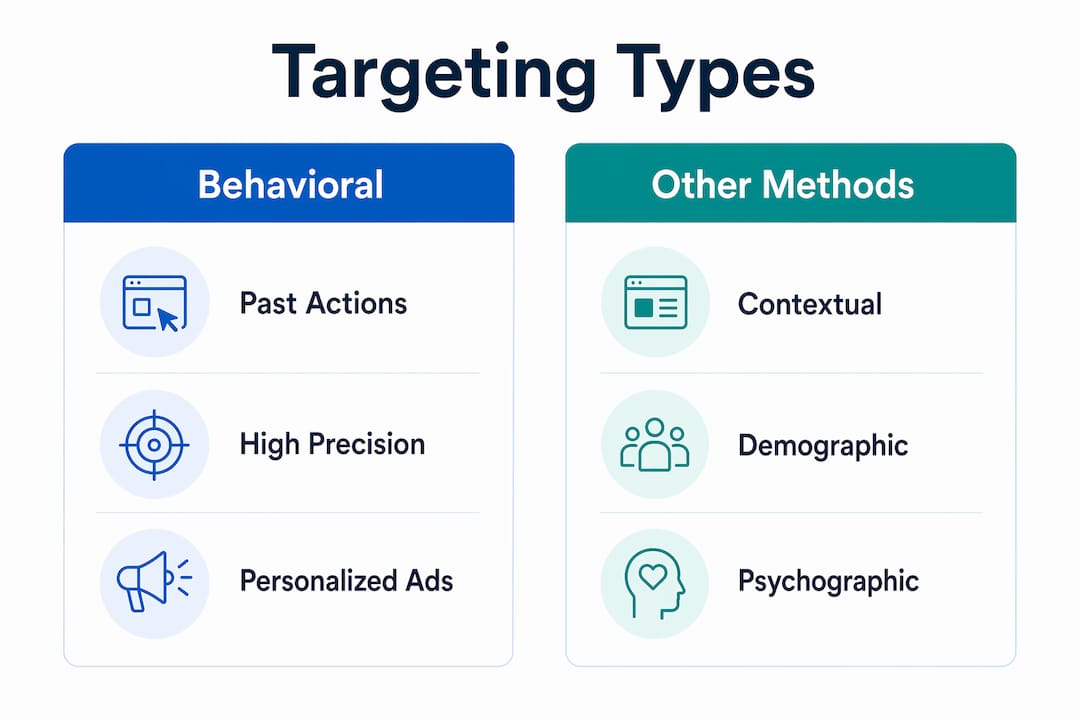
Psychographic targeting infers values and lifestyle from survey data or modeled profiles. It is useful for brand positioning but weak for direct response. Behavioral data reflects what people actually do, not what they say they care about.
What are the benefits of behavioral targeting for ecommerce?
Behavioral targeting reaches high-intent audiences at precise moments by using observed actions rather than static data. For ecommerce brands, that precision translates directly into higher engagement and better return on ad spend.
The most concrete benefits show up in three areas:
- Cart abandonment recovery: A shopper who added items to a cart and left is a high-intent signal. Retargeting that shopper with a reminder ad or a Klaviyo abandoned cart email converts at a far higher rate than a generic promotional message.
- Product page retargeting: Users who viewed a specific product but did not add it to their cart can be served dynamic ads featuring that exact product. This keeps the brand visible during the consideration phase.
- Personalized email segments: Behavioral data from your store feeds directly into email segmentation workflows. Frequent buyers get VIP offers. Deal seekers get sale alerts. New visitors get educational content about your brand.
Behavioral marketing connects data collection, segmentation, and personalized response in a continuous loop. Each new action a customer takes refines their segment and improves the next message they receive. Over time, this loop builds a more accurate picture of each customer’s preferences than any static profile could.
Pro Tip: Map your behavioral segments to specific funnel stages. Product viewers need awareness-level creative. Cart abandoners need urgency. Post-purchase customers need upsell or loyalty messaging. Matching the creative to the stage is where personalization boosts retail sales most effectively.
The advantages of targeted advertising built on behavioral data extend to ad spend efficiency as well. When your audience segments reflect real intent, you spend less money showing ads to people who are unlikely to buy, and more on people who have already demonstrated interest.
What are the privacy challenges for behavioral targeting in 2026?
Privacy regulations have reshaped how behavioral targeting operates. Marketers are shifting toward first-party authenticated data, contextual targeting, and compliant consent flows to adapt to these changes. The shift is not optional. It is driven by law.
The main compliance steps marketers must take in 2026:
- Audit your tracking stack. Identify every pixel, cookie, and tag on your site. Know what data each one collects and whether it requires consent under GDPR or the ePrivacy Directive.
- Implement a consent management platform. Tools like OneTrust or Cookiebot collect and store user consent records. Without documented consent, behavioral data collected via cookies is not legally usable in the EU.
- Shift to first-party data collection. Build email lists through opt-in forms, loyalty programs, and post-purchase surveys. First-party data collected with clear consent is the most durable foundation for behavioral targeting.
- Review analytics tracking. Consent obligations may apply even for first-party or analytics tracking, requiring marketers to carefully manage consent flows per ePrivacy Article 5(3). Many brands underestimate this requirement.
- Test server-side tagging. Moving tracking from the browser to the server reduces reliance on third-party cookies and improves data accuracy in privacy-restricted environments.
The deprecation of third-party cookies by major browsers accelerates this shift. Brands that built their behavioral targeting entirely on third-party cookie pools now face significant gaps in audience data. The brands that invested early in first-party data strategies are better positioned to maintain targeting precision as cookie-based signals disappear.
High-quality event data, fast propagation into segment models, and effective deduplication are critical to the performance of behavioral targeting systems. Operational ad stacks update audiences continuously as new behaviors are tracked. That continuous update cycle only works if the underlying data is clean and deduplicated.
Key Takeaways
Behavioral targeting outperforms demographic and contextual methods because it acts on what people actually do, not on who they are assumed to be.
| Point | Details |
|---|---|
| Definition and core mechanism | Behavioral targeting uses observed online actions to deliver personalized ads and content matched to user intent. |
| Data inputs that drive it | Pixels, cookies, CRM uploads, and app events feed the segments that power real-time ad delivery. |
| Advantage over other methods | Behavioral data predicts future interest more reliably than demographic or psychographic profiles. |
| Ecommerce applications | Cart abandonment emails, product retargeting, and personalized segments each map to a specific funnel stage. |
| Privacy compliance in 2026 | First-party data, consent management platforms, and server-side tagging are now required infrastructure, not optional upgrades. |
Why creative matching matters more than segment size
Most marketers I work with focus on building bigger segments. They want more data points, broader audiences, and wider reach. That instinct is understandable, and it is usually wrong.
The real performance gap in behavioral targeting comes from creative-message alignment, not audience size. A segment of 500 cart abandoners served a message that directly addresses why they left converts better than a segment of 50,000 site visitors served a generic brand ad. The behavior signal tells you exactly where someone is in the decision process. The creative has to meet them there.
I have seen brands run technically correct behavioral targeting setups and still get poor results because their ad creative did not change between segments. The same banner went to first-time visitors and to people who had already bought twice. That is not personalization. That is just targeting with extra steps.
The other issue I see consistently is consent management being treated as a legal checkbox rather than a data quality problem. Brands that collect behavioral data without proper consent flows end up with polluted segments. When non-consenting users get mixed into behavioral audiences, the signal quality drops, and campaign performance suffers. Clean consent is not just a compliance requirement. It is a data integrity requirement.
My practical advice: start with your highest-intent segment, which is cart abandoners, and build the most specific creative you can for that group. Measure the result. Then work backward through the funnel. That approach builds confidence in the system and produces results fast enough to justify the investment in proper data infrastructure.
— Leon
How Swyftinteractive helps ecommerce brands act on behavioral data
Behavioral targeting only delivers results when your data infrastructure, segmentation logic, and automation workflows are built to work together. Swyftinteractive specializes in exactly that combination for ecommerce brands.
Swyftinteractive builds Klaviyo automation systems that turn behavioral signals like product views, cart additions, and purchase history into personalized email sequences that run automatically. The agency’s ecommerce growth strategy work covers the full funnel, from first-party data collection through post-purchase retention. If you want to see how behavioral segmentation fits into a complete email marketing system, the email marketing automation guide is a practical starting point for understanding what a well-built workflow looks like in practice.
FAQ
What is behavioral targeting in simple terms?
Behavioral targeting is the practice of showing personalized ads or content based on a person’s past online actions, such as pages visited, products viewed, or purchases made. It uses real behavior signals instead of assumed demographic traits to match messages to intent.
How does behavioral targeting differ from contextual targeting?
Contextual targeting places ads based on the content of the page currently being viewed. Behavioral targeting uses a person’s historical actions across sessions and sites, so ads follow the user even after they leave the original website.
What data does behavioral targeting use?
Behavioral targeting relies on browsing history, search queries, purchase records, app events, and CRM data. These inputs are collected via pixels, cookies, and first-party data sources, then used to build audience segments for ad delivery.
Is behavioral targeting legal under GDPR?
Behavioral targeting is legal under GDPR when users give explicit, informed consent for tracking. Marketers must use a consent management platform, document consent records, and avoid using behavioral data collected without proper consent flows.
What is the best starting point for implementing behavioral targeting?
Cart abandonment is the highest-intent behavioral segment and the best starting point. Build a dedicated retargeting ad or Klaviyo email flow for cart abandoners first, then expand to product viewers and post-purchase segments as your data infrastructure matures.