
TL;DR:
- Retargeting includes email, SMS, and behavioral triggers, not just paid ads.
- It targets warm audiences who already showed interest, boosting conversion rates.
- Ongoing management and testing are essential for effective, profitable retargeting campaigns.
Most ecommerce owners think retargeting means chasing shoppers around the internet with banner ads. That misconception costs real money. Retargeting is far broader than paid ads alone. It includes email automation, SMS, personalized follow-ups, and behavioral triggers that pull interested shoppers back to your store at exactly the right moment. The brands quietly doubling their revenue aren’t spending more on acquisition. They’re recovering the shoppers who already showed up, browsed, and left. This guide breaks down what retargeting actually is, which channels work best, and how tools like Klaviyo turn abandoned carts into completed orders through smart, automated workflows.
Table of Contents
- What is retargeting in ecommerce?
- Types of retargeting: Email, ads, and more
- Benefits of retargeting for ecommerce growth
- Practical steps: Building your retargeting strategy
- Why successful ecommerce retargeting skips the ‘set-and-forget’ trap
- Take your ecommerce retargeting to the next level
- Frequently asked questions
Key Takeaways
| Point | Details |
|---|---|
| Retargeting defined | Retargeting is a focused marketing approach that targets shoppers who have shown interest but left without purchasing. |
| Email automation power | Automated emails like abandoned cart reminders drive high ROI and boost ecommerce sales. |
| Business growth impact | Effective retargeting increases repeat purchases, ROI, and keeps acquisition costs low. |
| Actionable strategy steps | Segmentation, automation, continuous optimization help you build and improve retargeting campaigns. |
What is retargeting in ecommerce?
Retargeting is the practice of re-engaging people who visited your store but didn’t buy. They browsed a product page, maybe added something to their cart, and then disappeared. Retargeting gives you a second shot at converting them using personalized messages across multiple channels.
Here’s what makes retargeting different from standard advertising: you’re not trying to reach cold audiences. You’re speaking to people who already know your brand. That distinction matters because warm audiences convert at dramatically higher rates. Retargeting increases conversions by focusing on visitors who have already shown genuine interest in what you sell.
A few myths worth clearing up right now:
- Retargeting is only for big brands. Wrong. Any store with website traffic can run retargeting campaigns, including small Shopify stores with a few hundred monthly visitors.
- It’s intrusive and annoying. Only when done poorly. Relevant, well-timed messages feel helpful, not pushy.
- It requires a big ad budget. Email retargeting costs almost nothing compared to paid media and often outperforms it.
- Retargeting is just abandoned cart emails. It covers the full customer journey, from first visit to post-purchase follow-up.
Every effective retargeting campaign starts with audience segmentation. You need to know who you’re targeting before you craft the message. A visitor who viewed a product once behaves differently from someone who added three items to their cart and reached checkout. Treating them the same way wastes budget and goodwill.
“Segmentation is the foundation of retargeting. Without it, you’re sending the right message to the wrong person at the wrong time.”
Building segments based on behavior, purchase history, and engagement level is one of the core marketing strategies that separates growing ecommerce brands from stagnant ones. Once your segments are defined, you can craft messages that feel personal rather than generic.
The mechanics of email segmentation in ecommerce go deeper than most brands realize. You can segment by product category viewed, time since last visit, average order value, and even device type. The more precise your segmentation, the sharper your retargeting becomes.
Types of retargeting: Email, ads, and more
Now that you know the basics, let’s explore the main types of retargeting and how they compare.
Retargeting isn’t a single tactic. It’s a collection of channels, each with its own strengths, costs, and ideal use cases. Here’s how the main options stack up:
| Channel | Cost per result | Personalization | Speed to launch |
|---|---|---|---|
| Email automation | Low | High | Fast |
| Google/Facebook ads | Medium to high | Medium | Medium |
| SMS marketing | Low to medium | High | Fast |
| Push notifications | Low | Medium | Fast |
Email retargeting is the most cost-effective channel by a wide margin. Email retargeting delivers an average ROI of $36 for every $1 spent, which beats paid ads consistently. Klaviyo makes this channel especially powerful for ecommerce brands because it connects directly to your store data and triggers automated flows based on real shopper behavior.
Paid ad retargeting through Google and Meta works well for visual products and impulse categories. You install a pixel on your site, and the platform shows banner or video ads to your past visitors as they browse other websites and social feeds. The downside is cost. Competitive niches can push cost-per-click high, and without tight audience controls, you burn budget on low-intent visitors.

SMS retargeting is growing fast. Open rates for SMS hover above 90%, which makes it a strong complement to email. The key is using it sparingly and only for high-value moments like cart abandonment or back-in-stock alerts.
Other channels worth considering:
- Push notifications for mobile app users
- Personalized product recommendation emails
- Post-purchase upsell sequences
- Win-back campaigns for lapsed customers
Pro Tip: Start with email automation before investing in paid retargeting. You’ll get faster results at lower cost, and the data you collect will sharpen every other channel you add later. Explore proven retargeting email strategies to see what high-performing sequences look like in practice.
Combining email with loyalty programs and retargeting creates a retention engine that compounds over time. Loyal customers respond to retargeting at higher rates and spend more per order when they return.
Benefits of retargeting for ecommerce growth
Understanding the methods is important, but what’s the real business impact?
Retargeting doesn’t just recover lost sales. It reshapes how your entire revenue model performs over time. Here are three core benefits that show up consistently across ecommerce brands that commit to retargeting:
- Higher conversion rates without increasing ad spend. You’re working with a warmer audience, so every dollar goes further. Retargeting visitors convert at significantly higher rates than cold traffic.
- Reduced ad waste. Instead of broadcasting to everyone, you focus budget on people who already engaged. This precision cuts wasted impressions and improves return on ad spend.
- Enhanced personalization at scale. Automated tools like Klaviyo let you deliver individualized messages to thousands of shoppers simultaneously, creating experiences that feel one-on-one.
The retention angle is where retargeting really compounds. Retail ecommerce brands see up to a 70% increase in repeat purchases with active retargeting campaigns. That’s not a marginal improvement. That’s a fundamental shift in how often your existing customers come back.
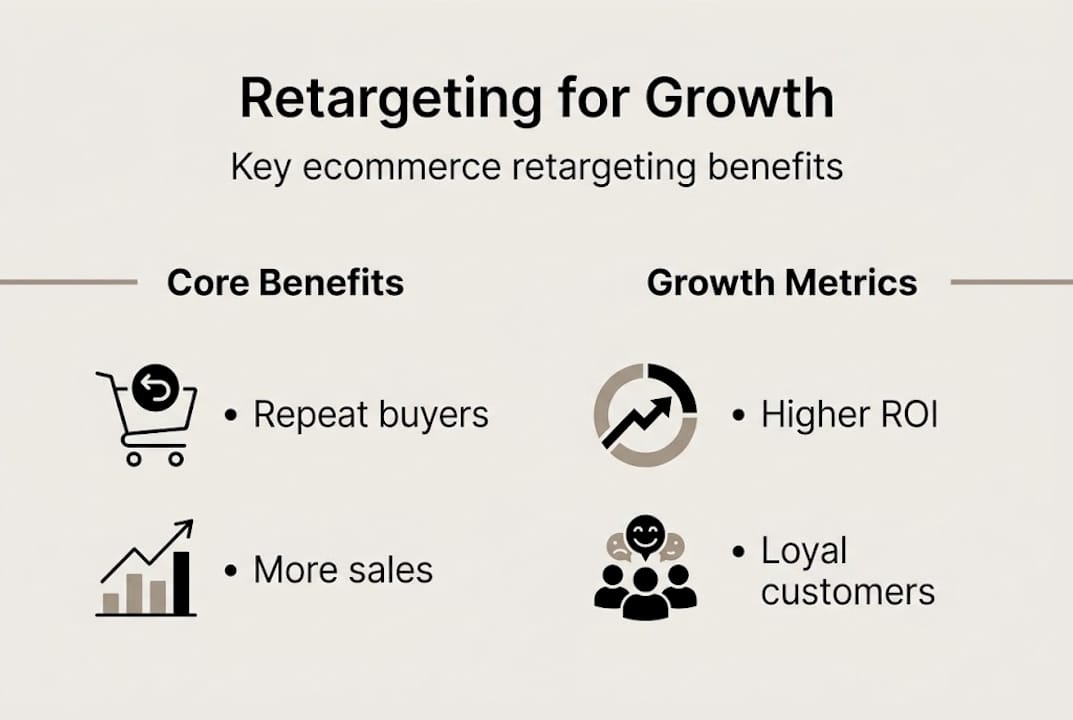
Customer lifetime value (CLV) is the metric that ties this all together. When you retain customers through smart retargeting, your CLV climbs without a proportional increase in acquisition costs. Retention-driven growth is one of the highest-leverage moves available to ecommerce brands, and retargeting is the engine that powers it.
| Metric | Without retargeting | With retargeting |
|---|---|---|
| Repeat purchase rate | Baseline | Up to 70% higher |
| Cart recovery rate | Under 5% | 10 to 15% or more |
| Email ROI | Variable | Average $36 per $1 spent |
Beyond the numbers, retargeting improves the customer experience. Shoppers who receive a well-timed reminder about a product they genuinely wanted don’t feel marketed to. They feel understood. That emotional connection builds brand loyalty faster than any discount campaign. Pair retargeting with consistent tracking of ecommerce metrics and you’ll spot opportunities to improve at every stage of the funnel.
Practical steps: Building your retargeting strategy
With benefits established, let’s lay out the key steps toward building your own winning strategy.
Building a retargeting strategy doesn’t require a massive team or a complicated tech stack. It requires clarity on your audience, a solid automation setup, and a commitment to testing. Here’s a straightforward process to follow:
- Define your audience segments. Start with three core groups: cart abandoners, product page viewers who didn’t add to cart, and past purchasers. These segments have different intent levels and need different messages.
- Craft your message for each segment. Cart abandoners need urgency and a clear path back to checkout. Product viewers need social proof and a reason to trust. Past purchasers need personalized product recommendations based on what they already bought.
- Set up your automation flows in Klaviyo. Klaviyo enables ecommerce brands to automate retargeting workflows with segmentation and personalization built directly into the platform. Connect your store, define your triggers, and let the automation run.
- Launch and monitor. Watch open rates, click rates, and conversion rates during the first two weeks. Identify which flows are underperforming and why.
- Optimize based on real data. Change one variable at a time. Subject line, send time, offer, or image. Let each test run long enough to reach statistical significance before drawing conclusions.
Pro Tip: A/B test your subject lines before anything else. Subject line performance has the biggest single impact on email open rates, and a 10% improvement in opens compounds across every campaign you send.
Integrating Klaviyo with your ecommerce platform takes less than an hour for most stores. Once connected, you have access to real-time behavioral data that makes email automation in ecommerce genuinely powerful rather than just convenient. Layer in personalizing email campaigns using dynamic product blocks and first-name personalization to push conversion rates higher.
Why successful ecommerce retargeting skips the ‘set-and-forget’ trap
Here’s something most retargeting guides won’t tell you: automation is not a substitute for active management. We’ve seen this play out with clients repeatedly. A brand sets up a solid abandoned cart flow, sees strong results in month one, and then leaves it untouched for six months. By month four, performance has quietly eroded because customer behavior shifted, product inventory changed, and competitors adjusted their offers.
The brands that double their sales through retargeting are the ones treating their flows like living assets. They review performance monthly. They update creative seasonally. They adjust segment criteria when their customer base evolves. Ignoring customer data trends is the most common reason retargeting campaigns plateau.
One client we worked with was running a technically correct retargeting setup but hadn’t updated their messaging in over a year. After refreshing the copy, rebuilding the segments, and adding a post-purchase upsell flow, their repeat purchase rate jumped 40% within 90 days. The automation wasn’t the problem. The lack of attention was. Looking at retargeting campaign examples from brands in your category can spark ideas that your current flows are missing entirely.
Take your ecommerce retargeting to the next level
If this guide has made one thing clear, it’s that retargeting done right is a revenue multiplier, not just a recovery tactic. The next step is putting the right systems in place so your store captures more of the revenue it’s already generating.
At Swyft Interactive, we build and manage Klaviyo automation systems designed specifically for ecommerce growth. From abandoned cart flows to full post-purchase sequences, our work is built around measurable outcomes. Explore our step-by-step email automation resources to see how the setup process works, or dig into the specific Klaviyo automation advantages that make it the top choice for serious ecommerce brands. Your next campaign starts here.
Frequently asked questions
What is retargeting in ecommerce?
Retargeting is a marketing strategy that re-engages visitors who left your store without purchasing, using channels like email, ads, or SMS to bring them back. It focuses on users who already showed interest, which is why conversion rates are significantly higher than cold traffic campaigns.
How effective is email retargeting compared to ads?
Email retargeting consistently outperforms paid ads on ROI. Email retargeting delivers an average return of $36 for every $1 spent, making it the most cost-efficient retargeting channel available to ecommerce brands.
What tools are best for ecommerce retargeting?
Klaviyo is the leading platform for ecommerce email retargeting because it connects directly to your store data and automates personalized workflows. Klaviyo enables brands to build segmented, behavior-triggered retargeting sequences without manual effort.
How do you track the ROI of retargeting campaigns?
Track conversion rate, repeat purchase rate, and customer lifetime value using your ecommerce analytics dashboard. Tracking ecommerce metrics consistently is the only reliable way to measure whether your retargeting investment is paying off.