
TL;DR:
- Paid ads management involves planning, executing, and continuously optimizing campaigns to achieve measurable business results. It requires setting revenue-focused KPIs, precise conversion tracking, and disciplined scaling, rather than relying solely on automation or vanity metrics. Successful management hinges on strategic human decisions and ongoing performance analysis across platforms like Google Ads, Meta, and TikTok.
Paid ads management is the ongoing process of planning, executing, monitoring, and optimizing paid advertising campaigns across platforms like Google Ads, Meta, and TikTok to drive measurable business outcomes. Most marketing professionals know the term, but fewer treat it with the discipline it demands. At its core, paid media management combines budget control, audience targeting, creative development, and performance measurement into one continuous cycle. The KPIs that define success, including ROAS, CPA, and CTR, are not just reporting numbers. They are the levers you pull to make campaigns profitable.
What does paid ads management actually involve?
Paid ads management, also called PPC management when focused on pay-per-click channels, covers every decision made between setting a campaign goal and hitting that goal profitably. It breaks into four distinct phases.
-
Planning. You define campaign objectives, set budgets, identify target audiences, and choose platforms. A lead generation campaign for a B2B software company looks nothing like a product sales campaign for a Shopify store. The planning phase forces you to align spend with the specific business outcome you need.
-
Execution. You build ad creatives, write copy, configure bidding strategies, and launch. Bidding choices, whether manual CPC, Target CPA, or Target ROAS, directly affect how the platform’s algorithm allocates your budget. Getting this wrong from day one costs money that you cannot recover.
-
Monitoring and optimization. Daily monitoring and relentless optimization keep campaigns from drifting. This means pausing underperforming ad sets, reallocating budget to top performers, testing new creatives, and adjusting audience parameters based on real data.
-
Measurement and reporting. Conversion tracking ties every dollar spent to a business result. Without it, you are flying blind. The operational cadence most teams use includes daily performance checks and monthly strategic reviews to evaluate scaling decisions.
Pro Tip: Set your primary conversion action before you launch. Platforms like Google Ads and Meta optimize toward whatever signal you give them. If you track form fills but care about closed revenue, you are training the algorithm on the wrong outcome.
Which KPIs should you track and why?

The difference between a metric and a KPI is purpose. A metric records what happened. A KPI measures whether what happened moved you toward a business goal. Key paid media KPIs in 2026 include ROAS, CPA, CTR, CVR, and Impression Share. Each one tells a different part of the story.
Here is how the core KPIs map to decisions:
| KPI | What it measures | Decision it drives |
|---|---|---|
| ROAS (Return on Ad Spend) | Revenue generated per dollar spent | Budget allocation and campaign viability |
| CPA (Cost Per Acquisition) | Cost to acquire one customer or lead | Bid strategy and audience refinement |
| CTR (Click-Through Rate) | Ad relevance and creative performance | Creative testing and copy iteration |
| CVR (Conversion Rate) | Landing page and offer effectiveness | Landing page optimization and offer testing |
| Impression Share | Visibility relative to total eligible impressions | Competitive positioning and budget sizing |
Focusing on revenue-linked KPIs rather than vanity metrics like raw clicks or impressions is the defining habit of high-performing ad managers. Clicks alone tell you nothing about profitability. A campaign generating 50,000 clicks at a 0.2% conversion rate is not a success story. It is a budget drain.
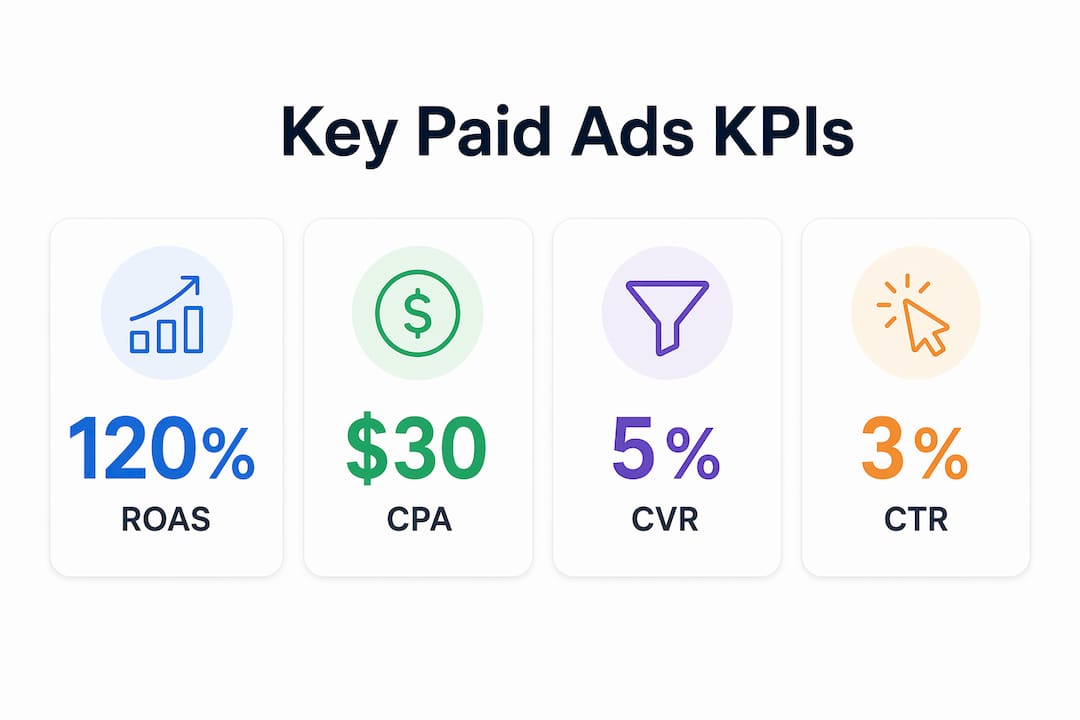
The most common mistake is optimizing for CTR when the actual goal is revenue. High CTR with low CVR means your ad is attracting the wrong audience or your landing page is failing to convert. You need both numbers in the same view to diagnose the real problem.
Understanding ecommerce KPIs for smarter growth also means knowing when a KPI is telling you to act versus when it is just noise. Impression Share dropping by 5% on a Monday morning is not a crisis. ROAS dropping 40% over a two-week period is.
How do you set up conversion tracking correctly?
Conversion tracking precision is a gating factor for every paid ads strategy. Incomplete or incorrect tracking leads directly to wasted spend and poor algorithm optimization. The platform cannot optimize toward outcomes it cannot see.
The practical setup steps are:
- Install the base tag. Use Google Tag Manager to deploy the Google Ads global site tag or Meta Pixel across your entire site. GTM reduces implementation errors and makes future updates faster.
- Define primary vs. secondary conversions. Primary conversions are the actions you want the bidding algorithm to optimize toward, such as purchases or qualified leads. Secondary conversions, like page views or add-to-cart events, are informational only. Mixing them degrades bidding performance.
- Test every tag before going live. Use Google Tag Assistant or Meta’s Pixel Helper to confirm tags fire correctly on the right pages. A tag firing on every page instead of only the confirmation page will double-count conversions and corrupt your data.
- Deduplicate across platforms. If you run Google Ads and Meta simultaneously, the same purchase will appear in both dashboards. Use UTM parameters and a single source of truth, such as your Shopify analytics or Google Analytics 4, to reconcile numbers.
- Import offline conversions. Linking CRM outcomes back into ad platforms significantly improves optimization by focusing the algorithm on revenue rather than superficial signals like form submissions.
Pro Tip: For accounts spending over $10,000 per month, server-side GTM bypasses browser-level limitations like ad blockers and iOS privacy restrictions, improving conversion signal accuracy and giving your bidding algorithm cleaner data to work with.
What are best practices for monitoring, scaling, and optimization?
Ongoing paid ads management is not a set-and-forget activity. It is a structured discipline with a clear operational rhythm. Here is the cadence that produces consistent results:
-
Daily checks. Review spend pacing, CPA, and ROAS at the campaign level. Flag any campaign that has spent more than 20% of its daily budget before noon without hitting target CPA. Pause ad creatives with CTR below your account average.
-
Weekly creative rotation. Test at least two to three creative variants per ad set. Identify the top performer by CVR, not CTR, and pause the rest. Rotate in fresh creatives before frequency climbs above 3.0 on paid social campaigns.
-
Controlled budget scaling. Increase budgets incrementally, by 20 to 30% at a time, only after KPIs meet targets, creative fatigue is absent, and audience saturation is low. Large budget jumps force the algorithm into a relearning phase that can last 5 to 10 days, during which performance typically drops.
-
Monthly strategic reviews. Evaluate audience performance, platform mix, and campaign structure. Ask whether your current KPIs still align with your business goals. A campaign that was profitable in Q1 may need restructuring in Q3 as competition and seasonality shift.
-
Audience refresh cycles. Lookalike audiences and interest-based segments decay over time. Refresh your seed audiences every 60 to 90 days using updated customer lists from your CRM or email platform.
The paid social scaling approach that consistently works is patience combined with data. Marketers who chase scale by doubling budgets overnight almost always trigger algorithm relearning dips that erase the gains they were chasing.
How do paid advertising strategies differ by platform and goal?
Paid search, paid social, and display campaigns each operate on different intent signals, and managing them requires different strategies.
Paid search on Google Ads targets users who are actively searching for a solution. The intent is high, which means CPA tends to be higher but conversion quality is better. Keyword selection, match types, and negative keyword lists are the primary levers. Google’s 2026 lead management dashboard now centralizes funnel reporting, improving bidding prioritization toward qualified leads rather than raw form submissions. This is a meaningful shift for B2B advertisers who have historically struggled to connect ad spend to pipeline value.
Paid social on Meta, TikTok, and Pinterest targets users based on behavior, interests, and demographics. Intent is lower, so creative quality and audience precision matter more. eCommerce brands running paid ads for growth typically find that paid social excels at top-of-funnel awareness and retargeting, while paid search captures the conversion at the bottom.
Display and programmatic campaigns prioritize reach and brand visibility. CTR is low by design. Impression Share and view-through conversions are the relevant KPIs here, not CPA.
Aligning campaign goals with measurement creates the conditions for campaigns that drive real business results. A brand awareness campaign judged by CPA will always look like a failure. A conversion campaign judged by impressions will always look like a success. Matching the KPI to the objective is not optional. It is the foundation of every sound paid advertising strategy.
Key takeaways
Effective paid ads management requires precise conversion tracking, revenue-linked KPIs, and disciplined scaling to produce consistent, profitable results.
| Point | Details |
|---|---|
| Define primary conversions first | Set purchase or lead actions as primary before launch so bidding algorithms optimize toward real outcomes. |
| Track revenue-linked KPIs | Prioritize ROAS, CPA, and CVR over clicks and impressions to measure actual business impact. |
| Scale budgets incrementally | Increase spend by 20 to 30% at a time to avoid algorithm relearning dips that erode performance. |
| Match KPIs to campaign objectives | Awareness campaigns need reach metrics; conversion campaigns need CPA and ROAS. |
| Audit conversion tracking regularly | Double-counting and misfired tags corrupt bidding data and inflate reported performance. |
Why automation alone will not save your paid campaigns
I have reviewed hundreds of ad accounts over the years, and the pattern is always the same. The accounts that underperform are not failing because of bad creative or wrong platforms. They are failing because the person managing them handed control to the algorithm without giving it the right inputs.
Paid ads management is increasingly about human strategic decisions on bidding and messaging while execution leverages automation. That framing is exactly right, but most marketers read it backward. They automate the strategy and manually tinker with the execution. They let Smart Bidding run on incomplete conversion data, then manually adjust bids by day of week as if that will fix the underlying problem.
The discipline that actually moves results is upstream. It is setting the right conversion actions, building the right audience segments, and writing copy that speaks to a specific customer problem. Automation amplifies whatever foundation you build. If the foundation is weak, automation makes the waste happen faster.
The other trap I see constantly is chasing vanity metrics because they are easier to report. A 5% CTR looks great in a slide deck. It means nothing if your CVR is 0.3% and your ROAS is 0.8. Report what your CFO cares about, which is revenue per dollar spent, and you will make better decisions every time.
— Leon
How Swyftinteractive can help you manage paid ads for real growth
Swyftinteractive builds full-funnel eCommerce growth systems that connect paid advertising to conversion tracking, customer journey mapping, and post-purchase revenue programs. If your paid campaigns are generating traffic but not profitable revenue, the problem is usually in the measurement layer or the post-click experience, not the ads themselves. Swyftinteractive’s ecommerce growth and automation services are designed to fix exactly that, combining precise analytics setup with paid media strategy to turn ad spend into scalable, measurable revenue. Reach out to discuss where your current campaigns are leaking value.
FAQ
What is paid ads management in simple terms?
Paid ads management is the process of planning, running, and continuously optimizing paid advertising campaigns on platforms like Google Ads and Meta to hit specific business goals. It covers everything from budget setting and audience targeting to conversion tracking and performance analysis.
What is the difference between paid ads management and PPC management?
PPC management specifically refers to pay-per-click campaigns, primarily on search engines like Google. Paid ads management is the broader term that covers all paid channels, including paid social, display, and programmatic advertising.
Which KPIs matter most for paid ads?
ROAS, CPA, CVR, CTR, and Impression Share are the core paid media KPIs that tie campaign performance to business outcomes. ROAS and CPA are the most directly linked to profitability and should anchor every optimization decision.
How often should you optimize paid ad campaigns?
Daily monitoring is the standard for active campaigns, with weekly creative reviews and monthly strategic audits. High-spend accounts may require intraday checks to catch budget pacing issues before they compound.
Why does conversion tracking matter so much?
Conversion tracking tells the bidding algorithm which users to target more aggressively. Without accurate tracking, platforms optimize toward the wrong signals, which wastes budget and produces poor-quality leads or sales.