
TL;DR:
- Full-funnel growth aligns marketing efforts across every stage of the customer journey to increase revenue. Most brands focus only on conversion ads, losing potential in awareness, engagement, and retention. Implementing a full-funnel approach improves predictability, customer lifetime value, and long-term business growth.
Full-funnel growth is the practice of aligning marketing efforts across every stage of the customer journey, from first awareness through post-purchase retention, to drive predictable and compounding revenue. Most eCommerce brands lose money by focusing only on conversion ads while ignoring the stages before and after the sale. A full-funnel marketing strategy treats acquisition, engagement, conversion, and retention as one connected system. Tools like Klaviyo, platforms like Shopify, and emerging AI search channels all play defined roles in that system. The brands winning in 2026 are not spending more. They are spending smarter across the entire funnel.
What is full-funnel growth and how does it work?
Full-funnel growth is defined as the coordinated management of marketing touchpoints across all four funnel stages: awareness, consideration, conversion, and retention. The goal is not just to acquire customers but to build a system where each stage feeds the next. Full-funnel marketing aligns brand marketing, performance marketing, content, automation, and retention into one continuous growth process. That integration is what separates it from traditional campaign-by-campaign thinking.

The standard industry term for this approach is “full-funnel marketing,” and the growth application simply means using that framework to drive measurable business expansion over time. A brand running paid ads without email retention, or building content without conversion rate work, is running a partial funnel. Partial funnels produce inconsistent results. Full-funnel systems produce compounding ones.
What are the core stages of the full-funnel growth process?
Four core stages define the full-funnel growth process: TOFU (top of funnel), MOFU (middle of funnel), BOFU (bottom of funnel), and post-purchase retention. Each stage has a distinct job, and each requires different tactics and metrics.
TOFU is about reach. The objective is to put your brand in front of people who do not know you yet. Tactics include SEO content, social media, video, and paid awareness campaigns. The KPI is impressions, reach, and new visitor traffic.
MOFU is about education and trust. Prospects know you exist but are not ready to buy. Email sequences, comparison content, retargeting ads, and case studies all belong here. The KPI is email signups, time on site, and return visits.
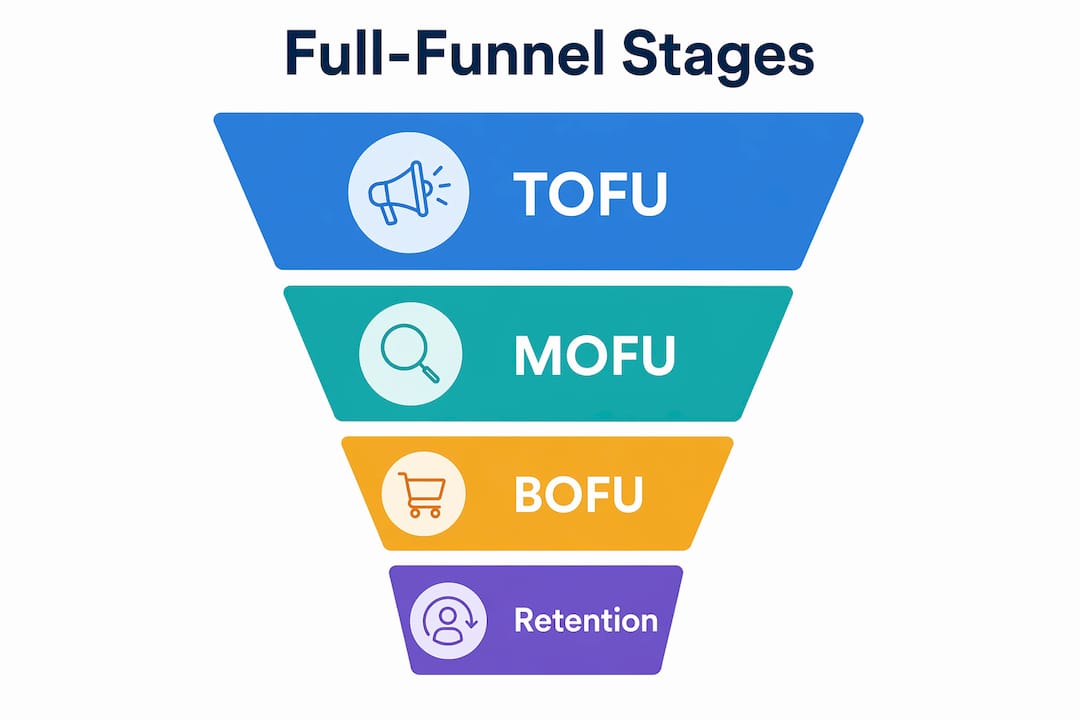
BOFU is where purchase decisions happen. Product pages, cart abandonment flows, limited-time offers, and checkout optimization all drive conversions. The KPI is conversion rate, revenue per session, and cost per acquisition.
Post-purchase retention is the stage most brands underinvest in. Retaining customers through automated email flows is significantly more cost-effective than acquiring new ones. Loyalty programs, upsell sequences, and review requests all belong here. The KPI is repeat purchase rate and customer lifetime value.
| Stage | Objective | Key Tactics | Primary KPI |
|---|---|---|---|
| TOFU | Build awareness | SEO, paid reach, video | Impressions, new visitors |
| MOFU | Nurture and educate | Email flows, retargeting, content | Signups, return visits |
| BOFU | Drive conversions | Product pages, cart recovery, offers | Conversion rate, CPA |
| Retention | Build loyalty | Klaviyo automation, loyalty programs | Repeat rate, LTV |
Pro Tip: Map your customer journey stages before choosing tactics. Most brands discover they have strong BOFU assets but almost no MOFU content. Fix the gap before scaling ad spend.
How does full-funnel growth differ from siloed marketing?
Siloed marketing treats each channel as a separate campaign with its own budget, team, and goal. A paid ads team runs conversions. An email team sends newsletters. An SEO team publishes blog posts. None of them share data or coordinate timing. Brands that unify channels and touchpoints consistently outperform those running channels in isolation.
The practical difference shows up in attribution. A siloed approach credits the last click. A full-funnel approach tracks how a blog post drove an email signup, which led to a retargeting ad click, which converted three weeks later. Without that view, you cut the channels that look expensive but actually start most purchase journeys.
The 2026 shift adds another layer. Marketers must balance traditional SEO with emerging AI search visibility to sustain acquisition at scale. AI-powered search tools like Perplexity and Google’s AI Overviews now answer buyer questions before users click any result. Brands optimized only for traditional search miss that entire traffic layer. A full-funnel approach accounts for both channels in its organic strategy.
Pro Tip: Run a channel audit before building your funnel plan. List every active channel, its current goal, and who owns it. If no one can explain how two channels connect, you have a silo problem.
How to implement full-funnel growth in eCommerce
The most effective implementation sequence starts at the bottom and works upward. Starting with BOFU assets secures immediate revenue, which then funds broader funnel expansion. Brands that try to build awareness before fixing their checkout lose money on every click.
Follow this sequence to build a working full-funnel system:
- Audit your BOFU first. Fix product pages, checkout flow, and cart abandonment emails before spending on awareness. Revenue from these fixes funds the rest.
- Build MOFU content and email sequences. Create comparison guides, how-to content, and a welcome series in Klaviyo that educates new subscribers over 5–7 emails.
- Set up post-purchase automation. A Klaviyo post-purchase email flow should include a thank-you, a product education email, a review request, and a replenishment or upsell offer.
- Launch TOFU content with SEO and AI search in mind. Write content that answers the questions your buyers ask at the start of their research. Optimize for both Google and AI search tools by writing clear, direct answers that AI systems can cite.
- Connect paid ads to each funnel stage. Run awareness campaigns to cold audiences, retargeting to MOFU visitors, and conversion campaigns to high-intent shoppers. Each ad set should have a stage-specific goal and landing page.
- Measure with full-funnel attribution. Use a model that credits multiple touchpoints. Google Analytics 4, Triple Whale, and Northbeam all support multi-touch attribution for eCommerce.
Pro Tip: The most common implementation mistake is launching TOFU campaigns before MOFU and BOFU are ready. You pay to drive traffic into a leaky funnel. Seal the bottom first.
What measurable benefits can businesses expect from full-funnel growth?
The performance data on full-funnel investment is clear. A structured full-funnel strategy drives an 81% improvement in mid-funnel ROAS and a 65% increase in video completion rates. Those numbers reflect what happens when creative and media are matched to the right funnel stage instead of running generic conversion ads everywhere.
Full-funnel growth creates predictable revenue increases by building trust and loyalty beyond the first transaction. That predictability is the real business case. Brands dependent on a single channel, whether that is Meta ads or Google Shopping, face revenue swings every time an algorithm changes or CPMs spike. A diversified funnel absorbs those shocks.
“Long-term brand awareness and trust-building take time but enable significantly more predictable and scalable growth than focusing only on bottom-funnel conversions.” — Gemius Marketing Blog
Customer lifetime value improves because retention is built into the system from the start. Post-purchase retention through automated email flows significantly improves LTV and overall funnel effectiveness. A customer who buys twice is worth three to five times more than a one-time buyer, and email automation is the most cost-effective way to drive that second purchase.
| Metric | Single-Stage Focus | Full-Funnel Approach |
|---|---|---|
| Mid-funnel ROAS | Baseline | Up to 81% improvement |
| Video completion rate | Baseline | Up to 65% increase |
| Revenue predictability | Low (channel-dependent) | High (multi-channel) |
| Customer lifetime value | Limited (one-time buyers) | Higher (repeat purchase flows) |
How are AI search and retention marketing shaping the funnel’s future?
The marketing funnel is evolving from a linear path to a complex, non-linear journey where buyers move between stages in real time. A shopper might watch a TikTok video (TOFU), read a comparison article (MOFU), abandon a cart, get a Klaviyo email, and convert two weeks later. No single channel owns that journey.
SEO remains foundational but must be supplemented with AI search optimization to cover all organic opportunity. AI-driven search tools now surface direct answers to buyer questions, which means brands need content structured for citation, not just for ranking. Short, direct answers with named entities and clear claims perform best in AI search results. Swyftinteractive covers this shift in depth in its 2026 SEO trends guide.
Personalized retention marketing is the other major force reshaping the funnel. Klaviyo’s behavioral segmentation lets brands trigger emails based on browse history, purchase frequency, and predicted churn risk. That level of personalization turns the post-purchase stage into a revenue engine rather than an afterthought. Brands using AI-driven eCommerce tools are already combining predictive analytics with automated flows to identify high-value customers before they lapse.
The flywheel model captures this shift well. Practitioners now treat the funnel as a flywheel ecosystem where each satisfied customer generates awareness for new prospects. That means retention investment directly fuels acquisition, and the two stages are no longer separate budget lines.
Key Takeaways
Full-funnel growth works because it connects acquisition, conversion, and retention into one system where each stage funds and strengthens the next.
| Point | Details |
|---|---|
| Start at the bottom | Fix BOFU assets and cart recovery before investing in awareness campaigns. |
| Unify your channels | Brands that connect channels outperform those running them in silos. |
| Automate retention | Klaviyo email flows drive repeat purchases at a fraction of new acquisition cost. |
| Add AI search to organic | Supplement traditional SEO with content structured for AI-driven search results. |
| Measure across the full funnel | Use multi-touch attribution to see which channels start journeys, not just close them. |
Why most eCommerce brands are only running half a funnel
After working with eCommerce brands across a range of categories, the pattern I see most often is not a bad strategy. It is an incomplete one. Teams have solid paid ads and a decent product page, but nothing in between and nothing after the sale. They are running the last 20% of the funnel and wondering why growth feels expensive and unpredictable.
The Klaviyo piece is where I see the biggest gap. Brands set up a welcome series and a cart abandonment flow, then stop. They never build the post-purchase sequence that turns a first-time buyer into a loyal customer. That sequence, three to five emails over 30 days, is often the highest-ROI work in the entire funnel. It costs almost nothing to run once it is built.
The AI search shift is real, but I would not let it distract you from fixing the basics first. If your MOFU content is thin and your retention emails are generic, no amount of AI optimization will fix your unit economics. Get the fundamentals right, then layer in the new channels. The brands I respect most in this space are not chasing every trend. They are building systems that compound.
— Leon
How Swyftinteractive helps eCommerce brands build full-funnel systems
Swyftinteractive builds the complete growth infrastructure that eCommerce brands need to run a real full-funnel strategy, not just one piece of it.
The team combines high-converting website development with Klaviyo email automation to cover every stage from first visit to repeat purchase. If you are ready to move from scattered campaigns to a connected system, the eCommerce growth strategy guide is a strong starting point. For a practical checklist covering both your website and Klaviyo setup, the eCommerce website and Klaviyo checklist walks through every element that drives measurable results. Swyftinteractive works with brands that are serious about building revenue systems, not just running campaigns.
FAQ
What is full-funnel growth in simple terms?
Full-funnel growth is the practice of running coordinated marketing across all stages of the customer journey, from awareness to retention, so each stage supports the next and revenue compounds over time.
How does full-funnel marketing differ from performance marketing?
Performance marketing focuses on direct-response conversions at the bottom of the funnel. Full-funnel marketing includes awareness, nurturing, and retention stages alongside conversion, creating a more complete and resilient growth system.
What tools are used in a full-funnel eCommerce strategy?
Common tools include Klaviyo for email automation and retention flows, Google Analytics 4 or Triple Whale for multi-touch attribution, and content platforms for TOFU and MOFU organic reach across both traditional and AI-driven search.
Where should eCommerce brands start when implementing full-funnel growth?
Start with BOFU optimization. Fix product pages, checkout flow, and cart abandonment emails first. That work generates immediate revenue and funds the broader funnel build-out.
How long does it take to see results from a full-funnel strategy?
BOFU improvements can show results within weeks. MOFU and TOFU investments in content and brand awareness typically take three to six months to build measurable momentum, which is why retention automation is the fastest path to early ROI.