TL;DR:
- Post-purchase marketing transforms a one-time transaction into a long-term customer relationship that increases loyalty and revenue. Companies that strategically implement timing, segmentation, and personalized content see significant improvements in retention, CLV, and profits. Focusing on genuine engagement and recovery opportunities elevates brands beyond generic flows, fostering sustainable growth.
The sale isn’t the finish line. For e-commerce brands that want sustainable growth, it’s actually the starting point of the most profitable relationship you’ll ever build with a customer. Post-purchase marketing is a set of tactics that engage customers after they complete a transaction to maintain engagement, build trust, and encourage repeat purchases. Done right, it transforms one-time buyers into loyal advocates, reduces churn, and unlocks revenue that most brands simply leave on the table. This guide walks you through every essential tactic, from timing to loyalty to automation.
Table of Contents
- Understanding post-purchase marketing: beyond the sale
- Core components of effective post-purchase marketing
- How post-purchase marketing lifts revenue and retention
- Personalizing timing and content for maximum effect
- Integrating loyalty, referrals, and upsells into post-purchase flows
- Why most post-purchase marketing falls short—and how to get it right
- Boost your results with expert post-purchase marketing solutions
- Frequently asked questions
Key Takeaways
| Point | Details |
|---|---|
| Retention powerhouse | Post-purchase marketing is crucial for turning one-time buyers into loyal repeat customers. |
| Revenue uplift proven | Brands that optimize post-purchase flows see significant increases in revenue and customer lifetime value. |
| Go beyond transactional | Success requires strategic messaging, not just standard order confirmations or thank-you emails. |
| Personalization matters most | Timing and content tailored to customer behavior and product lifecycle outperform generic sequences. |
| Integration boosts impact | Combining loyalty, referral, and upsell offers within post-purchase flows can drive exponential growth. |
Understanding post-purchase marketing: beyond the sale
Most marketing budgets pour money into acquisition. Ads, social, SEO, influencer deals. All of it focused on getting a stranger to click “buy.” Then what? For too many brands, the answer is silence until the next promotional blast. That gap is where customer relationships die and where competitors quietly win repeat business.
Post-purchase marketing fills that gap with intention. As defined by industry practitioners, it is a coordinated set of tactics designed to keep customers engaged after a transaction, build genuine trust, and create the conditions for a second purchase and beyond. The goal isn’t just to reduce churn. It’s to increase customer lifetime value (CLV), the total revenue a customer generates over their entire relationship with your brand.
Here’s why this matters so much right now:
- Acquiring a new customer costs five to seven times more than retaining an existing one
- Existing customers are 50% more likely to try a new product than new buyers
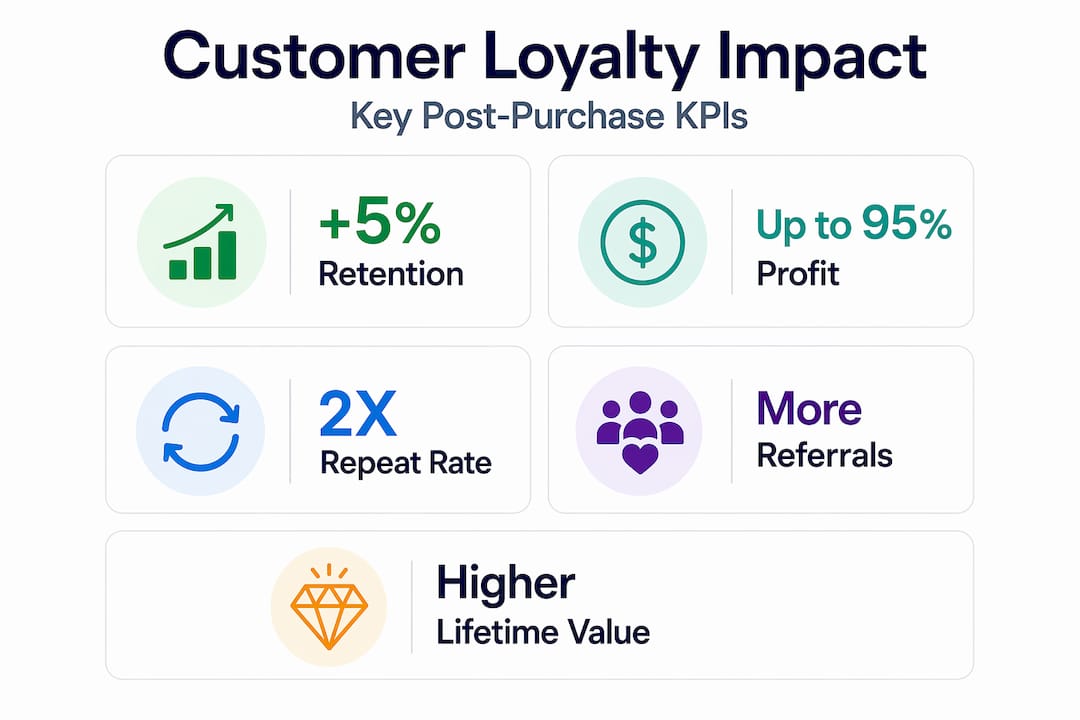
- A 5% increase in retention can generate up to a 95% increase in profits
- Post-purchase touchpoints receive some of the highest open rates of any email type because customers are actively expecting communication
“Post-purchase marketing is not an afterthought. It is the mechanism by which brands convert a transaction into a relationship.”
Effective post-purchase campaigns do exactly that. They replace silence with relevant, timely communication that makes customers feel seen, valued, and motivated to come back. When paired with smart customer retention strategies, the compound effect on CLV is significant and measurable.
Core components of effective post-purchase marketing
With the core concept defined, it’s important to see exactly which channels and messages turn a simple order confirmation into a dynamic customer journey. The spectrum runs from purely functional transactional messages to strategically designed promotional sequences, and every touchpoint carries weight.
In e-commerce, post-purchase marketing typically includes order and shipping confirmation plus delivery updates, alongside additional lifecycle communications such as product education, review requests, cross-sells and upsells, loyalty offers, referral programs, and win-back flows. Each of these serves a different purpose at a different stage of the post-purchase window.
Here’s how transactional and promotional messages compare:
| Message type | Primary purpose | Compliance notes | Typical timing |
|---|---|---|---|
| Order confirmation | Reassure and confirm | No unsubscribe required | Immediately after purchase |
| Shipping update | Build trust and reduce anxiety | No unsubscribe required | At dispatch and delivery |
| Product education | Increase product success | Unsubscribe required | Days 2 to 7 |
| Review request | Gather social proof | Unsubscribe required | Days 7 to 14 |
| Cross-sell or upsell | Grow order value | Unsubscribe required | Days 7 to 21 |
| Loyalty offer | Drive repeat purchase | Unsubscribe required | Days 14 to 30 |
| Win-back flow | Re-engage dormant buyers | Unsubscribe required | Days 60 to 90 |
The sequence matters. Think of it as a relationship arc. You don’t pitch a referral program before the customer has even received their order. You move through stages: reassurance, education, delight, and then growth.
Here are the core steps to building this sequence correctly:
- Confirm and reassure. Send the order confirmation within seconds. Make it warm, branded, and informative. Include estimated delivery timelines.
- Update proactively. Send shipping notifications at every major milestone. This reduces “where is my order” contacts dramatically.
- Educate and add value. A few days after delivery, send content that helps customers get the most from their purchase. This is especially powerful for consumables, tech, and beauty products.
- Ask for feedback or a review. Once they’ve had time to experience the product, request a review. Make it easy with a direct link.
- Introduce loyalty and referral offers. If your brand runs ecommerce loyalty programs, this is the moment to invite happy customers in.
- Suggest complementary products. Based on what they bought, recommend what pairs well. Keep it relevant, not generic.
- Plan the win-back. If they haven’t purchased again within 60 to 90 days, trigger a re-engagement sequence with a compelling offer.
Pro Tip: Always separate transactional and promotional emails at the list and sending domain level. Mixing them can hurt your deliverability and create compliance issues, especially in regions with strict email marketing laws. Automation in post-purchase marketing makes this segmentation much easier to manage at scale.
Using relationship marketing tactics throughout this sequence ensures that each message feels like a natural conversation rather than a promotional blast.
How post-purchase marketing lifts revenue and retention
Now that you know the core tactics, let’s look at the tangible business gains effective post-purchase marketing can deliver, with real numbers.
The evidence is clear. Brands that invest in structured post-purchase flows consistently outperform those that don’t on the metrics that matter most. Post-purchase marketing is strongly associated with retention and measurable revenue lift in practice, and brands often report large gains after improving these flows.
Key performance indicators (KPIs) that improve with well-built post-purchase flows include:
- Repeat purchase rate: The percentage of customers who buy again within a defined window, typically 90 to 180 days
- Customer lifetime value (CLV): Total revenue per customer over their relationship with your brand
- Email click-through rate (CTR): Post-purchase emails consistently outperform standard promotional campaigns
- Return on investment (ROI) from email: Email sequences with personalized post-purchase content generate disproportionately high returns
- Net promoter score (NPS): Happy, engaged post-purchase customers score higher and refer more
| KPI | Typical pre-optimization baseline | Post-optimization improvement |
|---|---|---|
| Repeat purchase rate | 15 to 25% | 30 to 45% |
| Email open rate | 20 to 25% | 45 to 65% |
| CLV increase | Baseline | 20 to 40% uplift |
| Churn reduction | Baseline | 10 to 30% reduction |
The revenue impact of a 5% retention increase can reach up to 95% in additional profits, according to widely cited research in retention economics. That single number reframes the entire conversation around where marketing spend should go.
Revenue from customer feedback is also often underestimated. Review request emails that generate authentic testimonials directly influence conversion rates for new buyers, creating a compounding loop where post-purchase investment drives both retention and acquisition.
The connection between retention and profit impact is not theoretical. It’s one of the highest-leverage opportunities available to any e-commerce marketing manager who wants to grow revenue without proportionally growing ad spend.
Personalizing timing and content for maximum effect
To truly outperform, it’s not just about what you send, but when and why. This is where most brands leave money on the table.
Generic post-purchase sequences are everywhere. A confirmation, a shipping update, and then a discount code ten days later. That template might have worked in 2018. Today’s buyers expect relevance. Post-purchase messaging cadence and content should be driven by product lifecycle and customer behavior, such as replenishment timing based on when the product is expected to run out, not a generic calendar schedule.
Think about what that means in practice. If you sell a 30-day supply of a supplement, your replenishment email should arrive on day 22, not day 45. If you sell a premium skincare serum that takes four weeks to show results, your educational content should land at the four-week mark when the customer is just beginning to see changes. If you sell high-consideration products like furniture or electronics, your post-purchase nurture should focus on confidence-building content, assembly tips, and care guides.
Here’s a practical framework for aligning timing with product and customer data:
- Map your product lifecycle. For each product category, define when average customers reorder, when they expect results, and when they’re most at risk of returning it or going quiet.
- Segment by purchase history. First-time buyers need reassurance and education. Repeat buyers need VIP treatment and early access to new products.
- Use behavioral triggers, not just calendar delays. If a customer opens your shipping confirmation email three times, that’s a signal worth acting on. Set up flows that respond to behavior, not just elapsed time.
- Factor in order value. A high-value purchase warrants more attentive post-purchase communication, including a personal thank-you, an extended education series, and a more generous loyalty welcome.
- Test and iterate continuously. Split test subject lines, send times, and content blocks within your post-purchase sequences every quarter.
Pro Tip: Behavioral triggers outperform calendar-based delays every single time in our experience. A customer who visits your product page twice in the first week after purchase is signaling interest in related products. Trigger a targeted cross-sell based on that behavior rather than waiting for a fixed 14-day window.
Smart lifecycle marketing treats every post-purchase moment as a data point that informs the next message. Applying lead nurturing best practices to post-purchase flows ensures that your sequences feel personalized and timely rather than automated and cold.
Integrating loyalty, referrals, and upsells into post-purchase flows
With timing and content now tailored, it’s time to embed proven tactics for boosting repeat purchases and advocacy in every post-purchase journey.
Loyalty, referral, and win-back flows are foundational components of high-performing post-purchase programs. Each one activates a different motivation. Loyalty rewards progress. Referrals leverage trust. Win-backs rekindle interest that’s gone cold.
Here are the best practices for integrating all three:
- Introduce loyalty immediately after purchase. Don’t wait. Show the customer exactly how many points they just earned and what they can redeem them for. The emotional high of a fresh purchase is the best moment to anchor a loyalty relationship.
- Make referrals frictionless. The ideal referral ask arrives after the customer has received the product and is satisfied. Give them a unique link, a clear incentive for both parties, and one tap to share. Complexity kills referral programs.
- Make upsells feel like recommendations, not ads. “Customers who bought X also love Y” is far more persuasive than a discount banner. Use purchase data to make product suggestions feel curated and personal.
- Segment win-back sequences by risk level. A customer who bought six months ago and hasn’t returned needs a different message than one who lapsed after 90 days. Personalize the offer and the urgency accordingly.
- Time loyalty tier reveals strategically. If a customer is close to hitting a new rewards tier, tell them. The motivational pull of “you’re just $20 away from Gold status” is powerful and underused.
- Use packaging inserts to extend the digital journey. A well-designed physical card in the package with a QR code linking to a loyalty signup or referral page bridges offline and online in a way that surprises customers and increases participation rates.
Studying proven loyalty program examples gives you a clear picture of what structures work across different product categories. When you’re ready to build or upgrade your own program, a solid loyalty program setup guide makes the process far less daunting. Grounding your program in relationship marketing for loyalty ensures that every tactic reinforces genuine connection rather than purely transactional incentives.
Why most post-purchase marketing falls short—and how to get it right
Here’s the uncomfortable truth: most e-commerce brands copy each other’s post-purchase flows and then wonder why results are mediocre. The same sequence, the same discount strategy, the same “rate your experience” email. It all blurs together for the customer.
The brands that win in post-purchase marketing aren’t necessarily using better tools. They’re using better judgment. They obsess over the emotional state of their customer at each point in the journey and design communication that genuinely meets them there. That’s a fundamentally different orientation than “what template should we use.”
Generic automation is better than nothing. But it’s a floor, not a ceiling. The real opportunity is in brand voice, storytelling, and hyper-relevance. A customer who just bought their first pair of premium running shoes doesn’t want a discount code. They want to feel like they made a great decision. They want validation, inspiration, and community. Give them that, and the upsell conversation becomes natural.
Feedback loops are massively underutilized. Most brands send a review request and move on. High-performing brands actually read the reviews, identify patterns, and feed those insights back into product development, customer service, and future post-purchase messaging. When a significant number of customers mention that the sizing runs small, that’s a data point that should change your post-purchase education email for that product.
The other thing most brands miss is the recovery moment. When something goes wrong, whether it’s a delayed shipment, a damaged product, or a billing issue, that moment of friction is actually a retention opportunity. Brands that respond with speed, empathy, and a genuine fix retain those customers at higher rates than brands that never had a problem at all. Building recovery sequences into your boosting retention profitably strategy is the move most competitors overlook entirely.
Post-purchase marketing is not a set of emails. It’s a philosophy. When you treat every touchpoint after the sale as an investment in a long-term relationship rather than an opportunity to squeeze more revenue, the revenue follows naturally.
Boost your results with expert post-purchase marketing solutions
If this guide has clarified the gap between where your post-purchase marketing is and where it could be, you’re not alone. Most growing e-commerce brands have the right instincts but lack the systems to execute at scale.
At Swyft Interactive, we specialize in building the exact kind of automated, personalized post-purchase ecosystems described throughout this article. From strategic flow architecture to advanced segmentation, we combine deep Klaviyo expertise with full-funnel thinking to help brands turn one-time buyers into loyal customers on autopilot. If you’re serious about building a retention engine, start with our complete guide to email marketing automation for e-commerce, or explore our Klaviyo email marketing services to see how we put these strategies to work for brands like yours.
Frequently asked questions
What are some examples of post-purchase marketing in e-commerce?
Common examples include order confirmations, shipping updates, product education emails, review requests, loyalty offers, and referral incentives. E-commerce post-purchase marketing covers the full spectrum from transactional updates to lifecycle-driven promotional flows.
Why is post-purchase marketing important for repeat sales?
It keeps your brand top-of-mind and builds relationships that drive customers back to buy again, rather than letting engagement drop after a sale. Post-purchase tactics directly address the gap between a first transaction and a second purchase.
How do you measure the ROI of post-purchase marketing?
Monitor metrics such as repeat purchase rate, customer lifetime value (CLV), and incremental revenue from post-purchase flows. Brands that invest in these measurable post-purchase gains typically see significant lifts within the first 90 days of optimization.
What is the difference between transactional and promotional post-purchase emails?
Transactional emails provide required order info, while promotional emails contain upsells, recommendations, or loyalty offers and must include unsubscribe options. Separating these at the sending domain level protects deliverability and ensures compliance.
How can timing improve post-purchase marketing results?
Tailoring send times to your product’s lifecycle and individual customer behavior leads to better engagement and higher repeat purchases. Messaging cadence driven by behavior consistently outperforms fixed-calendar approaches because it reaches customers when they’re actually ready to act.