
Every ecommerce marketing manager knows how challenging it is to turn casual browsers into loyal customers in a crowded American online marketplace. Loyalty programs promise much more than basic discounts by offering structured, data-driven systems that keep shoppers coming back. With modern customers joining multiple programs at once, your approach needs to stand out. This guide breaks down the core features and types of loyalty programs while revealing how automation and personalized engagement strategies can fuel sustained growth for your retail brand.
Table of Contents
- Defining Loyalty Programs In Ecommerce
- Major Types Of Ecommerce Loyalty Programs
- Key Features And How They Operate
- Integrating Loyalty With Email Automation
- Common Pitfalls And Optimization Tips
Key Takeaways
| Point | Details |
|---|---|
| Loyalty Programs Enhance Retention | Implementing effective loyalty programs fosters long-term customer relationships beyond one-time purchases. |
| Diverse Program Types Maximize Engagement | Utilizing various loyalty program designs—such as point-based, tiered, or cashback—can appeal to a wider customer base. |
| Personalization Drives Impact | Tailoring rewards and communications based on customer data enhances engagement and encourages repeat interactions. |
| Regular Evaluation is Crucial | Conducting quarterly audits ensures that loyalty programs meet customer expectations and remain relevant in a competitive landscape. |
Defining Loyalty Programs in Ecommerce
Loyalty programs represent strategic digital initiatives designed to transform one-time shoppers into repeat customers through structured reward mechanisms. These sophisticated marketing tools go beyond simple discounts, creating complex customer engagement strategies that incentivize continued brand interaction and purchase behavior.
In the ecommerce landscape, loyalty programs typically operate through points-based systems, tiered rewards, and personalized incentive structures. Customers earn points or credits with each purchase, which can be redeemed for discounts, free products, exclusive access, or other valuable benefits. The core objective is building long-term relationships that extend past transactional interactions, creating emotional connections between consumers and brands.
Effective loyalty programs recognize that modern consumers participate in multiple programs simultaneously, requiring brands to design unique, competitive experiences. Customer loyalty involves navigating a complex competitive landscape where rewards must feel genuinely valuable and attainable. Successful programs integrate elements like gamification, progress tracking, and personalized reward qualification to maintain customer interest and encourage ongoing engagement.
Pro tip: Track your loyalty program’s performance using granular metrics like point redemption rates, repeat purchase frequency, and average customer lifetime value to continuously refine your rewards strategy.
Major Types of Ecommerce Loyalty Programs
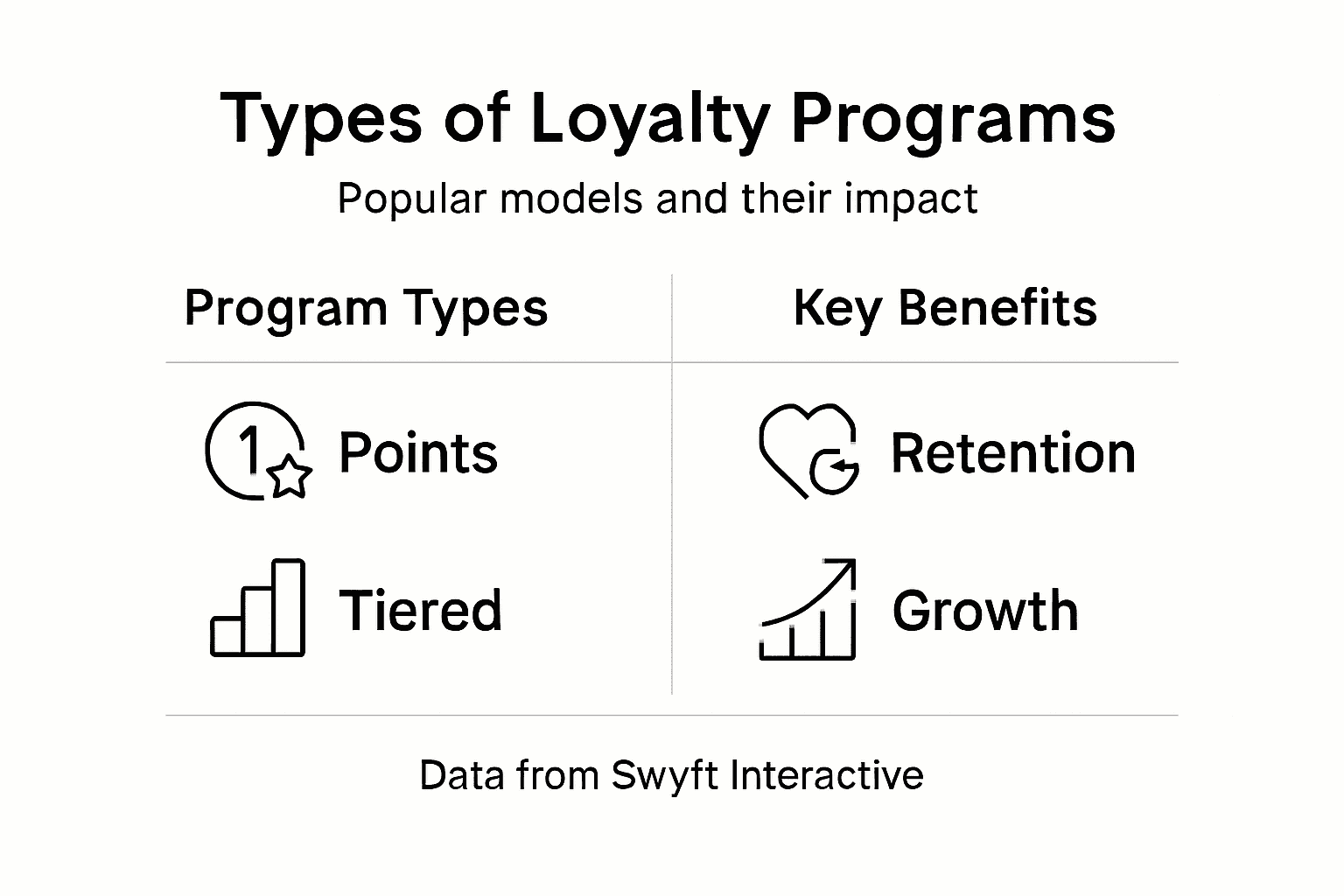
Ecommerce loyalty programs come in several strategic designs, each offering unique approaches to customer retention and engagement. Transaction-focused loyalty programs represent the foundational model where customers accumulate points or rewards based on their purchasing behavior, creating direct incentives for repeat business.
The primary categories of ecommerce loyalty programs include:
- Point-Based Programs: Customers earn points for each purchase, which can be redeemed for discounts, products, or special rewards
- Tier-Based Programs: Rewards increase in value as customers move up membership levels, encouraging higher spending and continued engagement
- Cashback Programs: Customers receive a percentage of their purchase amount back as store credit or direct monetary compensation
- Membership Programs: Exclusive access to special benefits, early product releases, or premium services
- Coalition Programs: Rewards that can be earned and redeemed across multiple partner brands and retailers
Technological advances have enabled more personalized loyalty program designs, allowing brands to create increasingly sophisticated and targeted reward structures. Modern loyalty programs leverage data analytics to understand customer preferences, customize reward offerings, and create more meaningful engagement strategies that go beyond simple transactional interactions.
Here’s a summary of how different loyalty program types influence customer experience and business results:
| Loyalty Program Type | Key Benefit for Customers | Impact on Business |
|---|---|---|
| Point-Based | Clear rewards for spending | Drives repeat purchases |
| Tier-Based | Status and exclusive perks | Boosts customer retention |
| Cashback | Immediate value return | Increases purchase frequency |
| Membership | Premium access and offers | Enhances brand loyalty |
| Coalition | Flexibility across brands | Expands customer base |
Pro tip: Implement a hybrid loyalty program approach that combines multiple reward types to maximize customer interest and engagement across different purchasing behaviors.
Key Features and How They Operate
Loyalty programs are sophisticated digital ecosystems designed to track, incentivize, and reward customer interactions. Key operational features integrate advanced tracking mechanisms that monitor customer behaviors, preferences, and purchasing patterns to create personalized engagement strategies.
The core operational components of ecommerce loyalty programs typically include:
- Point Tracking Systems: Automated platforms that calculate and update customer reward points in real-time
- Reward Qualification Algorithms: Dynamic systems that determine customer eligibility for specific rewards based on predefined criteria
- Personalization Engines: Tools that analyze individual customer data to generate tailored promotional offers
- Multi-Channel Integration: Capabilities to track and reward interactions across websites, mobile apps, and physical stores
- Automated Notification Systems: Mechanisms that inform customers about point balances, available rewards, and special promotions
Loyalty program engagement strategies require careful design to maintain customer interest. The most successful programs create seamless, low-effort experiences that provide clear value, using data analytics to continuously refine reward structures and communication approaches. Advanced programs leverage machine learning to predict customer preferences and proactively offer relevant incentives that feel personalized and meaningful.

This table outlines how core features of loyalty programs support business goals:
| Feature | Primary Function | Business Value |
|---|---|---|
| Point Tracking System | Monitors rewards instantly | Reduces manual errors |
| Personalization Engine | Tailors offers to customers | Increases campaign effectiveness |
| Multi-Channel Integration | Syncs online and offline data | Provides unified customer journey |
| Automated Notification | Sends timely reward updates | Improves customer engagement |
Pro tip: Design your loyalty program with progressive complexity, starting with simple point accumulation and gradually introducing more sophisticated reward mechanisms to maintain ongoing customer excitement.
Integrating Loyalty With Email Automation
Email automation transforms loyalty programs from static reward systems into dynamic, personalized customer engagement engines. Targeted email workflows enhance loyalty program effectiveness by delivering precisely timed, contextually relevant communications that motivate continued customer interaction and repeat purchases.
Key integration strategies for loyalty and email automation include:
- Behavioral Trigger Emails: Automated messages sent when customers reach specific loyalty milestones or point thresholds
- Personalized Reward Notifications: Real-time updates about point balances, available rewards, and upcoming expirations
- Segmented Communication Flows: Customized email journeys based on individual customer loyalty tiers and engagement levels
- Re-engagement Campaigns: Targeted messages designed to reactivate dormant loyalty program participants
- Milestone Celebration Emails: Automated communications recognizing customer anniversaries, birthdays, or significant interaction points
Dynamic communication channels leverage behavioral data to create meaningful customer interactions. Advanced email automation platforms can track customer preferences, purchase history, and loyalty program participation, enabling brands to craft hyper-personalized experiences that feel individually tailored rather than generically distributed.
Pro tip: Implement a progressive email automation strategy that gradually increases communication complexity, starting with basic trigger emails and evolving to sophisticated, predictive engagement sequences.
Common Pitfalls and Optimization Tips
Loyalty programs require strategic design to avoid common implementation mistakes that can diminish customer engagement. Ecommerce loyalty programs frequently encounter critical design challenges that can undermine their effectiveness and customer appeal.
Key pitfalls to avoid include:
- Overly Complex Redemption Processes: Creating complicated point systems that frustrate customers
- Generic Reward Offerings: Providing uninspired incentives that fail to differentiate from competitors
- Insufficient Personalization: Treating all customers identically without recognizing individual preferences
- Poor Communication: Failing to clearly explain program benefits and reward structures
- Neglecting Customer Psychology: Ignoring emotional connections and perceived value of rewards
Strategic program design demands understanding customer motivation beyond transactional interactions. Successful loyalty programs create emotional engagement by offering meaningful rewards, simplifying user experiences, and continuously adapting to changing customer expectations. This requires leveraging data analytics to develop nuanced, personalized reward strategies that feel authentic and valuable to individual customers.
Pro tip: Conduct quarterly loyalty program audits to assess engagement metrics, gather customer feedback, and proactively refine your reward structures to maintain program relevance and appeal.
Transform Your Ecommerce Loyalty Program into a Growth Engine
Building an effective loyalty program requires more than just offering discounts. The challenge is creating personalized reward structures and seamless integration that keep customers engaged long term while simplifying their experience. If your ecommerce brand struggles with complex redemption processes or generic reward offerings, it is time to rethink your strategy using proven digital marketing and email automation technologies.
At Swyft Interactive, we specialize in combining high-converting website development with advanced email marketing automation using Klaviyo to create loyalty programs that drive repeat sales and deepen customer loyalty. Explore our Email Marketing Archives to understand how sophisticated automation can keep your customers connected.
Ready to turn your loyalty program into a powerhouse for sustained ecommerce growth? Visit Swyft Interactive to get started today. Learn strategic approaches from our Digital Strategy Archives and discover how to implement smart, data-driven loyalty systems that transform customer engagement and boost revenue.
Frequently Asked Questions
What are loyalty programs in ecommerce?
Loyalty programs in ecommerce are strategic initiatives designed to encourage repeat purchases by rewarding customers for their loyalty. These programs often utilize points-based systems, tiered rewards, and personalized incentives to foster ongoing brand engagement.
How do point-based loyalty programs work?
Point-based loyalty programs allow customers to earn points for every purchase they make. These points can be redeemed for discounts, free products, or exclusive rewards, incentivizing customers to return for more purchases.
What are the benefits of tier-based loyalty programs?
Tier-based loyalty programs reward customers with increasing benefits as they reach higher membership levels. This approach encourages continued spending and engagement, as customers aim to unlock exclusive perks associated with higher tiers.
How can businesses optimize their loyalty programs for better results?
Businesses can optimize their loyalty programs by tracking key metrics like point redemption rates and customer lifetime value, simplifying the redemption process, and personalizing rewards to meet individual customer preferences.