TL;DR:
- Effective ecommerce email marketing relies on deliberate structure, combining automated flows with scheduled campaigns to increase engagement.
- Prioritizing relevant, behavior-triggered flows like abandoned cart and post-purchase sequences significantly outperforms generic campaigns in click and order rates.
Most ecommerce brands invest real money into email marketing and still watch their campaigns land with a thud. Low open rates, dead click rates, and no replies. The problem usually isn’t the offer or even the copy. It’s the structure. Without a deliberate framework connecting the right message to the right customer at the right moment, even your best promotions get buried in the inbox. Klaviyo’s 2026 Benchmarks report confirms that automated flows generate over 3× higher click rates than standard campaigns, which tells you everything about what intentional structure can do for your program.
Table of Contents
- Understand the building blocks of ecommerce email structure
- Plan your essential Klaviyo flows
- Design reusable email templates for engagement and compliance
- Optimize subject lines, preview text, and CTA for higher conversions
- Verify, test, and continuously improve your structure
- What most guides miss: Structure is about relevance, not volume
- Unlock your ecommerce email potential with expert help
- Frequently asked questions
Key Takeaways
| Point | Details |
|---|---|
| Automated flows outperform campaigns | Event-triggered flows deliver much higher engagement than one-off campaigns for ecommerce email. |
| Reuse and personalize templates | Structured, reusable layouts and dynamic content blocks improve consistency and personalization in every send. |
| Timing is critical | Send time after key customer actions, especially for abandoned cart flows and welcome emails, directly increases conversion rates. |
| Focus on relevant metrics | Rely on click and revenue rates instead of open rate due to changing privacy rules. |
| Orchestrate for context, not just volume | Success comes from aligning emails with customer journey stages rather than ramping up generic sends. |
Understand the building blocks of ecommerce email structure
Effective email programs in Klaviyo operate on two distinct layers, and confusing the two is one of the most common structural mistakes brands make. Understanding each layer and how they serve different goals is the starting point for everything else.
According to Klaviyo Email Automation Workflows, you should structure email programs as two layers: scheduled campaigns and event-triggered flows. Scheduled campaigns are your broadcast messages, like a holiday sale announcement or a new product launch. You write them once, schedule them, and send to a defined segment. Flows, on the other hand, are automated sequences triggered by specific customer behaviors. They run in the background continuously, firing whenever a subscriber matches the trigger condition.
The core lifecycle flows every ecommerce brand needs include:
- Welcome series: Triggered when someone joins your list, introducing your brand and setting expectations
- Abandoned cart flow: Triggered when a shopper adds to cart but doesn’t complete checkout
- Post-purchase flow: Triggered after a completed order, designed to build loyalty and drive repeat purchases
- Browse abandonment flow: Triggered when a visitor views a product without adding to cart
- Winback flow: Triggered when a subscriber hasn’t engaged or purchased in a defined window, typically 90 to 180 days
These flows represent your email automation guide in action. They work around the clock without you touching them, which is why the performance numbers are so strong. Flow-based emails yield over three times higher click rates than standard campaigns.
| Metric | Campaigns | Automated flows |
|---|---|---|
| Average click rate | ~1.0% | ~3.5%+ |
| Order rate | ~0.1% | ~1.3%+ |
| Revenue per recipient | Lower | Significantly higher |
| Sending frequency | Manual | Always-on, behavior-driven |
This data should shift your mindset immediately. If you’re spending most of your time writing campaigns, you’re optimizing the lower-performing layer of your program. The step-by-step automation work that builds out your flows is where the real returns are hiding.
Plan your essential Klaviyo flows
Once you understand the available building blocks, it’s time to choose and sequence the essentials for your store. The temptation is to build everything at once. Resist it. A small set of well-executed flows beats a large set of half-baked ones every time.
Use lifecycle-triggered flows as your foundation. Here’s how to prioritize and sequence them:
-
Welcome flow (trigger: list subscribe event): Send the first email immediately after signup. A two to three email series works well, with the first focused on brand story and value, the second on your bestsellers or product categories, and the third offering a soft incentive or social proof.
-
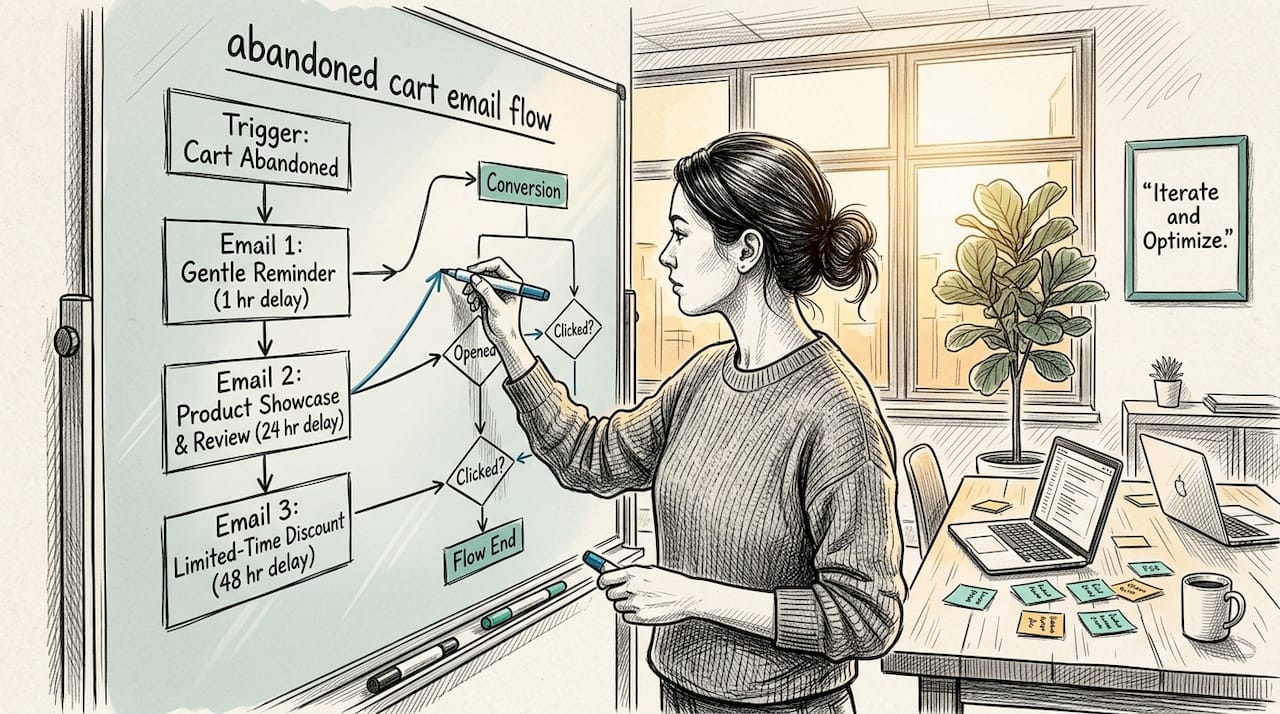
Abandoned cart flow (trigger: started checkout or added to cart): This is your highest-ROI flow. Multi-email abandoned cart flows, structured as a reminder, reassurance, and incentive sequence, improve recovery rates meaningfully when timed correctly. Send the first email 2 to 4 hours after abandonment. Follow up 24 hours later with trust signals like reviews or guarantees. Send a final email 48 to 72 hours after abandonment with a discount or free shipping offer only if needed.
-
Post-purchase flow (trigger: placed order): Start with an order confirmation, then a shipping update, then a product education or usage email 5 to 7 days after delivery. Follow with a review request at day 14 and a cross-sell or upsell around day 21 to 30.
-
Browse abandonment flow (trigger: viewed product without adding to cart): Keep this short, one to two emails, sent within 1 to 4 hours of the session. The intent signal is weaker than cart abandonment, so don’t overinvest here initially.
-
Winback flow (trigger: no purchase or engagement in 90 to 180 days): Use a re-engagement subject line, a compelling reason to return, and a clear offer. If they don’t engage after two to three emails, suppress them to protect deliverability.
Your abandoned cart strategy deserves particular attention because it sits at the highest-intent moment in your funnel. A shopper who adds to cart has already made a psychological purchase decision. Your job is to remove friction, not manufacture urgency.
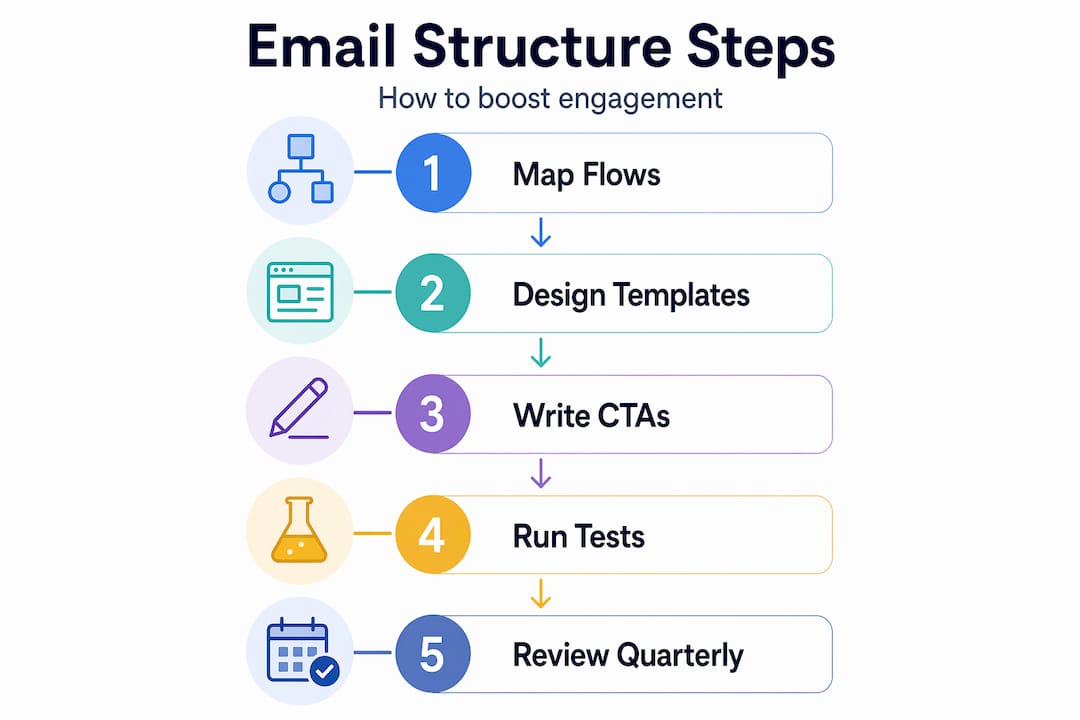
Pro Tip: Map your flows on paper or a whiteboard before you build them in Klaviyo. Write out each trigger, each email in the sequence, the delay between emails, and the exit conditions. This reveals gaps and overlaps, like a customer receiving both a browse abandonment email and an abandoned cart email at the same time, before they become a problem.
Design reusable email templates for engagement and compliance
With your flows mapped, focus shifts to the templates that power every outgoing message. Templates are not just design assets. They’re operational infrastructure. A well-built template saves hours of production time and ensures consistent branding, compliance, and user experience across every email your brand sends.
Email templates should include a header, preheader text, engaging visuals, a background, and a footer containing all required operational links. Here’s what each element does for your email:
- Header: Your logo and primary navigation. This anchors brand recognition immediately.
- Preheader text: A short teaser line visible in the inbox preview. Think of it as a second subject line.
- Hero visual: The main image or graphic that sets the emotional tone of the email.
- Body content block: Product images, descriptions, pricing, and proof elements.
- Primary CTA button: One clear action you want the reader to take.
- Footer: Unsubscribe link, preference center link, physical mailing address, and any legal notices.
Here’s a practical comparison of template blocks:
| Template element | Must-have | Optional |
|---|---|---|
| Logo header | Yes | |
| Preheader text | Yes | |
| Hero image | Yes | |
| Navigation bar | Yes (works well for catalog brands) | |
| Social proof block | Yes | |
| Product grid | Yes | |
| Primary CTA | Yes | |
| Secondary CTA | Yes | |
| Footer with links | Yes | |
| Conditional personalization block | Yes (but highly recommended) |
Use reusable blocks and show or hide sections based on user traits to avoid template duplication across flows. For example, a customer who has made three or more purchases shouldn’t see the same “first order” welcome messaging that a brand-new subscriber sees. Conditional blocks in Klaviyo let you serve the right content without building entirely separate templates.
For personalizing email templates at scale, use Klaviyo’s dynamic variables for first name, last viewed product, recommended items, and loyalty points. This level of personalization doesn’t require a custom template for every segment. One smart base template, configured with logic, handles it all.
You can also look at retail template layouts for visual inspiration on how leading brands structure their emails before adapting those patterns to your own brand system.
Pro Tip: Build a compliance-first footer block as a global block in Klaviyo, then lock it. This way, every template automatically includes your unsubscribe link and preferences center, and no team member can accidentally delete it.
Optimize subject lines, preview text, and CTA for higher conversions
Now that your foundational flows and templates are set, it’s crucial your emails actually get opened and clicked. Everything lives or dies at the inbox level. If your subject line doesn’t earn a click, nothing else in the email matters.
Treat subject line and preview text as a paired two-line pitch. The subject line hooks attention. The preview text deepens the reason to open. The most common mistake? Writing preview text that just repeats the subject line. “50% off sitewide” followed by “50% off everything today” wastes your most valuable inbox real estate.
Use the preview text to answer the unspoken question your subject line raises. If your subject line says “Your cart misses you,” the preview text could say “Plus a little something to sweeten the deal.” That combination creates enough curiosity and implied value to earn the open.
Here’s a simple four-step process for stronger inbox copy:
- Write the subject line first: Keep it under 50 characters for mobile. Test curiosity-based versus direct benefit framing.
- Write preview text second: Add context, not repetition. Target 90 to 130 characters.
- Align both to your CTA: Your subject line and preview text should point directly at the primary action in the email.
- Avoid spam triggers: Excessive caps, multiple exclamation points, and misleading personalization all hurt deliverability.
“The best subject lines read like something a friend would text you, not a billboard they designed.” This holds across every product category and audience demographic.
For CTAs, primary CTA should be explicit and focused to drive clicks. Avoid vague labels like “Learn more” or “Click here.” Instead, use outcome-based language: “Claim your 20% off,” “Shop the collection,” “Track my order.” Every word in your CTA button should confirm what happens next.
Pair strong CTAs with deliberate segmentation strategy. A CTA that converts brilliantly for a loyal VIP segment might fall flat for a cold subscriber who’s never purchased. Segmentation lets you tailor not just the offer but also the urgency, the language, and the visual treatment of your CTA across different audiences.
Verify, test, and continuously improve your structure
With everything in place, regular testing is vital to ensure your structure drives improvements, not just a busier inbox. The brands that sustain high engagement over time don’t just set up their flows and walk away. They monitor, measure, and iterate with discipline.
Key metrics every email marketing manager should track:
- Click rate: The most reliable indicator of content and CTA performance
- Placed order rate: How often email recipients go on to make a purchase
- Revenue per recipient: Total email-attributed revenue divided by emails sent
- Unsubscribe rate: A spike signals misaligned targeting or send frequency
- Flow conversion rate: Specific to each flow, measures how well the sequence achieves its goal
Apple Mail privacy can inflate open rates significantly, making that metric unreliable for performance decisions. Shift your analysis to click and revenue metrics, which reflect actual engagement rather than passive email loading.
For A/B testing, start with subject lines because they have the highest leverage. Test one variable at a time: emoji versus no emoji, question versus statement, short versus long. Then move to testing CTA placement, visual hierarchy, and email length within your flows. Use Klaviyo’s built-in A/B testing for campaigns and the multivariate options available in flows.
Pro Tip: Prioritize Klaviyo metric analysis for the flows that generate the most revenue, typically abandoned cart and post-purchase, before testing lower-volume flows. Small improvements to your highest-impact flows compound much faster than optimizations applied to minor sequences.
What most guides miss: Structure is about relevance, not volume
Here’s what we’ve seen consistently working with ecommerce brands at Swyft Interactive. Most brands frame their email problems as a volume problem. They think the answer to declining revenue is more emails. More campaigns. More flows. More touchpoints. The data almost never supports that conclusion.
The brands winning in email right now are the ones obsessing over contextual relevance, sending fewer emails that land at precisely the right moment in the customer journey. A perfectly timed browse abandonment email sent two hours after a session will outperform five campaign blasts to your full list. Every time.
We’ve seen brands double their email-attributed revenue not by adding more emails to their calendar but by auditing their existing flows and removing emails that fired at the wrong moment or repeated messages the customer already acted on. Automation, done wrong, is just a faster way to annoy your best customers.
The uncomfortable truth is that most automation setups treat the “set it and forget it” nature of flows as a feature when it’s actually a risk. Flows go stale. Customer behavior shifts. Product catalogs change. A flow that converted brilliantly six months ago might be sending outdated product recommendations or irrelevant promotions today.
Real structural discipline means reviewing your flows quarterly, checking for message relevance, updating suppression logic, and testing new hypotheses. It means treating your email program as a living system aligned to the customer journey, not a marketing calendar with extra steps. Why email marketing matters isn’t a question of channel loyalty. It’s a question of whether your program is genuinely built around your customer’s experience or just your marketing team’s convenience.
Unlock your ecommerce email potential with expert help
Ready to elevate your email structure further? The tactical steps in this guide give you a strong foundation, but building a truly high-performing Klaviyo program requires ongoing strategy, testing, and execution.
At Swyft Interactive, we specialize in helping ecommerce brands design and implement email systems that convert. Whether you’re starting from scratch or optimizing an existing program, our full automation guide is a great next step to go deeper on flows, triggers, and sequencing logic. If you’re ready for expert hands-on support building out your Klaviyo flows, templates, and segmentation strategy, our team offers done-for-you services tailored specifically to online retail brands. We bring both the strategic framework and the technical execution so your email program starts driving measurable revenue, not just impressions.
Frequently asked questions
What is the optimal structure for ecommerce emails in Klaviyo?
Combine lifecycle-triggered automated flows with scheduled campaigns, focusing flows on key customer actions such as sign-ups, purchases, and cart abandonment. As outlined in Klaviyo Email Automation Workflows, structuring your program across these two layers ensures both consistent broadcasting and always-on behavioral targeting.
How many emails should an abandoned cart flow include?
A best-practice abandoned cart flow uses a series of 2 to 3 emails, with the first reminder sent 2 to 4 hours post-abandonment, followed by reassurance and incentive emails if the shopper hasn’t converted. Multi-email cart sequences consistently outperform single-email approaches when spaced and timed correctly.
What template elements must every ecommerce email include?
Every email needs a header, preheader text, engaging visuals, a clear CTA button, and a compliant footer with unsubscribe and preference links. Klaviyo’s design best practices confirm these elements are foundational to both deliverability and user experience.
Do automated flows outperform campaigns for engagement?
Yes, and by a wide margin. Automated flows deliver over 3× higher click rates and roughly 13× higher order rates than scheduled campaigns, driven by their relevance to the specific moment in the customer’s journey.
What metric matters most for improving email performance given privacy changes?
Due to open rate inflation caused by Apple Mail Privacy Protection, prioritize click rate and revenue per recipient when evaluating performance. Apple Mail privacy makes open rates an unreliable signal for real engagement, so shifting your benchmarks to click-through and conversion data gives you a far more accurate picture.