TL;DR:
- Most ecommerce brands focus heavily on acquisition, ignoring the significant profits from retention improvements. Implementing personalized, automated lifecycle marketing across five key phases can increase customer lifetime value and repeat purchase rates dramatically. Despite its proven effectiveness and lower costs, lifecycle marketing remains underutilized due to perceived complexity and prioritization of new customer acquisition.
Most ecommerce brands pour their budget into acquisition, chasing new customers while barely noticing the ones quietly walking out the back door. But a 5% retention lift can boost profits anywhere from 25% to 95%. That single number reframes the entire growth conversation. Lifecycle marketing is the system that makes retention work at scale, turning one-time buyers into loyal customers through personalized, automated messaging that meets shoppers exactly where they are in their journey with your brand.
Table of Contents
- Defining lifecycle marketing for ecommerce brands
- The core components of lifecycle marketing
- Measuring success: Lifecycle marketing metrics and benchmarks
- Applying lifecycle marketing: Real-world ecommerce strategies
- Why most ecommerce brands underutilize lifecycle marketing
- Explore lifecycle marketing solutions for ecommerce growth
- Frequently asked questions
Key Takeaways
| Point | Details |
|---|---|
| Retention drives profit | Even a 5% increase in retention can deliver up to 95% more profits for ecommerce brands. |
| Lifecycle marketing is cost-effective | Automated messaging strategies are usually 30-50% cheaper than paid ads for driving repeat purchases. |
| Track vital metrics | Monitoring customer lifetime value and retention benchmarks is essential for improving marketing ROI. |
| Personalization powers growth | Segmentation and tailored workflows maximize engagement and repeat purchases throughout the customer lifecycle. |
| Apply proven tactics | Examples and automation checklists help turn lifecycle marketing strategies into actionable results for ecommerce teams. |
Defining lifecycle marketing for ecommerce brands
Lifecycle marketing, at its simplest, is a strategy that treats every customer differently based on where they are in their relationship with your brand. A first-time visitor gets a very different message than a lapsed buyer who hasn’t purchased in eight months. That distinction sounds obvious, but most ecommerce teams still blast the same promotional email to their entire list and wonder why engagement drops.
In ecommerce, lifecycle marketing covers five distinct stages:
- Acquisition: Attracting new customers and capturing their contact information
- Onboarding: Welcoming new subscribers and first-time buyers with relevant, timely messaging
- Engagement: Nurturing mid-funnel customers with content, recommendations, and offers
- Repeat purchase: Converting one-time buyers into habitual customers through loyalty programs and personalized offers
- Reactivation: Winning back dormant customers before they’re gone for good
Each stage requires a completely different message, tone, and offer. That’s what separates lifecycle marketing from bulk promotional campaigns. The entire model is built on automation and personalization, using behavioral data to trigger the right message at the right moment without your team manually sending a single email.
“Lifetime value and retention are the metrics that separate growing ecommerce brands from struggling ones. Everything else, including traffic, clicks, and conversion rates, is secondary.”
Understanding marketing metrics for ecommerce ROI helps clarify why lifecycle marketing consistently outperforms acquisition-only strategies over time. The math is straightforward: acquiring a new customer costs five to seven times more than retaining an existing one, and existing customers already trust your brand enough to buy again. Lifecycle marketing capitalizes on that existing trust with far less spend.
According to ecommerce benchmarks, average CLV sits at $168, while top-performing brands reach $250 to $450. That gap is almost entirely explained by how well brands implement lifecycle marketing. The brands at the top are not just spending more on ads; they’re retaining more customers and increasing the total value each customer delivers over time.
The core components of lifecycle marketing
Now that the framework is clear, let’s examine the specific building blocks that make lifecycle marketing work in practice. Each component serves a distinct role, and together they create a compounding system that drives revenue long after a customer’s first purchase.
The five core phases, and what each one actually does:
- Welcome flow: Triggered immediately when someone subscribes or makes a first purchase. This is your highest-engagement window. Open rates on welcome emails average 50% or higher, making this the single most important automation to get right.
- Nurture sequence: A series of educational or value-driven emails that builds relationship and product familiarity. This works especially well for brands with complex products or longer consideration cycles.
- Conversion triggers: Abandoned cart, browse abandonment, and price-drop alerts. These are behavior-driven messages that catch shoppers at the moment of highest purchase intent.
- Loyalty and post-purchase: Order confirmation, cross-sell, upsell, and loyalty reward emails that extend customer lifetime value after the sale.
- Win-back campaign: A targeted sequence sent to customers who haven’t purchased in 60 to 180 days, often using a compelling offer or emotional appeal to reignite interest.
Understanding the email automation benefits for each of these phases makes it easier to prioritize your rollout. Most brands start with welcome flows and abandoned cart, then layer in post-purchase and win-back sequences as their automation matures.
Here’s how lifecycle phases compare in terms of effort and impact:
| Lifecycle phase | Setup complexity | Average ROI impact | Customer segment |
|---|---|---|---|
| Welcome flow | Low | Very High | New subscribers |
| Abandoned cart | Low | High | Active browsers |
| Post-purchase nurture | Medium | High | Recent buyers |
| Loyalty and upsell | Medium | Medium-High | Repeat buyers |
| Win-back campaign | Low | Medium | Lapsed customers |
The cost efficiency of lifecycle messaging is a major advantage. Email and SMS lifecycle strategies run 30% to 50% cheaper than paid advertising for driving repeat purchases. That’s not a marginal difference; it’s the difference between sustainable unit economics and burning budget on channels that deliver diminishing returns.

Brands using types of ecommerce emails strategically across each lifecycle phase consistently outperform those relying on batch-and-blast campaigns. The repeat purchase rate for brands with advanced email automation jumps from a baseline of 25 to 35% all the way to 40 to 52%. That’s not a small lift. For a brand doing $2 million in annual revenue, moving the repeat purchase needle by even 10 percentage points can mean hundreds of thousands in additional revenue without spending a dollar more on acquisition.
Pro Tip: Don’t wait until your entire lifecycle system is built before launching. Set up your welcome flow and abandoned cart automation first. Those two alone will deliver measurable ROI within 30 days, giving you the data and confidence to build out the remaining phases.
Measuring success: Lifecycle marketing metrics and benchmarks
Understanding the parts is only useful if you measure what matters. Here’s how to track lifecycle marketing performance and know whether your efforts are actually moving the needle.
The three metrics every ecommerce brand should track obsessively:
- Customer lifetime value (CLV): The total revenue a customer generates over their entire relationship with your brand. The average ecommerce CLV sits around $168, but top-quartile brands reach $250 to $450. Your goal is to consistently push your CLV toward that upper range.
- Retention rate: The percentage of customers who return to make a second purchase within a defined window. Industry benchmarks show 20 to 35% retention at 90 days for most ecommerce categories, with annual retention running 15 to 25% for transactional brands.
- Repeat purchase rate: How often customers come back to buy again. Brands without strong lifecycle marketing hover around 25 to 35%. With automation, that number climbs to 40 to 52%.
Learning how to increase retention for profit requires tracking these numbers at the cohort level, meaning you look at how groups of customers acquired in the same month behave over time. This gives you a much clearer picture of whether your lifecycle campaigns are actually changing behavior.
Here’s how the benchmarks stack up across brand tiers:
| Metric | Average brand | Top 25% brand |
|---|---|---|
| Customer lifetime value | $168 | $250 to $450 |
| 90-day retention rate | 20 to 35% | 35 to 50%+ |
| Annual retention rate | 15 to 25% | 25 to 40% |
| Repeat purchase rate (no automation) | 25 to 35% | Not applicable |
| Repeat purchase rate (with automation) | 40 to 52% | 52%+ |
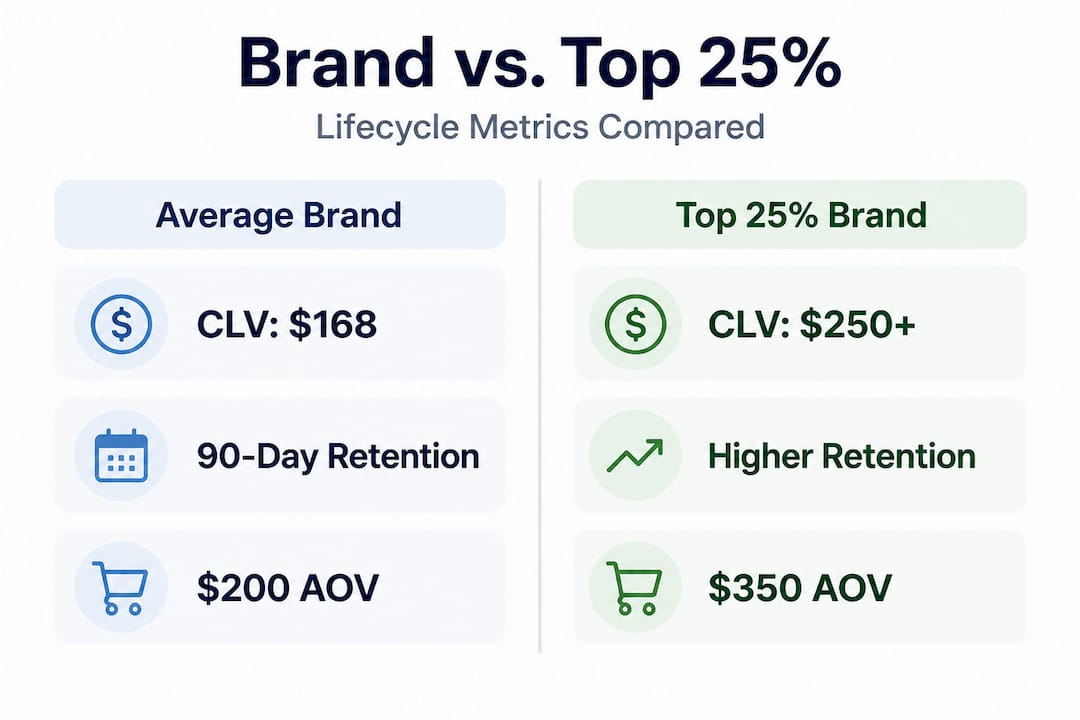
Even incremental improvements across these benchmarks have a significant impact. Moving CLV from $168 to $210 on a list of 10,000 active customers adds $420,000 in total revenue without acquiring a single new customer. That’s the compounding power of lifecycle marketing executed consistently over 12 to 24 months.
Tracking ecommerce engagement metrics across your lifecycle campaigns gives you the early warning signals you need. If open rates on your win-back sequence are dropping, your subject lines or offer aren’t compelling enough. If post-purchase click rates are high but conversion is low, your landing page or product recommendations need work. The metrics tell you exactly where to focus.
Applying lifecycle marketing: Real-world ecommerce strategies
Once metrics and benchmarks are clear, it’s time to put lifecycle marketing into practice. Here’s a step-by-step approach that works for brands at any stage of automation maturity.
- Audit your current flows. Before building anything new, map out what automation already exists. Most brands have a basic welcome email and a cart abandonment flow. Evaluate performance against the benchmarks above and identify the biggest gaps.
- Prioritize by revenue impact. Win-back campaigns and post-purchase upsell sequences often deliver the fastest ROI for brands with an existing customer base. Build those before spending time on advanced segmentation.
- Build your welcome series properly. A single welcome email is not a welcome series. The most effective welcome flows run three to five emails over seven to ten days, progressively introducing your brand story, bestsellers, social proof, and a time-sensitive offer.
- Segment before you personalize. Use purchase history, browse behavior, and engagement data to split your list into meaningful segments. At minimum, separate new subscribers, active buyers, and lapsed customers.
- Create a win-back sequence with urgency. Send lapsed customers a three-email sequence: a soft re-engagement, a compelling offer, and a final “last chance” message. This approach consistently recovers 5 to 15% of dormant customers who would otherwise be gone permanently.
- Test, measure, and iterate. The brands that dominate lifecycle marketing are not the ones who set it up perfectly the first time. They’re the ones who test subject lines, offers, and send timing constantly and use that data to improve.
Looking at email marketing strategy examples from top-performing ecommerce brands reveals a consistent pattern. They treat automation as a living system, not a set-and-forget tool. They review performance monthly, update creative quarterly, and refresh offer structures when engagement starts to dip.
Top-performing brands achieve annual retention rates of 15 to 25%, and the ones at the upper end of that range almost universally share one trait: they use data-driven automation for sales to personalize messaging based on actual customer behavior, not demographic assumptions.
Integrating essential ecommerce marketing strategies into your lifecycle system ensures that email and SMS don’t operate in isolation from your broader marketing effort. Your paid ads should reinforce the same messaging your lifecycle emails deliver, creating a unified experience that increases the likelihood of conversion at every touchpoint.
Pro Tip: When building a win-back sequence, test giving customers a reason beyond a discount to return. Messaging around new arrivals, a product improvement, or a loyalty milestone often outperforms a straight coupon offer because it feels less transactional and more personal.
Why most ecommerce brands underutilize lifecycle marketing
Here’s the uncomfortable reality we see again and again when working with ecommerce brands: lifecycle marketing is consistently underinvested, not because brands don’t understand its value, but because acquisition feels more urgent. A slow sales day is immediately fixed with a paid ad budget increase. There’s no equivalent quick fix for retention, so it gets deprioritized quarter after quarter until the customer base quietly erodes.
The second issue is perceived complexity. Lifecycle marketing sounds like a sophisticated, resource-intensive undertaking. Brands assume they need a dedicated CRM team, an advanced data infrastructure, and six months of setup time. In reality, a well-structured welcome flow and a basic win-back sequence can be live within two weeks using modern automation tools like Klaviyo. The complexity is mostly imagined.
What’s not imagined is the cost of inaction. Email and SMS lifecycle strategies run 30 to 50% cheaper than paid advertising for repeat purchases, yet most brands continue to over-index on ad spend and under-invest in the channels that serve customers they’ve already paid to acquire. That’s not a strategy; it’s a leak.
The brands we’ve seen make the most dramatic revenue shifts are the ones that commit to building a lifecycle system and then using an automation checklist for ecommerce to execute it methodically. They stop treating retention as a nice-to-have and start treating it as the primary growth lever it actually is. Automation levels the playing field here, giving lean teams the ability to deliver personalized, timely communication at scale without adding headcount.
The mindset shift required is real: stop measuring success only by new customer acquisition and start measuring the total revenue generated from your existing base. When you do that, lifecycle marketing becomes the most obvious investment in your marketing stack.
Explore lifecycle marketing solutions for ecommerce growth
Lifecycle marketing works, and the data makes that undeniable. But knowing the strategy and having the systems to execute it are two very different things.
At Swyft Interactive, we specialize in building the exact automation infrastructure that powers lifecycle marketing for growing ecommerce brands. From Klaviyo flow architecture to full customer journey mapping, our approach connects every stage of the lifecycle to measurable revenue outcomes. Start with our email automation guide to understand how automation should be structured, walk through our ecommerce website checklist to ensure your store and email system work together, and explore real email automation examples to see exactly what high-performing lifecycle campaigns look like in practice. The infrastructure that separates top-tier ecommerce brands from average ones is more accessible than you think.
Frequently asked questions
What is lifecycle marketing in ecommerce?
Lifecycle marketing in ecommerce is a strategy that targets customers at every stage, from acquisition through repeat purchase and reactivation, using personalized messaging and automation to drive engagement and increase retention. Brands using this approach consistently see stronger CLV and repeat purchase rates than those relying on acquisition-only tactics.
Why is lifecycle marketing more profitable than acquisition marketing?
A small improvement in retention delivers outsized profit returns because existing customers require no acquisition cost and are statistically more likely to convert. Research shows a 5% retention improvement translates to profit growth of 25% to 95%.
Which lifecycle marketing metrics should ecommerce brands track?
Focus on customer lifetime value, retention rate, and repeat purchase rate as your primary indicators. Ecommerce benchmarks show an average CLV of $168, repeat purchase rates of 25 to 35% without automation, and annual retention rates of 15 to 25% for top performers.
How can automation improve lifecycle marketing results?
Email and SMS automation personalize communication based on real customer behavior and timing, dramatically improving engagement. Brands with advanced email automation push repeat purchase rates from 25 to 35% all the way to 40 to 52%.
What is the biggest mistake ecommerce brands make with lifecycle marketing?
The most common mistake is treating acquisition as the only growth lever while neglecting retention. Lifecycle email and SMS strategies are 30 to 50% cheaper than paid ads for repeat purchases, yet most brands continue to underinvest in them.