

Tracking customer clicks and repeat visits can feel overwhelming for American retail brands trying to grow online. Understanding how shoppers interact with your store and respond to Klaviyo emails makes all the difference in measuring true engagement. By focusing on quantifiable data points like website traffic, session duration, and email open rates, marketing managers gain deeper insight to optimize shopping experiences and improve conversion. This guide highlights practical strategies for using engagement metrics to drive stronger customer relationships and measurable results.
Table of Contents
- What Are Ecommerce Engagement Metrics?
- Types of Metrics: Website vs. Email
- Key Klaviyo Metrics for Ecommerce Brands
- How Engagement Metrics Impact Conversions
- Common Pitfalls and Optimization Strategies
Key Takeaways
| Point | Details |
|---|---|
| Ecommerce Engagement Metrics | These metrics provide insights into customer interactions, helping businesses improve conversion and retention rates. |
| Website vs. Email Metrics | Distinct types of metrics offer insights; website metrics examine navigation, while email metrics gauge campaign effectiveness. |
| Impact on Conversions | Analyzing engagement metrics helps reduce bounce rates and improve user experience, driving more purchases. |
| Common Pitfalls | Brands must avoid inconsistent data tracking and single-channel dependency to optimize their strategies effectively. |
What Are Ecommerce Engagement Metrics?
Ecommerce engagement metrics are quantifiable data points that reveal how customers interact with online stores across multiple digital touchpoints. These critical measurements help businesses understand customer behavior, track performance, and optimize strategies for improved conversion and retention.
At their core, these metrics capture various user interactions, including:
- Website visits and traffic sources
- Time spent on product pages
- Click-through rates
- Email marketing engagement
- Cart abandonment rates
- Repeat purchase frequency
Understanding these metrics is crucial because they provide actionable insights into customer interest and purchasing patterns. Quantitative data points measuring online interactions enable retailers to pinpoint exactly where customers engage most and where potential friction points exist in the shopping experience.
By tracking comprehensive engagement metrics, ecommerce brands can make data-driven decisions that directly impact revenue. These measurements go beyond simple traffic numbers, diving deep into how customers truly interact with an online store. From understanding bounce rates to analyzing email marketing effectiveness, engagement metrics paint a holistic picture of customer behavior.
Pro tip: Start by tracking your top three engagement metrics consistently and use those insights to incrementally improve your online store’s user experience.
Types of Metrics: Website vs. Email
Ecommerce engagement metrics can be distinctly categorized into two primary types: website metrics and email metrics. While both provide critical insights into customer behavior, they capture different aspects of the digital shopping experience. Tracking user interactions across digital channels requires understanding the unique characteristics of each metric type.
Website engagement metrics focus on how customers interact with an online store, including:
- Page views and total website traffic
- Average session duration
- Bounce rate
- Conversion rates
- Product page interactions
- Click-through rates
- Cart abandonment rates
Email engagement metrics, on the other hand, measure the performance of marketing campaigns and customer communication:
- Email open rates
- Click-through rates
- Unsubscribe rates
- Conversion rates from email campaigns
- Forwarding and sharing rates
- List growth rate
- Spam complaint rates
The key difference lies in their measurement focus. Website metrics reveal how users navigate and interact with an online store, while email metrics demonstrate how effectively marketing messages resonate with customers. By analyzing both types of metrics, ecommerce brands can develop a comprehensive understanding of customer engagement and optimize their digital strategies accordingly.
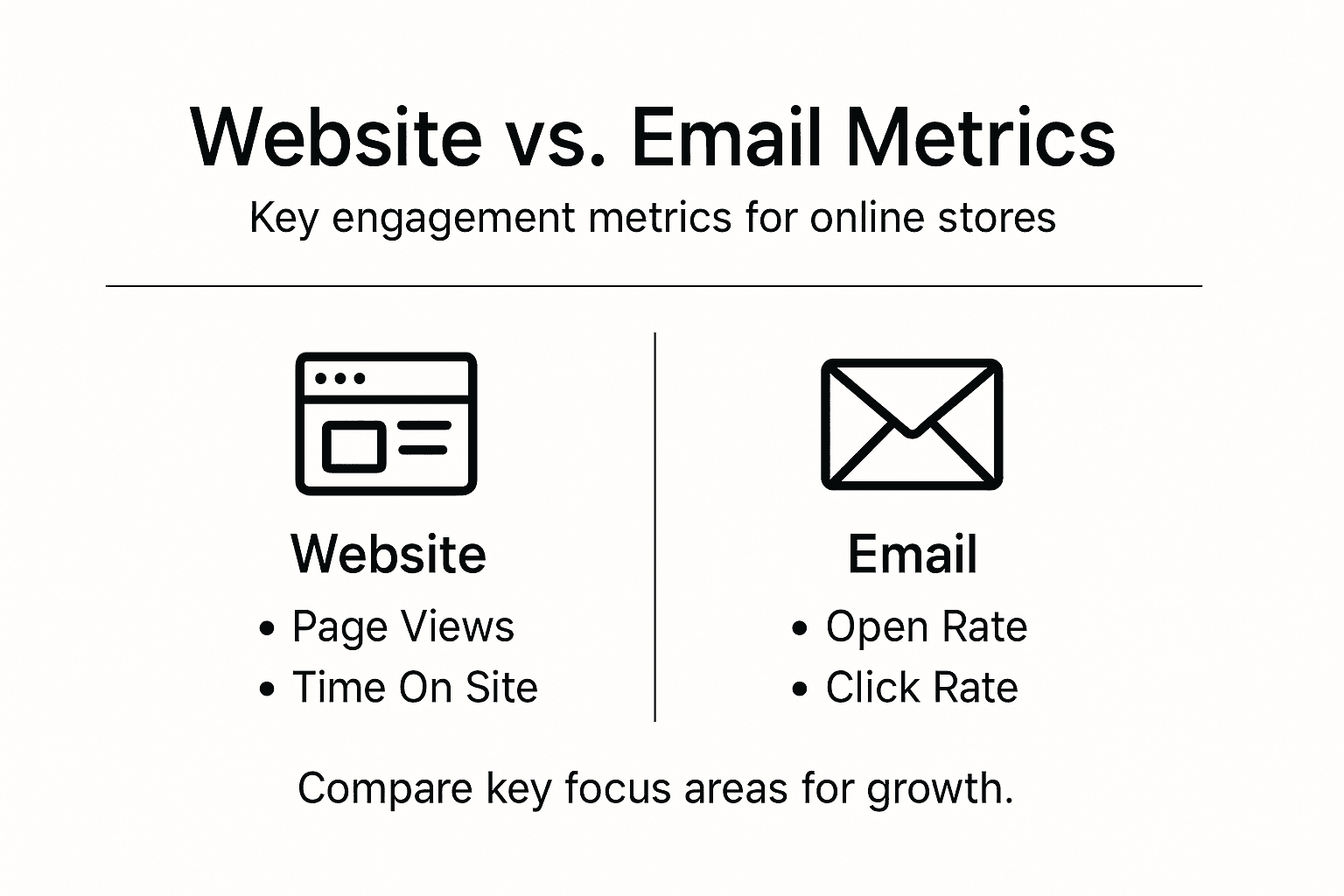
Here’s a comparison of website and email engagement metrics for ecommerce businesses:
| Metric Type | Main Purpose | Example Insights Provided | Key Optimization Focus |
|---|---|---|---|
| Website Metrics | Analyze store navigation | Identify high-converting pages | Improve site design and user flow |
| Email Metrics | Gauge campaign response | Track subscriber engagement | Strengthen messaging and list health |
Review the main Klaviyo email metrics and their business impact:
| Klaviyo Metric | What It Measures | Business Impact |
|---|---|---|
| Open Rate | Email opens | Indicates subject line success |
| Click-Through Rate | Link engagement | Drives site traffic and sales |
| Revenue Per Email | Earnings per campaign | Guides ROI-focused decisions |
| Unsubscribe Rate | Opt-outs | Signals content relevance |
Pro tip: Integrate your website and email metrics into a unified dashboard to gain holistic insights into customer behavior and identify cross-channel opportunities for improvement.
Key Klaviyo Metrics for Ecommerce Brands
Klaviyo provides ecommerce brands with powerful email marketing analytics that go beyond traditional engagement tracking. Marketing performance indicators help businesses optimize revenue by understanding detailed customer interaction patterns through sophisticated metric tracking.
Key Klaviyo metrics for ecommerce brands include:
- Open Rates: Percentage of subscribers who open email campaigns
- Click-Through Rates (CTR): Number of recipients clicking links within emails
- Conversion Rates: Percentage of email recipients making a purchase
- Revenue Per Email: Total revenue generated divided by total emails sent
- List Growth Rate: Speed at which email subscriber base is expanding
- Unsubscribe Rates: Percentage of subscribers opting out of email communications
- Spam Complaint Rates: Frequency of emails marked as spam
These metrics provide granular insights into email marketing performance, allowing brands to refine their communication strategies. Tracking these indicators helps identify which email campaigns resonate most with customers, optimize content, and ultimately drive higher engagement and revenue.

Understanding the nuanced relationship between these metrics enables ecommerce brands to create more targeted, personalized email experiences that convert subscribers into loyal customers. By continuously monitoring and adjusting based on Klaviyo’s detailed analytics, businesses can develop more effective marketing approaches.
Pro tip: Create benchmark reports comparing your Klaviyo metrics against industry standards to identify specific areas for improvement in your email marketing strategy.
How Engagement Metrics Impact Conversions
Engagement metrics are the critical bridge between customer interaction and actual sales, transforming raw data into actionable insights for ecommerce growth. User engagement directly correlates with conversion potential, revealing the intricate relationship between how customers interact with a website and their likelihood of making a purchase.
Key ways engagement metrics influence conversions include:
- Reducing Bounce Rates: Lower bounce rates signal more compelling content and user experience
- Improving User Experience: Metrics help identify and eliminate friction points in the customer journey
- Tracking Customer Interest: Detailed interactions reveal which products and content resonate most
- Optimizing Marketing Strategies: Data-driven insights allow for more targeted approach
- Personalizing Customer Interactions: Understanding individual user behaviors enables more precise targeting
Most critical engagement metrics that directly impact conversion rates involve:
- Session Duration
- Page Views per Visit
- Traffic Source Quality
- Mobile User Experience
- Checkout Process Efficiency
By meticulously analyzing these metrics, ecommerce brands can create a more intuitive, responsive online environment that guides potential customers smoothly from initial interest to final purchase. The goal is transforming passive website visitors into active, purchasing customers through strategic, data-informed design and marketing approaches.
Pro tip: Implement A/B testing on key conversion pages using engagement metrics as your primary success benchmark to continuously refine and improve your ecommerce performance.
Common Pitfalls and Optimization Strategies
Ecommerce brands frequently encounter significant challenges when attempting to optimize their engagement metrics and conversion strategies. Strategic approaches to engagement require comprehensive analysis of platform-specific interactions and customer behavior patterns.
Common pitfalls in ecommerce engagement include:
- Misaligned Marketing Strategies: Failing to match engagement approaches with specific platform characteristics
- Inconsistent Data Tracking: Using fragmented or incomplete measurement techniques
- Overlooking Customer Experience: Neglecting emotional and cognitive dimensions of user interaction
- Single-Channel Dependency: Relying exclusively on one marketing or engagement channel
- Inadequate Performance Analysis: Not conducting regular, comprehensive metric evaluations
Optimization strategies to address these challenges involve:
- Implementing multi-channel engagement approaches
- Developing platform-specific interaction models
- Creating personalized customer journey mappings
- Utilizing advanced data analytics tools
- Conducting continuous A/B testing and performance monitoring
Successful ecommerce brands understand that engagement metrics are not static indicators but dynamic insights requiring constant refinement. By adopting a holistic, data-driven approach, businesses can transform potential obstacles into opportunities for growth and customer connection.
Pro tip: Develop a quarterly engagement metric audit process that systematically reviews and realigns your strategies based on the most recent performance data.
Unlock Your Ecommerce Growth Potential with Data-Driven Engagement
Struggling to translate engagement metrics into real sales growth? This article highlights the challenge ecommerce brands face in understanding detailed customer interactions like session duration, click-through rates, and email performance metrics. If you aim to reduce bounce rates, improve user experience, and harness the full power of Klaviyo automation combined with a high-converting website setup, you need a partner who knows how to make those numbers work for you.
Discover how Swyft Interactive’s tailored solutions bring together expert website development and sophisticated email marketing strategies found in Email Marketing Archives – Swyft Interactive and Digital Strategy Archives – Swyft Interactive to transform raw customer data into measurable revenue. Our proven full-funnel approach helps ecommerce brands build scalable online sales engines that boost engagement, optimize conversions, and automate their growth. Don’t wait to turn your engagement metrics into a powerful growth engine. Start today at https://swyftinteractive.com/ and see the difference expert integration makes.
Frequently Asked Questions
What are ecommerce engagement metrics?
Ecommerce engagement metrics are quantifiable data points that measure how customers interact with online stores through various digital touchpoints, helping businesses track performance and optimize strategies for improved conversion and retention.
Why are ecommerce engagement metrics important for my online store?
These metrics provide actionable insights into customer behavior, allowing retailers to identify areas of interest and friction points in the shopping experience, ultimately helping to drive revenue through data-driven decisions.
What are the main types of ecommerce engagement metrics?
Ecommerce engagement metrics can be categorized into two main types: website metrics, which track user interactions on the online store, and email metrics, which measure the effectiveness of marketing campaigns directed at customers.
How can I improve my ecommerce conversions using engagement metrics?
By analyzing key engagement metrics such as session duration and page views, you can identify areas to enhance user experience, reduce bounce rates, and refine your marketing strategies, all aimed at turning visitors into paying customers.