
Retention drives profit harder than acquisition ever could. Increasing customer retention by just 5% can boost profits by up to 95%, making it the most overlooked lever in ecommerce growth. This guide shows you how to build Klaviyo retention automation from setup to optimization, covering segmentation, key flows, performance tracking, and common mistakes that kill results.
Table of Contents
- Prerequisites And Setup: Understanding Customer Segmentation
- Key Retention Email Flows And Segmentation Strategies
- Data-Driven Performance Tracking And Iteration
- Common Mistakes And Failure Points In Klaviyo Retention Automation
- Expected Results And Outcomes
- Boost Your Ecommerce Retention With Swyft Interactive
- Frequently Asked Questions
Key Takeaways
| Point | Details |
|---|---|
| Foundation Matters | 500 customers and 180 days of order data enable robust RFM segmentation for retention automation. |
| Flow Variety Wins | Welcome, post-purchase, and re-engagement flows target specific lifecycle stages to reduce churn. |
| Data Drives Results | Funnel analysis reveals revenue impact, helping you prune weak flows and optimize segmentation continuously. |
| Avoid Over-Mailing | Unsegmented bulk emails increase unsubscribes; segmented, targeted sends boost engagement and revenue. |
| Small Gains Scale | A 5% retention lift delivers profit increases ranging from 25% to 95%. |
Prerequisites and Setup: Understanding Customer Segmentation
Before building retention flows, you need the right infrastructure. Effective Klaviyo retention automation requires at least 500 customers and 180 days of order history, integrated with an ecommerce platform such as Shopify. Without this data volume, segmentation lacks statistical power, and flows miss their targets.
Integration with Shopify, WooCommerce, or similar platforms ensures Klaviyo receives transactional data in real time. This feeds RFM segmentation, which groups customers by Recency (last purchase date), Frequency (order count), and Monetary (total spend). For example, a customer who bought twice in the last 30 days and spent $500 fits a high value, high frequency segment. Someone who last purchased 180 days ago falls into a re-engagement target group.
RFM segments drive automation triggers. Instead of sending every subscriber the same message, you create flows activated when customers enter specific segments. This prevents misfires, like offering discounts to already loyal buyers or sending replenishment reminders to one time purchasers. Proper setup saves time and scales retention without manual intervention.
Follow these steps to prepare your Klaviyo account:
- Connect your ecommerce platform and sync historical order data
- Verify at least 500 customers and six months of purchase history
- Build baseline RFM segments using Klaviyo’s segment builder
- Test trigger conditions on sample segments before launching flows
- Document your segmentation logic for future iteration
Once setup is complete, you can start building flows confidently. Check our step-by-step email automation guide and email automation workflow steps for detailed walkthroughs. Klaviyo’s retention flow prerequisites offer platform-specific configuration details.
Key Retention Email Flows and Segmentation Strategies
With segmentation in place, you can deploy flows that target the right people at the right time. Three core flows handle the majority of retention work: welcome series, post-purchase sequences, and re-engagement campaigns.
A multi-path welcome series addressing different customer intents significantly increases early engagement. Instead of a single path, create branches based on signup source or first browse behavior. Someone who signed up for a discount expects product recommendations and offers. Someone who subscribed for educational content wants tips and stories. Split your welcome flow accordingly to match expectations and build trust early.
Post-purchase flows reduce buyer dissonance and can increase repeat purchases by 10-30%. Send order confirmations immediately, then follow with usage tips two days later. At 30 days, introduce complementary products or replenishment offers. This sequence reassures customers post purchase and nudges them toward a second order while your brand remains top of mind.
Re-engagement flows rescue at-risk customers before they churn. Using segmentation-triggered automation flows based on RFM groups facilitates personalized re-engagement, boosting retention and revenue. Target customers who haven’t purchased in 90 days with tailored messaging. Highlight new products for frequent buyers, offer discounts to price-sensitive segments, or share user-generated content to reignite interest.
Personalized product recommendations within flows increase click-through and conversion. Use Klaviyo’s dynamic content blocks to pull items based on past purchases or browsing history. A customer who bought running shoes sees recommendations for running apparel, not unrelated categories.
| Flow Type | Primary Objective | Trigger Condition | Typical Email Count |
|---|---|---|---|
| Welcome Series | Build early engagement and set expectations | Signup or first website visit | 3 to 5 |
| Post-Purchase | Reduce uncertainty, increase repurchase rate | Order placed event | 2 to 4 |
| Re-Engagement | Win back at-risk or lapsed customers | 90+ days since last purchase | 2 to 3 |
Here’s how to structure each flow:
- Define the segment or event trigger that starts the flow
- Map the customer journey from trigger to desired outcome
- Write emails that address specific pain points or goals at each stage
- Insert dynamic product blocks to personalize recommendations
- Set time delays that match purchase cycles and customer behavior
- Add conversion tracking to measure flow impact
Pro Tip: Prioritize segmentation triggers over generic bulk sends to avoid fatigue. A targeted email to 100 high-value customers outperforms a blast to your entire list because relevance drives action, not volume.
Explore our email campaign strategies, advantages of Klaviyo automation, email marketing automation guide, and email segmentation tutorial for deeper dives. Review segmentation-triggered automation flows and multi-path welcome series and post-purchase flows for case studies and advanced tactics.
Data-Driven Performance Tracking and Iteration
Building flows is only the beginning. Retention marketing should use funnel analysis to track revenue impact and discontinue low-performing flows, iterating segmentation and messaging based on engagement. Klaviyo’s funnel reports show which flows drive signups, clicks, and revenue. Check these daily to spot underperformers.

If a flow generates opens but zero purchases, either the offer misses the mark or the segment is wrong. Pause the flow, adjust the messaging, tighten the segment criteria, then relaunch. This continuous iteration prevents wasted sends and keeps your account healthy.
Cohort analysis reveals retention trends over time. Compare repeat purchase rates for customers acquired in different months. If January cohorts show lower repeat rates than February, investigate what changed in your flows or product mix. Use these insights to refine segmentation thresholds and email content.
Adjust messaging frequency based on customer responses. Monitor unsubscribe rates and engagement metrics by segment. If high-frequency buyers tolerate weekly emails but occasional shoppers unsubscribe, create separate cadences. Klaviyo’s smart sending features help prevent over-mailing, but manual oversight ensures you stay aligned with customer preferences.
Here’s what to track weekly:
- Flow revenue contribution as a percentage of total email revenue
- Conversion rates by flow and segment
- Unsubscribe rates per flow and email
- Click-through rates on product recommendation blocks
- Time from flow entry to first purchase
Pro Tip: Regularly clean and update RFM segments for best targeting effectiveness. Purchase behavior shifts over time, so segments that worked six months ago may no longer reflect reality. Recalculate RFM scores monthly and adjust segment definitions as needed.
Learn more about optimization in our conversion rate optimization strategies and engagement metrics explained guides. Klaviyo’s documentation on optimizing retention flows with funnel analytics provides platform-specific instructions.
Common Mistakes and Failure Points in Klaviyo Retention Automation
Even with solid setup, specific mistakes undermine retention efforts. The most common error is increasing email volume without segmentation. More emails don’t mean more revenue if they lack relevance. Focus on sending the right message to the right person, not blasting your entire list.
Personalization matters more than you think. Studies show 69% of subscribers unsubscribe when emails lack personalization, yet many brands still send generic messages. Use merge tags, dynamic content, and behavioral triggers to tailor every send. A customer’s name in the subject line is a start, but product recommendations based on browsing history deliver real impact.
Misusing platform features harms retention. Don’t activate every Klaviyo feature without a clear strategy. For example, enabling predictive analytics before your data set is large enough produces unreliable recommendations. Stick to proven flows and add advanced features incrementally as your data matures.
Monitor engagement beyond open rates. Opens inflate due to image pixel loads and privacy changes, making them unreliable. Clicks and conversions reveal true engagement. If open rates climb but clicks stay flat, your subject lines work but your content doesn’t. Fix the body copy, not the subject.
Segment lifecycle stages carefully to prevent fatigue. Sending post-purchase emails too soon annoys customers. Wait at least 48 hours after delivery before asking for reviews or introducing replenishment offers. Timing matters as much as message quality.
Avoid these pitfalls:
- Sending the same flow to all customers regardless of purchase history
- Ignoring unsubscribe spikes after specific flows
- Letting flows run indefinitely without performance reviews
- Using overly aggressive discount strategies that train customers to wait for sales
- Neglecting mobile optimization when 60%+ of emails open on mobile devices
For comprehensive best practices, visit our email marketing best practices resource.
Expected Results and Outcomes
What should you expect from retention automation? A 5% increase in customer retention can boost profits by 25% to 95%, depending on your margin structure and customer acquisition costs. This wide range reflects differences across industries, but the directional impact remains clear: retention scales profit faster than acquisition.
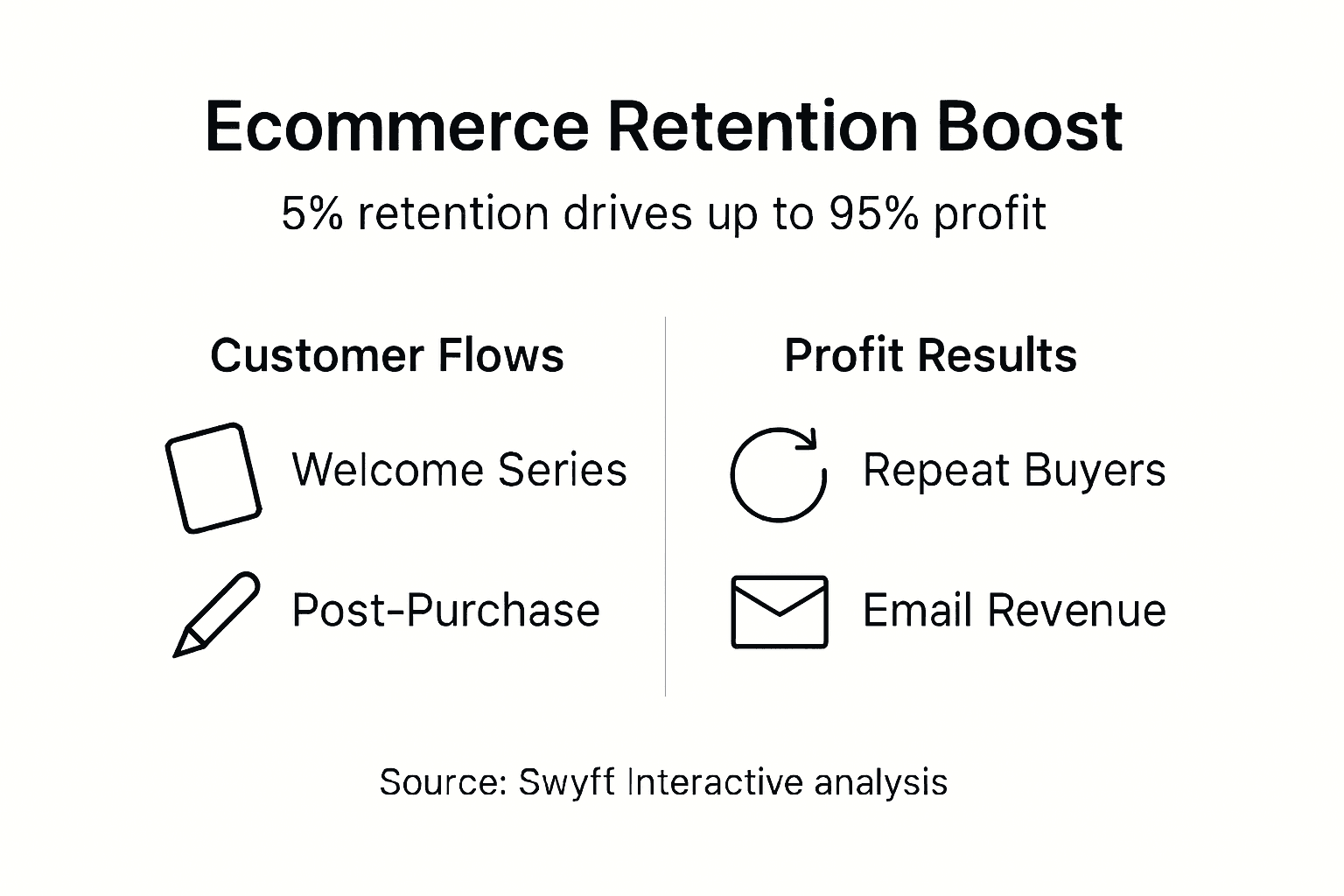
Post-purchase flows typically deliver a 10% to 30% increase in repeat purchase rates. If 20% of first-time buyers currently make a second purchase, a well-executed post-purchase flow can push that to 24% or higher. This compounds over time as more customers enter repeat buyer segments.
High-value customers identified through RFM segmentation spend four to ten times more than average buyers. Retention flows that nurture these segments protect your most valuable revenue streams. Losing a single high-value customer costs more than losing ten low-value ones, making targeted retention flows a revenue insurance policy.
Automated flows often represent 40% to 50% of total email revenue once fully deployed. This passive income stream runs 24/7, converting customers while you focus on strategy and growth initiatives. Manual campaigns still play a role, but automation handles the repetitive, high-volume work.
| Metric | Baseline | After Retention Automation | Improvement |
|---|---|---|---|
| Repeat Purchase Rate | 20% | 24% to 26% | 20% to 30% lift |
| Customer Lifetime Value | $150 | $180 to $210 | 20% to 40% increase |
| Email Revenue Share from Automation | 25% | 40% to 50% | 60% to 100% growth |
| Average Order Value (AOV) | $75 | $80 to $90 | 7% to 20% lift |
Understanding these benchmarks helps you set realistic goals and measure progress. Track your numbers monthly and compare them to industry standards. If you fall short, revisit segmentation, flow design, and messaging quality.
Boost Your Ecommerce Retention with Swyft Interactive
Retention automation delivers measurable profit growth, but execution demands expertise, time, and continuous optimization. Swyft Interactive specializes in Klaviyo email marketing automation designed to maximize customer lifetime value and revenue.
We build tailored retention flows that align with your brand, products, and customer behavior. From segmentation strategy to funnel analysis and iterative improvement, our team handles the technical details so you focus on running your business. Our clients see automated email revenue contributions climb to 50%+ of total email revenue within six months.
Partner with us to deploy data-driven Klaviyo email marketing services that turn one-time buyers into loyal, repeat customers. Explore our ecommerce growth strategy automation solutions or dive into our comprehensive email marketing automation guide to see how we help brands scale retention profitably.
Frequently Asked Questions
How do I start Klaviyo retention automation with a small customer base?
Focus on building your list to 500 customers and six months of order data before launching complex segmentation flows. In the meantime, deploy simpler flows like welcome series and basic post-purchase sequences that don’t require RFM analysis.
What is the optimal email sending frequency for retention?
It depends on segment behavior. High-value, frequent buyers tolerate weekly sends, while occasional shoppers prefer monthly updates. Monitor unsubscribe rates by segment and adjust cadence accordingly to avoid fatigue.
How does RFM segmentation improve email targeting?
RFM groups customers by Recency, Frequency, and Monetary value, enabling you to send relevant messages to each group. High-value recent buyers receive loyalty rewards, while lapsed customers get re-engagement offers, dramatically improving relevance and conversion.
Can SMS automate alongside Klaviyo for retention?
Yes, Klaviyo supports SMS automation triggered by the same events and segments that power email flows. SMS works especially well for time-sensitive messages like cart abandonment or flash sales, complementing email retention efforts.
What metrics best indicate retention flow success?
Track repeat purchase rate, customer lifetime value, flow revenue contribution, and conversion rate per flow. These metrics reveal whether your flows drive actual revenue, not just opens or clicks, ensuring you focus on profitable retention activities.