
TL;DR:
- Effective user experience is vital for online retail growth, directly influencing conversion, bounce rates, and customer loyalty.
- However, UX alone cannot sustain traffic amid rapidly evolving discovery channels and AI-driven search, requiring integrated channel strategies and automation.
Your products are strong. Your ad spend is solid. Yet conversion rates stay stubbornly flat, cart abandonment climbs, and repeat purchases feel rare. The missing piece is almost always user experience (UX). Most eCommerce brand managers treat UX as a cosmetic layer, something to polish once the “real” work is done. That thinking quietly costs brands thousands in lost revenue every month. This guide breaks down why UX is a core business driver, how it connects with marketing automation for compounding results, and why evolving discovery channels now demand that you think beyond your website alone.
Table of Contents
- Why UX matters more than ever in online retail
- What defines effective UX for eCommerce stores?
- How automation and UX work together in online retail
- Avoiding pitfalls: UX, discovery channels, and agentic commerce
- Why UX is necessary—but never the whole story
- Unlock your online retail potential with applied UX and automation
- Frequently asked questions
Key Takeaways
| Point | Details |
|---|---|
| UX drives conversions | User experience is a fundamental lever for boosting online retail sales and customer loyalty. |
| Automation amplifies UX | Marketing automation enhances UX impacts, driving engagement and repeat purchases through personalized journeys. |
| Discovery channels are shifting | Emerging agentic commerce trends require constant adaptation in both UX and external channel strategies. |
| Continuous optimization is key | Successful brands regularly refine both UX and automation in response to market changes for sustainable growth. |
Why UX matters more than ever in online retail
User experience in online retail covers every touchpoint a shopper encounters. Navigation, search and product discovery, page load speed, product descriptions, checkout flow, and post-purchase messaging all fall under the UX umbrella. When any part of that chain breaks down, shoppers leave. And they rarely come back.
The direct link between UX and revenue is no longer debatable. Brands that prioritize effective UX strategies consistently see higher add-to-cart rates, lower bounce rates, and stronger lifetime customer value. Website design for conversions is not decoration, it is architecture that either moves shoppers forward or stops them cold.
The deeper issue is that digital marketplaces are shifting fast. Shoppers increasingly discover products through AI-driven answer engines and agent-assisted searches rather than by typing a query into Google and landing on your homepage. Per Forrester’s 2026 predictions, agentic commerce is reshaping discovery, which means UX optimization alone may not protect your traffic if external channels pull buyers before they ever reach your storefront.
Great products are not enough. Shoppers expect frictionless experiences, and when a competitor delivers that, the switch costs are almost zero. Here is what strong UX actually changes for your brand:
- Conversion rates increase because clearer navigation and faster pages reduce decision fatigue and hesitation
- Bounce rates drop when site structure guides visitors toward relevant products immediately
- Average order value rises because well-designed product pages surface related items and bundles naturally
- Customer loyalty strengthens when post-purchase flows, account management, and returns are painless
Each of these outcomes feeds directly into revenue. UX is not a support function. It is a growth lever.
What defines effective UX for eCommerce stores?
Strong UX is measurable. It is not a feeling or an opinion. The benchmarks that matter most for online retail are site speed (under 2.5 seconds for meaningful content to appear), mobile responsiveness across all device types, intuitive category and filter structures, and a checkout process that requires as few steps as possible. Miss any of these and the data will show it clearly in your analytics.
The role of design in ecommerce goes well beyond visual identity. Layout decisions, button placement, color contrast for readability, and image load priority all affect whether a visitor converts or exits. A beautiful site that loads slowly on mobile is actively harmful to your revenue. Building high-converting websites means making performance and clarity non-negotiable from the first wireframe, not as afterthoughts.
The contrast between optimized and unoptimized experiences is stark. Here is how they compare across the metrics that matter:
| Metric | Optimized UX | Unoptimized UX |
|---|---|---|
| Conversion rate | 3 to 5 percent average | 0.5 to 1.5 percent average |
| Bounce rate | 30 to 40 percent | 60 to 80 percent |
| Checkout completion | 65 to 80 percent | 25 to 45 percent |
| Repeat purchase rate | 35 percent or higher | Under 15 percent |
| Mobile session duration | 3 to 5 minutes | Under 90 seconds |
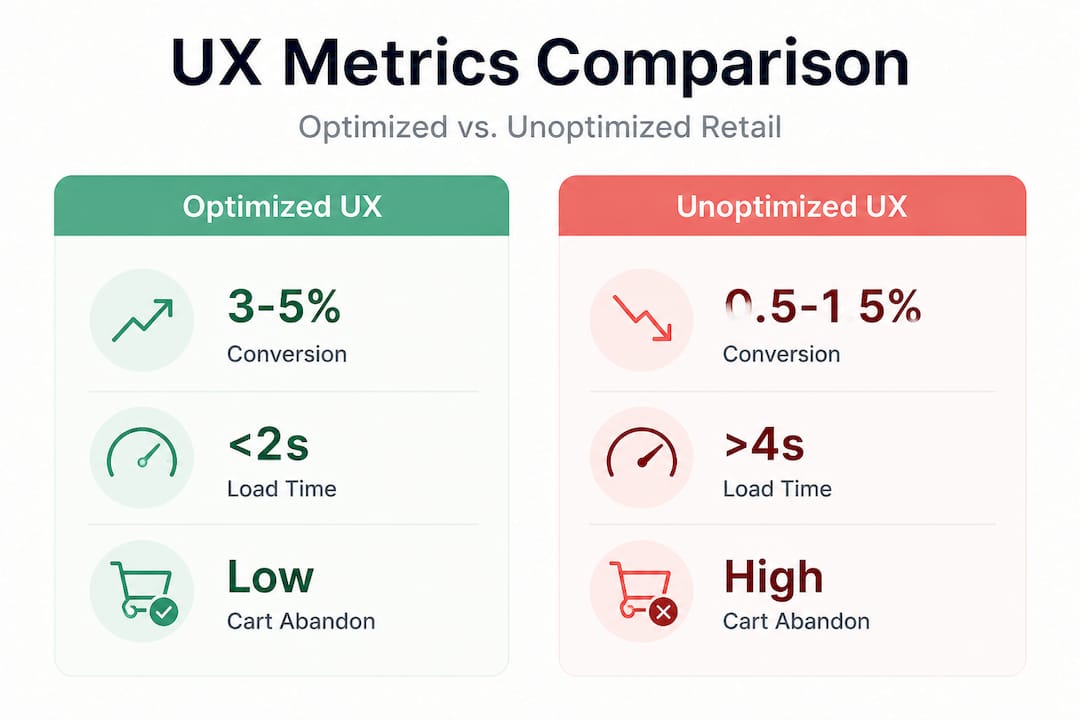
The gap is not small. Brands on the right side of that table are not operating in a different league. They have simply made UX a structured priority.
To assess where your own store stands, run through these steps:
- Audit your funnel in Google Analytics. Identify the exact pages where the largest percentage of sessions end without a purchase or add-to-cart action.
- Record real user sessions. Tools like Hotjar or Microsoft Clarity show where users click, scroll, and rage-click, giving you behavioral evidence rather than guesswork.
- Test your mobile experience on a slow 4G connection. Most shoppers are on mobile, and many are not on fast Wi-Fi. Simulate their reality.
- Walk through your own checkout as a first-time buyer. Count every click and form field. Anything you find unnecessary, your customers find annoying.
- Survey recent buyers and recent abandoners. Ask both groups one question: “What almost stopped you from completing your purchase?” The answers are routinely surprising.
Pro Tip: Do not redesign everything at once. Target the single biggest bottleneck in your funnel first, measure the lift, then move to the next one. Scattered redesigns spread effort thin and make it nearly impossible to attribute revenue gains to specific changes.
Also worth noting is the emerging pressure from agentic commerce. Even a perfectly optimized site can lose traffic if AI agents complete transactions on behalf of shoppers without ever sending them to your storefront. This is the new frontier for UX strategy, and it demands that site experience be considered alongside discovery architecture.
How automation and UX work together in online retail
Think of UX and marketing automation as two parts of the same customer journey. Your site experience gets a visitor to convert. Your automation stack keeps them coming back. When the two are disconnected, you see one-time buyers who never return and abandoned cart sequences that land in inboxes for products the customer found confusing on the site anyway.
The integration works in both directions. Strong UX collects better behavioral data, which makes your automation smarter. A well-structured site generates clean signals: what categories a user browsed, how long they spent on a product page, where they dropped off in checkout. Those signals feed directly into Klaviyo flows that feel personal and timely rather than generic and irrelevant.
At the same time, automation supports UX by extending the experience past the session. A post-purchase flow that handles order updates, cross-sells relevant accessories, and makes a return request effortless is part of the user experience, even though it happens in email. These tools depend entirely on seamless UX to perform:
- Abandoned cart sequences only work when the site experience was close to converting. If shoppers leave because the checkout was confusing, recovery emails rarely land.
- Browse abandonment flows require accurate product page data and clear category structures to surface the right follow-up content to each subscriber.
- Post-purchase loyalty programs need simple account management UX to see real engagement. Friction in loyalty portals kills redemption rates.
“UX-focused optimization may not be sufficient if external discovery channels shift, for example, answer engines and agentic commerce pulling traffic before your site experience can win.” This Forrester 2026 prediction is a clear signal that site-only thinking has limits, and that automation must extend into new touchpoints to stay ahead.
Optimizing your eCommerce website is therefore not just about on-page conversion. It is about creating a data-rich environment that makes every downstream marketing strategy for eCommerce more effective. Brands that treat UX and automation as separate workstreams consistently underperform against those that integrate them from the start.
Pro Tip: Map your customer journey from first ad click through to the third post-purchase email before you redesign any single touchpoint. Seeing the full arc reveals whether your UX and automation are telling a coherent story or contradicting each other at every step.
Avoiding pitfalls: UX, discovery channels, and agentic commerce
Here is a scenario playing out for more brands than realize it: traffic drops despite a site that converts well. The cause is rarely the site itself. It is the upstream discovery landscape changing. Search engines are giving way to AI answer engines, voice assistants, and agentic tools that complete transactions before a user visits any storefront. This is not a distant concern. Per Forrester’s 2026 forecast, agentic commerce is already reshaping how buyers reach products.
The comparison below shows what happens when brands optimize different variables:
| Strategy | Short-term result | Long-term outcome |
|---|---|---|
| UX only | Improved conversion rate | Vulnerable to traffic drops |
| Discovery channel only | Increased traffic | High bounce if site underwhelms |
| UX plus automation | Strong conversion and retention | Compound revenue growth |
| UX plus channel strategy | Resilient traffic and conversion | Sustainable long-term growth |
Brands optimizing for higher revenue need all four levers working together, not just one or two. The table above makes the case visually. There is no single-variable path to sustainable growth.
The specific pitfalls to watch for when improving UX without a broader channel strategy:
- Neglecting traffic strategy while redesigning the site means improved conversion rates apply to a shrinking pool of visitors, with diminishing returns over time
- Ignoring AI-driven discovery by building exclusively for traditional SEO leaves brands exposed as answer engines replace blue-link search results
- Non-adaptive site design that performs well on desktop only continues to bleed mobile revenue, which now accounts for the majority of eCommerce sessions globally
- Treating UX as a one-time project rather than a continuous testing discipline means gains erode as competitor experiences improve and customer expectations rise
The brands applying proven conversion rate tips alongside channel diversification are the ones building durable revenue engines, not just short-term conversion bumps.
Balancing UX and channel strategy starts with owning your data and your audience. Email lists, SMS subscribers, and loyalty program members are audiences you control. Even if discovery channels shift dramatically, those relationships insulate your revenue. Build them through great UX. Maintain them through smart automation.
Why UX is necessary—but never the whole story
We work with eCommerce brands regularly, and the most common mistake we see is not ignoring UX. It is the opposite: becoming so focused on UX improvement that channel strategy and automation get deprioritized. A brand can run twelve months of A/B tests, redesign their product pages beautifully, and still see flat revenue if their email list is cold, their discovery channels are shrinking, and their post-purchase experience does nothing to earn a second order.
The conventional wisdom that “fix the site and revenue follows” made more sense when Google was the only discovery gateway that mattered. Now, with AI agents, answer engines, and social commerce all competing to intercept buyers before they reach your storefront, a great site is a necessary condition for success, not a sufficient one. Forrester’s 2026 agentic commerce predictions are not a prediction of doom. They are a call to build brands with wider surface areas.
What does that look like practically? It means that every UX improvement should also ask: “How does this make our automation stronger?” and “How does this help us stay visible if traffic patterns change?” Those questions keep UX work connected to business outcomes rather than becoming an internal craft project. Unlocking ecommerce growth requires that UX decisions feed your owned channels and your retention strategy, not exist independently of them.
Pro Tip: Build a continuous discovery loop by reviewing customer journey data every quarter, not just after a redesign. Markets shift. Buyer behavior shifts. Brands that build feedback mechanisms into their operations adapt faster and protect their revenue with far less drama.
The brands we admire most are not the ones with the most beautiful stores. They are the ones where every UX decision connects to a measurable downstream outcome, and where the team running discovery, automation, and design is talking to each other weekly.
Unlock your online retail potential with applied UX and automation
Applying the strategies in this guide moves fast when you have the right systems in place. The connection between a high-converting site and a sophisticated automation stack is not theoretical, it is where the most consistent revenue gains actually live.
At Swyft Interactive, we build eCommerce sites engineered for conversion and pair them with Klaviyo automation flows that extend the customer experience well past the first purchase. Whether you need a full site build or want to strengthen your existing email strategy, our team works from your data to close the gap between traffic and revenue. Explore our approach to eCommerce website design and see how integrated UX and automation create results that compound over time. Visit Swyft Interactive to connect with our team.
Frequently asked questions
What are the most important UX factors for online retail in 2026?
Site speed, intuitive navigation, mobile responsiveness, and seamless checkout remain the strongest conversion and retention drivers for eCommerce brands, though agentic commerce shifts now demand that these factors be considered alongside discovery channel strategy.
How does agentic commerce impact my retail site’s UX?
Agentic commerce routes buyers through AI agents before they reach your storefront, meaning even well-designed sites must pair strong on-page experience with visibility strategies that work inside AI-driven discovery environments.
Can automation tools enhance user experience beyond basic site design?
Yes. Personalized email flows, dynamic product recommendations, and customer journey mapping all extend your site’s UX into post-visit touchpoints, increasing repeat purchase rates when they are integrated with strong UX from the start.
Is focusing solely on UX enough for growth if marketplace discovery evolves?
No. Brands must pair UX improvements with active discovery channel strategy and marketing automation because external channel shifts can reduce traffic to even the best-designed stores, making multi-lever growth the only durable path forward.
Recommended
- Unlock ecommerce growth with effective UX design
- Role of Design in Ecommerce: Driving Conversions Online
- How future ecommerce marketing drives growth in 2026
- Boost eCommerce sales: how website design drives conversions
- Industry 3D innovation: Transforming e-commerce in 2026
- Meeting 2026 E-Commerce Visual Standards | AI 3D Product Visualization