
If your paid ads and email campaigns feel like separate planets, you’re not alone. Most ecommerce marketing managers run disconnected tactics that eat budget without compounding results. Awareness ads drive traffic that email never captures. Abandoned cart flows fire without context from the ad that brought the shopper in. The result: wasted spend, inconsistent revenue, and a customer journey full of gaps. A full funnel marketing workflow fixes this by connecting every touchpoint into one system where each channel feeds the next. This guide walks you through exactly how to build that system, from setup to scale.
Table of Contents
- What is a full funnel marketing workflow?
- Preparation: Tools and prerequisites for your workflow
- How to set up your full funnel marketing workflow
- Common mistakes and troubleshooting in full funnel marketing
- A smarter approach: Integration is the real growth engine
- Ready to build? Start your full funnel workflow with Swyft
- Frequently asked questions
Key Takeaways
| Point | Details |
|---|---|
| Non-linear customer journeys | Modern ecommerce workflows must adapt to cyclical, multi-touch customer paths for real growth. |
| Integration over isolation | Seamless automation between ads, website, and email outperforms disconnected campaigns. |
| Preparation is essential | Verifying your tools and data are properly set up prevents costly workflow mistakes. |
| Iterate for impact | Monitor, troubleshoot, and improve your workflow to boost revenue and customer retention. |
What is a full funnel marketing workflow?
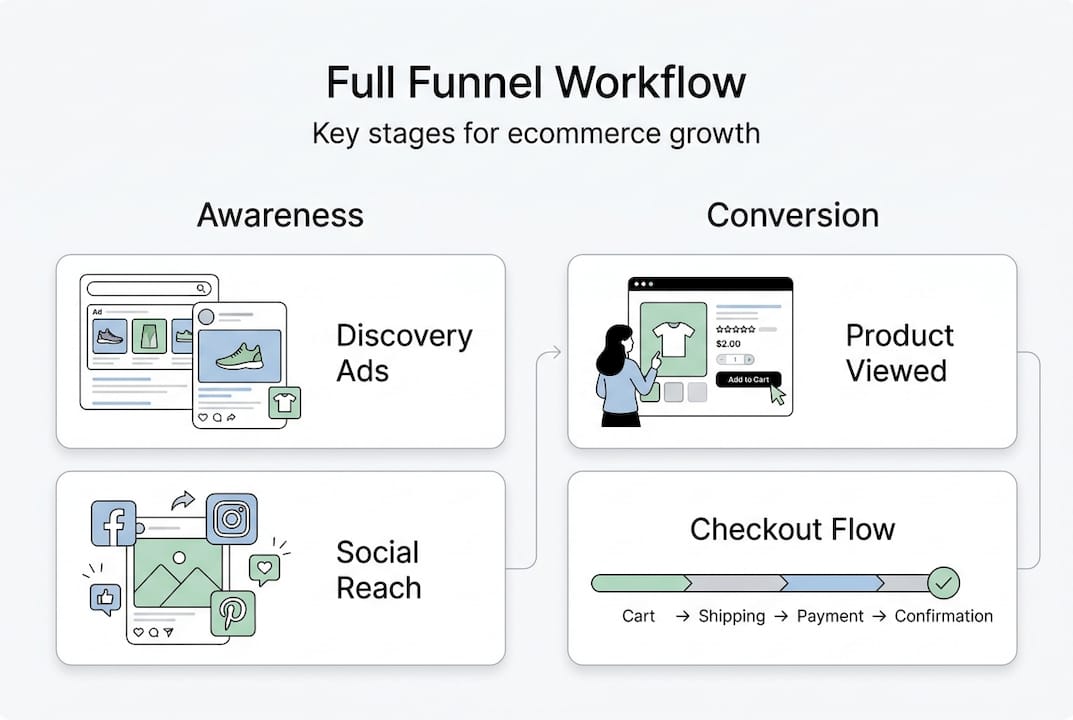
A full funnel marketing workflow is a connected system that guides potential customers from first awareness all the way through purchase and repeat buying. It’s not a campaign. It’s an operating model. Every stage, awareness, consideration, conversion, and retention, is linked by shared data and automated triggers so that what happens in one channel informs what happens in the next.
Traditional linear funnels treated the customer journey as a straight line: see ad, visit site, buy, done. That model no longer reflects how people shop. Today’s buyers research across multiple sessions, compare on social, check reviews, abandon carts, and return days later through a completely different channel. Modern ecommerce funnel strategies account for this non-linear behavior by building cyclical, feedback-driven workflows instead of one-directional campaigns.
The difference matters more than most brands realize. As one marketing strategist points out, agencies love talking about full funnel without actually integrating the stages, making it a buzzword rather than a system. True integration means your paid ad audiences inform your email segments, your on-site behavior triggers automation sequences, and your post-purchase flows feed back into your top-of-funnel lookalike audiences.
| Dimension | Linear funnel | Integrated workflow |
|---|---|---|
| Structure | One-directional | Cyclical and feedback-driven |
| Channel relationship | Siloed | Shared data and triggers |
| Customer journey | Assumed linear | Multi-touch and non-linear |
| Optimization | Per campaign | Across the full system |
| Retention | Afterthought | Built into every stage |
A solid customer journey mapping process is what makes this tangible. You identify every touchpoint where a customer interacts with your brand and then connect those touchpoints with automation logic.
Key touchpoints in a full funnel system include:
- Paid ads (awareness and retargeting)
- Landing pages and product pages (consideration and conversion)
- Email capture and welcome sequences (nurture entry)
- Abandoned browse and cart flows (conversion recovery)
- Post-purchase sequences (retention and upsell)
- Loyalty and review requests (advocacy and re-entry)
When these touchpoints share data, you stop running campaigns and start running a growth system.
Preparation: Tools and prerequisites for your workflow
Before you automate anything, you need the right foundation. Jumping into workflow setup without clean data or integrated tools is one of the fastest ways to waste time and budget. Automation tools for website and email drive more consistent revenue than siloed campaigns, but only when the underlying data is reliable.
Here’s what you need before you build:
| Tool or requirement | Function | Popular options |
|---|---|---|
| Ecommerce platform | Product catalog, checkout, order data | Shopify, WooCommerce, BigCommerce |
| Email service provider (ESP) | Automation, segmentation, flows | Klaviyo, Omnisend, Drip |
| Web analytics | Traffic, behavior, attribution | Google Analytics 4, Triple Whale |
| CRM or CDP | Unified customer profiles | Klaviyo, HubSpot, Segment |
| Automation engine | Cross-channel trigger logic | Klaviyo, Zapier, Make |
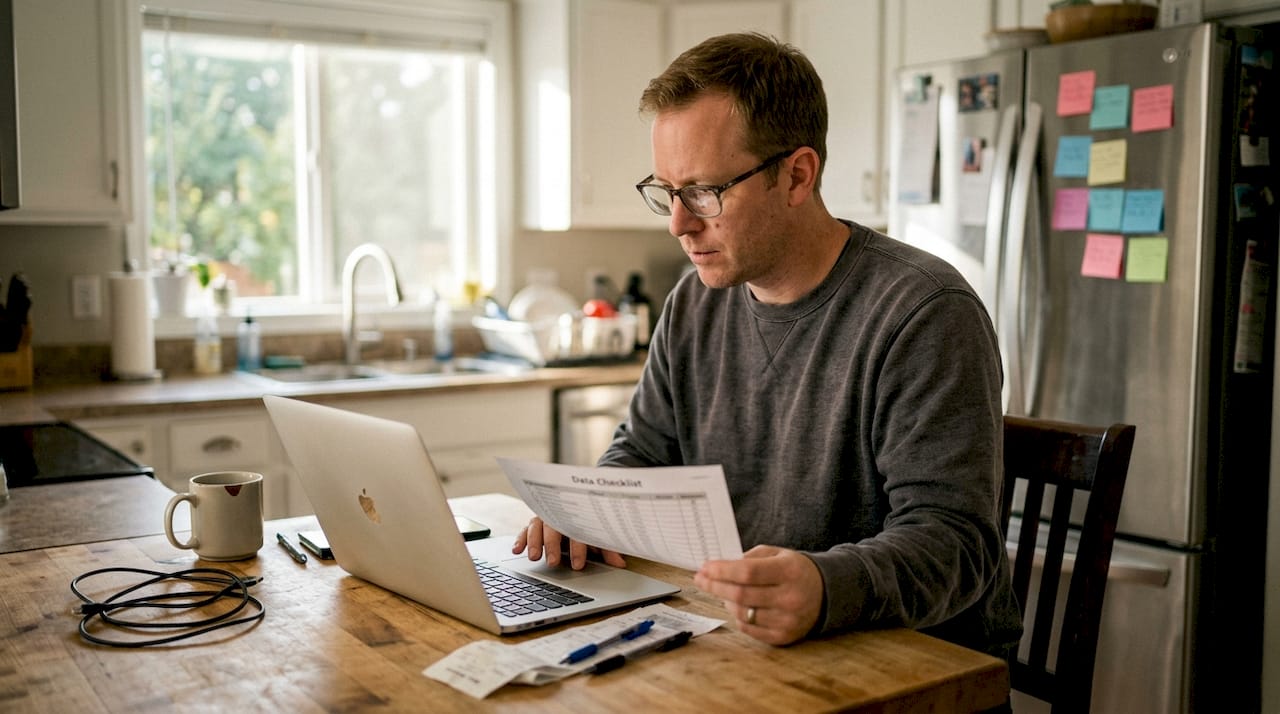
Beyond tools, your data prerequisites matter just as much. You need accurate event tracking on your site (add to cart, product view, checkout start), segmented email lists based on purchase behavior, and historical order data synced to your ESP. Without these, your automation fires based on guesswork.
Data and integration musts before setup:
- Site tracking verified across all key events
- ESP connected to your ecommerce platform with real-time sync
- Suppression lists active to avoid emailing unsubscribes
- UTM parameters in place on all paid traffic
- Customer purchase history imported and mapped to email profiles
Review our email marketing automation guide for a deeper look at ESP setup and the benefits of marketing automation if you’re still evaluating whether to invest in this infrastructure.
Pro Tip: Before you turn on a single automation, run a data audit. Check that your ESP and ecommerce platform are syncing in real time, not on a delay. A 24-hour sync lag can cause abandoned cart emails to fire after a customer already purchased, which erodes trust fast. Use the marketing automation checklist to verify every integration point before going live.
How to set up your full funnel marketing workflow
With your tools and prerequisites set, you’re ready to build your first automated full funnel marketing workflow. The goal here is not to build everything at once. It’s to build one connected sequence, prove it works, and then expand.
-
Map your funnel stages. Document every stage from first touch to repeat purchase. Identify where customers drop off and what data you have at each stage. This becomes your automation blueprint. Reference the ecommerce funnel explained guide if you need a framework to start from.
-
Integrate your tools. Connect your ecommerce platform to your ESP and analytics. Confirm that customer events (purchases, product views, cart activity) flow into your ESP as properties you can trigger automations from.
-
Design your trigger logic. Map which customer actions trigger which automated responses. A product view with no purchase within 24 hours triggers a browse abandonment email. A first purchase triggers a post-purchase welcome sequence. Keep triggers specific and behavior-based.
-
Build your first nurture sequence. Start with one fully automated flow before scaling. A welcome series for new subscribers is ideal. It’s low risk, high volume, and gives you clean performance data fast. Follow the step-by-step email automation process to structure this correctly.
-
Connect paid ads to the same data layer. As integrated automation across all funnel stages shows the best results, your paid ads should feed your email audiences, not run in parallel. Sync your ESP segments to your ad platforms so that customers in your post-purchase flow are excluded from acquisition ads. Learn more about the strategic role of paid ads in a connected workflow.
-
Set up attribution tracking. Decide how you’ll measure which channel gets credit for a conversion. Last-click attribution misses most of the story in a multi-touch workflow. Use a model that reflects the full journey.
Pro Tip: Resist the urge to build 10 automations at once. One fully optimized nurture sequence will outperform five half-built ones every time. Get your welcome flow converting, then layer in abandoned cart, post-purchase, and win-back sequences one at a time.
Common mistakes and troubleshooting in full funnel marketing
Even the best workflows hit bumps. Here’s how to sidestep common errors and keep revenue growing.
The most costly mistake is launching automation before your data is clean. If your ESP doesn’t have accurate purchase history, your segmentation is wrong from day one. Customers who already bought get acquisition offers. Loyal customers get generic welcome emails. The automation runs, but it actively damages the relationship.
“Disjointed systems and lack of integration between channels hobble revenue growth.” Getting this right before launch is not optional.
Top troubleshooting tips by workflow stage:
- Awareness stage: If paid traffic isn’t converting to email subscribers, check your landing page offer and form placement. A weak lead magnet kills the top of your funnel.
- Consideration stage: If browse abandonment emails have low open rates, your subject lines may be too generic. Personalize with the specific product viewed.
- Conversion stage: If cart abandonment flows aren’t recovering sales, check your send timing. The first email should go out within one hour of abandonment.
- Retention stage: If post-purchase open rates drop after email two, your sequence is too long or too salesy. Add value before asking for the next purchase.
- Attribution: If you can’t tell which channel drove a conversion, your UTM structure is broken. Audit every paid and email link.
For ongoing monitoring, track these metrics weekly: flow revenue per recipient, list growth rate, and conversion rate by traffic source. Use these to identify which stage is leaking and fix it before scaling spend. The customer journey mapping process can help you visualize where drop-offs are happening, and the benefits of email automation resource covers what healthy performance benchmarks look like at each stage. Also review how to boost ecommerce sales through funnel optimization for additional context.
A smarter approach: Integration is the real growth engine
Here’s what most articles won’t tell you: the brands winning in 2026 are not the ones with the most automations. They’re the ones with the tightest integration between channels.
The industry conversation obsesses over tools, platforms, and campaign volume. But the actual lever is the handoff. What happens when a paid click becomes an email subscriber? When a post-purchase flow feeds a lookalike audience? When your on-site behavior data and your email engagement data live in the same profile? That’s where cyclical, integrated workflows outperform linear, campaign-heavy approaches.
Most brands over-invest in new tools and under-invest in making their existing tools talk to each other. They add a new ESP, a new ad platform, a new analytics tool, and then wonder why revenue attribution is a mess. The non-linear customer journey demands that your data model matches the way customers actually behave, not the way your org chart is structured.
True full funnel marketing is not about stacking campaigns. It’s about creating a feedback loop where every channel learns from every other channel. That’s the real growth engine.
Ready to build? Start your full funnel workflow with Swyft
If you want to implement this strategy faster and avoid costly pitfalls, Swyft Interactive can help. We build ecommerce growth systems that connect high-converting websites with Klaviyo email automation, so every stage of your funnel works together instead of in isolation.
Our workflow templates give you a proven starting point for your automation sequences, and our growth strategy with automation approach ensures your website, email, and paid channels share the same data layer. Whether you’re starting from scratch or optimizing an existing setup, we’ll help you build a system that compounds results over time. Reach out to Swyft Interactive and let’s map your full funnel workflow together.
Frequently asked questions
What is the biggest advantage of a full funnel marketing workflow for ecommerce?
Integrated, cyclical workflows connect every stage of the customer journey, which prevents revenue from leaking between channels and maximizes the return on every marketing dollar you spend.
Do I need advanced technical skills to set up a workflow?
No, most modern automation platforms like Klaviyo are designed for marketers and offer pre-built templates for common ecommerce flows like welcome series, abandoned cart, and post-purchase sequences.
How do I measure the success of my full funnel workflow?
Track conversions, customer retention rate, and revenue per recipient by channel before and after automation integration. Automation integrated across channels improves both revenue clarity and growth over time.
What’s a common mistake to avoid when automating workflows?
Launching automation before your tracking and data are fully integrated leads to wasted spend and missed sales. Disjointed systems hobble revenue growth, so audit your data layer before you activate any flow.