

Tracking your Klaviyo email campaigns often feels like trying to read your customers’ minds. Finding out how recipients interact with your emails is more than curiosity—it is the foundation of effective ecommerce marketing. Recognizing patterns in opens and clicks lets you focus your budget on what actually drives sales, while offering real insight into what your American brand’s audience wants. This guide breaks down the details and value of email engagement tracking so you can make smarter decisions that lead to measurable growth.
Table of Contents
- What Email Engagement Tracking Really Means
- Key Klaviyo Engagement Metrics Explained
- Segmentation and Personalization Using Data
- Business Impact: Revenue, Deliverability, Growth
- Common Pitfalls and Compliance Concerns
Key Takeaways
| Point | Details |
|---|---|
| Email Engagement Tracking | Monitoring opens, clicks, and other interactions helps assess campaign effectiveness and customer behavior. |
| Data-Driven Insights | Utilize metrics like open rates and click-through rates to optimize future campaigns for higher revenue and engagement. |
| Segmentation and Personalization | Tailor content to specific audience segments to enhance engagement and conversion rates, moving away from generic messaging. |
| Compliance and Security | Ensure adherence to laws like CAN-SPAM and implement security measures to protect customer data and maintain sender reputation. |
What Email Engagement Tracking Really Means
Email engagement tracking is straightforward: it’s monitoring how recipients interact with your emails after they arrive in their inbox. This includes opens, clicks, and other behaviors that tell you whether your campaigns resonate with customers.
At its core, tracking captures time-stamped records of when customers open emails and which links they click. These metrics reveal recipient behavior patterns, helping you understand what drives action versus what gets ignored.
The Data You Actually Get
Email engagement tracking provides data on open rates, click-through rates, and recipient interaction patterns. Your email service collects this information automatically whenever someone engages with your message.
Here’s what typically gets tracked:
- Open rate: Percentage of recipients who opened your email
- Click-through rate: Percentage of recipients who clicked a link in your email
- Unsubscribe rate: How many people opted out after receiving your message
- Bounce rate: Emails that failed to deliver due to invalid addresses
- Device type: Whether recipients opened on mobile, desktop, or tablet
- Time opened: Exact timestamp showing when someone read your email
Why This Matters for Your Bottom Line
Engagement data isn’t just vanity metrics—it directly impacts revenue. When you understand which campaigns drive clicks and conversions, you can optimize future sends for higher performance.
For eCommerce brands using Klaviyo, engagement tracking becomes your feedback loop. It shows which product announcements, discount codes, or abandoned cart reminders actually convert customers into sales.
Engagement tracking measures how effectively your emails reach and resonate with audiences, enabling you to optimize campaigns for higher user interaction and ROI.
The Reality of Tracking Accuracy
Track opens with realistic expectations. Not all email clients support tracking features equally. Some recipients use email clients that load images automatically or block tracking pixels entirely, so your open rates won’t capture the complete picture.
Click tracking, however, remains highly reliable. When someone clicks a link in your email, that action gets logged with near-perfect accuracy, giving you concrete proof of engagement.
How Engagement Data Connects to ROI
Engagement metrics help you identify high-performing segments and content types. An email with a 35% open rate and 8% click-through rate tells you that subject line and content resonated with that audience.

You can then replicate those elements in future campaigns, systematically improving your return on investment over time.
Pro tip: Set engagement benchmarks for each campaign type (product launches, promotions, educational content) so you can quickly spot underperformers and adjust your strategy before wasting budget on repeating poor results.
Key Klaviyo Engagement Metrics Explained
Klaviyo tracks far more than just basic open rates. The platform captures detailed engagement metrics that reveal exactly how customers interact with your campaigns across all channels.
Understanding these metrics helps you identify what’s working, what’s falling flat, and where to invest your marketing budget for maximum return.
The Core Metrics That Matter
Klaviyo provides visibility into several key performance indicators that directly impact revenue:
- Open rate: Percentage of subscribers who opened your email message
- Click-through rate (CTR): Percentage who clicked a link within the email
- Revenue per email: Total sales generated divided by emails sent
- Conversion rate: Percentage of recipients who completed a purchase after clicking
- Unsubscribe rate: How many people opted out from your list
- List growth rate: New subscribers added compared to unsubscribes
Beyond Basic Metrics: Advanced Signals
Klaviyo goes deeper by tracking channel affinity and purchase behavior across email, SMS, push notifications, and WhatsApp. This reveals which channels each customer prefers and when they’re most likely to engage.
You also get visibility into customer lifetime value predictions and next purchase date forecasts. These predictive metrics let you time campaigns perfectly for maximum impact.
Klaviyo’s AI-powered tools analyze engagement data to deliver personalized messages at the right time via customers’ preferred channels, driving higher conversion rates and revenue growth.
Segment-Level Performance
Not all customers behave the same way. Klaviyo breaks down engagement by customer segments, showing you which groups respond best to specific messaging or offers.
A segment of repeat buyers might have a 45% open rate and 12% CTR on product announcements, while first-time buyers only achieve 22% and 4%. This intel guides your content strategy moving forward.
ROI-Focused Metrics
Revenue generated per campaign is the metric that matters most for eCommerce brands. Klaviyo tracks revenue per email sent, revenue per subscriber, and revenue per campaign directly.
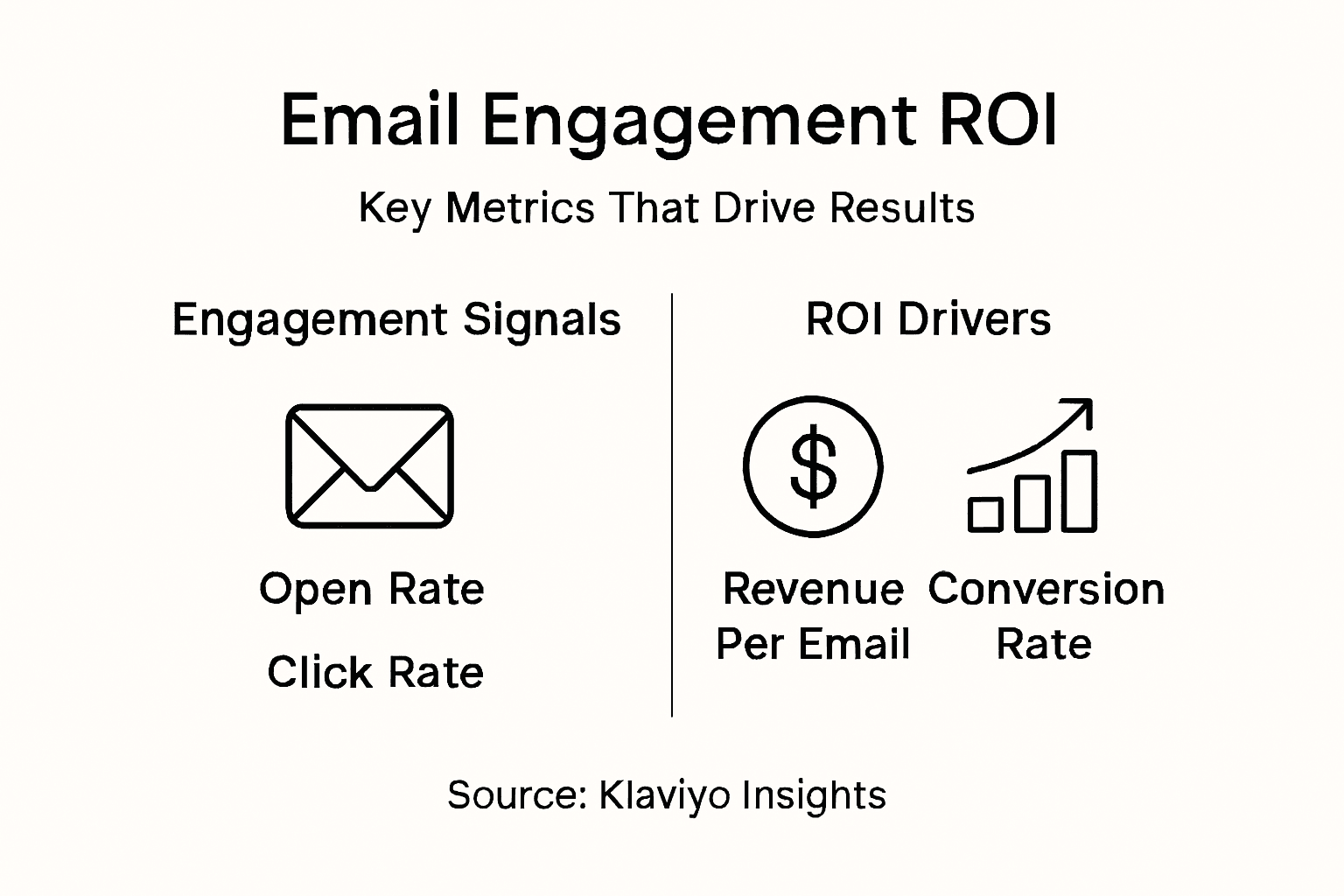
This removes guesswork from your marketing spend. You’ll know exactly which campaigns pay for themselves and which drain budget without generating sales.
Here’s a comparison of common email engagement metrics and the business decisions they inform:
| Metric Name | What It Measures | Guides Which Decisions |
|---|---|---|
| Open Rate | Email visibility and subject appeal | Subject line and send time strategy |
| Click-Through Rate | Content relevance and call-to-action | Email layout and offer effectiveness |
| Conversion Rate | Actual purchases from email | Product fit and promotional timing |
| Unsubscribe Rate | Disengagement or message fatigue | Content frequency and audience fit |
| Revenue per Email | Overall profitability of each campaign | Budget allocation and channel ROI |
Pro tip: Create custom dashboards in Klaviyo for each product category or customer segment, tracking revenue per email and conversion rate together so you can quickly spot underperforming campaigns and shift budget to winners.
Segmentation and Personalization Using Data
Segmentation and personalization have evolved dramatically. Instead of blasting the same message to everyone, you now use engagement data to create hyper-targeted campaigns that speak directly to individual customer needs.
This data-driven approach means higher open rates, more clicks, and ultimately more sales. Your email list becomes a collection of micro-audiences, each receiving content tailored to their behavior and preferences.
Why Generic Email Lists Fail
Sending identical emails to all 50,000 subscribers wastes potential revenue. A customer who bought winter boots needs different messaging than someone browsing summer sandals. Modern personalization adapts content dynamically based on user behavior, context, and purchase history.
Engagement data reveals these differences. By tracking opens, clicks, and purchases, you identify patterns that guide your segmentation strategy.
How Engagement Data Powers Segmentation
Your engagement metrics create natural segments automatically:
- High engagers: Open 50%+ of emails, click frequently, purchase regularly
- Moderate engagers: Open 20-40%, click occasionally, browse before buying
- Low engagers: Open less than 10%, rarely click, need re-engagement campaigns
- Product-specific: Customers who viewed or bought certain categories
- Purchase behavior: First-time buyers, repeat customers, VIP spenders
- Time-based: Recently purchased (post-purchase nurture), haven’t bought in 60 days (win-back)
Machine Learning Meets Email Strategy
Advanced machine learning allows firms to segment customers at granular levels and personalize marketing messages effectively. Predictive analytics forecast which customers will respond to specific offers, eliminating wasted send volume.
Instead of guessing who wants a discount, your data tells you exactly which segments convert on promotions versus full-price messaging.
Data-driven segmentation maximizes profitability by only targeting customers likely to respond positively, balancing personalization benefits with operational efficiency.
Real-World Personalization Examples
Here’s how engagement data transforms your campaigns:
A customer who opened your last five product launch emails gets early access to new releases. Someone who only opens discount promotions gets targeted flash sales. A lapsed customer receives a special comeback offer different from your active buyer messaging.
Each segment sees subject lines, content, product recommendations, and offers tailored to their demonstrated preferences.
This table summarizes how segmentation levels affect campaign personalization:
| Segment Type | Personalization Approach | Example Use Case |
|---|---|---|
| High Engagers | Early access, exclusive offers | VIP product launch emails |
| Moderate Engagers | Occasional incentives | Promotional reminders |
| Low Engagers | Re-engagement messaging | Win-back discounts |
| Product-Specific | Tailored product suggestions | Category-based recommendations |
| Time-Based | Sequenced follow-ups | Post-purchase or lapsed campaigns |
Pro tip: Start with three core segments based on engagement level (high, medium, low), then layer in one behavioral segment like “viewed category X but didn’t buy.” Test how each segment responds before adding complexity.
Business Impact: Revenue, Deliverability, Growth
Email engagement tracking isn’t a vanity metric exercise. It directly impacts three critical business outcomes: revenue generated, email deliverability rates, and sustainable growth. Understanding these connections transforms how you measure marketing success.
When you track engagement systematically, you gain clarity on which campaigns drive sales, which damage your sender reputation, and which position you for long-term customer relationships.
Revenue Impact: The Direct Connection
Engagement data reveals exactly which emails generate sales. An email with a 6% conversion rate obviously outperforms one with 0.8%, but only if you’re tracking it. Real-time data allows organizations to measure revenue attributed to specific campaigns.
ECommerce managers can now calculate the precise ROI of each send. If a promotional email costs $50 in Klaviyo and generates $1,200 in revenue, that’s a 24x return. Knowing this metric means you can confidently invest more in high-performing campaign types.
Deliverability: Your Hidden Growth Lever
Engagement metrics directly affect whether your emails reach the inbox. Email providers like Gmail and Outlook monitor open rates and click rates on your sends. High engagement keeps you in the inbox; low engagement pushes you to spam.
A 15% open rate signals strong sender reputation. A 2% open rate tells providers your emails lack relevance, damaging future deliverability for all subscribers.
Here’s how engagement influences your long-term growth:
- High engagement = inbox placement = more opens = higher ROI
- Low engagement = spam folder placement = fewer opens = lower ROI
- Consistent engagement = improved sender reputation = better results over time
- Declining engagement = deliverability problems = wasted marketing spend
Growth and Customer Lifetime Value
Tracking business impact through comprehensive metrics like engagement enables sustainable expansion. Customers who consistently engage with your emails spend more and stay longer.
A customer with 50% email open rates has 3x higher lifetime value than one with 10% open rates. Engagement tracking helps you identify these high-value customers early and prioritize them with premium content.
Organizations that measure marketing impact through engagement data make faster, better decisions about budget allocation, customer targeting, and growth strategy.
Measurable Outcomes Worth Tracking
Focus on these impact metrics:
- Revenue per email sent: Directly measures profitability
- Customer acquisition cost by channel: Identifies most efficient acquisition sources
- Repeat purchase rate by engagement level: Shows loyalty correlation
- List growth rate: Indicates sustainable audience expansion
- Unsubscribe trend: Early warning signal of content mismatch
Pro tip: Build a monthly dashboard showing revenue generated by email channel, average order value from engaged versus unengaged segments, and trend lines for each metric so you can spot declining performance before it impacts quarterly revenue.
Common Pitfalls and Compliance Concerns
Email engagement tracking creates powerful business value, but it also brings legal and security responsibilities. Missteps can damage your sender reputation, expose your business to fraud, and result in heavy regulatory penalties.
Understanding common pitfalls helps you track engagement responsibly while protecting your brand and customers.
CAN-SPAM Compliance Matters
Common pitfalls in email marketing include failure to comply with CAN-SPAM Act requirements like deceptive subject lines, missing opt-out mechanisms, and insufficient identification of commercial content. The Federal Trade Commission enforces this law aggressively.
Violations aren’t minor issues. Each non-compliant email can result in fines up to $43,280. A single poorly executed campaign could cost your business six figures in penalties.
Critical CAN-SPAM Requirements
Stay compliant by following these essentials:
- Truthful subject lines: No misleading claims or fake urgency
- Clear sender identification: Display your actual business name and address
- Explicit opt-out option: Make unsubscribing easy and honor requests within 10 days
- Honest content labeling: Clearly mark promotional emails as advertisements
- Valid physical address: Include your actual street address or P.O. box
- Privacy respect: Don’t buy email lists or add people without consent
Email Security and Fraud Prevention
Business Email Compromise represents a major compliance threat where scammers access legitimate accounts to fraudulently redirect payments. This costs businesses billions annually.
ECommerce companies managing customer data through email systems face particular risk. Your Klaviyo account contains payment information, purchase history, and customer details that criminals actively target.
Protecting Your Email Systems
Implement these security measures immediately:
- Multi-factor authentication: Require two verification methods for account access
- Strong password policies: Enforce complex passwords changed quarterly
- Employee training: Teach staff to recognize phishing and suspicious account activity
- Regular access audits: Monitor who has permissions to send emails and access data
- Email verification protocols: Confirm major transactions through secondary channels
Compliance violations and security breaches destroy sender reputation faster than any marketing mistake, making legal adherence and security investment non-negotiable business requirements.
Tracking Data Privacy Concerns
Engagement tracking collects personal data. You must respect subscriber privacy by storing data securely, not selling lists to third parties, and honoring GDPR requirements if you have European subscribers.
Transparency matters. Tell subscribers what you’re tracking and why in your privacy policy. This builds trust and protects you legally.
Pro tip: Audit your email list quarterly for compliance: verify all subscribers opted in, remove bounced addresses, check that your physical address and unsubscribe link work, and review your subject line practices to ensure nothing resembles spam or deception.
Unlock Greater ROI with Expert Email Engagement Strategies
Tracking email engagement reveals the true impact of your campaigns but turning that data into scalable growth can be challenging. If you struggle with low open rates, unclear ROI, or turning metrics like click-through and conversion rates into real revenue, you are not alone. Understanding engagement metrics, segmentation, and personalization requires specialized expertise paired with the right tools to optimize every customer interaction.
EMAIL MARKETING ARCHIVES – SWYFT INTERACTIVE offers deep insight into elevating email strategies, while our full-funnel approach brings together high-converting eCommerce websites and Klaviyo-powered automation to build measurable revenue streams.
Don’t let your valuable engagement data go unused. Partner with Swyft Interactive to harness predictive insights, segment audiences effectively, and create personalized, timely campaigns that drive sustained growth. Visit Swyft Interactive today and start transforming your clicks and opens into consistent sales. Ready for smarter email marketing and higher ROI? Explore our Digital Strategy Archives and You Suck At Klaviyo Archives to begin your journey.
Frequently Asked Questions
What is email engagement tracking?
Email engagement tracking is the process of monitoring how recipients interact with your emails, including opens, clicks, unsubscribes, and bounces.
Why is tracking email engagement important for ROI?
Tracking email engagement provides insights into recipient behavior, allowing you to optimize your campaigns for better performance, which can lead to increased sales and higher return on investment (ROI).
What metrics should I focus on when tracking email engagement?
Key metrics to focus on include open rates, click-through rates, conversion rates, unsubscribe rates, and revenue per email.
How can I improve my email engagement rates?
You can improve engagement rates by segmenting your audience, personalizing content, optimizing send times, and consistently analyzing and adjusting your email strategies based on engagement data.