TL;DR:
- Post-purchase experience influences customer retention, loyalty, and lifetime value in e-commerce. Brands that invest in proactive communication, smooth delivery, and seamless returns see higher repeat purchases and customer spend. Treating post-purchase as a strategic system rather than an afterthought drives long-term growth.
The post-purchase experience is defined as every interaction a customer has with your brand after completing a transaction, from the order confirmation email to delivery, returns, and follow-up messaging. This phase is the single most underinvested area in e-commerce, and the numbers prove it. 85% of consumers report that a poor delivery experience reduces their likelihood to repurchase, yet only 17% of customers feel that brands genuinely care about them after the sale. The importance of post-purchase experience is not a soft metric. It is a direct driver of revenue, retention, and long-term brand equity.
Why post-purchase experience is the most overlooked revenue lever
Most e-commerce brands spend the majority of their budget acquiring new customers. That math does not work in their favor. Repeat customers convert at 60–70%, while new customers convert at just 1–2%. That gap represents a massive revenue opportunity sitting right after the checkout page, not before it.

The financial case for retention is just as clear. According to Bain & Company, a 5% increase in retention can grow profits by 25–95%. That is not a marginal gain. It is a structural shift in how profitable your business becomes over time. Acquiring a new customer costs 5–7 times more than keeping an existing one, which means every dollar you put into post-purchase strategies pays back at a higher rate than most paid acquisition channels.
Customers with strong post-purchase experiences also spend more. Research shows they spend up to 140% more over their lifetime compared to customers who had a neutral or negative experience. That figure reframes the entire conversation. Post-purchase is not a cost center. It is a growth channel.
The brands that win long-term are the ones that treat the moment after payment as the start of the relationship, not the end of the transaction. Post-purchase marketing is the mechanism that makes that relationship real and measurable.
What are the key post-purchase touchpoints that drive loyalty?
The post-purchase phase contains several distinct moments where brands either build trust or lose it. Each one carries real consequences for whether a customer comes back.
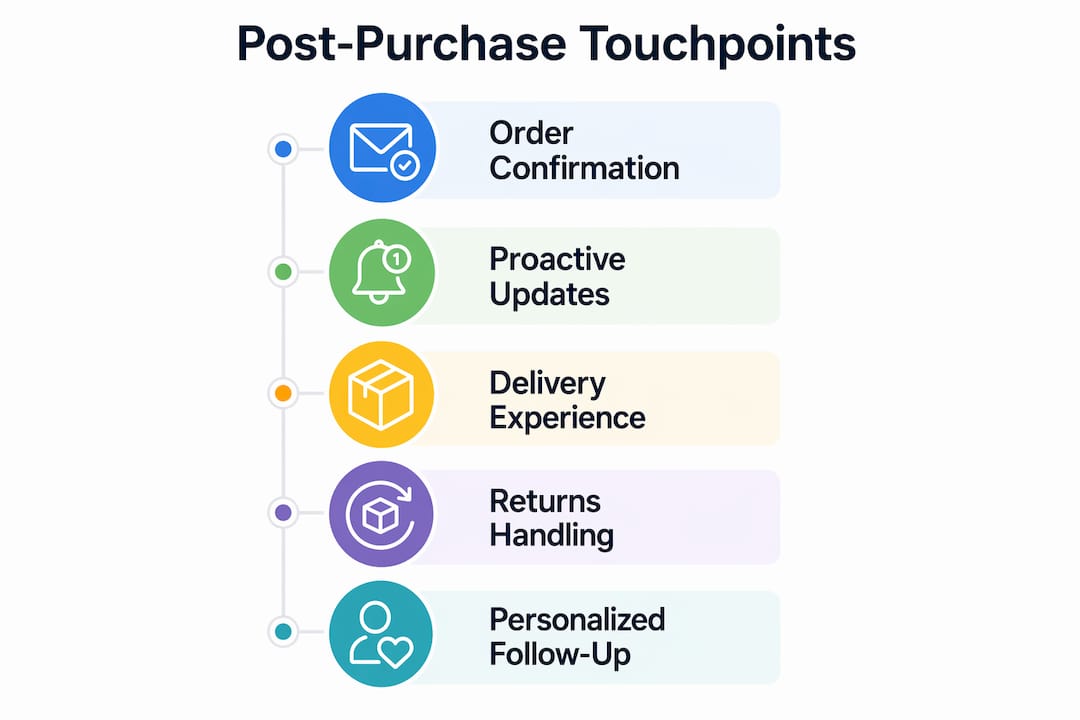
Proactive communication is the highest-leverage touchpoint. Brands that send automated tracking updates before customers ask see support volume drop by up to 72%. Fewer support tickets means lower operational costs and higher customer satisfaction at the same time. That is a rare combination.
Delivery experience shapes repurchase intent more than most brands realize. 52% of customers will boycott a retailer after just one or two failed deliveries. Consumers now expect real-time tracking, realistic delivery windows, and proactive compensation when something goes wrong. An apology alone is not enough.
Returns handling is where many brands quietly destroy loyalty. 76% of customers will not buy from a retailer again after a poor returns experience. A frictionless return process, on the other hand, signals confidence in your product and respect for the customer’s time.
Personalized follow-up messaging closes the loop. Generic “thanks for your order” emails do not build relationships. Segmented messages that reflect where the customer is in their journey, such as product setup tips, care instructions, or usage guides, add real value and keep your brand top of mind.
Pro Tip: Build your post-purchase communication sequence around customer milestones, not just internal shipping events. A message triggered by estimated delivery day lands better than one triggered by label creation.
The table below shows how each touchpoint affects customer behavior:
| Touchpoint | Customer Impact |
|---|---|
| Proactive tracking updates | Reduces support inquiries by up to 72% |
| Delivery experience | 52% boycott after 1–2 failed deliveries |
| Returns process | 76% won’t repurchase after poor returns |
| Personalized follow-up | Increases lifetime spend by up to 140% |
| Review and cross-sell timing | Usage-based triggers improve engagement rates |
For brands looking to build a text-based engagement layer on top of email, SMS is a natural extension of these touchpoints, particularly for delivery alerts and time-sensitive follow-ups.
Common mistakes brands make in the post-purchase phase
The most common mistake is treating the thank-you page as the finish line. Brands that go silent after shipping confirmation create anxiety, not satisfaction. That silence drives customers to search for order status on their own, which is exactly how WISMO inquiries pile up. WISMO, meaning “Where Is My Order,” represents 30–50% of all support volume, with each ticket costing roughly $5 to handle. Proactive updates eliminate most of these before they happen.
The second major mistake is sending generic transactional emails. A plain “your order has shipped” message is a missed opportunity. Customers are at peak engagement right after purchase. That window is the right time to reinforce their decision, introduce your brand story, or share product tips. Brands that use this moment well build loyalty before the product even arrives.
Timing errors in review requests and cross-sell emails are also widespread. Asking for a review the day after purchase, before the customer has even received the product, signals that you care more about your metrics than their experience. The same logic applies to cross-sell offers sent too early.
- Silence after shipping confirmation. Customers fill the information gap with anxiety. Send at least three status updates between label creation and delivery.
- Generic transactional emails. Replace template copy with messages that reflect the specific product purchased and the customer’s likely next question.
- Premature review requests. Wait until the customer has had time to use the product before asking for feedback.
- No returns communication. Customers who initiate a return and hear nothing feel abandoned. Automate return status updates the same way you automate shipping updates.
- Ignoring post-purchase feedback signals. Customers who contact support after delivery are telling you something. Capture that data and act on it.
Pro Tip: Map your current post-purchase sequence against a timeline of when customers actually use your product. Most brands find they are sending messages at the wrong moments, not the wrong messages.
How to build effective post-purchase strategies in 2026
The brands that lead on post-purchase experience in 2026 share one common approach: they treat it as a designed system, not a series of one-off emails. Segmenting communications by customer journey stage is the foundation of that system. A first-time buyer needs different messaging than a repeat customer. A customer who bought a complex product needs setup guidance. A customer who bought a consumable needs a replenishment reminder at the right interval.
Automation is the engine that makes segmentation work at scale. Post-purchase automation tools handle tracking notifications, returns management, review requests, and personalized follow-ups without manual effort. Klaviyo, for example, allows brands to build flows triggered by specific order events, delivery milestones, and customer behavior, which means every message goes out at the right time with the right content.
Feedback collection needs to go deeper than standard CSAT surveys. Conversational AI follow-ups capture the specific reasons behind customer satisfaction or dissatisfaction, turning vague ratings into specific product or process improvements. That kind of insight is what separates brands that iterate quickly from those that repeat the same mistakes.
Timing for review requests and cross-sell messages should follow usage-based triggers. For general products, 7–10 days after delivery is the right window. For electronics or complex items, 14–21 days gives customers enough time to form a real opinion. Premature asks hurt response rates and signal poor judgment.
Key metrics to track across your post-purchase system:
- Repeat purchase rate: the clearest signal of whether your post-purchase experience is working
- Support ticket volume: specifically WISMO tickets, which should fall as proactive communication improves
- Return rate and return-to-repurchase rate: a high return-to-repurchase rate means your returns process is building loyalty, not destroying it
- Review request response rate: a proxy for how well your timing and messaging are calibrated
- Customer lifetime value by cohort: tracks whether post-purchase investments compound over time
Brands that want to go deeper on the financial case for this work can review why retention drives long-term profit and use that framework to build internal buy-in for post-purchase investment.
Key Takeaways
Post-purchase experience is the highest-return investment in e-commerce because it converts existing buyers into repeat customers at 60–70%, far outpacing any new-customer acquisition channel.
| Point | Details |
|---|---|
| Retention economics | A 5% retention increase grows profits by 25–95%, making post-purchase the most cost-efficient growth lever. |
| Delivery and returns matter most | 85% of customers reduce repurchase intent after poor delivery; 76% leave after a bad returns experience. |
| Proactive communication pays off | Automated tracking updates cut support volume by up to 72% and reduce WISMO costs substantially. |
| Timing drives engagement | Review and cross-sell requests work best 7–21 days after delivery, matched to actual product usage. |
| Automation enables scale | Segmented, trigger-based flows deliver the right message at the right moment without manual effort. |
The part of e-commerce most brands still get wrong
I have worked with enough e-commerce brands to see the same pattern repeat. The marketing team is obsessed with acquisition costs, ad performance, and conversion rate on the product page. The moment a customer clicks “buy,” attention shifts to the next campaign. The post-purchase phase gets handed off to whoever manages the shipping platform, and it stays there, untouched, for years.
That is a structural mistake. The post-purchase phase is where brand perception actually forms. A customer can love your product and still never come back because the experience between purchase and delivery felt indifferent. Silence reads as neglect. Generic emails read as automation without thought. A difficult return reads as a brand that does not stand behind what it sells.
The brands I have seen grow fastest are the ones that treat post-purchase as a core product feature, not an operational afterthought. They invest in it the same way they invest in their homepage or their ad creative. They measure it, test it, and improve it on a regular cadence. The results compound. Customers who feel cared for after a purchase tell other people. That word-of-mouth is the cheapest and most credible acquisition channel available.
The emotional window right after purchase is also the most underused moment in e-commerce. Customers are at peak excitement. A well-timed, genuinely useful message in that window does more for loyalty than any loyalty program launched six months later. Start there.
— Leon
How Swyftinteractive helps brands build post-purchase systems that retain customers
Swyftinteractive builds the email automation and customer journey infrastructure that turns post-purchase from a gap into a growth engine. The team designs Klaviyo flows that cover every stage after checkout, from order confirmation and shipping updates to review requests, cross-sell sequences, and replenishment reminders, all segmented by customer behavior and purchase history.
If your brand is ready to build a post-purchase system that actually retains customers, the email marketing automation guide from Swyftinteractive is the right starting point. For brands that want to see the full picture of how automation drives revenue, the ecommerce growth strategy page covers the complete framework Swyftinteractive uses with its clients.
FAQ
What is the post-purchase experience in e-commerce?
The post-purchase experience covers every brand interaction after a customer completes a transaction, including order confirmation, shipping updates, delivery, returns, and follow-up messaging. It directly shapes whether a customer buys again.
Why does post-purchase experience affect customer retention?
Repeat customers convert at 60–70% compared to 1–2% for new customers, and customers with strong post-purchase experiences spend up to 140% more over their lifetime. Retention is simply more profitable than acquisition.
How do WISMO inquiries affect post-purchase costs?
WISMO inquiries represent 30–50% of all support volume and cost roughly $5 each to handle. Proactive shipping updates eliminate most of these tickets before customers need to ask.
When should brands send review requests after purchase?
Usage-based timing works best: 7–10 days after delivery for general products and 14–21 days for electronics or complex items. Sending too early, before the customer has used the product, reduces response rates and signals poor intent.
How does a poor returns experience affect customer loyalty?
76% of customers will not repurchase from a retailer after a poor returns experience. A frictionless, well-communicated returns process is one of the most direct ways to protect long-term customer loyalty.