TL;DR:
- Customer retention is crucial because it increases profit by boosting purchase frequency and reducing acquisition costs. Retained customers spend more, refer others, and their loyalty creates predictable revenue growth over time. Focusing on onboarding, feedback, and personalized communication improves loyalty and prevents early churn from product issues.
Customer retention is the practice of keeping existing customers engaged and buying over time, and it is one of the most direct paths to sustainable profit growth. Increasing retention by just 5% can improve profits by 25% to 95%. That single statistic reframes every dollar you spend on marketing. Business owners and marketing professionals who understand why customer retention is crucial stop chasing new customers as their primary growth lever and start building systems that make existing customers stay, spend more, and refer others.
Why customer retention is crucial for business profitability
The financial case for retention is concrete and well-documented. Repeat customers spend 33% more per transaction than new customers, and by their third year, that figure climbs to 67% more. That means a customer you acquired two years ago is worth dramatically more to your revenue today than a brand-new buyer.

Customer lifetime value (CLV) is the industry term that captures this compounding effect. CLV measures the total revenue a business can expect from a single customer over the entire relationship. When you improve retention, you extend that relationship and increase CLV without spending more on ads or outreach.
The revenue stability argument is equally strong. Businesses with high retention rates can forecast revenue with far greater accuracy. Predictable cash flow lets you plan inventory, hire confidently, and invest in growth without guessing. Customer-obsessed businesses grow revenue 41% faster and profits 49% faster than competitors who do not prioritize the customer relationship.
Loyal customers become unpaid marketing
60% of loyal customers actively recommend their favorite brands to others. That referral behavior is unpaid marketing at scale. A retained customer who refers two friends effectively lowers your customer acquisition cost for those new buyers to zero.
Loyal customers are also less price-sensitive. They absorb small price increases without churning. They forgive the occasional shipping delay or product issue because the relationship has built enough trust to absorb friction. That forgiveness has real dollar value when supply chain disruptions or service errors happen.
What measurable benefits do businesses gain from improving retention?
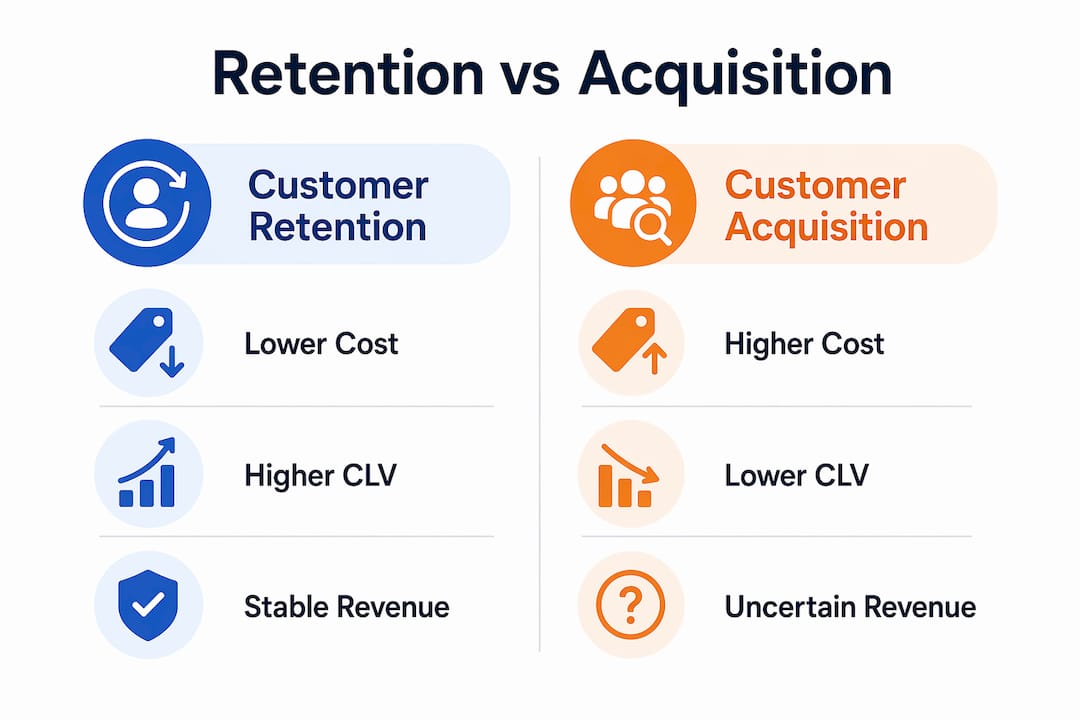
The benefits of keeping customers fall into four clear categories: higher revenue per customer, lower acquisition costs, stronger referral volume, and more predictable cash flow.
- Higher revenue per customer. By year three, retained customers spend up to 67% more per transaction. Long-term customers reach peak profitability in their second or third year. The first year of a customer relationship is often the least profitable because acquisition costs are front-loaded.
- Lower acquisition costs. When retained customers refer others, your paid acquisition budget stretches further. Word-of-mouth referrals convert at higher rates than cold traffic because trust transfers from the referring customer.
- Stronger brand advocacy. Loyal customers post reviews, share on social media, and defend your brand in public forums. This advocacy builds brand equity that paid advertising cannot replicate.
- More predictable revenue. Subscription businesses, SaaS companies, and ecommerce brands with strong retention can model revenue months in advance. That predictability reduces financial risk and supports smarter investment decisions.
Pro Tip: Track cohort revenue, not just monthly revenue. A cohort report shows how much each group of customers spends over time, making the compounding value of retention visible in your own data.
Retention improvements compound over time, where small monthly churn reductions translate into large future revenue gains. A 1% monthly improvement sustained over five years multiplies revenue far beyond what the initial percentage suggests. This is the math that makes retention one of the highest-return investments a business can make.
How does customer retention compare with customer acquisition?
Acquiring a new customer costs 5 to 25 times more than retaining an existing one. That cost differential alone justifies shifting budget toward retention programs. But the comparison goes deeper than unit economics.
| Factor | Customer acquisition | Customer retention |
|---|---|---|
| Cost per customer | High (ads, sales, onboarding) | Low (email, loyalty, service) |
| Revenue timeline | Slow (first year often unprofitable) | Fast (existing trust accelerates purchases) |
| Compounding effect | Minimal | Significant over 2–3 years |
| Referral generation | Rare | Common among loyal customers |
| Churn signal value | None | High (reveals product and service gaps) |
Most businesses over-invest in acquisition and under-invest in retention. The most successful companies reverse this ratio after reaching product-market fit. Pouring budget into acquisition while ignoring churn is the “leaky bucket” problem: you fill the bucket faster, but water keeps escaping from the bottom.
Retention also serves as a leading indicator of product-market fit. High early churn signals product or onboarding issues before they become existential problems. If customers leave within the first 30 days, no amount of acquisition spend will fix the underlying issue.
Pro Tip: Calculate your payback period for acquisition spend. If it takes 18 months to recoup the cost of acquiring a customer, and your average customer stays 14 months, you are losing money on every new customer you bring in.
What are the best strategies to improve customer loyalty?
Improving customer loyalty requires a systematic approach across the entire customer lifecycle, not a single campaign or tactic.
-
Fix onboarding first. The first 30 days determine whether a customer stays or churns. Map every step a new customer takes after purchase and remove friction. A customer who reaches their first “aha moment” quickly is far more likely to become a long-term buyer. Retention must be focused on early activation to reduce churn.
-
Build systematic feedback loops. Use Net Promoter Score (NPS) surveys, exit surveys, and usage analytics to understand why customers leave. Treat every churn event as a data point. Patterns in exit feedback reveal product gaps, pricing misalignment, or service failures you can fix.
-
Create consistent experiences across every touchpoint. Loyalty builds through multiple predictable interactions, not single standout moments. A customer who receives a great product but a confusing returns process will not stay. Audit every touchpoint: checkout, post-purchase email, customer service, and reorder flow.
-
Deploy loyalty programs with clear incentives. Loyalty programs increase repeat purchases, referrals, and upgrade willingness by giving customers a concrete reason to return. Points systems, tiered rewards, and exclusive access all build the habit of buying from you. For ecommerce brands, tools like LoyaltyLion and Smile.io integrate directly with Shopify to automate these programs. You can explore proven loyalty program examples to see what structures drive the strongest results.
-
Automate personalized communication. Klaviyo and similar tools let you send behavior-triggered emails that respond to what customers actually do, not just when you want to send a campaign. A win-back sequence for lapsed customers, a post-purchase thank-you flow, and a replenishment reminder are all retention tools that run without manual effort. A well-built lifecycle email strategy keeps customers engaged between purchases and reduces the chance they drift to a competitor.
What misconceptions surround customer retention?
Several common misunderstandings cause businesses to undervalue or mismanage their retention efforts.
- Retention is not just “not losing” customers. It is the active management of compounding revenue growth. A business that keeps 90% of its customers each year doubles its customer base roughly every seven years without adding a single new acquisition channel.
- Churn is not a failure metric. Churn is a signal. High churn in the first 60 days points to onboarding or product problems. High churn at month 12 often signals a pricing or value perception issue. Reading churn by cohort and lifecycle stage turns a lagging metric into a roadmap for improvement.
- Retention gains are slow but compound dramatically. Most businesses abandon retention programs too early because results are not immediate. The compounding effect of small monthly retention improvements only becomes visible over 12 to 24 months. Patience is a competitive advantage here.
- Retention strategy is not one-size-fits-all. A SaaS company retains customers differently than a fashion ecommerce brand. Lifecycle stage matters too: a customer in year one needs different communication than a customer in year three. Segmenting your retention approach by customer age and behavior produces better results than a single program applied to everyone.
- Loyal customers are not immune to leaving. Even strong relationships erode if you stop delivering consistent value. Retention requires ongoing investment, not a one-time setup.
Key Takeaways
Customer retention is the highest-return growth lever available to most businesses, because it reduces acquisition costs, increases revenue per customer, and compounds profitability over time.
| Point | Details |
|---|---|
| Retention drives profit directly | A 5% retention increase can improve profits by 25% to 95%, making it one of the most efficient investments. |
| Loyal customers spend more over time | By year three, retained customers spend up to 67% more per transaction than new buyers. |
| Acquisition costs far exceed retention costs | Acquiring a new customer costs 5 to 25 times more than keeping an existing one. |
| Churn is a product signal, not just a loss | High early churn reveals onboarding or product-market fit problems that acquisition spending cannot fix. |
| Consistency builds loyalty, not single moments | Predictable positive experiences across every touchpoint retain customers better than one great interaction. |
The retention investment most businesses delay too long
Working with ecommerce brands across different growth stages, I have seen the same pattern repeat: founders pour budget into paid acquisition, hit a revenue plateau, and then wonder why growth stalls. The answer is almost always the same. They are filling the bucket while ignoring the holes.
The businesses that break through that plateau share one trait. They treat retention as a leading indicator of business health, not a lagging metric to review quarterly. They watch early churn weekly. They map the customer journey and fix friction points before they become reasons to leave. They build email flows in Klaviyo that respond to behavior, not just broadcast schedules.
The uncomfortable truth is that most retention problems are product and experience problems wearing a marketing costume. No loyalty program fixes a confusing checkout. No win-back email recovers a customer who had three bad service interactions. The retention work that actually moves the needle starts with honest diagnosis, not more campaigns.
My practical advice: before you launch another acquisition campaign, calculate your current retention rate and your average customer lifetime value. If your retention rate is below 60% in the first year, every dollar you spend on acquisition is working against you. Fix the foundation first. The compounding returns from even modest retention improvements will outperform almost any paid channel you can name.
— Leon
How Swyftinteractive helps ecommerce brands retain more customers
Retention strategy only works when the right systems are in place to execute it consistently.
Swyftinteractive builds the email automation, customer journey mapping, and loyalty infrastructure that ecommerce brands need to turn one-time buyers into repeat customers. From Klaviyo-powered lifecycle flows to post-purchase sequences that drive second and third orders, the team connects every retention tactic to measurable revenue outcomes. If you want a clear starting point, the ecommerce growth strategy guide covers how automation integrates with retention at every stage of the customer lifecycle. For brands ready to act on the numbers, the email marketing automation guide is the most direct path to building retention systems that run without constant manual input.
FAQ
What is customer retention and why does it matter?
Customer retention is the ability of a business to keep existing customers buying over time. It matters because retained customers spend more, refer others, and cost far less to maintain than acquiring new buyers.
How much can retention improvements increase profit?
Increasing retention by 5% can improve profits by 25% to 95%, according to widely cited research. The exact gain depends on your industry, average order value, and current churn rate.
What is the difference between customer retention and customer loyalty?
Retention measures whether customers continue buying. Loyalty describes the emotional connection and preference that makes customers choose you over competitors, even when alternatives exist. Strong retention often produces loyalty, but loyalty is the deeper, more durable outcome.
How do I start improving customer retention for my ecommerce store?
Start by auditing your onboarding experience and calculating your 30-day and 90-day retention rates by cohort. Then build automated email flows for post-purchase follow-up, replenishment reminders, and win-back sequences. Tools like Klaviyo make this executable without a large team. You can also review proven retention strategies for a structured starting framework.
What is a good customer retention rate for ecommerce?
Retention benchmarks vary by category, but ecommerce brands generally target a repeat purchase rate above 25% to 30% in the first year. Subscription-based models aim for monthly retention above 90%. Tracking your own cohort data over time is more useful than chasing an industry average.