TL;DR:
- Personalization in ecommerce emails enhances relevance by tailoring messages based on customer data and behavior. Failures occur when personalization becomes intrusive, irrelevant, or poorly synchronized with current customer context, risking distrust and churn. Successful strategies focus on clean data, continuous testing, and aligning messaging with customer journey stages to maximize revenue and trust.
Most eCommerce teams already know email is one of their best revenue channels. What many still get wrong is treating every subscriber the same way. Batch-and-blast sends, the practice of pushing the same message to your entire list at once, are fading fast as a growth strategy. Brands that invest in personalization are pulling ahead because they recognize that every customer is at a different stage, with different needs and behaviors. This guide walks through exactly how personalization works, why it matters, where it goes wrong, and what your team can do to make it work consistently.
Table of Contents
- Why personalization matters in online retail
- How personalization is powered: automation, segmentation, and real-time data
- Personalization pitfalls: risks, privacy, and intrusiveness
- Best practices: maximizing value with personalized email flows
- Why most retail personalization fails, and how to make yours stand out
- Build smarter personalization with Swyft Interactive
- Frequently asked questions
Key Takeaways
| Point | Details |
|---|---|
| Personalization drives engagement | Behavior-driven, personalized email flows lead to higher click rates and revenue in ecommerce. |
| Real-time data amplifies results | Modern personalization engines process signals instantly, delivering highly relevant experiences. |
| Avoid common pitfalls | Irrelevant or intrusive personalization, poor integration, and lack of optimization can backfire and lose trust. |
| Best practices maximize value | Segmentation, triggered flows, AI recommendations, and constant testing yield the best outcomes. |
| Privacy and compliance are critical | Collecting too much sensitive data raises legal risks and can damage customer trust. |
Why personalization matters in online retail
Personalization in email marketing is not simply adding a customer’s first name to a subject line. In online retail, personalization is implemented by combining customer data with automation and segmentation so messages change based on purchase history, on-site actions, and journey stage. The difference between a generic promotion and a contextually relevant recommendation is the difference between being ignored and driving a sale.
Consider what that actually looks like in practice. A first-time visitor who browsed your sneaker category but never purchased should receive a different message than a loyal customer who buys every quarter. A subscriber who abandoned a cart 30 minutes ago needs a different trigger than someone who made a purchase yesterday. When these moments are matched with the right content, email stops feeling like marketing and starts feeling like helpful service.
Here are the most common trigger events that power meaningful personalization:
- Cart abandonment flows sent within the first hour of abandonment
- Post-purchase follow-ups including usage tips, upsell offers, or review requests
- Product recommendations based on browse or purchase behavior
- Win-back campaigns targeting subscribers who haven’t engaged in 60 to 90 days
- Welcome series tailored to the source or referral channel that brought in the new subscriber
- Replenishment reminders for consumable products based on average purchase cycles
The data behind triggered flows is hard to argue with. Email flows generate nearly 41% of total email revenue from just 5.3% of sends, with click rates above 5.5% compared to 1.69% for standard campaigns. Flows also show meaningfully higher placed order rates, which means the automations you set up once keep working around the clock.
When you’re building a strategy around personalized emails for ecommerce, the goal isn’t complexity for its own sake. It’s matching message to moment. Solid segmentation best practices make that matching process systematic rather than guesswork.
How personalization is powered: automation, segmentation, and real-time data
Understanding how personalization actually works behind the scenes helps teams make smarter platform decisions and avoid common setup mistakes. There are three core engines driving modern personalization: automation logic, segmentation, and real-time data processing.
Automation handles the timing and delivery of messages at scale. Instead of manually triggering each email, automation rules fire based on actions like a cart being created, a product being viewed, or a purchase being completed. These rules form the backbone of lifecycle email marketing.
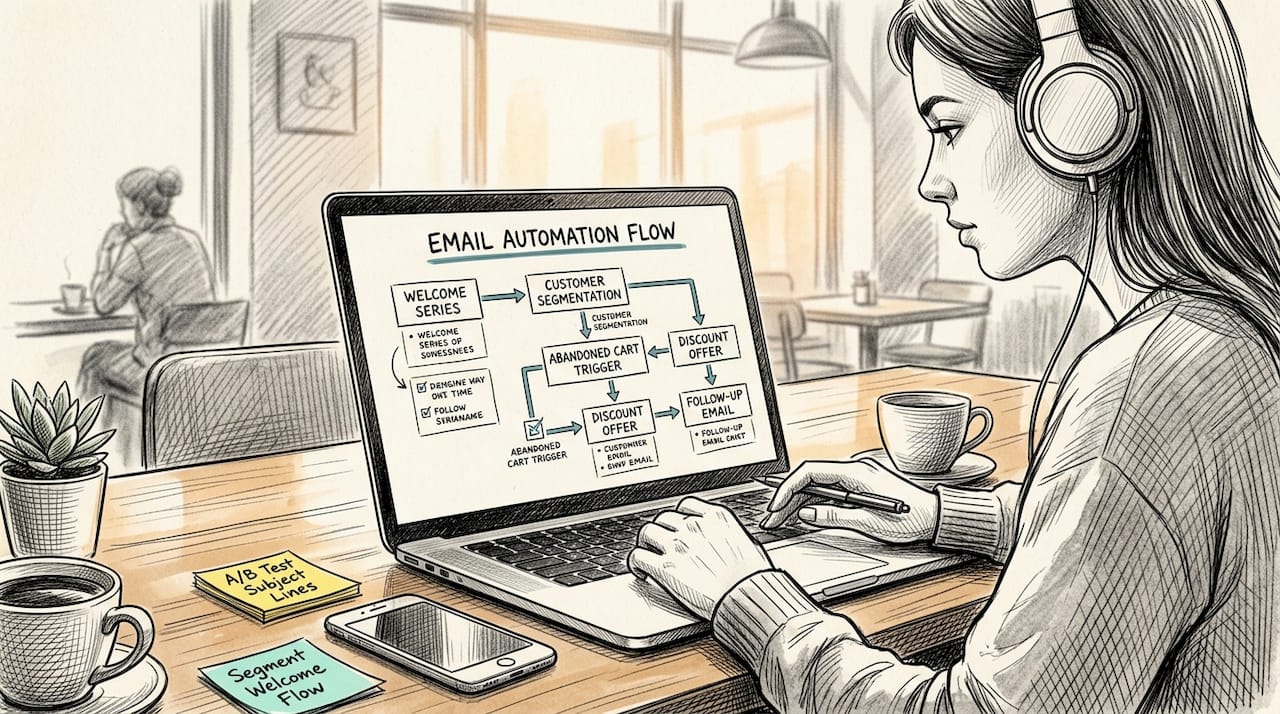
Segmentation goes beyond list-splitting by gender or location. Modern email segmentation in ecommerce means building complex audience profiles that account for recency, frequency, monetary value (RFM scoring), product category affinity, and predicted next purchase date. A buyer who purchased once six months ago belongs in a completely different segment than a repeat buyer who orders monthly.
Real-time data processing is where traditional marketing automation falls short. Legacy systems are built on batch processing, meaning they analyze data at fixed intervals and deliver messages based on rules written weeks or months ago. Modern personalization engines, as Gartner defines them, identify and deliver “the optimum experience for an individual based on knowledge about them, their intent and context,” processing signals in milliseconds rather than hours.
Here’s a straightforward comparison of the two approaches:
| Feature | Batch/rule-based automation | Real-time personalization engine |
|---|---|---|
| Data processing | Periodic updates | Processes signals instantly |
| Audience targeting | Static segments | Dynamic, intent-based audiences |
| Recommendation logic | Pre-configured rules | AI-driven, context-aware |
| Responsiveness to behavior | Hours or days | Milliseconds to minutes |
| Scalability for personalization | Limited | High |
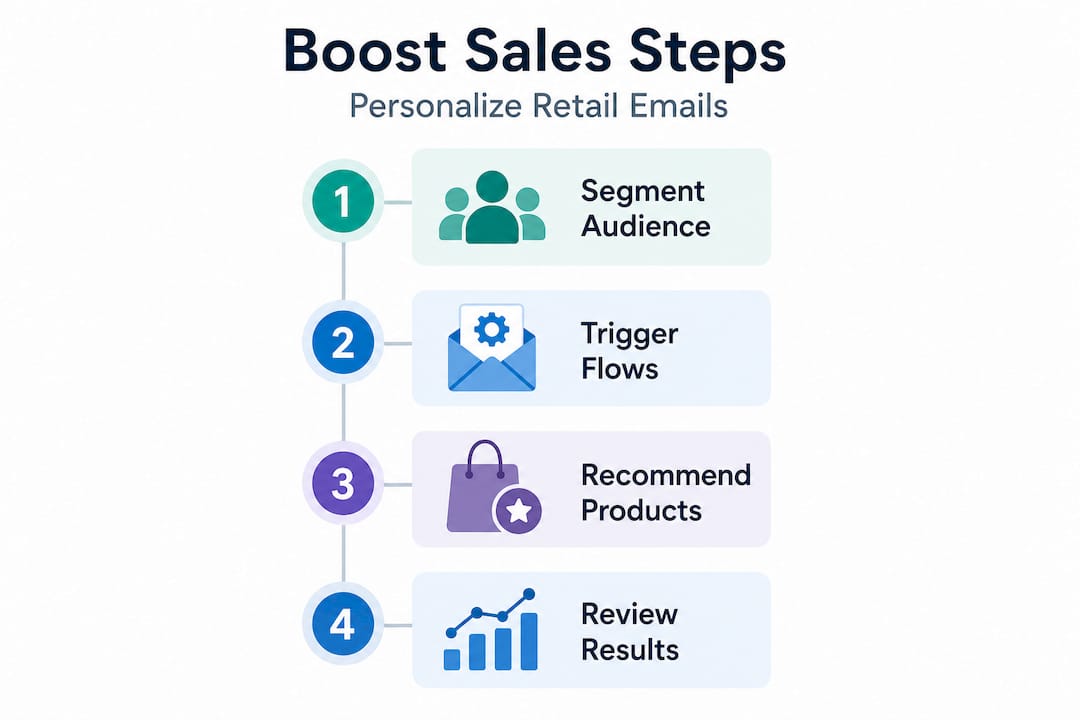
The practical step-by-step flow for building personalization with automation looks like this:
- Map your customer lifecycle stages from first visit through loyal repeat buyer
- Identify the key behavioral triggers at each stage
- Build segments based on purchase history, engagement, and predicted value
- Connect your data sources so automation tools receive clean, real-time signals
- Design content variations that reflect each segment’s needs and intent
- Set rules for exclusions, timing windows, and frequency capping
- Monitor performance by segment and flow, not just by overall email metrics
One often overlooked element is connecting real-time price changes to email triggers. Price drops on wishlist or recently viewed items are powerful personalization signals that most brands don’t fully use.
The email automation guide for ecommerce covers the strategic setup in more detail, and there are step-by-step instructions for building out automated email flows when you’re ready to get into the technical setup.
Personalization pitfalls: risks, privacy, and intrusiveness
Here’s something most personalization guides skip over: personalization can actively hurt your brand if executed poorly. The evidence on this is uncomfortable, and it’s worth sitting with for a moment before diving into tactics.
Gartner reports that 48% of personalized communications fail to hit the mark and are perceived as irrelevant or intrusive. That’s nearly half. Worse, a separate Gartner survey found that 53% of customers who experienced negative personalization were 3.2 times more likely to regret a purchase, and 44% less likely to buy again in the future. Personalization isn’t a guaranteed win. It’s a doubled-edged capability.
The privacy dimension adds another layer of complexity. Personalization increases data collection needs beyond basic browsing and purchase history into more sensitive behavioral and preference data, raising compliance obligations. As personalization strategies mature, so does the data appetite behind them. Brands that don’t have clear data governance in place are building on an unstable foundation.
Here’s a breakdown of the most common personalization pitfalls and what drives them:
| Pitfall | Root cause | Customer impact |
|---|---|---|
| Irrelevant recommendations | Stale or incomplete data | Distrust, unsubscribes |
| Intrusive timing | No frequency or context rules | Annoyance, negative brand perception |
| Compliance gaps | Lack of data governance | Legal risk, customer churn |
| Disjointed experience | Data silos across platforms | Confusion, lost conversions |
| Poor omnichannel consistency | Siloed channel strategies | Mixed messages, eroded trust |
“Personalization only delivers value when the data behind it is current, relevant, and ethically sourced. When any of those three conditions fail, personalization becomes a liability rather than an asset.”
Common failure patterns to watch for:
- Recommending already-purchased items because product purchase history isn’t syncing properly with the recommendation engine
- Sending cart abandonment emails hours after the customer already completed the purchase through a different device
- Over-personalizing by referencing behaviors that feel surveillance-level, even if legally collected
- Ignoring lifecycle context by sending promotional emails to customers who just filed a return or complaint
Pro Tip: Before scaling personalization, run a data audit. Identify where customer data lives, how frequently it syncs, and which systems are siloed. Fixing integration gaps before building complex flows prevents the most damaging personalization failures.
Understanding how to personalize email campaigns correctly requires knowing what to avoid just as much as knowing what to do. The best automation examples in ecommerce share one common trait: they’re built on clean, complete, and well-connected data.
For brands thinking about the full customer journey, personalized online shopping experiences that extend beyond email and into the site itself create a consistent context that reinforces trust. An omnichannel commerce guide can help contextualize how email fits into a broader consistent experience.
Best practices: maximizing value with personalized email flows
With the risks clearly understood, here are the practices that consistently produce results. These aren’t theoretical. They’re grounded in benchmark data and the patterns that separate top-performing eCommerce email programs from average ones.
1. Make segmentation your foundation, not an afterthought. Before building flows, define your core audience segments. At minimum, separate new subscribers, one-time buyers, repeat buyers, and lapsed customers. Each group needs different messaging, different offers, and different cadences. A segmentation tutorial can help you structure this from the ground up.
2. Prioritize your highest-impact triggered flows first. Cart abandonment, welcome series, and post-purchase flows account for the majority of flow revenue for most brands. Build these before attempting complex behavioral targeting. They’re proven, relatively simple to set up, and generate consistent returns.
3. Use AI-powered product recommendations inside flows. This is one of the clearest levers for lifting email revenue. AI product recommendations increase click rates to 3.75% on average, with top performers reaching 8.79%. Dynamic content blocks populated with individually relevant products outperform static product grids by a significant margin in both clicks and conversions.
4. Set frequency caps and exclusion rules. One of the fastest ways to damage list health is to bombard customers with overlapping flows. A customer who triggers both a browse abandonment and a cart abandonment shouldn’t receive both sequences simultaneously. Build logic that prioritizes the higher-intent signal and suppresses redundant sends.
5. Test continuously, but do it with purpose. Retail personalization pitfalls frequently include a lack of testing and optimization, with only about one third of brands consistently running tests. Subject line tests, content variation tests, and send-time experiments all generate data that improves flow performance over time. Don’t set flows live and forget them.
6. Align email content with purchase cycle timing. The best personalized email arrives when the customer is naturally ready to receive it, not when it’s convenient for your sending schedule. Map your average purchase cycles by category and build re-engagement and replenishment flows around those patterns.
7. Review the personalization orchestration benchmark to understand how your program compares to industry peers across key engagement metrics.
Pro Tip: Don’t judge flow performance on open rate alone. Placed order rate, revenue per recipient, and unsubscribe rate paint a much more complete picture of whether your personalization is resonating or backfiring.
The benefits of email automation compound over time. Each flow you build and optimize adds a permanent revenue layer that runs independent of your campaign calendar.
Why most retail personalization fails, and how to make yours stand out
Here’s our honest take after working with eCommerce brands across many categories: the personalization conversation in marketing almost always focuses on tools and tactics, and almost never focuses on context and timing. That’s exactly why so many programs underperform.
The most common mistake we see isn’t using the wrong platform or skipping segmentation. It’s treating personalization as a set-it-and-forget-it configuration rather than an ongoing discipline. Brands launch a cart abandonment flow, see early returns, and move on to the next project. Six months later, the flow is still running on its original logic while customer behavior, inventory, and market conditions have all changed significantly.
There’s also a widely held belief that more personalization equals better results. It doesn’t. Adding more triggers, more dynamic variables, and more complex segmentation without improving the underlying data quality just amplifies mistakes at scale. A poorly timed message with bad product data sent to the wrong segment, at high volume, does more damage than a simple broadcast email.
The brands that genuinely stand out aren’t necessarily running the most sophisticated personalization stacks. They’re doing three things consistently: keeping their data clean and integrated across all touchpoints, respecting the customer’s current journey stage rather than just their historical behavior, and testing every assumption rather than trusting their initial setup to hold indefinitely.
We’d also push back on the tendency to focus personalization entirely within email. Email is where personalization converts, but the signals that power personalization come from everywhere, including site behavior, purchase patterns, support interactions, and loyalty program activity. Brands that invest in connecting those signals through solid segmentation insights create a genuine advantage that’s hard to replicate with a tool swap alone.
The goal isn’t to be clever with data. It’s to be genuinely useful to the customer at the right moment.
Build smarter personalization with Swyft Interactive
Personalization at scale requires the right combination of strategy, data architecture, and automation setup. Getting any one of those wrong tends to limit the others.
At Swyft Interactive, we specialize in building email programs that connect all three. Whether you’re starting with foundational automation or ready to implement advanced segmentation and AI-driven flows, our team works directly with your Klaviyo setup to design systems that deliver measurable revenue results. Explore our automation guide for ecommerce to understand how we structure these programs, walk through our step-by-step automation workflow for a practical build guide, and see why the Klaviyo automation advantages make it the platform of choice for serious eCommerce growth.
Frequently asked questions
What types of customer data are most effective for email personalization in online retail?
Purchase history, recent site actions, and lifecycle signals like cart abandonment or browse behavior are most effective for tailoring email content, as personalization combines customer data with automation and segmentation to match messages to journey stage.
How do real-time personalization engines outperform legacy marketing automation?
Real-time engines use current signals and context to deliver more relevant experiences in milliseconds, while legacy systems rely on static segmentation and batch rules that process data on fixed intervals and can’t respond to intent as it happens.
What email flows or automations are most valuable for ecommerce brands?
Cart abandonment, post-purchase follow-ups, and product recommendation flows generate the highest engagement and revenue, with email flows accounting for nearly 41% of total email revenue from just 5.3% of all sends.
What are the biggest privacy risks when personalizing emails?
Collecting and using sensitive behavioral or preference data can raise compliance risks and affect customer trust, as personalization expands data collection well beyond basic browsing and purchase signals into more sensitive behavioral territory.
How can personalization in retail email marketing backfire?
If personalization feels irrelevant or intrusive, it can lead to customer regret and reduced purchase likelihood, with Gartner reporting that 48% of personalized communications fail to hit the mark and that negative experiences make customers 3.2 times more likely to regret their purchase.