
TL;DR:
- Omnichannel marketing unifies all touchpoints and data sources into a seamless, customer-centric experience. It significantly improves retention and increases customer spending compared to multichannel or siloed approaches. Building a solid data foundation and starting with high-impact journeys are essential for successful implementation.
Omnichannel marketing is defined as an integrated, customer-centric approach that unifies every channel, touchpoint, and data source into a single, consistent brand experience. Unlike running separate campaigns on email, social, and paid ads, omnichannel connects them so that a customer who browses your Shopify store on mobile and later opens a Klaviyo email receives messaging that reflects exactly where they left off. Brands like Amazon and Disney have built their customer experience engines on this model. The results are measurable: companies with mature omnichannel strategies retain 89% of customers compared to just 33% for single-channel operators. That gap alone makes omnichannel the most consequential shift in modern marketing strategy.
What is omnichannel marketing vs. multichannel marketing?
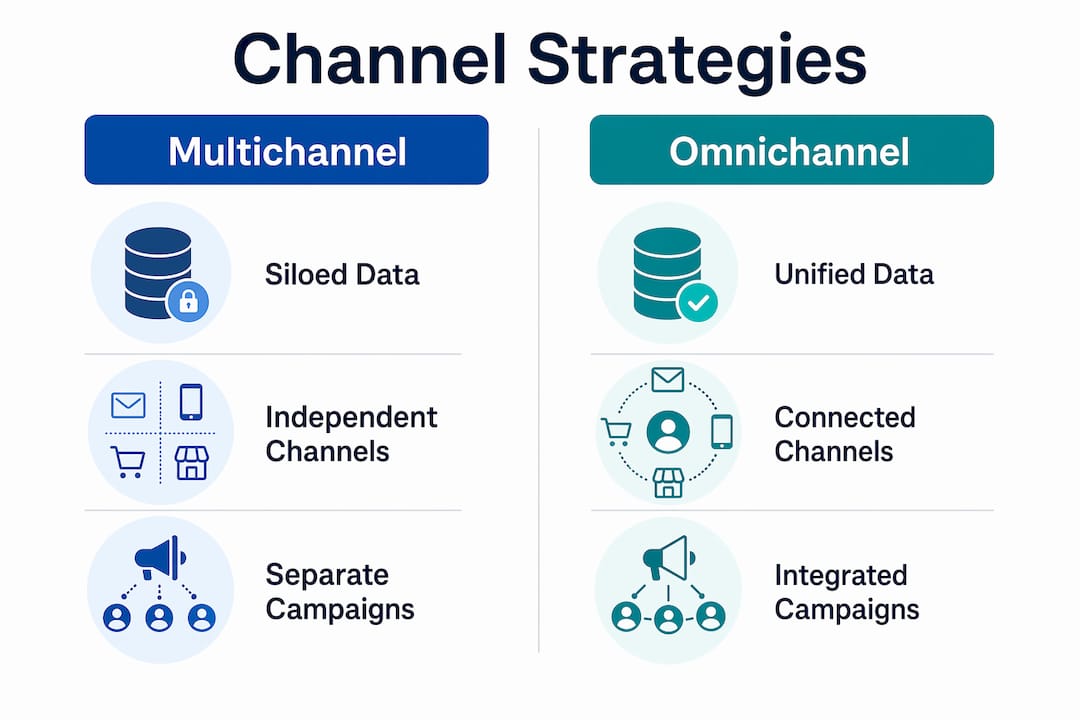
Multichannel marketing means your brand is present on multiple channels. Omnichannel marketing means those channels talk to each other. The distinction sounds subtle, but the operational difference is enormous.
Multichannel marketing operates in silos, where each channel runs its own campaigns, holds its own data, and measures its own results. A customer who clicks a Facebook ad, abandons a cart, and then opens an email gets three disconnected experiences. There is no shared memory between those touchpoints, so the brand cannot adapt its messaging based on prior behavior.
Omnichannel treats every channel as a node in a connected ecosystem. The data flows into a central system, typically a Customer Data Platform (CDP) or a CRM like Salesforce or HubSpot, and every channel draws from that shared record. When a customer abandons a cart, the email sequence, the retargeting ad, and the SMS reminder all reflect that specific cart, not a generic promotion.
| Dimension | Multichannel | Omnichannel |
|---|---|---|
| Data architecture | Siloed per channel | Unified in a CDP or CRM |
| Customer experience | Fragmented, repetitive | Consistent and context-aware |
| Messaging | Channel-specific, independent | Coordinated across all touchpoints |
| Measurement | Per-channel metrics | Cross-channel attribution |
| Strategic focus | Channel reach | Customer journey |
Pro Tip: If your email platform, ad manager, and CRM cannot share customer-level data in real time, you are running multichannel marketing regardless of how many channels you use. Integration is the test, not channel count.
For a deeper look at how multi-channel strategies compare in eCommerce contexts, the gap between the two models becomes even clearer when you examine revenue attribution.
What are the core components of an omnichannel strategy?
Building a functional omnichannel marketing strategy requires more than adding channels. It requires a specific architecture of technology, data, and messaging that most brands underestimate at the start.

Unified Customer Data Platforms are foundational to achieving true personalization across channels. A CDP like Segment or Bloomreach consolidates behavioral data, purchase history, and engagement signals from every source into a single customer profile. Without that unified record, personalization is guesswork and cross-channel attribution is impossible.
The core building blocks of an effective omnichannel strategy are:
- Unified data layer. A CDP or integrated CRM that creates a single customer record across all channels and devices.
- Marketing automation. Platforms like Klaviyo that trigger context-aware messages based on real-time customer behavior, not scheduled batch sends.
- Cross-channel analytics. Attribution models that measure how channels work together, not just which channel gets the last click.
- Customer journey mapping. A documented map of how customers move from awareness to purchase to retention, with defined triggers and responses at each stage.
- Consistent brand voice. Messaging guidelines that ensure tone, offer logic, and visual identity remain coherent whether a customer sees a Google ad, an SMS, or a post-purchase email.
- Channel routing logic. Rules that determine which channel reaches which customer segment based on engagement history and propensity data.
Pro Tip: Start your omnichannel build with customer journey mapping before you touch your tech stack. Knowing the journey tells you which integrations actually matter and which ones are just expensive noise.
The technology choice matters less than the integration quality. A brand running Klaviyo, Shopify, and a well-configured Google Ads account with shared audience data will outperform a brand with an enterprise suite that has never been properly connected.
What are the measurable benefits of omnichannel marketing?
The business case for omnichannel is not theoretical. The data is specific, consistent, and large enough to justify the investment for any brand doing meaningful volume.
Omnichannel shoppers spend 30% more per transaction and purchase 70% more frequently than single-channel customers. That combination of higher order value and higher purchase frequency compounds quickly. A customer worth $200 annually on a single channel becomes worth $340 or more when engaged across connected channels. Multiply that across your customer base and the revenue impact is structural, not marginal.
Retention is the other major lever. The 89% vs. 33% retention gap between omnichannel and single-channel operators reflects a simple reality: customers who feel recognized and understood across channels do not need to be re-acquired. Retention improvements of even 5% can increase profits by up to 95%, which makes omnichannel one of the highest-leverage investments available to a growth-stage eCommerce brand.
The complexity of the modern customer journey makes this even more urgent. Average purchase journeys now span eight touchpoints before a customer converts. That means eight opportunities to either reinforce a consistent message or deliver a fragmented one. Brands that connect those touchpoints win the sale. Brands that treat each touchpoint as independent lose customers to whoever does it better.
Amazon and Disney are the most cited examples for good reason. Amazon’s recommendation engine connects browsing behavior, purchase history, and email to deliver product suggestions that feel personally curated. Disney’s experience connects its website, app, MagicBand wristbands, and in-park interactions into a single continuous journey. Both companies treat the customer record, not the channel, as the primary unit of marketing.
How to implement an omnichannel marketing strategy that actually works
Most omnichannel efforts fail not because the strategy is wrong but because execution starts in the wrong place. Starting without a unified data foundation is the single most common cause of failure, and it is entirely avoidable.
The practical path to omnichannel execution follows a phased approach:
- Audit your current data architecture. Identify where customer data lives, which systems are connected, and where the gaps are. You cannot build a unified experience on disconnected data.
- Start with one high-impact journey. Cart abandonment recovery is the most common starting point because it has a clear trigger, a measurable outcome, and immediate ROI. Proving ROI on a single journey before expanding builds internal buy-in and validates your tech stack.
- Implement channel routing based on engagement data. Data-driven channel routing improves conversion rates and lowers customer acquisition costs by reaching customers on the channels where they are most likely to respond, rather than blasting every channel equally.
- Consolidate your tech stack. Tech stack consolidation reduces licensing costs and accelerates campaign deployment. Running five separate tools that do not share data is more expensive and less effective than running two integrated platforms well.
- Measure cross-channel, not per-channel. Shift your reporting to customer-level attribution. If a customer saw a Facebook ad, received an email, and converted via Google, the credit belongs to the sequence, not the last click.
Pro Tip: Avoid the trap of adding channels to signal sophistication. Channel routing based on propensity data means some customers should receive fewer touchpoints, not more. Overcommunication creates fatigue and unsubscribes, not conversions.
The brands that scale omnichannel successfully treat it as an operational model, not a campaign type. That means investing in data infrastructure first, proving value on a narrow set of journeys, and expanding only when the foundation is solid. For eCommerce brands using Klaviyo and Shopify, the integrated marketing approach that connects email flows, paid retargeting, and on-site personalization is the most accessible entry point.
Key takeaways
Omnichannel marketing works because it treats the customer record as the center of all marketing decisions, not the channel.
| Point | Details |
|---|---|
| Omnichannel vs. multichannel | Omnichannel unifies data across channels; multichannel runs each channel independently. |
| Retention advantage | Mature omnichannel strategies retain 89% of customers versus 33% for single-channel models. |
| Revenue impact | Omnichannel shoppers spend 30% more and purchase 70% more often than single-channel buyers. |
| Start small, scale smart | Begin with one high-impact journey like cart recovery, prove ROI, then expand systematically. |
| Data foundation first | Without a unified CDP or CRM, personalization and cross-channel attribution both fail. |
Why omnichannel is no longer optional in 2026
I have worked with enough eCommerce brands to know that most of them are running multichannel marketing and calling it omnichannel. They have email, paid ads, SMS, and social. They just have not connected them. The customer who clicks an ad and then receives a generic welcome email is not experiencing omnichannel. They are experiencing the illusion of it.
What I have found actually separates the brands that scale from the ones that plateau is not channel count. It is channel routing. The best operators I have seen are not asking “which channels should we be on?” They are asking “which channel should reach this specific customer right now, based on what we know about their behavior?” That is a fundamentally different question, and it requires a fundamentally different data architecture to answer.
The other thing I would push back on is the idea that omnichannel is a marketing project. It is not. It is an operational decision that touches your tech stack, your data team, your creative process, and your measurement framework. Brands that treat it as a campaign type will always underdeliver. Brands that treat it as infrastructure will compound their advantage every quarter.
My honest advice: do not try to build everything at once. Pick the one customer journey where a connected experience would have the most obvious impact, build it properly, measure it rigorously, and let the results make the case for the next phase. That approach works every time.
— Leon
How Swyftinteractive helps eCommerce brands build omnichannel growth engines
Swyftinteractive specializes in building the exact infrastructure omnichannel marketing requires: high-converting Shopify storefronts, Klaviyo automation flows, and full-funnel growth strategies that connect every customer touchpoint. If you are ready to move from disconnected campaigns to a coordinated customer experience, the eCommerce growth strategy framework Swyftinteractive uses gives you a clear path from audit to execution. For brands that want to start with email automation as their omnichannel foundation, the step-by-step email automation workflow covers exactly how to build flows that respond to real customer behavior, not just scheduled sends.
FAQ
What is omnichannel marketing in simple terms?
Omnichannel marketing is a strategy that connects all your marketing channels, including email, social, paid ads, and your website, into a single coordinated experience driven by shared customer data. The customer receives consistent, context-aware messaging regardless of which channel they use.
How is omnichannel different from multichannel marketing?
Multichannel marketing uses multiple channels independently, with no shared data between them. Omnichannel integrates those channels so that behavior on one channel informs messaging on every other channel.
What are the biggest benefits of omnichannel marketing?
Companies with mature omnichannel strategies retain 89% of their customers and see omnichannel shoppers spend 30% more and purchase 70% more frequently than single-channel customers. The retention and revenue gains compound significantly at scale.
Where should a brand start with omnichannel implementation?
Start with one high-impact customer journey, such as cart abandonment recovery, and build the data integration needed to make that journey consistent across email, retargeting, and SMS. Prove ROI on that single journey before expanding to additional touchpoints.
Do you need expensive technology to run omnichannel marketing?
No. Brands using Klaviyo for email automation, Shopify for their storefront, and a well-configured ad account with shared audiences can execute effective omnichannel marketing without enterprise-level tools. The quality of integration matters more than the size of the tech stack.