TL;DR:
- Most e-commerce brands spend heavily on new customer acquisition, despite higher returns from existing customers. Upsell programs can significantly increase average order value and customer lifetime value when strategically implemented, especially post-purchase and through email automation. Proper timing, personalization, and automation are essential to maximizing revenue while preserving customer trust and long-term engagement.
Most e-commerce brands pour the majority of their budgets into acquiring new customers, yet that approach consistently costs five to seven times more than selling to someone who already trusts you. Upsell programs can increase average order value (AOV) by 10-30% and customer lifetime value (CLV) by 20-40%, making them one of the highest-return strategies available to online retailers. This guide breaks down what effective upsell programs look like, when to activate them, how automation makes them scale, and the traps that quietly drain results before you ever notice.
Table of Contents
- Why upsell programs matter for e-commerce growth
- When and how to introduce upsell offers in the customer journey
- Automation and segmentation: Scaling upsell program success
- Common pitfalls and advanced tips for upsell program optimization
- Rethinking upsells: What most brands miss about value versus volume
- How Swyft Interactive accelerates upsell and automation mastery
- Frequently asked questions
Key Takeaways
| Point | Details |
|---|---|
| Upsells drive major revenue | Programs can increase average order value and customer lifetime value substantially when done correctly. |
| Timing is crucial | Post-purchase and email automation are the most effective moments to present upsell offers. |
| Personalization scales results | Segmenting customers and using automation improves upsell engagement and loyalty. |
| Avoid common pitfalls | Overloading customers or offering irrelevant products can reduce trust and conversion rates. |
| Value beats pure volume | A value-centered approach to upselling sustains brand reputation and long-term revenue growth. |
Why upsell programs matter for e-commerce growth
To understand the scale of upsell program impact, let’s define their role and look at critical evidence.
An upsell program is a structured strategy that encourages existing customers to spend more by offering upgraded versions of what they already want, premium add-ons, or higher-tier products. The goal is not to push customers toward things they do not need. It is to surface genuinely better options at the right moment. Done well, upsell programs grow revenue without increasing your ad spend at all.
The distinction between upsells and cross-sells matters here. An upsell moves a customer toward a pricier version of the same product (think: 32GB vs. 128GB storage). A cross-sell offers something complementary (think: a phone case with that phone). Both have value, but they operate differently and require different placements in the customer journey. Understanding which tool fits which moment is what separates programs that generate revenue from programs that generate friction.
The revenue case for upselling
The numbers behind upsell programs are hard to ignore. Amazon attributes 35% of revenue to its product recommendation engine, which is essentially a highly optimized upsell and cross-sell system running at massive scale. For brands without Amazon’s engineering resources, the results are still compelling. Post-purchase upsells convert at 5-15% and deliver an AOV lift of 20-30% in real-world e-commerce deployments.

Here is a quick breakdown of what each upsell touchpoint typically looks like in terms of performance:
| Upsell touchpoint | Typical conversion rate | AOV impact | Customer experience risk |
|---|---|---|---|
| Pre-checkout pop-up | 1-4% | Low to moderate | High (can cause abandonment) |
| Cart page offer | 3-7% | Moderate | Medium |
| Post-purchase page | 5-15% | Moderate to high | Low |
| Email upsell flow | 4-12% | High | Low to none |
The table makes one thing clear: post-purchase and email-based upsells consistently outperform pre-checkout interruptions, both in conversions and in how customers feel about the experience. That matters because customer trust is not just a soft metric. It compounds into repeat purchase rate, referrals, and long-term CLV.
Key benefits that well-executed upsell programs deliver include:
- Higher AOV without increasing paid media spend
- Improved CLV through deeper product engagement and satisfaction
- Stronger retention because customers who buy more feel more invested in your brand
- Lower cost per acquisition (CPA) as revenue grows from existing customers
For a deeper look at how upsell strategy tips apply across different e-commerce verticals, the evidence consistently points toward post-purchase and email automation as the highest-leverage channels.
When and how to introduce upsell offers in the customer journey
Having defined their value, let’s pinpoint the best moments for upsell offers and how to apply them for maximum effect.
Timing is everything in upselling. Offer too early, and you risk abandonment. Offer too late, and you miss the purchase momentum. The customer journey has four clear windows, and each one demands a different approach.
Comparing your upsell options
| Stage | Best for | Friction level | Recommended offer type |
|---|---|---|---|
| Pre-checkout (product page) | Premium upgrades | Low to medium | Higher-tier version |
| Cart page | Bundles, add-ons | Medium | Complementary items |
| Post-purchase confirmation | One-click upsells | Very low | Exclusive upgrade or add-on |
| Email flow (days 1-14) | Repeat purchase, expansion | None | Personalized product recommendation |
Post-purchase upsells outperform pre-checkout consistently across e-commerce categories, and email flows generate roughly $0.42 per recipient when set up correctly. That might sound modest per email, but at scale across tens of thousands of customers, the compounding effect is significant.
How to build a high-performing upsell journey
Here is a numbered framework that works across most e-commerce store formats:
- Map your product catalog for upsell relevance. Identify which products have clear premium alternatives and which have natural add-ons. Not every product qualifies for both, and forcing it creates irrelevant offers.
- Set price rules upfront. Value-focused offers prevent churn and the generally accepted rule is to keep upsell offers within 25% of the original purchase price. Beyond that, the cognitive leap becomes too large.
- Trigger post-purchase upsells immediately on the confirmation page. Use a one-click acceptance mechanism. Do not make customers re-enter payment details. That single friction point kills conversions.
- Build an email upsell sequence for days 1 through 14. Day 1 is a product usage tip plus a relevant add-on suggestion. Day 5 introduces a complementary product. Day 14 offers a loyalty-based upgrade incentive.
- Measure each stage independently. Do not lump all upsell revenue into one bucket. Track post-purchase separately from email to know exactly where your ROI is coming from.
Pro Tip: The confirmation page is your highest-intent real estate in the entire customer journey. A customer who just completed a purchase is in a “yes” mindset. Place your most relevant, low-friction upsell offer there before that momentum fades.
Understanding post-purchase automation at a technical level helps brands build flows that actually execute this sequence without manual intervention. And brands that understand post-purchase campaign benefits beyond just revenue, including loyalty building and brand sentiment, tend to design far better programs.
Automation and segmentation: Scaling upsell program success
Integrating automation and smart segmentation is the next step, enabling scale and greater relevance.
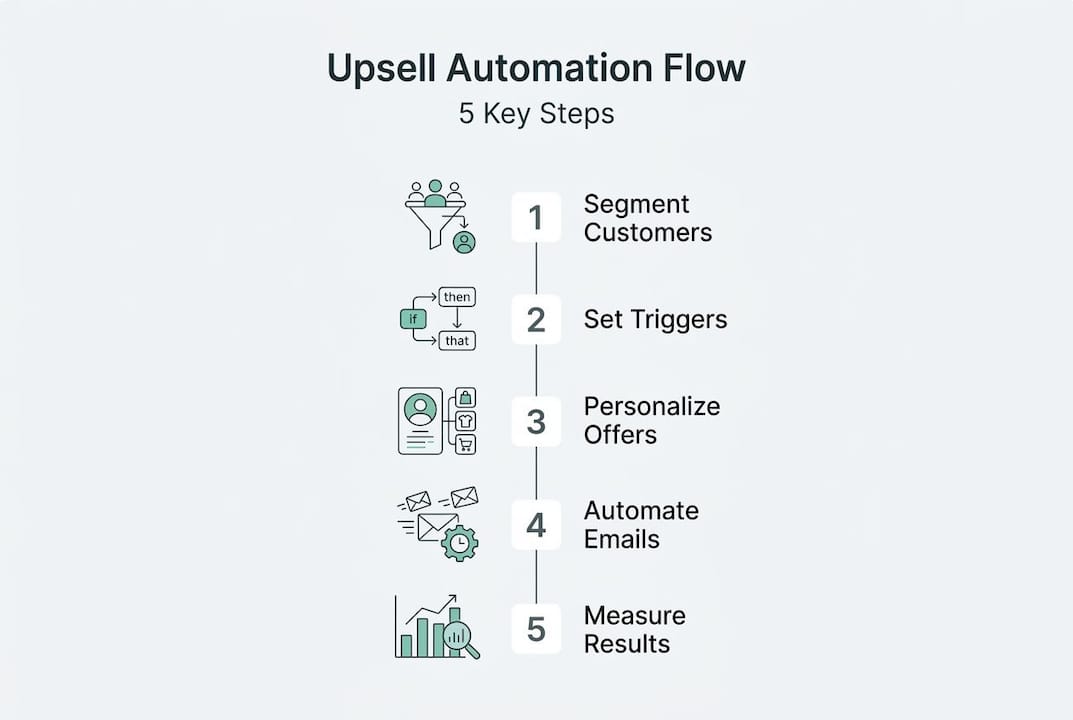
Manually managing upsell offers across thousands of customers is not a growth strategy. It is a bottleneck. The brands that scale upsell revenue consistently are the ones that have invested in email automation and audience segmentation to deliver the right offer to the right person at the right time without any manual intervention after setup.
Why automation is non-negotiable
Post-purchase email automation accounts for 14-22% of total revenue for e-commerce brands that use it effectively. That stat deserves a moment of consideration. Nearly a quarter of all revenue, generated by flows that run on their own once configured. That is the business case for automation in a single number.
Prioritizing post-purchase and email automation for highest ROI produces results that compound over time. Gartner data shows email automation ROI reaches 527% in year one for brands that implement it correctly. The reason the return is so high is simple: you are selling to people who already bought from you, using a channel (email) that costs a fraction of paid media.
Key segmentation approaches that make upsell automation more effective:
- First-time buyers: Focus on education and product discovery. Upsell offers should feel like helpful guidance, not sales pressure. A new customer does not yet trust you enough for aggressive upsells.
- Repeat buyers (2-4 purchases): These customers are showing loyalty signals. Introduce higher-tier products, subscription upgrades, or loyalty-program-linked upsells that reward their behavior.
- High-CLV customers (5+ purchases): These are your brand advocates in training. Offer early access to new products, exclusive bundles, and VIP-tier upgrades. Their AOV ceiling is much higher than new customers.
- Purchase-history-driven segments: If someone bought running shoes, they are a natural candidate for performance socks, insoles, or a heart rate monitor. The more specific the product affinity, the higher the conversion rate.
Pro Tip: A/B test your upsell offers within each segment separately. A headline that converts 8% for repeat buyers might only convert 3% for first-time buyers. Treat them as different audiences because they genuinely are.
Brands that invest in understanding the benefits of email automation find that segmentation is not just a nice-to-have feature. It is the engine that makes personalization work at scale, and personalization is what separates upsell programs that feel helpful from ones that feel spammy.
Common pitfalls and advanced tips for upsell program optimization
To ensure your efforts drive sustainable growth, addressing common mistakes and advanced tactics is essential.
Even well-intentioned upsell programs can backfire. The mistakes tend to fall into a few predictable categories, and most of them share a root cause: prioritizing short-term revenue over customer experience.
The most common upsell mistakes
- Pre-checkout interruptions that halt purchase flow. Presenting a pop-up upsell when a customer is about to hit “buy” is the fastest way to tank your conversion rate. Avoid pre-checkout interruptions and price jumps above 25% of the original item.
- Irrelevant offers. If a customer buys a baby stroller and your upsell is a kitchen appliance, you are not personalizing. You are guessing. AI-driven recommendation engines solve this by analyzing purchase patterns dynamically.
- Too many options presented at once. Decision fatigue is real. Offering five upsell products simultaneously forces a choice between options rather than a simple yes or no. Limit upsell offers to one or two at any given touchpoint.
- Out-of-stock upsell items. Nothing damages trust faster than clicking “add to my order” and finding the item is unavailable. Inventory logic must be integrated into your upsell rules.
- Touch fatigue from over-messaging. Upsell fatigue erodes trust, and brands that send upsell emails daily lose subscribers and customers. Limit post-purchase upsell email touches to three to four in the first two weeks.
“The goal of an upsell program is not to extract maximum spend from every customer. It is to match customers with products that genuinely make their original purchase more valuable. When you lose sight of that, you lose the customer.”
Advanced tactics for sustained optimization
Track refund rates by upsell offer. A high refund rate on a specific upsell tells you that either the offer was misleading or the product did not meet expectations in that context. Both are fixable, but only if you are monitoring the data.
Also watch your net revenue retention (NRR). NRR measures how much revenue you retain and grow from your existing customer base over time. When your upsell programs are working correctly, NRR climbs because existing customers spend more each period. When upsell programs are poorly designed, NRR drops as customers disengage or churn.
Leverage AI and dynamic rules within your cross-sell strategy to prevent wasted upsell opportunities. Modern platforms like Klaviyo allow you to set conditional logic that automatically excludes recent purchasers of a product from being upsold on that same product, presents the most relevant recommendation based on the last three purchases, and suppresses upsell messages for customers who recently issued a refund or opened a support ticket.
Rethinking upsells: What most brands miss about value versus volume
Here is a perspective that runs counter to what most upsell optimization content pushes: chasing volume through aggressive or frequent upsells is one of the most reliable ways to quietly destroy your best customer relationships.
The brands that build truly durable upsell programs, the ones where upsells become a revenue line they can count on year after year, are the ones that use upselling as a relationship tool rather than a revenue extraction mechanism. That sounds like a soft distinction, but the operational difference is enormous.
When your upsell program is designed primarily around what the customer gets out of it, the offer frequency feels natural. Customers accept. They do not unsubscribe. They do not feel sold to. They feel like the brand knows them. That perceived understanding is what drives CLV into the 20-40% improvement range that the data consistently shows is achievable.
The brands that miss this? They run upsell programs that work brilliantly in month one, generate inflated metrics, and then watch engagement crater by month three because customers have been trained to ignore the messages. Volume-focused upsell thinking burns through your list faster than most brands realize.
What enduring value-focused upselling looks like in 2026 is this: fewer touches, sharper personalization, longer decision windows, and offers that make the customer feel like the brand remembered something specific about them. A customer who bought a yoga mat three months ago getting an offer for a premium mat carry bag is not an upsell. It is a useful recommendation. That mental reframe, embedded into your program design, is what separates good programs from great ones.
We have seen this play out consistently in the brands that adopt ethical upsell techniques built around genuine relevance. Their repeat purchase rates climb. Their unsubscribe rates drop. Their CLV compounds in ways that pure acquisition spending never could match.
How Swyft Interactive accelerates upsell and automation mastery
Ready to implement an optimized upsell strategy? Here is how Swyft Interactive can help.
Building an upsell program that actually scales requires more than a single email flow or a confirmation-page widget. It requires a connected system where your store, your customer data, and your automation platform work together to surface the right offer at exactly the right moment.
At Swyft Interactive, we design and implement full-funnel upsell and automation systems built on Klaviyo, tailored to your specific product catalog and customer segments. From your step-by-step email automation setup to building a long-term ecommerce growth strategy that reduces acquisition dependency, our team handles both the strategy and the execution. If you want a clear starting point, our email marketing automation guide walks through the foundational systems every e-commerce brand needs before scaling upsell programs. Let’s build revenue that compounds.
Frequently asked questions
What is the difference between upselling and cross-selling?
Upselling encourages customers to buy a higher-end product or add premium features, while cross-selling suggests complementary or related products. Upsells carry higher return potential but slightly more risk; cross-sells are typically safer and involve adding items rather than replacing them.
When should I present upsell offers to customers?
The best time for upsell offers is after purchase or via email automation to avoid cart abandonment and optimize conversion rates. Post-purchase upsells outperform pre-checkout in both conversion rate and customer experience.
How much can upsell programs actually increase revenue?
Upsell programs can boost average order value by 10-30% and customer lifetime value by 20-40%, with top brands seeing up to 35% of revenue from product recommendations alone.
What pitfalls should I avoid in my upsell programs?
Avoid poor timing, irrelevant offers, too many options at once, and customer fatigue. Limit upsell touches and personalize each message based on purchase history to protect trust and maintain long-term engagement.