
TL;DR:
- Cross-selling recommends relevant, complementary products to increase customer satisfaction and loyalty.
- Well-executed cross-sell strategies boost average order value, purchase frequency, and lifetime customer value.
- Success relies on proper timing, segmentation, relevant recommendations, and ongoing optimization.
Cross-selling gets a bad reputation. Many ecommerce owners picture pushy popups, irrelevant product suggestions, and email blasts that feel like spam. But that picture is completely wrong. A well-executed cross-sell strategy is one of the most customer-friendly tools in your marketing arsenal. It helps shoppers discover products they actually need, increases average order value (AOV), and builds lasting loyalty without ever feeling intrusive. In this guide, you’ll learn exactly what cross-selling is, why it drives measurable ecommerce growth, and how to automate it using Klaviyo so it runs while you sleep.
Table of Contents
- What is a cross-sell strategy?
- Why cross-sell strategies drive ecommerce growth
- How to implement cross-sell strategy with Klaviyo automation
- Common pitfalls and pro tips for cross-sell success
- Our unique take on building high-impact cross-sell strategies
- Next steps: scale your revenue with expert-backed automation
- Frequently asked questions
Key Takeaways
| Point | Details |
|---|---|
| Cross-sell defined | Cross-sell strategies use personalized product recommendations to increase order value and boost retention. |
| Automation in Klaviyo | Klaviyo enables ecommerce automation for cross-sell via flows, dynamic blocks, and powerful segmentation tools. |
| Measured results | Effective cross-sell tactics can meaningfully lift average order value and spark more repeat purchases. |
| Start simple | Begin with straightforward post-purchase flows—then test, refine, and scale as your data grows. |
What is a cross-sell strategy?
A cross-sell strategy is the practice of recommending products that complement what a customer has already bought or is about to buy. If someone purchases a camera, showing them a compatible memory card is cross-selling. It’s not about piling on extras. It’s about being genuinely helpful at the right moment.
People often confuse cross-sell with upsell and bundling, but they serve different purposes:
| Tactic | Definition | Example |
|---|---|---|
| Cross-sell | Recommend related products | Camera bag after buying a camera |
| Upsell | Suggest a higher-value version | 256GB camera vs. 64GB camera |
| Bundling | Package products together at a deal | Camera + bag + memory card kit |
Knowing which tactic fits which moment is the foundation of a strong ecommerce email campaign strategy. Each one has its place, but cross-selling tends to have the highest acceptance rate because it feels natural rather than salesy.
The benefits go beyond a single transaction. Cross-selling:
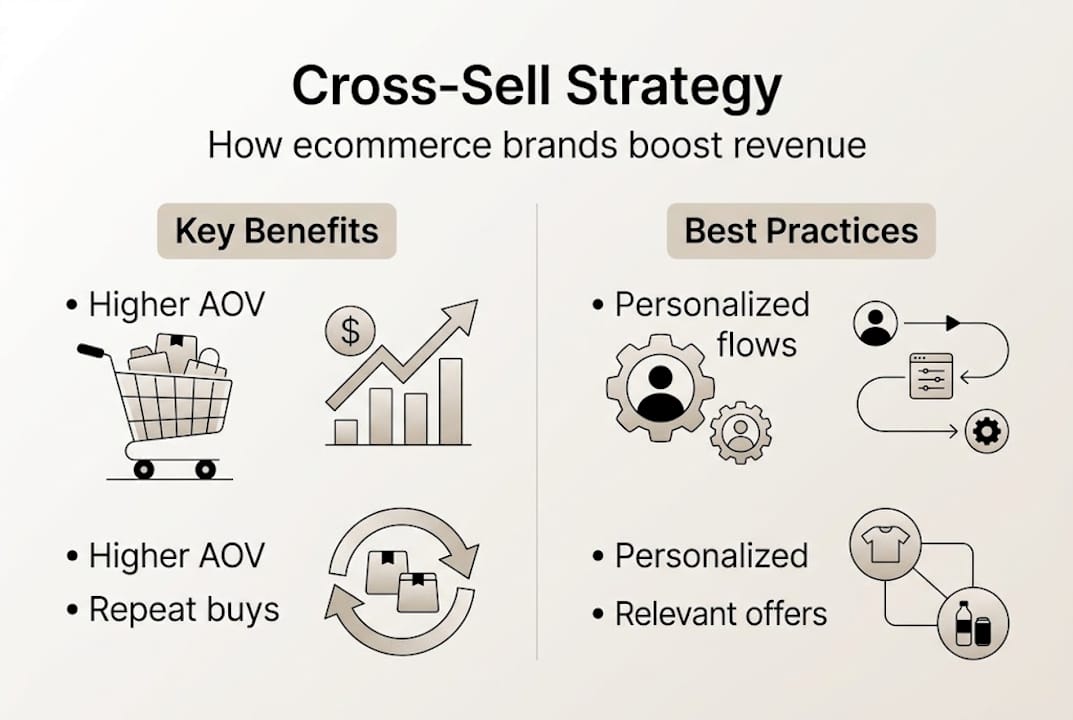
- Increases AOV by adding relevant items to each order
- Improves customer satisfaction when recommendations match real needs
- Raises repeat purchase rates by reminding customers what else you offer
- Reduces churn by strengthening the customer’s connection to your brand
“A brand that knows what I need before I ask is a brand I trust.” That’s the mindset your cross-sell strategy should aim to create.
Klaviyo makes this possible at scale. Cross-sell strategies in Klaviyo use flows, dynamic blocks, segments, and post-purchase sequences for AOV and repeat buys, allowing you to deliver personalized product suggestions automatically based on real purchase data. The Klaviyo automation benefits for ecommerce stores are significant, particularly when cross-sell flows are timed correctly and built on accurate segmentation.
Why cross-sell strategies drive ecommerce growth
If you’ve ever wondered whether cross-selling actually moves the needle, the data is clear. Cross-sell strategies directly affect three of the most important ecommerce metrics: lifetime value (LTV), AOV, and retention rate.
Here’s what the impact looks like across a growing store:
| Metric | Without cross-sell | With cross-sell |
|---|---|---|
| Average order value | Baseline | Up 10–30% |
| Repeat purchase rate | Lower | Significantly higher |
| Customer lifetime value | Stagnant | Compounding growth |
The math compounds over time. A customer who makes three purchases instead of two, each with a slightly higher AOV, is worth dramatically more over 12 months. That’s why efforts to increase ecommerce retention even modestly create outsized returns on revenue.
Here are the key growth levers that cross-sell directly impacts:
- AOV per transaction — Each recommendation adds incremental revenue
- Purchase frequency — Post-purchase flows re-engage customers sooner
- Customer LTV — More purchases over time mean higher total revenue per customer
- Email engagement — Relevant recommendations keep open and click rates healthy
- Product discovery — Customers find items they didn’t know you carried
Post-purchase flows and dynamic product blocks effectively boost AOV and repeat buys, making them one of the highest-return automations you can build. Combine this with email automation for ecommerce and you have a system that continuously drives revenue without manual effort.

The compounding effect is real. When a customer receives a well-timed, relevant recommendation after their first purchase and buys again, the probability of a third purchase jumps significantly. Cross-sell starts a momentum loop that is very hard to stop.
How to implement cross-sell strategy with Klaviyo automation
Klaviyo gives you everything you need to build a cross-sell engine that runs automatically. Here’s how to set it up in a way that actually works:
- Choose the right flow trigger. The most effective triggers are Placed Order, Fulfilled Order, and Viewed Product. Fulfilled Order is often the best starting point because the customer already has their purchase in hand and is in a receptive mindset.
- Add dynamic product recommendations. Klaviyo’s dynamic blocks pull in personalized product suggestions based on purchase history and browsing behavior. These blocks update automatically, so you don’t have to manually edit emails when your catalog changes.
- Build your segments first. Target first-time buyers differently from repeat customers. Use ecommerce segmentation to group customers by product category, order frequency, or spend level before triggering your cross-sell flow.
- Set smart timing delays. Don’t send a cross-sell email the same hour someone checks out. Wait 3 to 7 days after fulfillment so the customer has used their purchase and is naturally open to more.
- A/B test your offers. Test discounts vs. no discounts, single product recommendations vs. product grids, and subject lines that frame recommendations differently. Small wins here add up fast.
- Scale with AI product feeds. Once your basic flows are validated, Klaviyo’s cross-sell features include AI-powered recommendations that match each customer to the most likely next purchase automatically.
A solid step-by-step email automation process will help you build these flows without getting overwhelmed. Cross-sell strategies in Klaviyo are built using flows, dynamic recommendations, purchase triggers, and segmentation, giving you a powerful toolkit even before you add AI features.
Pro Tip: Start with your top 3 best-selling products and manually identify the most logical complementary item for each. Build simple two-email flows for each pairing. This approach validates product pairings before you layer in automation complexity.
Common pitfalls and pro tips for cross-sell success
Even with solid automation in place, cross-sell programs fail when common mistakes go unaddressed. Here’s what to watch for:
- Sending too soon. A cross-sell email the moment someone checks out feels aggressive. Timing matters enormously. Wait until the customer has received and used their order before suggesting what’s next.
- Ignoring segmentation. Sending the same recommendation to first-time buyers and loyal customers is a missed opportunity. High-value repeat buyers deserve more curated, premium suggestions.
- Recommending irrelevant products. If someone buys a yoga mat and you recommend power tools, you lose credibility instantly. Every recommendation should make obvious sense.
- Over-automating before validating. Many brands rush to build complex AI-driven flows before they know which product pairings actually convert. Start simple before using AI product feeds for best results.
- Neglecting email design. A cluttered, slow-loading email kills conversion regardless of how good the recommendation is. Content plays a major role in using content to boost conversions, and your cross-sell emails are no exception.
These mistakes are easy to miss because they feel like small details. But together, they are the difference between a cross-sell program that pays for itself and one that quietly underperforms. Reviewing essential ecommerce marketing strategies alongside your cross-sell setup helps you avoid gaps that hurt results.
Pro Tip: Run a monthly review of your cross-sell flow click-through rates by product pairing. If a pairing consistently underperforms, replace it. Your catalog changes, and your automation should keep pace.
Our unique take on building high-impact cross-sell strategies
After helping dozens of ecommerce stores build and scale their automation, one pattern stands out clearly: the brands that win with cross-sell are almost never the ones with the most sophisticated technology. They’re the ones who got the basics right first.
Most stores rush to implement AI-driven product recommendations and complex multi-step flows before they’ve even confirmed which product pairings resonate with their customers. Getting the first 10% of your strategy right, specifically timing, product pairing, and message relevance, delivers about 90% of the revenue lift. Automation only amplifies what works. It doesn’t fix what doesn’t.
We also believe empathy for the customer journey matters more than the tools you use. Understanding customer journey mapping for growth reveals the natural moments when customers are open to discovering something new. When you place recommendations at those moments, cross-selling stops feeling like marketing and starts feeling like service. That shift in perception is what builds the kind of loyalty that compounds revenue over time.
Next steps: scale your revenue with expert-backed automation
Building a cross-sell system that genuinely grows revenue takes more than a few triggered emails. It requires the right flows, smart segmentation, tested product pairings, and a strategy that evolves with your store.
If you’re ready to stop leaving revenue on the table, start by mastering email automation fundamentals so your flows are built on solid ground. From there, explore the key Klaviyo automation benefits that make personalization scalable for growing brands. And when you’re ready to audit your entire setup and build a cross-sell program that compounds, our ecommerce growth checklist is the place to start.
Frequently asked questions
What is the main goal of a cross-sell strategy?
The main goal is to increase a customer’s AOV and overall lifetime value by recommending relevant products at the right time. Cross-sell strategies increase AOV and repeat buys through strategic recommendations placed within automated flows.
How is cross-sell different from upsell?
Cross-sell recommends complementary products while upsell promotes a higher-value alternative to the item being purchased. Cross-sell offers related items after purchase, while upsell typically happens before or during checkout.
How does Klaviyo automate cross-sell for ecommerce stores?
Klaviyo uses automated flows triggered by customer actions, dynamic recommendations, and segmentation to suggest products and drive repeat sales. Klaviyo cross-sell features include flows, dynamic blocks, and segmentation for past purchasers.
What is a quick win for starting cross-sell automation?
Begin with simple post-purchase flows on best-selling products and personalize with dynamic content. Post-purchase flows with dynamic content deliver fast, measurable cross-sell results without requiring complex setup.
What mistake do most ecommerce brands make with cross-sell?
Most brands overcomplicate automation instead of focusing first on message relevance and the ideal timing for recommendations. Neglecting relevance and timing is the most common reason cross-sell flows underperform despite strong technical setups.