
Managing an online store can quickly spiral into a maze of repetitive tasks that drain your team’s energy and stifle growth. For Ecommerce marketing managers in the United States, the promise of automation is more than just saving time—it is about creating truly connected experiences that turn casual shoppers into loyal customers. By embracing technology that automates customer engagement and marketing workflows, you position your brand to move faster, reduce errors, and deliver timely, personalized communications through platforms like Klaviyo.
Table of Contents
- Defining Ecommerce Automation For Online Brands
- Types Of Ecommerce Automation Solutions
- How Automation Streamlines Store Operations
- Real-World Applications With Klaviyo Integration
- Risks, Challenges, And Limitations To Consider
Key Takeaways
| Point | Details |
|---|---|
| Ecommerce Automation Improves Efficiency | Automation streamlines repetitive tasks, freeing teams to focus on strategic activities that drive revenue. |
| Integration is Key for Seamless Experience | Combining various automation types creates a connected ecosystem for better customer interactions and data management. |
| Identify High-Impact Tasks for Automation | Start with automating time-consuming tasks that directly enhance revenue or customer satisfaction. |
| Risks Require Thoughtful Management | Maintain manual backups and conduct regular reviews to mitigate operational dependencies and ensure customer experience quality. |
Defining Ecommerce Automation for Online Brands
Ecommerce automation is the strategic use of technology and software to handle repetitive tasks across your online store. Instead of manually managing each order, email, or inventory update, automation systems handle these processes consistently and at scale. For most mid-sized online retailers, this means deploying tools that manage everything from customer communications to inventory adjustments without constant human intervention.
At its core, ecommerce automation refers to using technology to streamline repetitive tasks and workflows in your business. Think about what happens when a customer places an order on your site. Manually processing that order, sending a confirmation email, updating inventory, notifying your warehouse, and then following up with shipping information would require hours of human effort daily. Automation handles all of these steps instantly and accurately, allowing your team to focus on strategy rather than execution. This applies across your entire operation: order fulfillment, inventory management, customer support responses, and marketing campaigns can all run on automated workflows that trigger based on customer behavior or time-based schedules.
For ecommerce marketing managers like yourself, the real power lies in how automation connects different parts of your business. When a customer buys from you, that purchase data automatically feeds into your email platform, triggering personalized follow-up sequences. Your inventory decreases automatically. Customer service tickets are routed intelligently. Your team sees a unified view of what each customer has done and what they should see next. This coordination across systems is what separates stores that feel disjointed from those that deliver seamless experiences. Automation creates this coordination without requiring someone to manually move data between systems or remember which customers need what message.
The specific automation opportunities in your ecommerce business span several critical areas: strategic email campaigns that respond to customer actions, inventory tracking that prevents overselling, customer service workflows that route issues to the right person, and marketing sequences that nurture prospects through your sales funnel. Many retailers initially focus on email automation because the return on investment is immediate and measurable. A welcome series that triggers for every new subscriber costs nothing to send once it’s set up, yet generates consistent revenue month after month.
Pro tip: Start by identifying your three most time-consuming, repetitive tasks in your business right now, then prioritize automating whichever one directly impacts revenue or customer satisfaction first.
Types of Ecommerce Automation Solutions
Ecommerce automation solutions come in several distinct flavors, each designed to solve different operational challenges. Understanding which types exist helps you prioritize where to invest first based on your immediate pain points. The most effective approach combines multiple automation types working together, creating a connected ecosystem that handles everything from the moment a customer lands on your site to their post-purchase follow-up.
Email marketing automation stands as the most mature and widely adopted solution for mid-sized retailers. This is where you set up triggered messages based on customer actions: welcome sequences for new subscribers, abandoned cart reminders, post-purchase follow-ups, and re-engagement campaigns for inactive customers. The beauty here is that each sequence runs on its own once configured, meaning you gain immediate payoff for your setup effort. Beyond email, AI-powered personalization engines and automated notifications handle customer engagement across multiple touchpoints. These systems track what each customer views, purchases, and interacts with, then adjust what they see next. One customer might see winter coat recommendations while another sees swimwear, all without manual intervention. Email segmentation tools work here too, ensuring the right messages reach the right people based on their behavior and characteristics.
Order and inventory automation keeps your operations running smoothly behind the scenes. Real-time stock alerts prevent overselling and alert you when inventory runs low. Order processing automation routes customer purchases through your fulfillment system, updates tracking information, and triggers notifications to both your team and customers at the right moments. Supply chain and logistics optimization uses automation to coordinate with your suppliers and shipping partners, reducing manual order placement and tracking work. Customer service chatbots handle routine inquiries like tracking status or return policies, freeing your team to focus on complex issues that require human judgment.
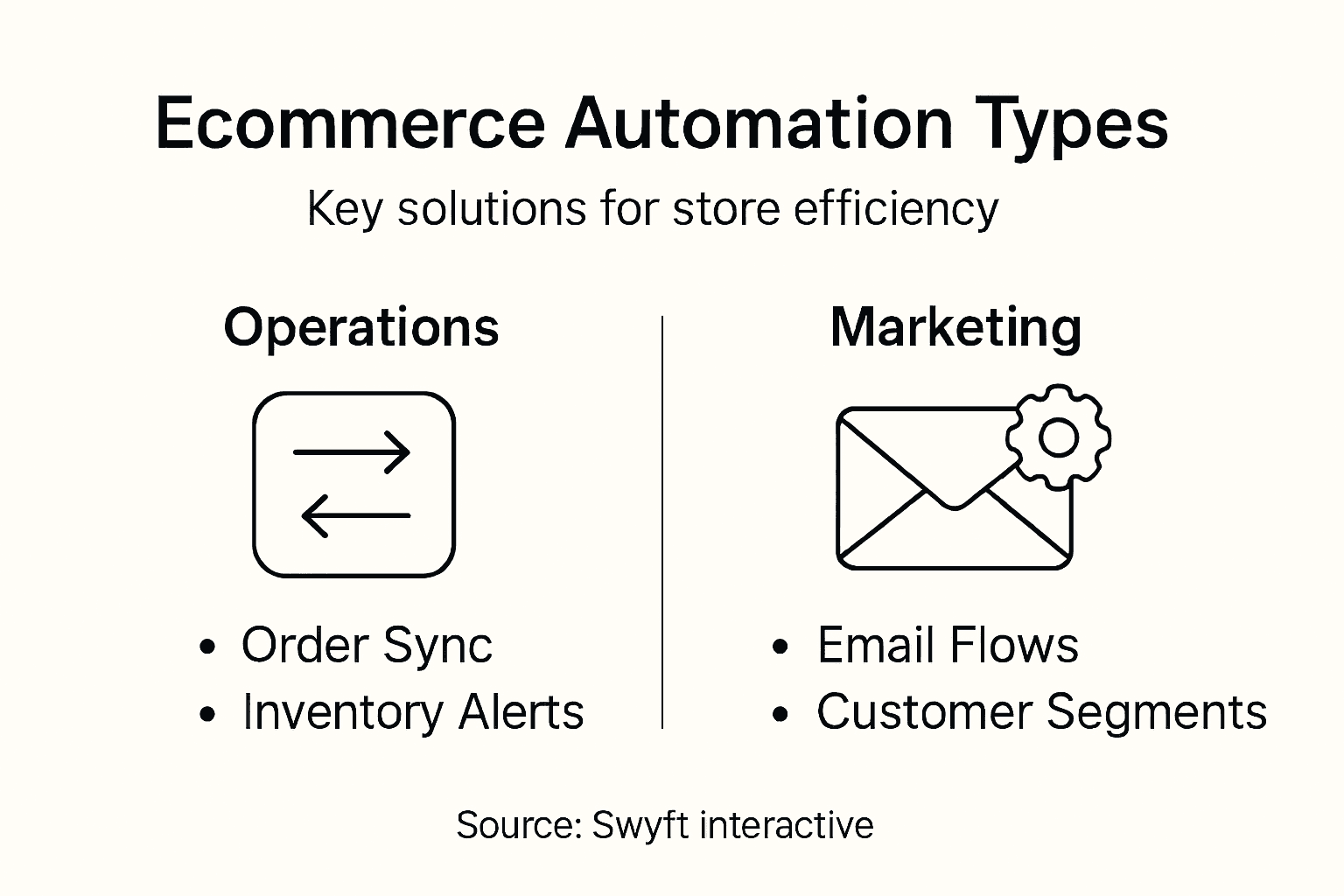
When evaluating solutions, consider that different companies adopt diverse strategies aligned with their digital maturity and business models, ranging from single-purpose tools to comprehensive platforms that integrate multiple automation types. Most successful retailers start with email automation and inventory management, then layer in additional solutions as their needs grow and their team learns what works best for their customers.
Pro tip: Map your customer journey from first touch to repeat purchase, then identify which of these automation types would eliminate your biggest bottleneck at each stage.
Here’s a summary of key ecommerce automation types and their primary business benefits:
| Automation Type | Main Functions | Business Benefit |
|---|---|---|
| Email Marketing | Triggered campaigns, segmentation | Higher engagement and sales |
| Inventory Management | Real-time alerts, automated updates | Prevents overselling, accuracy |
| Order Processing | Automatic fulfillment, notifications | Reduces errors, speeds delivery |
| AI Personalization | Dynamic recommendations, notifications | Increases conversion rates |
| Customer Service Chatbots | Automated responses, ticket routing | Faster support, frees staff |
How Automation Streamlines Store Operations
Automation transforms your store from a collection of disconnected manual processes into a coordinated machine that responds instantly to customer actions and market conditions. The operational improvements are measurable and immediate. When you automate order processing, for instance, a customer’s purchase automatically triggers inventory updates, sends confirmation emails, alerts your warehouse team, and creates a fulfillment ticket. What once required five separate manual steps now happens in seconds with zero room for data entry errors.
The operational streamlining happens across several key areas. Automation reduces manual task burdens such as data entry, order processing, and inventory management, which frees your team from repetitive work that doesn’t require human judgment. Your staff no longer spends hours each day entering orders into your system, updating inventory numbers, or sending status emails. Instead, they focus on activities that actually move your business forward: analyzing customer behavior patterns, optimizing your marketing campaigns, improving product pages, and building relationships with your most valuable customers. This reallocation of human effort is where you see real revenue impact. Your marketing manager can spend time developing strategic ecommerce marketing strategies rather than manually sending emails. Your operations manager can optimize supplier relationships instead of processing individual orders.

Beyond labor efficiency, automation dramatically improves accuracy and consistency. Humans make mistakes when handling repetitive tasks, especially under time pressure. Automation does the same task the exact same way thousands of times without variation or fatigue. Your inventory stays accurate because updates happen in real-time rather than accumulating in batches. Your customers receive consistent messaging and timely notifications because triggers fire predictably. Automation enhances operational efficiency by integrating data, processes, and technical performance, creating seamless connections among order management, marketing, customer experience, and other business functions. When your email platform knows your inventory levels, it can automatically pause oversold product recommendations. When your customer service system knows purchase history, it can route issues to the right team member immediately.
The customer experience improvements are equally significant. Faster order processing means customers receive their purchases sooner. Real-time notifications keep them informed at every step. Personalized recommendations based on automation-driven data analysis increase average order value. Automated workflows ensure nothing falls through the cracks, so customers feel valued and heard.
Pro tip: Start by automating your highest-frequency, lowest-complexity tasks first (like order confirmations and abandoned cart emails), then gradually move toward automating more nuanced workflows as your team gets comfortable with the technology.
Real-World Applications With Klaviyo Integration
Klaviyo transforms abstract automation concepts into concrete revenue-driving workflows that your team can execute immediately. This email platform has become the go-to solution for mid-sized ecommerce brands precisely because it bridges the gap between marketing strategy and operational reality. When integrated with your ecommerce store, Klaviyo becomes the central nervous system connecting customer behavior to personalized marketing actions.
Consider what happens when you implement Klaviyo in your store. A customer browses your clearance section but leaves without purchasing. Klaviyo automatically captures this behavior and triggers a personalized email 24 hours later with a discount code specifically for items they viewed. Another customer completes their first purchase. Klaviyo immediately enrolls them in a welcome series that educates them about your brand, introduces your best sellers, and requests a review. A third customer hasn’t purchased in six months. Klaviyo detects this inactivity and sends a win-back campaign offering a special incentive. Each of these sequences generates revenue without requiring your team to manually manage anything. Klaviyo integration leverages customer data for highly personalized marketing workflows that adapt based on individual behavior, meaning every customer receives treatment tailored to their specific journey.
The real power emerges when you combine Klaviyo with strategic segmentation. Rather than sending identical emails to your entire customer base, you use Klaviyo lists versus segments to create targeted groups based on purchase history, browsing behavior, customer lifetime value, and engagement level. A high-value customer who regularly purchases sees different messaging and offers than a first-time browser. Geographic data lets you customize recommendations by region. Product category preferences mean customers interested in outdoor gear never see fashion collections. This level of personalization drives dramatically higher open rates, click-through rates, and conversion rates compared to generic broadcasts.
When you combine these automation capabilities with your existing store infrastructure, the operational impact becomes visible immediately. Orders flow through Klaviyo automatically, updating customer profiles. Your marketing team watches engagement metrics improve month after month as customers receive messages at precisely the right moment in their buying journey. Your revenue per subscriber increases because automation delivers the right offer to the right person at the right time. You’re no longer hoping customers see your promotions. You’re orchestrating their entire experience through data-driven, personalized workflows that convert browsers into buyers and buyers into repeat customers.
Pro tip: Start your Klaviyo implementation by mapping your three highest-revenue customer journeys (first purchase, repeat purchase, win-back), then automate those workflows before adding complexity with additional segments or campaigns.
Risks, Challenges, and Limitations to Consider
Automation solves real problems, but it introduces new ones if you don’t approach implementation thoughtfully. The most successful retailers understand that automation is a tool, not a replacement for business strategy and human judgment. Jumping into full automation without considering potential pitfalls can create more headaches than it solves.
One significant challenge is operational dependency. When your entire order fulfillment process runs on automation, a system failure means your orders don’t process, your inventory doesn’t update, and your customers don’t receive notifications. You’re suddenly stuck without a manual backup process because your team has adapted to the automated workflow. Automation in ecommerce faces challenges including technology adoption barriers and operational dependency on automated systems, which can lead to cascading failures if you’re not prepared. This is why maintaining manual workflows for critical processes, at least as backups, remains essential. Additionally, data privacy and security concerns require constant vigilance. Your automation platform stores customer data, purchase history, and behavioral information. If that data gets compromised, your customers suffer and your business faces regulatory consequences. Choosing a platform with strong security credentials and maintaining regular security audits isn’t optional.
Another reality: automation can miss nuance. Your email platform might flag a customer as inactive and send a win-back offer, not realizing they’re in the hospital or dealing with a family emergency. A recommendation engine might suggest products that seem logical based on data but miss cultural or personal context. Key risks include the handling of exceptions, ensuring system robustness against failures, and addressing biases in AI algorithms that can affect customer experiences negatively. This is where human oversight becomes critical. Your marketing manager needs to regularly review what automation is doing and catch these scenarios before they damage customer relationships. Change management poses another challenge. Your team has worked a certain way for years. Automation disrupts those workflows. Some team members resist change. Others struggle to learn new systems. Training takes time and attention. Success requires clear communication about why automation matters and genuine support as your team adapts.
The integration complexity itself can become overwhelming. Most mid-sized retailers use multiple platforms: an ecommerce store, an email marketing tool, an analytics platform, a CRM system, potentially more. Getting all these systems to communicate reliably requires technical expertise and ongoing maintenance. When one system updates but another doesn’t sync properly, data becomes unreliable and your automation decisions are based on incomplete information.
The table below compares common risks of ecommerce automation and ways to mitigate them:
| Challenge | Impact on Store | Mitigation Approach |
|---|---|---|
| Operational Dependency | Process stoppages | Maintain manual backups |
| Data Security Issues | Compliance violations | Regular audits, strong encryption |
| Missed Customer Nuance | Poor personalization | Routine human review |
| Integration Complexity | Data inaccuracies | Invest in expert setup/support |
| Change Resistance | Employee frustration | Training and clear communication |
Pro tip: Implement automation gradually, starting with low-risk workflows like welcome emails, then monitor results closely for at least one full customer cycle before expanding to more complex automations.
Unlock Your Ecommerce Potential with Expert Automation Support
Are repetitive tasks and disconnected systems holding your online store back from reaching peak efficiency and revenue growth The article highlights the critical challenge of bridging operational automation with strategic marketing to deliver seamless customer experiences and scalable sales. If you are ready to eliminate manual bottlenecks such as order processing and customer segmentation while maximizing personalized engagement through powerful tools like Klaviyo you need tailored expertise that understands your ecommerce journey.
Discover how Swyft Interactive combines high-converting website development with sophisticated email marketing automation designed specifically for ecommerce brands. With proven success integrating strategic email campaigns and a deep focus on Klaviyo automation through our You Suck At Klaviyo Archives, we help you transform repetitive workflows into growth-driving engines. Don’t let complexity or time-consuming tasks slow your business. Visit Swyft Interactive now to take control of your ecommerce automation and start seeing measurable improvements today.
Frequently Asked Questions
What is ecommerce automation?
Ecommerce automation refers to the use of technology and software to handle repetitive tasks in online stores, allowing for streamlined operations and freeing up human resources for strategic activities.
How can automation improve the customer experience in ecommerce?
Automation enhances customer experience by providing real-time order processing, personalized communications, and timely notifications, ensuring customers receive accurate information and feel valued throughout their purchasing journey.
What are some common types of ecommerce automation solutions?
Common types of ecommerce automation solutions include email marketing automation, inventory management, order processing automation, AI personalization engines, and customer service chatbots. Each serves different operational needs within an ecommerce business.
What are the benefits of using Klaviyo for email marketing automation?
Klaviyo enables targeted email marketing by automating personalized workflows based on customer behavior, which can significantly improve engagement rates, increase conversion rates, and enhance customer retention without requiring manual management.