

Many marketers incorrectly treat all touchpoints as equally important when mapping customer journeys. This common mistake leads to poor prioritization and missed optimization opportunities. Most customer journey maps mistakenly assume all customer touchpoints hold equal importance, leading to poor prioritization, causing brands to waste resources on low-impact interactions while neglecting critical moments that drive conversions and loyalty. Precise customer journey mapping can transform your ecommerce marketing strategies by focusing efforts where they matter most.
Table of Contents
- What Is Customer Journey Mapping?
- Common Misconceptions About Customer Journey Mapping
- How To Create Effective Customer Journey Maps
- Integrating Customer Journey Mapping With Automated Marketing
- Measuring Impact And Prioritizing Improvements
- Boost Your Ecommerce Growth With Swyft Interactive
- Frequently Asked Questions
Key takeaways
| Point | Details |
|---|---|
| Customer journey mapping documents the entire customer experience | Maps include emotions, pain points, and expectations at every touchpoint, not just transactions. |
| Focus on specific personas and journey segments | Prioritizing one persona per map improves actionability and prevents generic outputs. |
| Integration with marketing automation enhances results | Journey insights guide trigger design and personalization for better conversion and retention. |
| Prioritize touchpoints based on measurable impact | Use impact-effort analysis to optimize resources and maximize revenue growth. |
| Cross-functional collaboration ensures comprehensive insights | Multiple perspectives improve accuracy and build organizational buy-in for improvements. |
What is customer journey mapping?
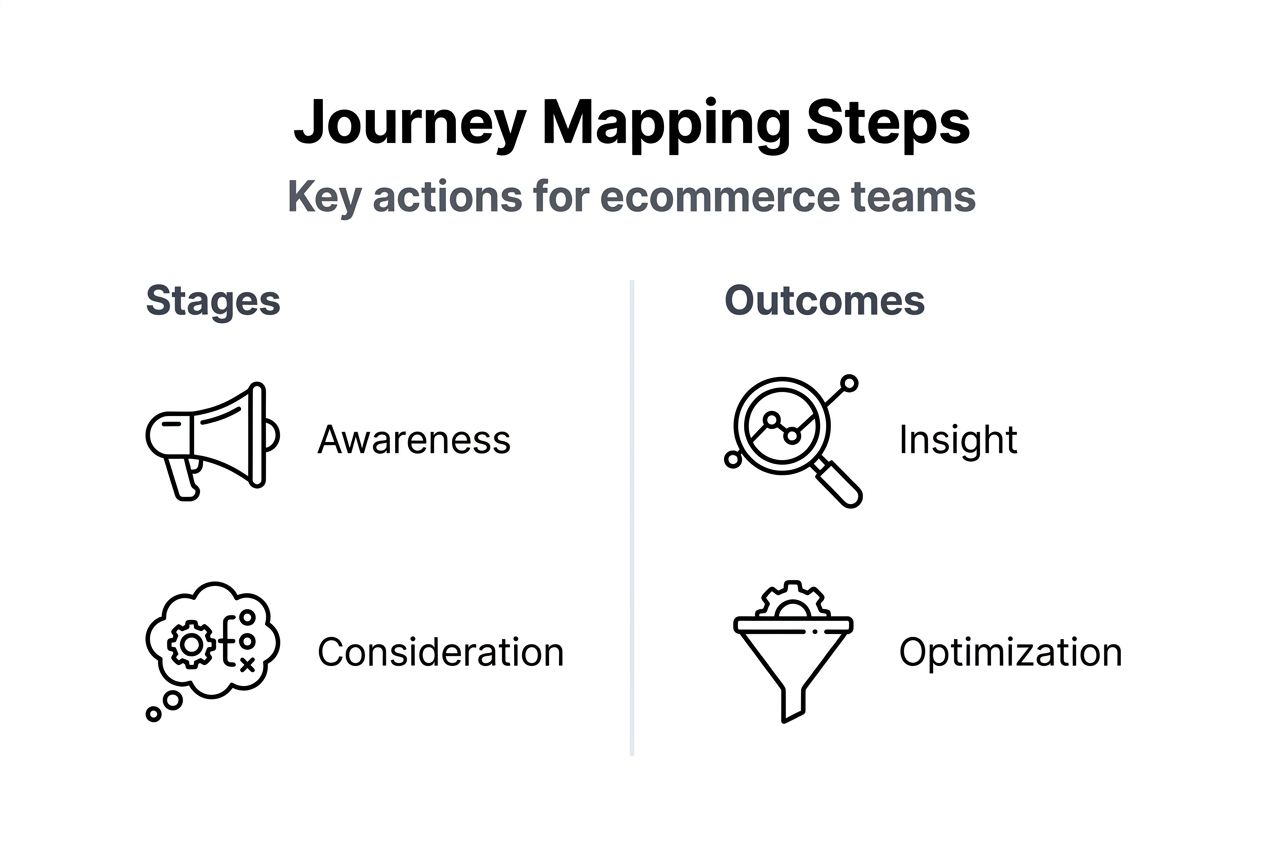
Customer journey mapping is a research-driven process documenting end-to-end experience including touchpoints, emotions, and expectations that customers encounter when interacting with your brand. Unlike simple buyer’s journey diagrams or CRM process flows, true journey maps capture the full emotional landscape of customer interactions from initial awareness through post-purchase advocacy.
Customer journey maps visually represent the full experience from awareness to advocacy capturing customer questions, emotions, and pain points at each stage. For ecommerce brands, this means documenting everything from how a customer discovers your products through social media to how they feel when encountering unexpected shipping costs at checkout.

Effective journey mapping provides a shared customer-centric view across teams. Your marketing team sees where prospects drop off, your design team identifies usability friction, and your customer service team understands recurring pain points. This strategic tool transforms abstract customer data into actionable insights that improve email marketing in ecommerce campaigns, website design, and overall conversion rates.
The customer journey mapping process requires gathering both qualitative feedback through customer interviews and quantitative data from analytics platforms. This combination reveals not just what customers do, but why they do it and how they feel throughout the experience.
Pro Tip: Start by mapping just one critical journey segment, like first-time purchase or cart abandonment recovery, rather than trying to document every possible customer path at once.
The role of design in ecommerce becomes clearer when journey maps reveal exactly where visual hierarchy, page speed, or navigation confuses potential buyers. This precision enables focused improvements that drive measurable revenue growth.
Common misconceptions about customer journey mapping
The belief that all touchpoints deserve equal attention ranks among the most damaging misconceptions in journey mapping. Most journey maps mistakenly assume equal importance of all touchpoints leading to poor prioritization, causing teams to spread resources too thin across dozens of customer interactions instead of focusing on the handful that truly influence purchase decisions.
Another frequent mistake involves trying to map every customer type and journey stage simultaneously. Overly broad journey mapping leads to generic outputs lacking actionable insights; focus on one persona and segment per map to maintain clarity and drive specific improvements. A map attempting to serve both first-time bargain hunters and loyal premium customers ends up serving neither effectively.
Many teams also treat journey mapping as a one-time design exercise rather than an ongoing strategic tool. They create beautiful visualizations for stakeholder presentations but never connect insights to automated marketing campaigns or conversion optimization efforts. This decorative approach wastes the operational power of journey mapping best practices.
Relying solely on internal assumptions without real customer data produces fiction, not strategy. Your team’s guesses about customer emotions and pain points often miss the mark completely. Validate every assumption with actual customer interviews, feedback, and behavioral analytics.
Comparison of effective vs. ineffective journey mapping:
| Approach | Effective Mapping | Ineffective Mapping |
|---|---|---|
| Scope | One specific persona and journey segment | All customer types and stages at once |
| Data Source | Customer interviews plus analytics | Internal team assumptions only |
| Touchpoint Priority | Weighted by impact on conversion | All treated as equally important |
| Application | Integrated with marketing automation | Static presentation document |
| Update Frequency | Continuous monitoring and refinement | One-time creation then forgotten |
Pro Tip: Rank every touchpoint by its impact on purchase decisions and customer lifetime value, then invest 80% of your optimization resources in the top 20% of highest-impact moments.
Focus enables action. When you try to map everything, you end up improving nothing. Select the journey segment that represents your biggest revenue opportunity or customer pain point, document it thoroughly with realistic journey map misconceptions addressed, and implement targeted improvements before expanding to other segments.
How to create effective customer journey maps
Start by defining your map scope with precision. Select one specific persona, such as “first-time mobile shoppers aged 25-35” and one journey segment like “product discovery to first purchase.” This focus persona journey mapping approach ensures actionable insights instead of vague generalizations.
Follow these steps to build maps that drive real improvements:
-
Gather qualitative customer data through interviews, surveys, and support ticket analysis. Ask customers to describe their experience in their own words, focusing on emotions and frustrations at each stage.
-
Incorporate quantitative analytics from your website, email platform, and sales data. Track where customers spend time, where they abandon carts, and which touchpoints correlate with conversions.
-
Conduct cross-departmental workshops bringing together marketing, design, customer service, and operations teams. Cross-functional collaboration during mapping ensures diverse insights and builds buy-in for effective CX improvements, creating alignment around customer-centric priorities.
-
Visualize the journey with clear stages, customer actions, emotions at each touchpoint, pain points, and opportunities for improvement. Use simple formats that anyone can understand and reference.
-
Prioritize improvements using an impact-effort matrix. Focus first on changes that significantly boost conversion or satisfaction while requiring minimal resources.
-
Establish continuous monitoring by integrating journey insights with your marketing automation platform to track how changes affect real customer behavior.
Pro Tip: Record customer interviews and pull direct quotes for your journey map. Real customer language like “I felt stressed when I couldn’t find shipping costs” creates more organizational urgency than sanitized summaries.
The customer journey mapping process succeeds when it moves beyond documentation to become a living tool that guides daily marketing decisions. Connect every mapped pain point to a specific automated email, website redesign, or policy change that addresses the issue.
Key elements to include in your journey visualization:
- Customer stages from awareness through advocacy
- Specific touchpoints and channels at each stage
- Customer questions, goals, and expectations
- Emotional highs and lows throughout the journey
- Current pain points and friction moments
- Opportunities for automation and personalization
Validate your completed map by sharing it with actual customers from your target persona. Their feedback reveals whether you’ve accurately captured their experience or made incorrect assumptions. Collaborative journey mapping approaches that include customer voices produce more accurate and actionable results than internal-only mapping sessions.
Integrating customer journey mapping with automated marketing
Journey mapping insights transform generic email campaigns into precisely targeted automated messages that address specific customer emotions and pain points. When your map reveals that customers feel anxious about product quality during consideration, your automation can trigger social proof emails featuring reviews and testimonials at exactly that stage.
Real-time analytics integration with journey maps enables dynamic optimization of customer interactions and marketing effectiveness, allowing your automated campaigns to adapt based on actual customer behavior rather than static assumptions. This integration turns journey mapping from a planning tool into an operational engine that continuously improves marketing performance.
Prioritize automation efforts on touchpoints your journey map identifies as highest-impact. If cart abandonment represents a critical pain point where customers express confusion about shipping timelines, your email marketing automation guide should focus recovery sequences that proactively address shipping concerns before customers abandon.
Journey mapping creates shared customer views across teams, reducing silos and aligning on evidence-based priorities. When marketing, design, and customer service all reference the same journey map, your automated touchpoints deliver consistent messaging that reinforces trust rather than creating confusion through contradictory communication.
Key integration opportunities:
- Align welcome series emails with new customer onboarding emotions and questions identified in your awareness stage mapping
- Design browse abandonment triggers that address specific product discovery pain points
- Create post-purchase automation sequences that anticipate anxiety moments during shipping and delivery
- Develop win-back campaigns targeting the emotional triggers that originally drove purchases
To optimize ecommerce website conversions, use journey map insights to identify where website friction creates abandonment. Then deploy automated email sequences that help customers complete actions they started but didn’t finish, like comparing products or calculating shipping costs.
The Klaviyo automation advantages become particularly powerful when fed with journey mapping data. Klaviyo’s segmentation and trigger capabilities allow you to automate responses to every mapped pain point and emotional moment, creating personalized experiences at scale.
Pro Tip: Map your automated email flows directly onto your customer journey visualization to identify gaps where customers experience pain points but receive no automated support or guidance.
Integration requires connecting your journey insights to specific real-time data analytics in journey mapping metrics that trigger automated responses. When behavioral data shows a customer hitting a mapped friction point, automation should immediately deliver helpful content or offers that smooth the path forward.
Measuring impact and prioritizing improvements
Use an impact-effort matrix to evaluate every improvement opportunity your journey map reveals. Plot each potential change based on its expected effect on conversion or retention versus the resources required to implement it. Focus first on high-impact, low-effort wins that deliver quick results and build momentum for larger initiatives.
Track these key metrics to measure how journey mapping improvements affect your ecommerce performance:
| Metric | What It Measures | Target Improvement |
|---|---|---|
| Cart abandonment rate | Percentage of started checkouts not completed | Reduce by 15-25% |
| Customer effort score | Perceived ease of completing desired actions | Increase by 20-30% |
| Email engagement rate | Open and click rates for automated sequences | Increase by 10-20% |
| Time to first purchase | Days from awareness to initial conversion | Reduce by 20-35% |
| Repeat purchase rate | Percentage of customers making second purchase | Increase by 15-25% |
| Customer lifetime value | Total revenue per customer over relationship | Increase by 25-40% |
Customer journey mapping helps reduce customer effort, lowering churn and improving satisfaction by identifying and eliminating unnecessary steps, confusing navigation, and information gaps that force customers to work harder than necessary to complete purchases.
The reality that nearly 70% of online carts are abandoned, with 40% due to fixable journey friction reveals enormous optimization potential. Mapping uncovers which friction points drive abandonment in your specific customer journey, enabling targeted fixes that significantly boost completion rates.
Pro Tip: Set up automated alerts when key journey metrics like cart abandonment or customer effort scores spike, triggering immediate investigation of what changed in the customer experience.
Align your improvement priorities with revenue and loyalty objectives. Changes that reduce churn among high-value customers deserve more resources than optimizations affecting one-time bargain shoppers. Your journey map should weight touchpoint importance by the customer segments experiencing them.
Continuously monitor outcomes by integrating journey metrics into your marketing automation dashboard. When you deploy a new email sequence addressing a mapped pain point, track how it affects downstream conversion and retention metrics. This feedback loop enables rapid iteration and continuous improvement.
To prioritize ecommerce conversion improvements, focus on moments where customers demonstrate high purchase intent but encounter friction. Fixing checkout confusion delivers better ROI than optimizing early awareness touchpoints where visitors haven’t yet decided to buy.
Prioritization framework:
- High impact, low effort: Implement immediately, typically within 1-2 weeks
- High impact, high effort: Plan for next quarter with dedicated resources
- Low impact, low effort: Batch together for efficiency when time permits
- Low impact, high effort: Defer or eliminate from roadmap entirely
Measurement transforms journey mapping from an interesting exercise into a revenue-driving strategic tool. Track how each mapped improvement affects your bottom line, then double down on the changes delivering the strongest returns while cutting investments in lower-performing optimizations.
Boost your ecommerce growth with Swyft Interactive
Transforming journey mapping insights into revenue requires expertise in both customer experience strategy and marketing automation execution. Swyft Interactive specializes in integrating detailed customer journey mapping process data with Klaviyo automation to create personalized experiences that boost conversions and customer lifetime value.
Our team helps ecommerce brands customize ecommerce growth automation strategy tailored to your specific personas, pain points, and revenue goals. We don’t just map your customer journey; we build the automated systems that address every friction point and capitalize on every high-intent moment.
Leverage our proven email marketing automation guide methodology to transform journey insights into campaigns that drive measurable growth. Our data-driven approach ensures every automated touchpoint aligns with customer emotions and expectations documented in your journey maps.
Ready to turn customer journey mapping into a revenue engine? Schedule a consulting session today to map and optimize your customer journey with expert guidance that delivers results.
Frequently asked questions
What is customer journey mapping in ecommerce?
Customer journey mapping in ecommerce is a research-driven process that documents every touchpoint, emotion, and pain point customers experience from discovering your brand through post-purchase advocacy. Unlike simple sales funnels, comprehensive maps reveal why customers behave as they do and how they feel at each stage. This deeper understanding enables targeted improvements to website design, customer journey mapping process automation, and customer service that significantly boost conversion rates and loyalty.
How can ecommerce brands use journey mapping to reduce cart abandonment?
Mapping identifies specific friction points like unexpected costs, complex checkout steps, or unclear shipping timelines that cause customers to abandon purchases. Once you understand which obstacles create the most abandonment, you can deploy targeted fixes like upfront shipping calculators, streamlined checkout flows, and automated reduce cart abandonment recovery emails that address the exact concerns customers expressed during research.
What role do customer emotions play in journey mapping?
Emotional journey curves reveal satisfaction drivers and frustration points that behavioral data alone misses. A customer might complete a purchase despite feeling stressed about product quality, creating an opportunity to improve confidence through better product information or reviews. Addressing negative emotions throughout the journey builds trust and loyalty that translates into higher conversion rates and repeat purchases.
How does cross-functional collaboration improve journey mapping outcomes?
Bringing together marketing, design, customer service, and operations teams surfaces insights no single department would identify alone. Customer service knows common complaints, design understands usability friction, and marketing sees where prospects drop off. This collective perspective creates more accurate maps and builds organizational buy-in to implement prioritized improvements across all customer touchpoints.
How can journey mapping integrate with Klaviyo or other automation tools?
Journey insights guide trigger design, segmentation strategy, and message personalization in Klaviyo automation platforms. When your map reveals customers feel anxious about shipping during checkout, you can automate reassuring messages at that exact moment. Real-time behavioral data flowing into your automation platform enables dynamic campaign adjustments that continuously optimize based on how customers actually navigate your journey.