TL;DR:
- Most ecommerce failures stem from disconnected marketing channels that confuse customers and erode trust.
- Integrated marketing aligns all channels, messaging, and customer data to create a seamless brand experience that drives revenue.
- Operational integration, fueled by shared data and triggers, produces compounding growth and significantly improves ROI.
Most ecommerce brands are not failing because they lack budget or creative talent. They are failing because their marketing channels operate like separate departments that have never met. Your ads say one thing, your emails say another, and your website tells a third story entirely. Customers feel the confusion, even if they can’t name it, and that confusion costs you revenue every single day. This guide breaks down what integrated marketing actually means for ecommerce, why it creates compounding returns, and the exact steps you can take to start fixing the disconnect today.
Table of Contents
- What is integrated marketing and why does it matter?
- How integration drives ecommerce growth: The compound effect
- Web, email, and automation: Putting integration into practice
- Common pitfalls and how to avoid integration failures
- From strategy to action: Steps to start integrating your ecommerce marketing
- Why most integrated marketing advice misses the operational reality
- Ready to unlock the benefits of integrated marketing?
- Frequently asked questions
Key Takeaways
| Point | Details |
|---|---|
| Consistent brand experience | Integrated marketing guarantees consistent messaging across every channel for more trust and recognition. |
| Amplified ROI | Coordinated efforts multiply the impact of your marketing spend, often yielding results far above the sum of isolated channels. |
| Operational alignment essential | Integration is not just about creative—connecting data and automation between platforms drives real performance. |
| Avoid common mistakes | Prevent failures like mis-timed emails or siloed teams by prioritizing system integration and routine audits. |
| Actionable first steps | Start by mapping your customer journey, aligning channels, and wiring your data for smarter automated engagement. |
What is integrated marketing and why does it matter?
Integrated marketing, formally called integrated marketing communications or IMC, is the practice of aligning every channel, message, and customer interaction so that your brand feels identical regardless of where a shopper encounters it. Shopify defines it clearly: integrated marketing aligns messaging and execution across channels so the brand feels consistent at every customer touchpoint.
For ecommerce, this is not just a branding exercise. It is a revenue strategy.
Here is what real integration looks like in practice:
- Your paid ads and email campaigns share the same offer language and visual identity
- A shopper who clicks an ad lands on a page that mirrors the exact promise made in that ad
- Post-purchase emails reference the product the customer actually bought, not a generic “thanks for shopping” message
- Your SMS, social retargeting, and loyalty program all reinforce the same seasonal campaign at the same time
The difference between creative consistency and operational integration is critical to understand. Creative consistency means your logo, color palette, and tone of voice look the same across channels. Operational integration means your systems, data, and triggers are wired together so the right message fires at the right moment for each individual shopper.
“Without operational integration, even the most beautifully branded campaign will underdeliver because the execution engine underneath is broken.”
When channels conflict, shoppers notice. A customer who just bought a jacket should never receive an abandoned cart email for that same jacket an hour later. That kind of mistake does not just fail to convert. It actively erodes trust. Understanding customer journey mapping is the foundation that prevents these errors, because it forces you to see your brand the way your customer experiences it rather than the way your internal teams are organized.
How integration drives ecommerce growth: The compound effect
Integration does not just produce additive gains. It creates what practitioners call the compound effect, where coordinated channels amplify each other in ways that isolated campaigns simply cannot replicate.
Think of it this way. A paid ad reaches a new visitor. That visitor browses but does not buy. A browse abandonment email brings them back. A retargeting ad on social reinforces the message. A well-timed SMS nudge closes the sale. Each of those touchpoints alone might convert at 1 to 2 percent. Together, in a coordinated sequence, the conversion rate can multiply significantly because the shopper experiences one coherent story rather than four unrelated interruptions.
Research confirms this dynamic: multi-channel coordination can produce compound effects greater than single-channel efforts if properly measured and orchestrated.
The numbers from real brands make this concrete. Urban Armor Gear reduced their marketing stack costs by 64% and achieved a 12.4x ROAS after integration improvements. That is not a marginal lift. That is the kind of result that redefines a brand’s growth trajectory.
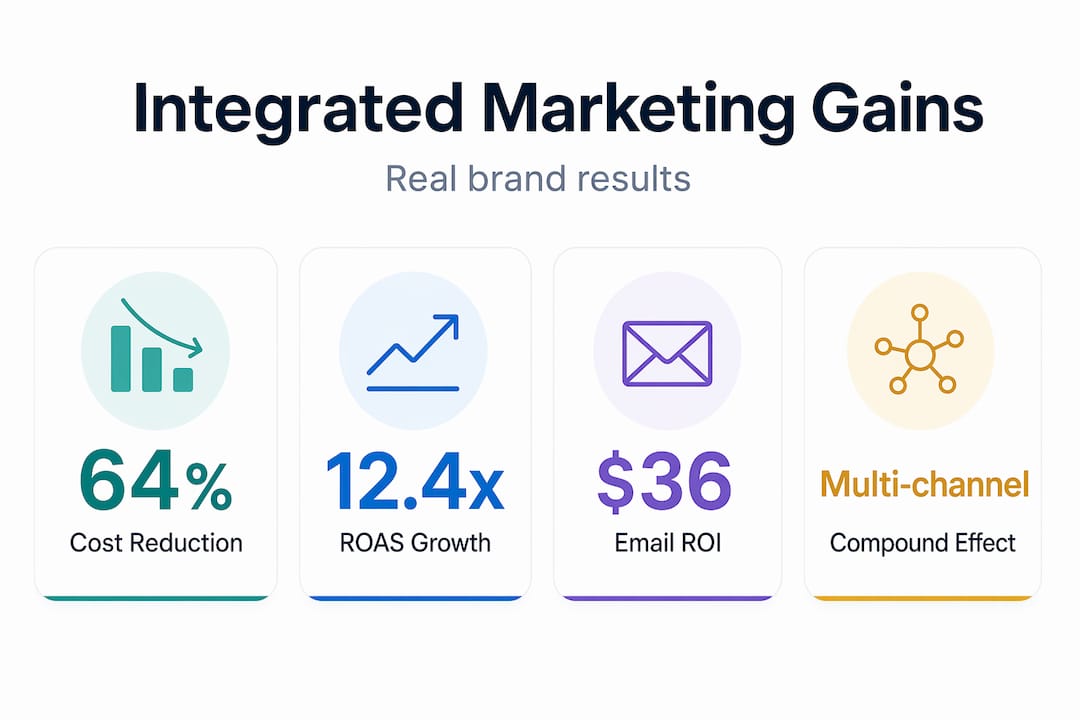
| Metric | Before integration | After integration |
|---|---|---|
| ROAS | Baseline | 12.4x improvement |
| Marketing stack costs | Full spend | 64% reduction |
| Conversion rate | Fragmented | Compound lift across channels |
| Customer confusion | High | Minimized through unified messaging |
The prerequisite for this kind of outcome is shared data and shared measurement. If your web team cannot see email performance data, and your email team cannot see on-site behavior, you are flying blind. Every team makes local decisions that look rational in isolation but create friction for the customer moving through your funnel. Exploring multi-channel marketing strategies built around shared data is the first step toward breaking that pattern.
The single most underrated integration lever: Align your campaign calendar across every channel before a campaign launches, not after. Brands that brief all channels simultaneously, rather than cascading briefs one team at a time, consistently see stronger campaign results because the timing coherence itself signals trust to the customer.
Web, email, and automation: Putting integration into practice
Understanding the theory is one thing. Building the actual system is another. Here is a practical framework for wiring your web events and email automation together into a machine that works around the clock.

Step 1: Map the full customer journey from first visit to repeat purchase.
Identify every major touchpoint: first visit, product view, add to cart, checkout abandonment, first purchase, post-purchase onboarding, and repeat purchase window. Assign a channel role to each stage.
Step 2: Connect your web event data to your email platform.
Every on-site action should be feeding your automation system. A product view is a signal. An add-to-cart event is a stronger signal. A checkout abandonment is an urgent signal. Automation platforms support behavioral automation with web and app events and purchase data driving targeted email flows, turning raw behavioral data into timely, relevant messages.
Step 3: Build your core trigger-based flows.
The highest-ROI automations for most ecommerce brands are:
- Abandoned cart sequence (typically 3 emails over 24 to 72 hours)
- Browse abandonment flow (1 to 2 emails within 1 to 4 hours of exit)
- Welcome series for new subscribers (3 to 5 emails building brand story and driving first purchase)
- Post-purchase sequence (confirmation, shipping, review request, cross-sell recommendation)
- Win-back campaign for lapsed customers (triggered at 60 to 90 days of inactivity)
Step 4: Align email content with your current web experience.
If your homepage is running a 20% summer sale, every active email flow should reference that sale contextually. Shoppers who receive an abandoned cart email during a sale period should see the sale price, not the standard price. That single alignment fix can lift email conversion rates meaningfully.
| Flow type | Typical trigger | Average ROI impact |
|---|---|---|
| Abandoned cart | Cart created, no purchase | High (often top revenue driver) |
| Browse abandonment | Product viewed, no add-to-cart | Moderate to high |
| Post-purchase | Order confirmed | High for LTV growth |
| Win-back | X days since last purchase | Moderate, high on LTV |
| Welcome series | New subscriber or first purchase | High for brand-building |
Email remains one of the highest-ROI channels available, generating $36 for every $1 spent. That return only grows when email is synchronized with on-site behavior rather than running as a standalone broadcast system.
Pro Tip: Start by auditing whether your email platform is receiving real-time purchase and cart events from your store. If there is more than a 15-minute delay between on-site action and email trigger, you are losing conversion window time that competitors with tighter integrations are capturing.
Reviewing email marketing best practices alongside email strategy examples from high-performing ecommerce brands will give you benchmarks to calibrate your own flows against.
Common pitfalls and how to avoid integration failures
Knowing what to build is half the battle. Understanding what breaks integrations is equally important, because most brands that attempt integration still fall short due to predictable, avoidable errors.
The most common pitfalls:
- Broken lifecycle logic: Your automation fires based on a trigger that does not account for the customer’s current state. An abandoned cart email going out after the customer already purchased is the classic example, and it happens more often than you would expect.
- Siloed teams: Your web developers do not talk to your email marketers. Each team optimizes for their own metrics without considering how their actions affect the other channels.
- Poor data flow: Customer purchase history, browsing behavior, and email engagement data live in separate systems that do not communicate in real time.
- Channel cannibalization: Your SMS, email, and retargeting ads all fire simultaneously for the same event, overwhelming the customer with redundant messages from every direction.
- Fixing only the creative layer: A brand redesigns all their email templates to match the new website look, but the underlying trigger logic and data connections are never updated. The emails look better but still perform poorly.
“Even with integrated messaging, failures like abandoned-cart emails firing post-purchase can occur due to broken lifecycle logic or poor data-sharing.”
The symptoms to watch for: duplicate messages reaching customers within hours of each other, email unsubscribe rates spiking after a campaign launch, customer service complaints about irrelevant communications, and revenue data that doesn’t match email platform attribution reports.
The solutions require both process and platform work. A unified data platform that all teams can access in real time is non-negotiable. Regular cross-channel audits, ideally monthly, help catch broken triggers before they erode customer trust at scale. Cross-functional planning sessions where web, email, and paid media teams review the same customer journey data together create the shared visibility that prevents silos from forming.
Pro Tip: Set up a simple shared dashboard that shows email trigger volumes alongside web event data for the same time periods. If a cart abandonment trigger is firing for significantly more sessions than you have actual cart abandonment events on the site, you have a data logic problem that no creative fix will solve.
Mapping out your customer journey process with all channel owners in the room is the single most effective way to surface broken logic before it goes live. Understanding the full benefits of marketing automation also helps build the internal case for investing in the operational infrastructure that makes integration work.
From strategy to action: Steps to start integrating your ecommerce marketing
The gap between knowing integration matters and actually building it is where most brands stall. Here is a clear starting sequence to get moving without overwhelming your team.
-
Audit your current channel stack. List every active marketing channel: your website, email, SMS, paid search, paid social, organic social, and any loyalty or referral programs. Note which channels are sharing data and which are operating independently.
-
Define one journey objective to start. Shopify recommends starting with a single journey objective, mapping channels to it, and wiring event data into automation before expanding. For most ecommerce brands, abandonment recovery is the highest-leverage starting point because the revenue impact is immediate and measurable.
-
Audit your data connections. Confirm that your email platform is receiving purchase events, cart events, and browse events from your store in real time. Fix any delays or gaps in this data flow before building new campaigns.
-
Map every active touchpoint for your chosen journey. Document what the customer sees, hears, and receives at each step. Identify contradictions or gaps between channels for that specific journey.
-
Wire your automation triggers to unified data. Build or update your flows so that every trigger references the customer’s current lifecycle state, not just the most recent single action.
-
Test, measure, and close gaps. Run the integrated sequence for 30 days, then compare conversion rates and revenue per recipient against your pre-integration baseline. Share that data with every team involved.
Reviewing customer journey mapping tips will help you accelerate this process and avoid common mapping errors that waste implementation time.
Why most integrated marketing advice misses the operational reality
Here is the uncomfortable truth that most integration guides skip entirely: making your emails and ads look visually consistent is the easy part. Every design tool and brand guideline template in existence can help you achieve that. What actually determines whether integration drives revenue is whether your platforms are talking to each other correctly, whether your lifecycle triggers fire at the right moments, and whether your teams are looking at the same data when they make decisions.
Most brands invest heavily in brand guidelines and creative refresh projects, then wonder why their integrated campaigns still underperform. The answer is almost always in the operations layer. A beautifully designed abandoned cart email that fires after the customer has already bought the product does not just fail to convert. It actively signals to the customer that your brand is not paying attention.
The brands that see outsized results from integration are not necessarily the ones with the best creative. They are the ones where a purchase event in the store immediately updates the customer’s status in the email platform, suppresses them from irrelevant flows, and triggers the right post-purchase sequence without a gap. That kind of reliability is built through platform configuration, shared data architecture, and cross-functional process, not through a brand photoshoot.
The good news is that this operational excellence is more accessible to mid-market ecommerce brands than it has ever been. Platforms that support email automation for ecommerce now offer native event tracking, pre-built flow templates, and real-time data syncing that previously required enterprise-level technical resources to build. The barrier is not budget or technology. It is knowing what to prioritize, and prioritizing the operations layer before the creative layer.
Ready to unlock the benefits of integrated marketing?
If this guide has clarified where your biggest integration gaps are, the next step is to start auditing and building with the right tools and frameworks in place.
Swyft Interactive helps ecommerce brands build the exact kind of integrated systems described in this article, connecting high-converting websites with Klaviyo-powered email automation and full-funnel journey mapping. Whether you are starting from scratch or fixing a broken integration, our ecommerce website checklist gives you a practical audit framework to identify gaps fast. And if you want to understand the full revenue impact of automation done right, explore our breakdown of the benefits of email automation for ecommerce growth. The brands that win in the next few years will be the ones that build integrated systems today, not the ones with the biggest ad budgets.
Frequently asked questions
What are the key elements of an integrated marketing strategy?
Key elements include unified messaging, shared data platforms, coordinated lifecycle triggers, and consistent measurement across all marketing channels. Shopify outlines that true integration requires both visibility and data-sharing, not just creative alignment.
How does integration impact ROI for ecommerce businesses?
Integration multiplies return on investment by ensuring every customer touchpoint works in concert, creating compound growth effects. Brands like Urban Armor Gear achieved a 12.4x ROAS alongside substantial cost reductions after consolidating and integrating their marketing systems.
What is the most common mistake in integrated marketing for ecommerce brands?
The most common mistake is broken lifecycle logic, where automation fires at the wrong moment because customer data is not shared in real time across platforms. As research on omnichannel failures shows, this is almost always a data-sharing problem rather than a creative one.
How important is email automation in integrated marketing?
Email automation is one of the highest-impact components of any integrated strategy, because email generates $36 for every $1 spent when properly coordinated with web behavior and customer lifecycle data.
Can integration benefit smaller ecommerce brands or just large enterprises?
Integration benefits ecommerce brands at every scale. Even mid-market brands have reported 500% organic growth after integration improvements, and modern automation platforms make the operational infrastructure accessible without enterprise-level budgets.