TL;DR:
- Effective upselling boosts revenue by 10-30% and customer lifetime value by 20-40%.
- Timing and relevance are crucial; post-purchase and personalized emails yield higher conversions.
- Building automated, behavior-triggered flows and limiting options enhances long-term customer trust and growth.
Most eCommerce brands treat upselling like a pushy car dealership tactic. Show the customer a more expensive option, hope they bite, repeat. But that framing misses something fundamental. The brands quietly generating the most sustainable revenue aren’t pushing harder. They’re listening better. Upsell strategies can boost average order value by 10 to 30% and customer lifetime value by 20 to 40%, with Amazon crediting 35% of its revenue to product recommendations alone. This guide breaks down the exact mechanics, timing, and automation frameworks that turn upselling from a blunt instrument into one of your most reliable growth levers.
Table of Contents
- Why upsell strategies matter in eCommerce
- Types of upsell strategies and their ideal timing
- Leveraging email automation for personalized upsells
- Best practices and pitfalls: optimizing upsell strategies
- The uncomfortable truth about upselling most brands miss
- Unlock your upsell advantage with expert guidance
- Frequently asked questions
Key Takeaways
| Point | Details |
|---|---|
| Upsells drive major value | Effective upsell strategies can lift your average order value by up to 30% and significantly grow your revenue. |
| Timing is everything | Post-purchase and tailored email automation provide the best upsell results with minimal customer risk. |
| Personalization wins | Segmentation and personalized recommendations make upsell offers far more likely to convert. |
| Avoid upsell fatigue | Limiting options and keeping offers relevant helps maintain customer trust and long-term loyalty. |
| AI enhances results | Artificial intelligence can optimize upsell offers for higher conversion and customer retention at scale. |
Why upsell strategies matter in eCommerce
Let’s get the definitions straight first, because most people blur these two together.
An upsell is when you encourage a customer to buy a higher-tier or upgraded version of what they’re already purchasing. Think: a customer adds a 16GB tablet to their cart, and you suggest the 32GB version for $40 more. A cross-sell is when you recommend a complementary product. Same customer, but now you’re suggesting a protective case or a stylus. Both are valuable. But they work differently, and mixing them up leads to poorly targeted offers that customers ignore.
Upselling works because it meets the customer at a moment of high intent. They’ve already decided to buy. The psychological barrier is down. A well-timed upsell isn’t an interruption. It’s a helpful nudge toward something that genuinely serves them better.
The numbers back this up. Brands implementing smart upsell programs see AOV increases of 10 to 30% and CLV improvements of 20 to 40%. Those aren’t theoretical gains. Real eCommerce operators are logging them. A supplement store boosted its AOV to $79, a 47% lift. Doppeltree saw a 44% AOV increase and generated $16,000 in upsell revenue in a single campaign window. A skincare brand drove a 30% revenue lift through targeted upsell automation alone.
Here’s what makes upselling especially powerful compared to other revenue levers:
- No customer acquisition cost. You’re selling to someone already buying. There’s zero ad spend to attribute to that incremental revenue.
- Higher margins. Premium product versions often carry better margins than entry-level items.
- Stronger retention signals. Customers who buy more in a transaction tend to stay longer and return more often.
- Scalable through automation. Once your flows are set up, every new customer triggers the same well-optimized experience without manual effort.
“Amazon attributes 35% of its revenue to its recommendation engine, the most well-documented example of upselling done at massive scale without feeling aggressive.”
To understand how to leverage a cross-sell strategy overview alongside upselling, it’s worth recognizing they’re complementary, not competing. The best brands deploy both within a coordinated post-purchase flow.
| Brand type | AOV lift | Revenue from upsells | Key tactic |
|---|---|---|---|
| Supplement store | +47% (to $79) | Significant monthly gains | Product upgrade offers |
| Doppeltree | +44% | $16,000 campaign revenue | Bundled upsell automation |
| Skincare brand | +30% revenue | Consistent monthly lift | Email-triggered recommendations |
These results aren’t outliers. They’re what happens when upsell strategy connects to the right ecommerce marketing strategies and gets executed with precision.
Types of upsell strategies and their ideal timing
Not all upsell moments are equal. Timing changes everything, and deploying the wrong upsell type at the wrong moment is a fast way to lose a sale you already had.
There are three core upsell categories every eCommerce brand should understand.
Pre-purchase upsells appear on product pages or in the cart before checkout. They show the customer a better version of what they’re considering. Conversion rates here run between 3 and 15% depending on offer relevance, price gap, and product category. The main risk is friction. If your upsell appears intrusive or adds confusion, you can increase cart abandonment.
Post-purchase upsells trigger after the customer completes their order, typically on the thank-you page or in an immediate follow-up. This is where the numbers get interesting. Post-purchase upsells convert at 10 to 25%, because the customer’s credit card is already out and the buying decision is complete. There’s no abandonment risk because the original order is confirmed. A well-structured 4-touch post-purchase flow has been shown to yield 3.2x the revenue of a single offer.
Email automation upsells are the most scalable and often the most underutilized. These are sequenced emails triggered by purchase behavior, browsing history, or time-based signals. Revenue per recipient in automated email flows runs 18x higher than campaign-style emails, and post-purchase sequences specifically add around 20% to average order value over time.
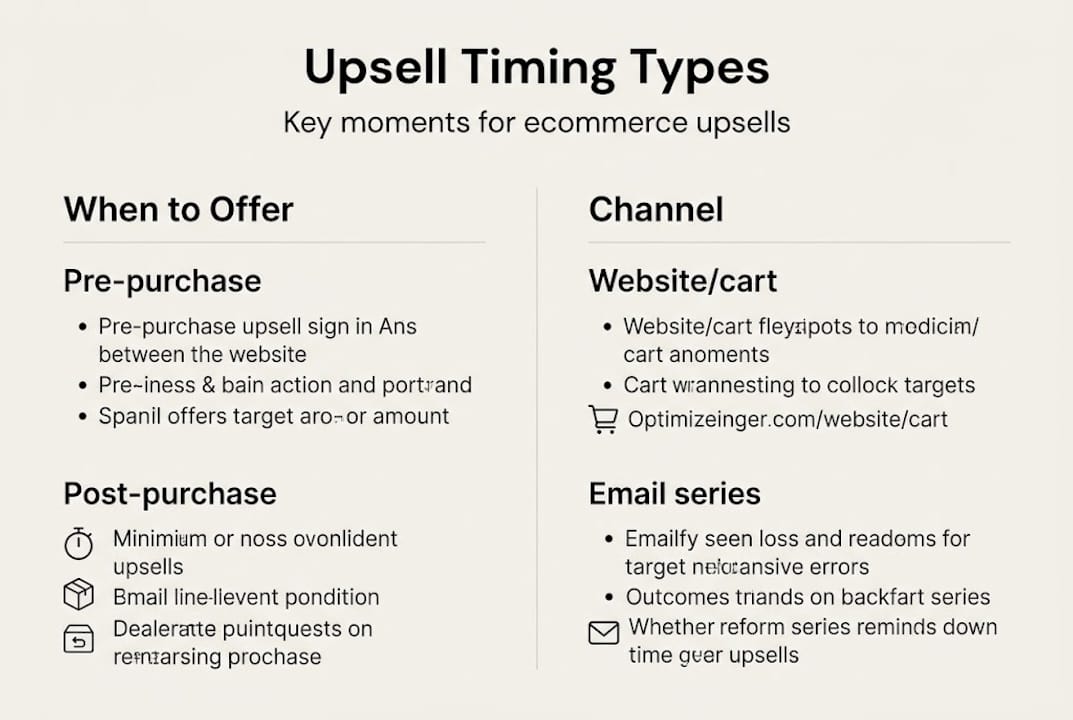
| Upsell type | Avg. conversion rate | Abandonment risk | Best for |
|---|---|---|---|
| Pre-purchase (product/cart page) | 3 to 15% | Higher | Impulse categories, small price gap |
| Post-purchase (thank-you page) | 10 to 25% | None | High-intent buyers, premium upgrades |
| Email automation (post-delivery) | Varies by flow | None | Repeat purchase, refill cycles, loyalty |
Understanding the post-purchase automation benefits is what separates brands that get a one-time AOV boost from brands that build compounding CLV over months and years.
Here are the scenarios where each type excels:
- Pre-purchase works well in electronics, software subscriptions, or any category where a clear “good, better, best” product ladder exists.
- Post-purchase shines in consumables, apparel, and beauty, where the customer is already satisfied and the offer feels like a logical next step.
- Email automation is the workhorse for subscription boxes, supplements, skincare, and any category with a natural replenishment cycle.
For practical inspiration on what these look like in action, studying email automation examples from successful eCommerce brands reveals patterns you can adapt directly to your own flows.
Leveraging email automation for personalized upsells
Here’s where most brands leave serious money on the table. They build one upsell email, send it to their entire list three days after purchase, and wonder why the conversion rates are mediocre. Personalization isn’t a nice-to-have in email upsell automation. It’s the entire mechanism.
Effective upsell emails work because they feel relevant at the exact right moment. Generic ones feel like spam. The gap between those two experiences is segmentation and behavioral triggers.
Follow these steps to build high-performing upsell email flows:
- Segment by purchase history. Group customers by the specific product they bought, not just the category. A customer who bought your entry-level protein powder gets a different upsell than someone who bought your premium bundle.
- Set behavioral triggers. According to email automation best practices, the optimal send window is 10 to 30 days post-delivery for consumables and replenishment items, or triggered by specific signals like low-stock alerts for their purchased product.
- Personalize the offer itself. Use the customer’s first name, reference their actual purchase, and make the upgrade feel like a natural continuation of a decision they already made well.
- Use one-click upsell mechanics. Reduce friction to near zero. Any extra step between the email and the completed upsell transaction bleeds conversion rate. One-click add-to-order functionality keeps momentum.
- A/B test timing and relevance. Even within a well-built flow, small changes in subject line, send day, or offer framing can shift conversion by significant percentages. Test one variable at a time and let data drive iteration.
Email automation flows generate 40 to 60% of total email revenue for brands that use them correctly, compared to campaign-style sends. That number reflects the power of relevance. Automated flows respond to what the customer actually did. Campaigns broadcast to whoever is on the list.
Pro Tip: The highest-performing upsell emails we’ve seen don’t lead with the product. They lead with the customer’s outcome. “You picked up our starter skincare kit. Here’s what our top-rated customers upgrade to next for even faster results.” That framing earns the click before the product image even loads.
The email automation benefits extend beyond revenue too. Brands that automate personalized post-purchase communication consistently see higher review rates, lower refund rates, and better long-term retention. The upsell email is doing double duty: generating revenue and reinforcing the relationship.

For teams building out their first or second automation layer, exploring proven email marketing strategy examples from similar eCommerce verticals accelerates the setup process considerably.
Best practices and pitfalls: optimizing upsell strategies
Even a well-intentioned upsell program can backfire. The mechanics matter, but so does the guardrails you put around them. Here’s what separates brands that sustain upsell success from those that see initial gains followed by rising unsubscribes and refund rates.
Core best practices:
- Limit options to one to three. Decision fatigue is real. More than three upsell options create confusion and inaction, not conversion. Pick your single strongest offer for each segment.
- Keep price differential under 25%. An upsell priced more than 25% above the original purchase creates sticker shock. The sweet spot is 10 to 20% above the original transaction value.
- Prioritize post-purchase over pre-checkout. Pre-checkout upsells carry abandonment risk. If a customer is on the fence, an upsell at checkout can tip them out of the purchase entirely. Post-purchase eliminates that risk while maintaining high conversion potential.
- Align offer relevance relentlessly. A customer who bought running shoes doesn’t want a upsell for kitchen equipment. The offer must be a logical, adjacent upgrade or it destroys trust immediately.
- Track the right metrics. AOV gains are easy to see. Refund rates and 60-day LTV tell you whether your upsells are building sustainable value or manufacturing short-term spikes at the cost of customer satisfaction.
Pro Tip: If you’re running upsells at scale, rule-based systems break down faster than most teams realize. A rule that says “if customer buys X, show Y” works when you have 10 SKUs. At 200 SKUs and 50,000 customers, the permutations become unmanageable. AI-powered upsell tools learn from behavioral patterns and dynamically adjust offers in ways a static ruleset never can.
The pitfalls worth calling out directly:
- Offer fatigue: Hitting a customer with an upsell at checkout, on the thank-you page, and in three consecutive emails creates exhaustion, not enthusiasm. Space your touchpoints and let the customer breathe.
- Mismatch timing: A refill upsell sent two days after delivery feels premature and tone-deaf. Match the upsell timing to the actual product consumption cycle.
- Irrelevant suggestions: Nothing erodes trust faster than an obviously untargeted recommendation. It signals to the customer that you don’t know them, which undermines everything good about the purchase experience.
Brands that apply disciplined conversion rate tips to their upsell flows consistently outperform those that treat upselling as a single-setup exercise. Revisiting your flows quarterly with fresh data, new A/B test results, and updated segmentation is what keeps performance compounding rather than plateauing. Connecting this to a broader ecommerce optimization guide ensures upsells don’t operate in isolation from the rest of your conversion strategy.
The uncomfortable truth about upselling most brands miss
After working with eCommerce brands across multiple verticals, a pattern becomes clear. The brands chasing AOV the hardest are often the ones most likely to plateau or see declining retention. They optimize for the transaction. The best brands optimize for the relationship.
Upselling done right is invisible. The customer doesn’t feel sold to. They feel understood. When an email arrives suggesting a refill of their favorite supplement at exactly the moment they’re running low, that’s not a sales tactic. That’s a brand demonstrating it actually pays attention. That experience is what drives repeat purchases, word of mouth, and the kind of CLV that makes a business genuinely defensible.
Smart upsellers also watch the signals most brands ignore: unsubscribes after upsell flows, refund rates on upsell items, repeat purchase windows on upgraded products. These numbers tell you whether your upsells are earning trust or spending it. A growth strategy with automation should center on building durable customer relationships, with upselling as one tool within that larger system, not the entire strategy.
The brands winning long-term reframe upselling entirely. They’re not asking “how do we get more from this order?” They’re asking “what does this customer need next, and how do we show them we already know?”
Unlock your upsell advantage with expert guidance
Building a upsell system that compounds CLV while maintaining customer trust takes more than a Klaviyo flow template and good intentions. It takes precise segmentation, behavior-triggered automation, ongoing A/B testing, and a strategy that connects post-purchase engagement to long-term retention. That’s what separates brands running upsells from brands running upsell systems.
If you’re ready to move beyond basic upsell attempts and build automation that generates consistent, scalable revenue, our email automation guide is a strong starting point for mapping your flow strategy. And if you want expert execution built on Klaviyo’s full capabilities, our Klaviyo marketing services team builds and manages the kind of upsell programs that deliver measurable, compounding results for growing eCommerce brands.
Frequently asked questions
How much can upsell strategies increase my eCommerce revenue?
Upsell strategies boost AOV by 10 to 30% and CLV by 20 to 40%, with leading brands like Amazon attributing over a third of their total revenue to recommendation-driven upsells.
What is the best time to offer an upsell?
Post-purchase and email automation are your highest-converting, lowest-risk moments, with post-purchase upsells converting at 10 to 25% and email flows producing 3.2x revenue through structured sequences.
How many upsell options should I show to a customer?
Stick to one to three highly relevant options. More than three choices trigger decision fatigue and reduce conversion, regardless of how good the individual offers are.
Does AI really outperform rule-based upsells?
Yes, at scale. AI-powered upsell tools adapt dynamically to customer behavior patterns, delivering more relevant offers and higher long-term returns than static rule-based systems that break down as your catalog and customer base grow.
Why can upselling backfire in eCommerce?
Aggressive, irrelevant, or poorly timed offers erode customer trust and drive up refund rates. Tracking 60-day LTV alongside AOV reveals whether your upsell program is building or burning customer relationships.