
Juggling messy customer data while trying to craft the perfect email campaign can feel overwhelming for any American ecommerce marketing manager. Getting it right matters because data-driven marketing turns scattered information into tailored experiences that persuade buyers to take action. Discover how strategic data analysis, powerful automation tools like Klaviyo, and refined segmentation can help your online retail brand increase conversions and deliver targeted messages that truly engage your customers.
Table of Contents
- Defining Data-Driven Marketing For Ecommerce
- Major Types Of Data Used In Marketing
- How Klaviyo Automation Enhances Email Roi
- Advanced Segmentation And Personalization Strategies
- Workflow Optimization And Common Mistakes To Avoid
- Measuring Success: Revenue, Engagement, And Growth Metrics
Key Takeaways
| Point | Details |
|---|---|
| Data-Driven Marketing | Transforms customer insights into personalized strategies, enhancing targeting and communication for ecommerce brands. |
| Types of Marketing Data | Includes demographic, behavioral, transactional, and psychographic data to drive strategic decision-making and customer engagement. |
| Email Automation with Klaviyo | Improves marketing performance through personalized communication based on customer behavior and engagement timing. |
| Measuring Performance | Focus on critical metrics helps businesses anticipate customer behavior and optimize marketing strategies for better outcomes. |
Defining Data-Driven Marketing for Ecommerce
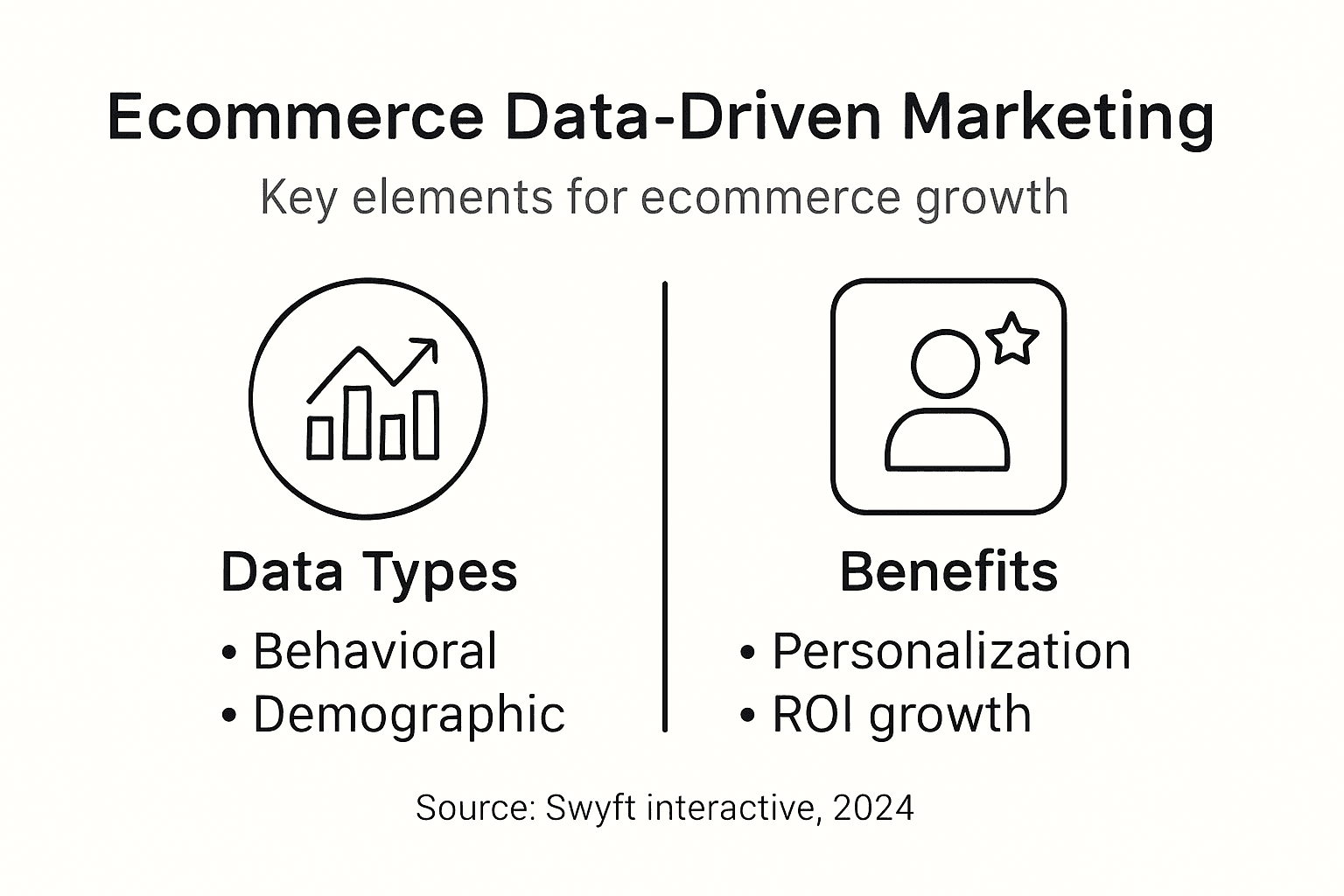
Data-driven marketing represents a strategic approach that transforms raw customer information into powerful, personalized marketing initiatives. At its core, this methodology uses comprehensive data analysis to predict consumer behaviors, design targeted campaigns, and optimize marketing performance for online retail businesses.
In the context of ecommerce, data-driven marketing goes beyond traditional guesswork by leveraging detailed consumer insights. This approach involves systematically collecting consumer behavior data to understand purchasing patterns, preferences, and potential future actions. Marketers can then craft highly tailored experiences that resonate with specific customer segments.
Key components of data-driven marketing for ecommerce include:
- Analyzing customer interaction data across multiple channels
- Tracking website browsing behaviors
- Monitoring purchase history and frequency
- Segmenting customers based on demographic and behavioral attributes
- Predicting potential customer lifetime value
- Creating personalized product recommendations
The strategic advantage of this approach lies in its ability to transform complex data into actionable marketing strategies. By understanding nuanced customer preferences, ecommerce brands can design more effective communication, improve targeting precision, and ultimately drive higher conversion rates.
Pro tip: Start by implementing basic data tracking tools and gradually build sophisticated analytics capabilities to understand your customer journey more comprehensively.
Major Types of Data Used in Marketing
Marketing professionals leverage diverse data types to create comprehensive insights that drive strategic decision-making. Marketing data encompasses multiple categories designed to provide a holistic understanding of customer behaviors, preferences, and potential interactions with brands.
The primary types of marketing data can be categorized into four fundamental groups:
- Demographic Data: Includes age, gender, income, education level, geographic location, and occupation
- Behavioral Data: Tracks online interactions, website visits, purchase history, product views, and engagement patterns
- Transactional Data: Captures specific purchase details, transaction values, frequency of purchases, and customer lifetime value
- Psychographic Data: Explores customer attitudes, interests, lifestyle choices, values, and personal motivations
Moreover, marketing teams increasingly distinguish data sources based on collection methods. First-party data represents information collected directly from customers through interactions with company websites, mobile apps, and customer relationship management (CRM) systems. Second-party data involves information shared between trusted business partners, while third-party data aggregates information from external sources to provide broader market insights.

Here’s a quick reference to how different data types impact ecommerce marketing strategies:
| Data Type | Main Focus | Business Impact |
|---|---|---|
| Demographic | Age, location, income | Refines audience targeting |
| Behavioral | Website actions, buys | Drives personalized campaigns |
| Transactional | Order details, frequency | Optimizes revenue generation |
| Psychographic | Values, lifestyle, needs | Shapes brand messaging |
Effective data utilization requires not just collection, but strategic interpretation and application across marketing initiatives.
Pro tip: Invest in robust data management tools that can integrate multiple data sources and provide actionable analytics for more targeted marketing strategies.
How Klaviyo Automation Enhances Email ROI
Klaviyo has revolutionized email marketing for ecommerce brands by transforming complex customer data into precision-targeted communication strategies. Email automation workflows dramatically improve marketing performance by delivering personalized messages at exactly the right moment in the customer journey.
The platform’s automation capabilities focus on several key strategic elements:
- Segmentation: Intelligently categorizing customers based on behavior, purchase history, and engagement levels
- Personalization: Creating tailored email content that speaks directly to individual customer preferences
- Timing Optimization: Sending messages when customers are most likely to engage
- Behavioral Triggered Campaigns: Automatically responding to specific customer actions
- Performance Tracking: Providing real-time analytics on email campaign effectiveness
Advanced automated workflows enable ecommerce marketers to create complex, multi-step email sequences that adapt dynamically to customer interactions. These sophisticated triggers can include abandoned cart reminders, post-purchase follow-ups, win-back campaigns for inactive customers, and personalized product recommendations based on browsing and purchasing history.
Effective email automation transforms generic marketing into a precision-targeted communication strategy that feels personal and relevant to each customer.
Pro tip: Map out your customer journey in detail before building automation workflows, identifying key touchpoints where automated emails can provide maximum value and engagement.
Advanced Segmentation and Personalization Strategies
Ecommerce marketing has evolved beyond generic mass communication into a sophisticated landscape of targeted, individualized experiences. Advanced customer segmentation techniques enable businesses to transform raw data into precise, actionable marketing strategies that speak directly to customer needs and preferences.
Successful advanced segmentation relies on multiple sophisticated approaches:
- Behavioral Segmentation: Analyzing customer actions, purchase frequency, and engagement patterns
- RFM Analysis: Categorizing customers by Recency, Frequency, and Monetary value
- Predictive Modeling: Using machine learning to forecast future customer behaviors
- Psychographic Segmentation: Understanding customer motivations, lifestyle, and values
- Micro-Segmentation: Creating extremely granular customer groups with shared characteristics
Personalization strategies take these segmentation approaches further by dynamically adapting content, product recommendations, and messaging to individual customer profiles. Contextual personalization goes beyond basic demographic targeting, incorporating real-time data such as browsing history, previous purchases, and even seasonal preferences to create uniquely tailored experiences.
This summary shows how advanced segmentation and personalization approaches differ in their benefits:
| Approach | Use Case Example | Key Benefit |
|---|---|---|
| RFM Analysis | Email loyalty offers | Boosts repeat purchases |
| Predictive Modeling | Product recommendations | Anticipates customer needs |
| Micro-Segmentation | Limited-time campaigns | Maximizes relevancy |
| Contextual Personalization | Dynamic content feeds | Increases engagement rates |
Effective personalization transforms generic marketing into a precision-targeted communication strategy that feels individually crafted for each customer.
Pro tip: Start with three to five core customer segments and progressively refine your approach, using data-driven insights to continually optimize your targeting strategy.
Workflow Optimization and Common Mistakes to Avoid
Marketing automation workflows represent powerful tools for streamlining complex communication strategies, but their effectiveness depends on careful design and implementation. Marketing automation requires strategic planning to transform repetitive tasks into intelligent, responsive customer engagement systems.
Common workflow optimization challenges include:
- Overcomplicated Sequences: Creating workflows with too many complex decision points
- Insufficient Data Integration: Failing to connect data sources across different platforms
- Lack of Clear Goals: Implementing automation without defined performance metrics
- Neglecting Personalization: Using generic messaging across all customer segments
- Ignoring Performance Monitoring: Not regularly reviewing and adjusting workflow performance
Successful workflow implementation demands a methodical approach that balances automation sophistication with strategic simplicity. Trigger-based sequences should align precisely with customer journey stages, using carefully mapped interactions that feel natural and responsive rather than mechanically generated.
Effective marketing workflows transform automated communication from a mechanical process into a dynamic, responsive customer engagement strategy.
Pro tip: Begin by mapping your customer journey in detail, identifying three to five critical interaction points where automated workflows can provide meaningful, personalized communication.
Measuring Success: Revenue, Engagement, and Growth Metrics
Ecommerce success hinges on comprehensively tracking performance through strategic metrics that reveal deeper insights beyond surface-level data. Key performance indicators transform raw numbers into actionable intelligence that guides marketing and operational decisions.
Critical metrics for measuring ecommerce performance include:
-
Revenue Metrics:
- Total sales revenue
- Average order value (AOV)
- Customer lifetime value (CLV)
- Gross profit margin
-
Engagement Metrics:
- Website traffic
- Conversion rates
- Email open and click-through rates
- Social media interaction
-
Growth Metrics:
- Customer acquisition cost
- Customer retention rate
- Repeat purchase rate
- Market share expansion
Successful data-driven marketing requires more than merely collecting metrics. Predictive analytics transforms historical data into forward-looking strategies, enabling businesses to anticipate customer behaviors, optimize marketing spend, and proactively address potential challenges before they impact performance.
Effective metric tracking is not about collecting data, but about translating that data into meaningful, strategic business insights.
Pro tip: Implement a monthly review process where you analyze your key metrics, identifying trends and making incremental adjustments to your marketing strategies.
Transform Your Ecommerce Growth with Data-Driven Marketing Solutions
Struggling to turn your ecommerce data into real growth can feel overwhelming. This article highlights how challenges like leveraging customer behavior data and optimizing email automation impact your revenue and engagement. If you want to move beyond generic marketing and tap into advanced segmentation, personalization, and workflow optimization, our team has the expertise to help.
We specialize in creating high-converting, fast-loading ecommerce websites combined with powerful Klaviyo email automation. Our full-funnel approach integrates digital strategy, targeted email marketing, and deep data insights to boost your conversions and customer lifetime value.
Take the first step today by exploring how our tailored data-driven marketing services at Swyft Interactive can convert your ecommerce challenges into measurable growth. Visit our You Suck At Klaviyo resource to see how advanced automation can maximize your email ROI and keep your customers engaged. Start turning your data into dollars now.
Frequently Asked Questions
What is data-driven marketing in ecommerce?
Data-driven marketing in ecommerce refers to the strategic use of customer data to create personalized marketing initiatives. It involves analyzing customer behavior and preferences to design targeted campaigns that ultimately improve marketing performance and conversion rates.
How does data-driven marketing improve customer targeting?
Data-driven marketing enhances customer targeting by utilizing detailed analysis of consumer demographics, behaviors, and transactional history. This allows marketers to segment customers effectively and tailor marketing strategies to meet the specific needs and preferences of different customer groups.
What types of data are essential for data-driven marketing?
Essential types of data for data-driven marketing include demographic data (age, gender, income), behavioral data (online interactions, purchase history), transactional data (order details, customer lifetime value), and psychographic data (customer interests and motivations). Each type of data provides unique insights that can guide marketing strategies.
How can Klaviyo automation enhance email marketing efforts in ecommerce?
Klaviyo automation enhances email marketing by allowing businesses to create targeted email campaigns based on customer behavior, preferences, and engagement levels. It helps deliver personalized messages at optimal times, utilizes behavioral triggers for campaigns, and includes performance tracking to measure effectiveness.