

Every Ecommerce marketing manager knows the frustration of launching an email campaign only to see lackluster results. With rapidly changing customer behaviors and crowded inboxes, guessing at what works no longer delivers the growth American brands need. By turning to data analytics in email marketing, you can replace guesswork with strategies grounded in measurable insights and advanced automation through platforms like Klaviyo. This approach empowers smarter decisions that spark engagement and drive real business outcomes.
Table of Contents
- Defining Data Analytics In Email Marketing
- Types And Metrics Essential For Ecommerce
- Integrating Klaviyo Automation And Segmentation
- Optimizing Campaigns With Analytical Insights
- Common Pitfalls And Data Hygiene Challenges
Key Takeaways
| Point | Details |
|---|---|
| Data Analytics in Email Marketing | Utilizes customer interaction data to enhance email campaigns, driving business growth through measurable insights. |
| Types of Analytics | Includes descriptive, predictive, diagnostic, and prescriptive analytics to guide effective email strategies. |
| Importance of Metrics | Key performance indicators such as conversion rates and engagement metrics are essential for tracking ecommerce performance. |
| Data Hygiene Practices | Maintaining data quality is critical; regular audits and clear protocols help ensure accurate segmentation and effective personalization. |
Defining Data Analytics in Email Marketing
Data analytics in email marketing represents a strategic approach to understanding and optimizing digital communication by systematically collecting, analyzing, and interpreting customer interaction data. Unlike traditional marketing methods, this process enables ecommerce brands to transform raw email engagement metrics into actionable insights that drive measurable business growth.
At its core, data analytics involves examining comprehensive datasets generated through email campaigns to uncover patterns of customer behavior, preferences, and potential opportunities. Marketing analytics focuses on tracking critical performance indicators such as open rates, click-through rates, conversion rates, and revenue generated. These metrics provide a granular understanding of how different customer segments respond to specific messaging, design elements, and promotional strategies.
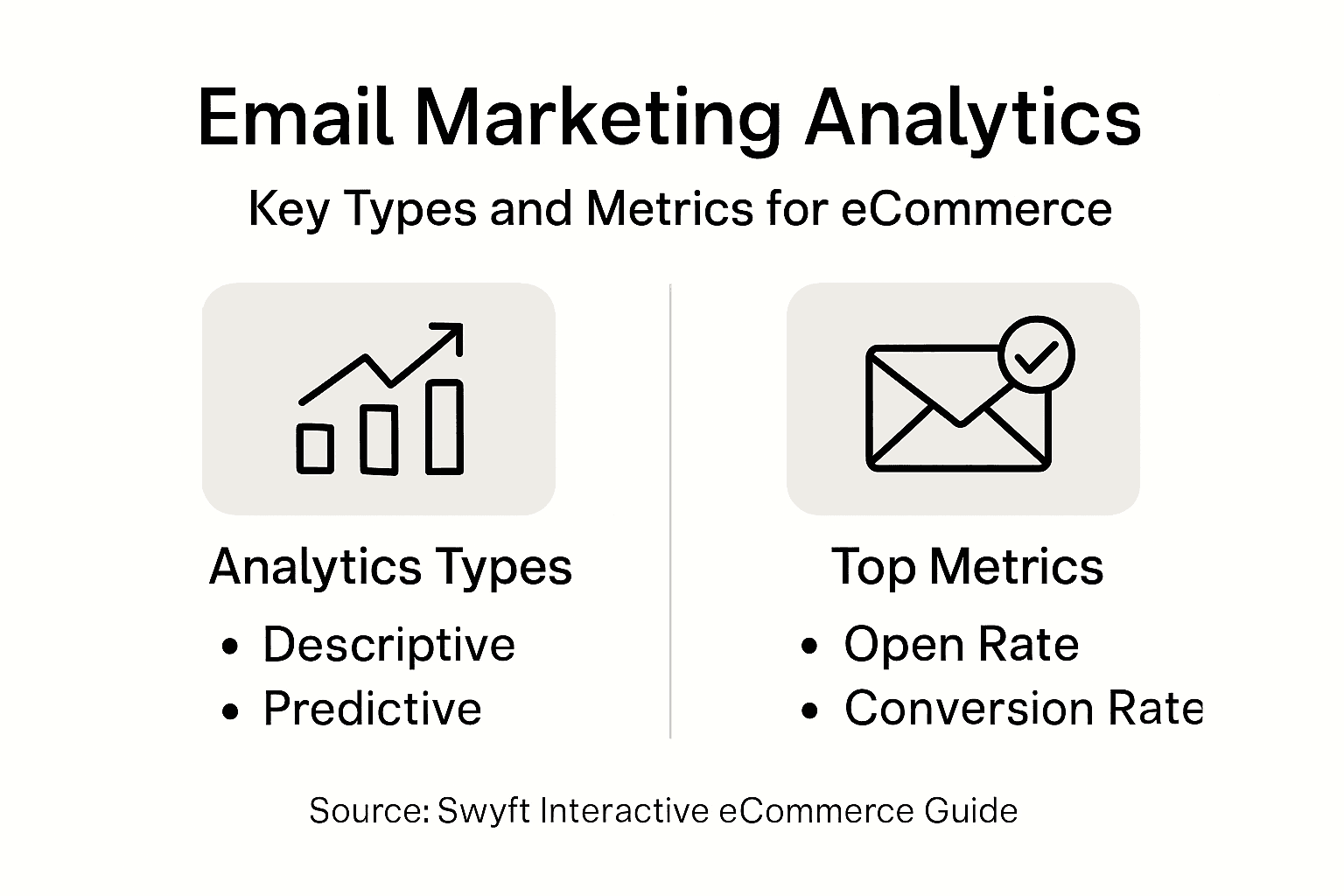
The primary types of data analytics in email marketing include descriptive, predictive, diagnostic, and prescriptive analytics. Descriptive analytics reveal what has already happened, like historical engagement trends. Predictive analytics forecast potential future outcomes, helping marketers anticipate customer actions. Diagnostic analytics identify why certain email campaigns performed better or worse, while prescriptive analytics recommend specific strategies to optimize future email marketing efforts.
Pro tip: Implement a consistent tracking system that captures granular email engagement data across all campaigns to build a comprehensive understanding of your audience’s evolving preferences and behaviors.
Here’s a breakdown of the four types of data analytics in email marketing and how each shapes strategy:
| Analytics Type | Main Focus | Example in Email Marketing | Strategic Impact |
|---|---|---|---|
| Descriptive | Past performance trends | Average open rate last quarter | Understanding historical engagement |
| Predictive | Future outcome forecasting | Likelihood of a recipient converting | Anticipating customer actions |
| Diagnostic | Explaining campaign results | Low clicks on specific campaign | Pinpointing why a strategy failed |
| Prescriptive | Action recommendations | Suggestions for improved segmentation | Guiding next steps for improvement |
Types and Metrics Essential for eCommerce
Ecommerce marketing analytics encompass a comprehensive range of metrics that provide critical insights into digital sales performance and customer behavior. U.S. Census Bureau tracking reveals important e-commerce indicators that help brands understand their digital market positioning and growth potential. These metrics go beyond simple sales numbers, offering nuanced perspectives on customer interactions, marketing effectiveness, and overall business strategy.
The most crucial metrics for ecommerce brands can be categorized into several key performance indicators (KPIs). Conversion metrics track how many website visitors complete a purchase, while engagement metrics measure interactions like email open rates, click-through rates, and time spent on product pages. Financial indicators such as average order value, customer acquisition cost, and customer lifetime value provide deeper insights into revenue potential and marketing efficiency.
A comprehensive analytics approach requires tracking both quantitative and qualitative data. Tracking user engagement metrics like daily and monthly active users helps brands understand customer retention and interaction patterns. Brands should focus on metrics that reveal not just sales numbers, but the entire customer journey from initial contact through post-purchase behavior.
Pro tip: Create a centralized dashboard that integrates multiple data sources to provide a holistic view of your ecommerce performance, enabling real-time insights and rapid strategic adjustments.
Integrating Klaviyo Automation and Segmentation
Email marketing automation has transformed how ecommerce brands approach customer communication, with Klaviyo’s AI-powered segmentation tools providing unprecedented opportunities for personalized marketing strategies. These advanced technologies enable brands to move beyond generic email blasts, creating highly targeted campaigns that speak directly to specific customer segments based on behavior, purchase history, and predictive analytics.

The core of effective Klaviyo automation lies in sophisticated segmentation techniques. Dynamic segmentation allows marketers to create fluid customer groups that automatically update based on real-time interactions. For instance, segments can be built around criteria like recent purchases, engagement levels, cart abandonment history, or predicted lifetime value. This approach ensures that each customer receives communications precisely tailored to their current relationship with the brand.
Klaviyo’s API integration capabilities enable seamless connections with existing ecommerce platforms, creating a unified data ecosystem. This integration means marketers can synchronize customer data across multiple touchpoints, ensuring that segmentation strategies are built on comprehensive, up-to-date information. Automated workflows can trigger specific email sequences based on complex conditions, such as sending personalized product recommendations or re-engagement campaigns to customers who haven’t purchased in a specific timeframe.
Pro tip: Conduct monthly audits of your Klaviyo segments to ensure they remain dynamic and reflective of evolving customer behaviors, removing stale criteria and introducing new segmentation strategies based on emerging purchasing patterns.
Optimizing Campaigns With Analytical Insights
Data-driven campaign optimization represents the cornerstone of successful email marketing strategies, transforming raw metrics into actionable strategic insights. Marketers can leverage campaign dashboards to drive continuous improvement by systematically analyzing performance indicators and making precision-targeted adjustments to their communication approaches.
Successful optimization requires a multi-dimensional approach to analytics. Performance metrics like open rates, click-through rates, and conversion percentages provide foundational insights, but sophisticated marketers dig deeper. Advanced analysis involves understanding complex interactions between campaign elements, such as how subject line variations impact engagement, or how different customer segments respond to specific messaging strategies. This granular approach allows brands to develop increasingly refined targeting and communication techniques.
Pivot tables and time-series trend analysis enable marketers to uncover nuanced patterns in customer behavior that might otherwise remain hidden. By comparing current campaign performance against historical benchmarks, brands can identify emerging trends, predict potential outcomes, and proactively adjust their strategies. Key optimization techniques include conducting systematic A/B tests, implementing dynamic content personalization, and continuously refining audience segmentation to improve overall campaign effectiveness.
Pro tip: Create a standardized monthly analytics review process that includes comparing key performance metrics, documenting insights, and developing specific, actionable optimization strategies for your next email campaign iteration.
Common Pitfalls and Data Hygiene Challenges
Email marketing analytics demand rigorous attention to data quality, with numerous potential pitfalls that can compromise campaign effectiveness and strategic decision-making. Data professionals must navigate complex challenges involving inconsistent data collection, interpretation errors, and systemic biases that can dramatically skew analytical insights.
One of the most critical challenges involves maintaining data integrity. Incomplete or inaccurate customer records can lead to misguided segmentation strategies, ineffective personalization attempts, and wasted marketing resources. Common issues include duplicate entries, outdated contact information, inconsistent data formatting, and incomplete profile information. Ecommerce brands must implement robust data validation processes that continuously clean and update customer databases, ensuring that every marketing decision is built on accurate, current information.
Implementing effective data hygiene practices requires a multifaceted approach. This involves establishing clear data collection protocols, creating standardized data entry guidelines, and developing automated systems that can identify and rectify potential data quality issues. Marketers should focus on collecting only necessary information, regularly purging outdated data, and implementing strict access controls to prevent unauthorized modifications that could compromise analytical accuracy.
Pro tip: Conduct quarterly data audits that systematically review your customer database, removing duplicate entries, updating contact information, and validating the accuracy of segmentation criteria to maintain high-quality, actionable marketing data.
The following table highlights common data hygiene challenges and effective solutions for ecommerce email marketers:
| Challenge | Consequence | Recommended Solution | Long-term Benefit |
|---|---|---|---|
| Duplicate entries | Inaccurate segmentation | Regular database audits | Improved campaign accuracy |
| Outdated contact info | Higher bounce rates | Automated record updates | Better deliverability |
| Inconsistent formatting | Faulty analytics | Standardized data protocols | More reliable reporting |
| Incomplete profiles | Missed opportunities | Mandatory field validation | Richer personalization capabilities |
Unlock the Power of Data-Driven Email Marketing for Your eCommerce Growth
Are you struggling to turn complex email data into real revenue growth? This article highlights the challenge many ecommerce brands face: harnessing descriptive, predictive, and prescriptive analytics to optimize campaigns and boost customer engagement. Without an expert approach to email segmentation, automation, and data hygiene, brands risk missing out on valuable opportunities and actionable insights.
Email Marketing Archives – Swyft Interactive provides tailored solutions designed specifically to solve these pain points.
Partner with Swyft Interactive to transform your email marketing with powerful Klaviyo automation and integrated analytics that deliver measurable ROI. Don’t wait to improve your segmentation, automate personalized flows, and clean your data for maximum impact. Visit Swyft Interactive now to explore our proven strategies and case studies, and take the first step toward scaling your ecommerce brand with confidence. Discover more insights in our You Suck At Klaviyo Archives – Swyft Interactive and develop a winning Digital Strategy – Swyft Interactive that unlocks new revenue streams.
Frequently Asked Questions
What is data analytics in email marketing?
Data analytics in email marketing involves collecting, analyzing, and interpreting customer interaction data to optimize email campaigns and improve engagement. It transforms raw metrics into actionable insights for business growth.
What are the main types of data analytics used in email marketing?
The primary types of data analytics in email marketing include descriptive, predictive, diagnostic, and prescriptive analytics. Each type has a different focus, such as understanding past performance, forecasting future outcomes, diagnosing campaign effectiveness, and recommending strategies for improvement.
How can I improve my email marketing campaigns using analytics?
To improve email marketing campaigns, you can implement data-driven strategies such as tracking key performance indicators, conducting A/B tests, and utilizing segmentation based on customer behavior. Regularly analyzing campaign metrics allows for ongoing optimization and tailored messaging.
What are common data hygiene challenges in email marketing?
Common data hygiene challenges include duplicate entries, outdated contact information, inconsistent data formatting, and incomplete profiles. Addressing these issues is crucial for maintaining data integrity and maximizing the effectiveness of email campaigns.