

TL;DR:
- Scalable web solutions are essential for eCommerce growth, ensuring websites handle traffic spikes without failure. They are built on modular architecture, API-first design, and cloud-native infrastructure to support long-term success. Implementing scalability from the beginning protects revenue, improves customer experience, and reduces operational costs.
Scalable web solutions are systems built to maintain speed, reliability, and performance as your user base, data volume, and transaction load grow. The industry term for this is web scalability, and it sits at the center of every serious eCommerce growth strategy in 2026. Businesses that ignore it pay a measurable price. Sites that go down during traffic spikes can lose $775,000 in a single Black Friday event. Netflix and Zoom built their dominance on architectures that scale on demand. For eCommerce brands using Klaviyo automation, the same principle applies: your marketing engine is only as strong as the infrastructure running beneath it.
Why scalable web solutions are a strategic business priority
Web scalability is not a developer preference. It is a revenue decision. Scalability has evolved into a leadership imperative because it directly underpins customer trust, marketing performance, and market agility. When your site handles a surge in traffic without slowing down, customers complete purchases. When it buckles, they leave and rarely return.

Three architectural principles define a truly scalable web solution.
Modular architecture breaks your application into independent components that can be deployed, updated, or scaled without touching the rest of the system. Modular architectures isolate components for independent deployment, which means your checkout module can be reinforced during a flash sale without rebuilding your entire storefront.
API-first design exposes your core functionality through interfaces that work equally well across web, mobile, and third-party services. APIs enable swapping frontends or integrating tools like Klaviyo without touching your core system. That flexibility is what lets you add a loyalty program, a new payment gateway, or a personalization engine without a full rebuild.
Cloud-native infrastructure with autoscaling handles the unpredictable. Netflix spins up hundreds of servers for peak demand and scales back down overnight. Your eCommerce store can operate on the same principle using AWS, Google Cloud, or Azure autoscaling groups.
Horizontal, vertical, and diagonal scaling compared
| Scaling method | How it works | Best for | Trade-off |
|---|---|---|---|
| Horizontal | Add more servers in parallel | High-traffic eCommerce, SaaS | Requires load balancing setup |
| Vertical | Upgrade existing server capacity | Simpler apps, short-term fixes | Hard ceiling on growth |
| Diagonal | Combine both approaches | Enterprise and fast-growth brands | Higher upfront architecture cost |
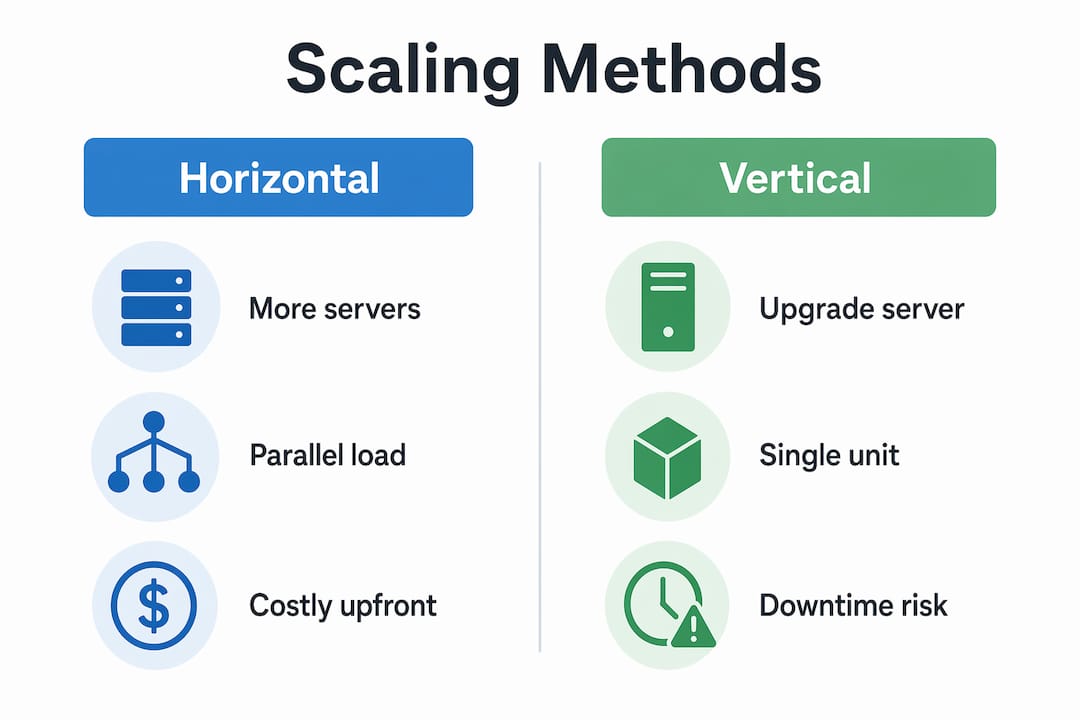
Pro Tip: Start with horizontal scaling from day one. It costs more to architect later than to build it right the first time.
What are the real business benefits of scalable web development?
The benefits of scalable web development show up directly in your revenue, your team’s productivity, and your customer retention numbers.
Businesses with scalable systems reduce engineer onboarding from 4 to 8 weeks down to 2 to 3 weeks, and they cut operational cost growth in half compared to non-scalable setups. That means your team ships faster and spends less time firefighting. For a growing eCommerce brand, that velocity is a direct competitive advantage.
On the customer side, the impact is equally clear. Non-scalable sites degrade user experience during traffic peaks, harming conversion rates and long-term brand trust. A slow or unavailable site during a product launch or seasonal sale does not just cost you that transaction. It costs you the customer’s lifetime value. Caching layers alone can reduce database load by 70%, which translates directly into faster page loads and higher conversion rates under pressure.
Here is what scalable web architecture delivers for eCommerce decision-makers:
- Consistent uptime during peak events like Black Friday, product drops, and email campaign sends
- Faster page load times that protect conversion rates and UX performance across all devices
- Lower operational cost growth as you scale, because the system handles 2x traffic without 4x infrastructure spend
- Marketing automation reliability so Klaviyo flows, abandoned cart sequences, and post-purchase emails fire on time, every time
- Faster feature deployment because modular systems let you add capabilities without breaking existing ones
- Reduced incident response time because well-architected systems are easier to monitor, debug, and fix
The connection between scalability and marketing automation is particularly important. When your site infrastructure is solid, your Klaviyo automation can do its job. Email flows that drive customers back to a slow or broken site produce no revenue. Infrastructure and marketing are not separate problems.
Common misconceptions about scalable web solutions
The most expensive misconception is that scalability is a technical concern to be handled after launch. Many business owners mistakenly delegate scalability entirely to developers, which means it gets deprioritized in favor of visual design and feature requests. By the time the site fails under load, the cost to fix the architecture is far higher than building it correctly from the start.
A second misconception is that a visually impressive site is a performant one. Visual-first site development makes content invisible to AI systems and search engines, which undermines both SEO and AI-driven discovery. Content-first architecture, which uses semantic HTML delivered server-side, is what makes your site indexable, citable, and findable. In 2026, with AI search tools like Perplexity and ChatGPT pulling citations from structured content, this distinction has direct revenue implications.
A third misconception is that scalability only matters at enterprise scale. That is wrong. A brand doing $500,000 a year in eCommerce revenue that runs a single successful email campaign to 50,000 subscribers will experience a traffic spike. If the site is not built to handle it, that campaign generates complaints instead of conversions.
Pro Tip: Before signing off on any web development project, ask your team three questions: How does this system handle 10x our current traffic? What happens to checkout if the product database slows down? Can we add a new integration without a full rebuild?
Watch for these warning signs that your current setup lacks scalability:
- Pages slow down noticeably during email campaign sends
- Your development team needs weeks to add a new feature or integration
- You have experienced downtime during a product launch or sale
- Your site was built as a monolithic application with no API layer
How to assess and implement scalable web solutions for your business
Evaluating your current infrastructure for scalability readiness starts with honest measurement, not assumptions.
-
Audit your current performance baseline. Use tools like Google PageSpeed Insights, GTmetrix, or Datadog to measure load times, server response times, and error rates under normal traffic. This gives you a factual starting point.
-
Identify your traffic ceiling. Review your analytics to find your highest-traffic day in the past 12 months. Then ask your development team what would happen at 3x that volume. Scale testing at 3x expected peak load is the industry standard for derisking high-stakes events like Black Friday.
-
Evaluate your architecture against the three pillars. Does your system use modular components? Is there an API layer? Is it hosted on a cloud platform with autoscaling enabled? If the answer to any of these is no, you have identified a priority.
-
Map your marketing automation dependencies. List every tool connected to your site, including Klaviyo, your analytics platform, your loyalty program, and your payment processor. Each integration is a potential failure point if the underlying architecture cannot support concurrent load.
-
Plan for eCommerce growth strategies before you need them. The brands that scale fastest are the ones that built the infrastructure before the demand arrived, not after.
| Factor | What to evaluate | Why it matters |
|---|---|---|
| Hosting infrastructure | Cloud vs. shared hosting, autoscaling availability | Determines your traffic ceiling |
| Architecture type | Monolithic vs. modular, API availability | Controls how fast you can add features |
| Caching setup | CDN, database caching layers | Directly impacts page speed and load handling |
| Integration flexibility | Number of active APIs, third-party tools | Affects marketing automation reliability |
| Scale testing history | Last load test date and volume tested | Reveals real-world readiness for peak events |
Key takeaways
Scalable web solutions are the infrastructure foundation that determines whether your eCommerce growth translates into revenue or into downtime, lost customers, and emergency development costs.
| Point | Details |
|---|---|
| Scalability is a revenue decision | Sites that fail under load lose customers and lifetime value, not just single transactions. |
| Three pillars define scalability | Modular architecture, API-first design, and cloud-native infrastructure are non-negotiable for growth. |
| Build before you need it | Retrofitting scalability after launch costs significantly more than architecting it from day one. |
| Marketing automation depends on it | Klaviyo flows and email campaigns only drive revenue when the site infrastructure can handle the resulting traffic. |
| Scale test before peak events | Testing at 3x expected peak load is the standard for avoiding costly downtime during high-stakes launches. |
The uncomfortable truth about scalability that most agencies won’t tell you
I have worked with enough eCommerce brands to recognize a pattern. The conversation about scalability almost never happens at the start of a project. It happens after the first major failure, usually during a product launch or a Black Friday campaign that the marketing team spent months preparing. The site goes down. The emails keep sending. Customers click through to a broken experience. Revenue that should have been captured is gone permanently.
What I have found is that scalability is treated as a technical afterthought because it is invisible when it works. Nobody celebrates the fact that the site stayed up during a 50,000-subscriber email send. But everyone remembers when it did not. The brands that win long-term are the ones whose leadership teams treat infrastructure decisions with the same seriousness they give to marketing spend and product development.
The other thing I have noticed is that the automation-driven eCommerce growth model only works when the underlying system is built to support it. You can have the best Klaviyo flows in your industry. If your site cannot handle the traffic those flows generate, you are paying for marketing that actively damages your brand. Scalability is not a cost. It is the multiplier on every other investment you make in growth.
— Leon
Build your eCommerce growth engine with Swyftinteractive
Swyftinteractive builds eCommerce websites and marketing systems designed to grow with your business, not against it. Every site we develop is architected for performance under load, with Klaviyo automation integrated from the ground up so your marketing and infrastructure work as a single system. If you are ready to stop leaving revenue on the table during your highest-traffic moments, explore our eCommerce growth and automation services or review our Klaviyo eCommerce checklist to see exactly what a scalable, conversion-ready store looks like in practice.
FAQ
Why do scalable web solutions matter for eCommerce?
Scalable web solutions keep your site fast and available during traffic spikes from email campaigns, product launches, and seasonal sales. Sites that fail under load lose both the immediate transaction and the customer’s long-term trust.
What is the difference between horizontal and vertical scaling?
Horizontal scaling adds more servers to distribute load, while vertical scaling upgrades the capacity of a single server. Horizontal scaling is the preferred approach for eCommerce because it has no hard ceiling and handles unpredictable traffic surges more reliably.
Is scalability necessary for small eCommerce businesses?
Yes. Any business running email marketing campaigns to a substantial subscriber list will experience traffic spikes. A single successful Klaviyo campaign can send thousands of visitors to your site within minutes, which is enough to expose infrastructure weaknesses.
How does scalable architecture affect SEO and AI search visibility?
Content-first architecture using semantic HTML delivered server-side makes your content indexable by both traditional search engines and AI tools like Perplexity and ChatGPT. Visual-first builds that rely on client-side rendering can make your content invisible to these systems entirely.
When should a business invest in scalable web infrastructure?
Before launch, not after. Retrofitting scalability into an existing monolithic system costs significantly more in development time and risk than building modular, API-first architecture from the start.