

TL;DR:
- Optimizing eCommerce sites increases conversions and loyalty more effectively than just driving traffic.
- Continuous testing, speed improvements, and personalization are key methodologies for sustainable growth.
- Building system-driven optimization processes outperforms short-term campaign efforts for long-term success.
Most eCommerce brands believe the fastest path to more revenue is more traffic. Pour money into ads, watch the numbers climb, and wait for sales to follow. But here’s what the data actually shows: sending more visitors to an underperforming store doesn’t fix the store. It amplifies its weaknesses. Optimized eCommerce sites can see up to 25% higher conversion rates compared to stores focused purely on traffic acquisition. This guide breaks down why optimization beats traffic chasing every time, what the best teams actually do, and how you can build a system that turns your existing visitors into loyal, high-value customers.
Table of Contents
- The real reason optimization outpaces traffic gains
- Key methodologies: How pro teams drive store growth
- Conversion rate optimization: Fact vs. fiction
- How automation and email marketing supercharge your results
- Why most ecommerce stores get optimization wrong
- Turn your online store into a revenue engine
- Frequently asked questions
Key Takeaways
| Point | Details |
|---|---|
| Optimization beats traffic | Improving user journeys and conversion rates grows revenue more effectively than focusing only on traffic. |
| Methodologies matter | Expert techniques like funnel audits and A/B testing create long-term gains, not just quick wins. |
| Automation accelerates results | Personalized email marketing and automated workflows boost engagement, recovering lost sales and increasing retention. |
| Persistent systems win | Stores that treat optimization as an ongoing system outperform those that rely on one-time campaigns or surface-level tweaks. |
The real reason optimization outpaces traffic gains
More traffic sounds like a simple win. But if your product pages are slow, your checkout is confusing, or your messaging doesn’t match what visitors came for, more traffic just means more people leaving faster. That’s money out the door on ads for zero return.
The website optimization impact is clearest when you compare two stores with identical traffic. Store A spends $10,000 per month on paid ads and converts at 1.2%. Store B invests in optimization and converts at 2.4%. Store B just doubled its revenue without spending an extra dollar on acquisition. That’s the compounding power of optimization.
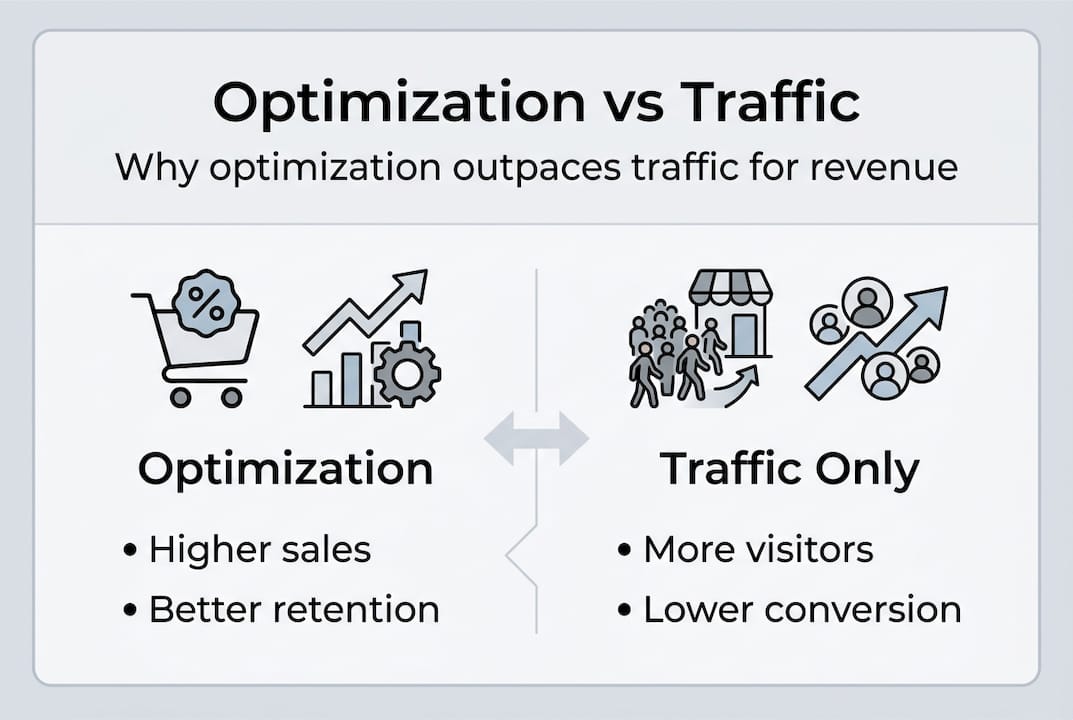
Here’s a side-by-side look at both approaches:
| Approach | Focus | Outcome |
|---|---|---|
| Traffic-focused | More visitors, higher ad spend | Diluted conversion rates, rising costs |
| Optimization-focused | Better experience, smarter flows | Higher conversions, lower cost per sale |
| Combined (ideal) | Qualified traffic + optimized store | Compounding revenue growth |
Optimized stores also build loyalty. When a customer has a smooth, fast, and relevant shopping experience, they come back. Repeat buyers cost far less to retain than new customers cost to acquire. That’s a business model, not just a tactic.
The key benefits of an optimization-first mindset include:
- Higher conversion rates from the same traffic volume
- Lower customer acquisition costs as repeat purchases increase
- Better data because optimized flows produce cleaner behavioral signals
- Stronger brand trust through consistent, frictionless experiences
One critical point worth calling out: CRO myths mislead brands into thinking traffic alone or guaranteed uplifts are realistic goals. They’re not. Real growth comes from treating your store as a system to be refined, not a funnel to be flooded. And site speed and revenue are directly linked, meaning a one-second delay in load time can significantly cut your conversions before a visitor even sees your offer.
Key methodologies: How pro teams drive store growth
Knowing optimization matters is one thing. Knowing how to do it is where most brands fall short. The best eCommerce teams use a repeatable set of methodologies, not guesswork.
Expert eCommerce teams rely on funnel audits, A/B testing for Revenue Per Visitor (RPV), site speed improvements, SEO architecture, and personalization to drive consistent store growth. Here’s what each one means in practice:

| Methodology | What it does | Why it matters |
|---|---|---|
| Funnel audits | Maps where visitors drop off | Reveals hidden revenue leaks |
| A/B testing (RPV) | Tests changes against real revenue | Prevents cosmetic wins that don’t convert |
| Core Web Vitals | Measures speed and stability | Google ranks fast sites higher |
| SEO architecture | Structures pages for discoverability | Attracts relevant, high-intent traffic |
| Personalization | Tailors content to visitor behavior | Increases average order value |
Here’s how to implement these methodologies step by step:
- Run a funnel audit. Use analytics to find where visitors exit your site. Product pages? Cart? Checkout? Each drop-off point is a revenue opportunity.
- Set up A/B tests focused on RPV. Don’t just test for clicks. Test for actual revenue generated per visitor so you know what’s working financially.
- Fix your Core Web Vitals. Use Google’s PageSpeed Insights to identify speed issues. Even small improvements in load time can lift conversions measurably.
- Restructure your SEO architecture. Ensure your category and product pages target specific, high-intent keywords so the right people find you.
- Add personalization and upsell logic. Show relevant products based on browsing history and add post-purchase upsells to grow order values.
Pro Tip: When running A/B tests, always let them reach statistical significance before calling a winner. Ending tests early is one of the most common mistakes that leads to false conclusions and lost revenue.
You can use our ecommerce conversion optimization framework as a starting point, and cross-reference it with our ecommerce marketing checklist to make sure no growth lever is left untouched. For a broader view, our marketing strategies for growth covers the full picture.
Conversion rate optimization: Fact vs. fiction
Conversion rate optimization (CRO) is one of the most misunderstood disciplines in eCommerce. A lot of brands treat it like a design refresh or a one-time project. That’s not what CRO is.
Real CRO requires significant traffic volume, a systematic testing process, and time. It’s not about quick wins or surface-level changes. It’s a discipline built on data, patience, and iteration.
Here are the most common CRO myths, and what’s actually true:
- Myth: Changing button colors will lift conversions. Fact: Isolated cosmetic changes rarely move the needle without addressing the full user journey.
- Myth: Any test will produce a positive result. Fact: Most A/B tests fail to show a statistically significant improvement, and that’s useful data too.
- Myth: CRO is a one-time project. Fact: Sustainable gains come from ongoing testing cycles, not a single campaign.
- Myth: More features equal better conversions. Fact: Simplicity and clarity almost always outperform complexity in eCommerce UX.
“Optimization is not theater. It’s long-term systems over short campaigns.”
The brands that win with conversion rate optimization treat it as an ongoing operating system, not a quarterly initiative. They build testing calendars, document hypotheses, and review results rigorously. Over time, this compounds into real, lasting revenue growth.
Pro Tip: Before running any CRO test, document your hypothesis clearly. What do you expect to happen and why? This discipline forces sharper thinking and makes your results far more actionable. Check out these conversion tips for ecommerce to build your testing backlog.
How automation and email marketing supercharge your results
Your website optimization efforts don’t exist in a vacuum. The brands that extract the most value from their traffic combine on-site optimization with targeted automation and email marketing. These two systems work together to capture, nurture, and convert visitors at every stage.
Personalization and upsell through automation are critical to extracting full value from your website traffic. A visitor who doesn’t buy today isn’t lost. An automated email sequence can bring them back tomorrow.
The core benefits of email marketing automation for eCommerce include:
- Precise timing: Trigger messages based on real behavior, like cart abandonment or post-purchase activity
- Deep segmentation: Send different messages to first-time visitors, loyal buyers, and lapsed customers
- Personalized content: Recommend products based on browsing and purchase history
- Sales recovery: Automated cart abandonment flows recover revenue that would otherwise be lost
- Scalability: One well-built flow can run for months without manual intervention
Here’s how to set up revenue-generating email automations:
- Map your customer journey. Identify the key touchpoints: welcome, browse abandonment, cart abandonment, post-purchase, and win-back.
- Build flows for each stage. Use a platform like Klaviyo to create automated sequences triggered by specific actions.
- Write personalized copy. Generic emails get ignored. Reference what the customer viewed, bought, or left behind.
- Test subject lines and send times. Small improvements in open rates translate directly to more revenue.
- Analyze and refine regularly. Review flow performance monthly and update underperforming sequences.
Pro Tip: Automate your cart abandonment and post-purchase flows first. These two sequences consistently deliver the highest return on investment and are the fastest way to see a measurable revenue lift from email. Explore our email best practices to build flows that actually convert.
Why most ecommerce stores get optimization wrong
Here’s the uncomfortable truth we see repeatedly: most eCommerce brands are addicted to campaigns. A new product launch, a seasonal sale, a fresh ad creative. These feel productive because they’re visible and exciting. But they’re often a distraction from the deeper work.
When a brand runs a campaign on top of a broken funnel, they’re paying to expose more people to a bad experience. The design role in conversions matters enormously here. A store that looks polished but has a confusing checkout flow will always underperform a simpler store with a frictionless path to purchase.
The brands that consistently grow are the ones that treat optimization as infrastructure, not a side project. They build testing systems, review data weekly, and make incremental improvements that compound over quarters. As the evidence clearly shows, systems-driven optimization over campaigns is what produces sustainable results. The brands chasing short-term campaign wins are always starting over. The brands building optimization systems are always moving forward.
Turn your online store into a revenue engine
The strategies in this guide work. But applying them consistently, across your site, your email flows, and your customer journey, takes structure and expertise. That’s where having the right partner makes all the difference.
At Swyft Interactive, we help eCommerce brands implement exactly this kind of system-driven growth. From our website optimization checklist to full revenue growth strategies and hands-on conversion optimization service, we build the infrastructure that turns your store into a predictable revenue engine. If you’re ready to stop guessing and start growing, let’s talk.
Frequently asked questions
What does it mean to optimize an online store?
Optimizing an online store means improving usability, speed, and marketing systems so more visitors convert into buyers and return for repeat purchases.
Does optimization matter more than increasing site traffic?
Yes. Converting existing traffic is typically more cost-effective than acquiring new visitors, and traffic myths mislead brands into spending more without fixing the underlying experience.
What are the most effective optimization strategies?
Expert methodologies include funnel audits, A/B testing for revenue per visitor, page speed improvements, SEO architecture, and automated personalized email campaigns.
How do I measure the impact of optimization?
Track conversion rate, average order value, revenue per visitor, and customer lifetime value before and after any optimization effort to measure real impact.
How long does it take to see results from optimization?
Early conversion lifts can appear within weeks, but lasting revenue growth comes from system-driven optimization maintained consistently over months, not one-off campaigns.