

Most eCommerce brands treat the sale as the finish line. They celebrate the conversion, send a confirmation email, and move on to the next customer. This approach leaves massive revenue on the table. The post-purchase phase is where customer relationships deepen, loyalty forms, and repeat purchases happen. Strategic post-purchase campaigns can increase repeat purchase rates by 20-40% and generate 5-10x ROI. This guide explains what post-purchase campaigns are, how they work, and how to implement them effectively to transform one-time buyers into loyal customers who drive sustainable revenue growth.
Table of Contents
- Key takeaways
- What are post-purchase campaigns? Understanding their role and sequence
- Mechanics of post-purchase campaigns: triggers, segmentation, and personalization
- Why post-purchase campaigns matter: engagement, repeat purchases, and ROI
- Nuances and best practices: segment wisely, avoid over-emailing, and optimize for mobile
- Boost your eCommerce revenue with expert post-purchase automation
- Frequently asked questions about post-purchase campaigns
Key Takeaways
| Point | Details |
|---|---|
| Post purchase ROI | Post purchase campaigns can generate five to ten times ROI. |
| Sequence length | A typical post purchase sequence spans five emails over about ninety days including thank you shipping updates education review requests and cross selling. |
| Relationship focus | These campaigns aim to build relationships provide value and guide the next purchase to increase lifetime value and loyalty. |
| Triggers and personalization | Campaigns use triggers from purchase events and personalize content with order data while segmenting by product type. |
What are post-purchase campaigns? Understanding their role and sequence
Post-purchase campaigns are automated sequences of emails typically spanning 5 emails over 90 days including thank-you, shipping updates, education, review requests, and cross-selling. These strategic communications begin immediately after a customer completes their purchase and continue through the critical post-delivery period when engagement and satisfaction shape future buying decisions.
Unlike promotional emails that push for new sales, post-purchase campaigns focus on building relationships, providing value, and naturally guiding customers toward their next purchase. They transform the transactional moment into an ongoing conversation that increases lifetime value and strengthens brand loyalty.
Here’s how a typical post-purchase sequence unfolds:
-
Thank you email (immediately after purchase): Confirms the order, expresses genuine appreciation, and sets delivery expectations. This email reassures customers their transaction succeeded and builds initial trust.
-
Shipping notification (when order ships): Provides tracking information and estimated delivery date. This keeps customers informed and reduces anxiety about their purchase.
-
Product education (2-3 days after delivery): Shares tips for using the product, care instructions, or best practices. This email maximizes product satisfaction and reduces returns.
-
Review request (5-7 days after delivery): Asks for feedback and product reviews. Timing matters here because customers have used the product enough to form opinions but the experience remains fresh.
-
Cross-sell or replenishment (30-90 days after purchase): Recommends complementary products or reminds customers to reorder consumables. This email drives the next purchase naturally.
Each email serves a specific purpose in the customer journey. The thank you email builds trust. Shipping updates reduce support inquiries. Education emails increase product satisfaction. Review requests generate social proof. Cross-sells drive repeat revenue. Together, they create a seamless experience that feels helpful rather than pushy.
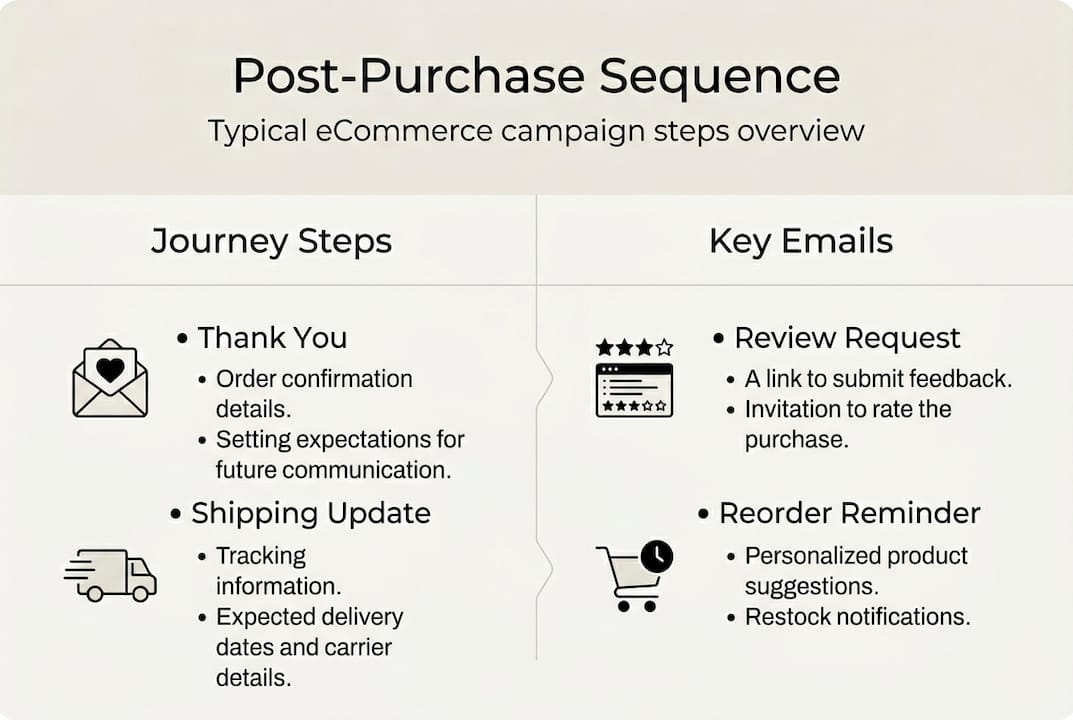
Implementing step by step email automation ensures these sequences trigger automatically based on customer behavior. You can explore proven email marketing strategies to see how successful brands structure their post-purchase flows.
Mechanics of post-purchase campaigns: triggers, segmentation, and personalization
The power of post-purchase campaigns comes from their automated, personalized approach. Mechanics include triggers based on purchase events, segmentation by product type, personalization via order data, and use of platforms like Shopify and Klaviyo. Understanding these mechanics helps you build campaigns that feel personal at scale.
Triggers activate your campaigns automatically. When a customer completes a purchase, that event triggers the first email immediately. When the order ships, another trigger fires the shipping notification. When delivery confirmation arrives, the education sequence begins. These automated triggers ensure timely, relevant communication without manual intervention.
Segmentation makes your campaigns relevant. Not all products require the same follow-up approach. Consumable products like skincare or supplements need replenishment reminders. Durable goods like furniture or electronics benefit from accessory recommendations. Segmenting customers by product category lets you tailor messaging appropriately.
| Product type | Campaign focus | Typical sequence length | Key email types |
|---|---|---|---|
| Consumables (skincare, supplements, food) | Replenishment reminders, usage tips | 60-90 days | Education, reorder prompts, loyalty offers |
| Durables (electronics, furniture, apparel) | Accessories, complementary products | 30-60 days | Care instructions, cross-sells, warranties |
Personalization increases engagement dramatically. Using order data, you can reference the specific product purchased, suggest items that pair well, and acknowledge the customer’s preferences. Dynamic content blocks adjust email content based on purchase history, creating unique experiences for each customer.
Integration with platforms enables sophisticated automation. Tools like Klaviyo connect with your Shopify store to access real-time order data, trigger emails based on fulfillment status, and track revenue attribution. This email marketing automation eliminates manual work while maintaining precision.
The advantages of Klaviyo automation include predictive analytics that identify high-value customers, dynamic segmentation that updates in real-time, and revenue tracking that proves campaign ROI. These capabilities transform basic email sequences into revenue-generating machines.
Pro Tip: Limit your post-purchase sequence to 7 emails maximum per customer within 90 days. More than this increases unsubscribe rates without proportional revenue gains. Quality and timing matter more than quantity.
Effective email segmentation goes beyond product type. Consider purchase frequency, average order value, and customer lifecycle stage when designing your flows. First-time buyers need different messaging than repeat customers.
Why post-purchase campaigns matter: engagement, repeat purchases, and ROI
The business case for post-purchase campaigns is compelling. Post-purchase emails see 2-3x higher open and click rates versus promotional emails and improve repeat purchases by 20-40%, with ROI 5-10:1. These numbers reflect fundamental customer psychology: people pay attention to emails about products they already bought.
Post-purchase emails outperform promotional campaigns across every metric. Open rates average 60-70% compared to 15-25% for promotional emails. Click rates reach 15-25% versus 2-5% for promotions. Conversion rates on cross-sell offers hit 8-12% compared to 1-3% for cold promotional emails. Customers trust brands more after a successful purchase, making them receptive to additional recommendations.
“Post-purchase campaigns represent the highest-leverage opportunity in email marketing. They reach customers when engagement peaks, trust is highest, and purchase intent remains strong. Brands that ignore this window leave 30-40% of potential revenue unrealized.”
Repeat purchase rates improve dramatically with strategic post-purchase communication. Customers who receive educational content are 35% more likely to buy again within 90 days. Those who engage with review requests show 42% higher lifetime value. Cross-sell emails generate immediate revenue while reinforcing brand presence.
Repeat customers convert at 60-70% compared to 1-3% for new visitors. This conversion rate difference makes retention far more profitable than acquisition. Post-purchase campaigns nurture these high-value relationships systematically.

Real-world results validate these strategies. Freshly Cosmetics implemented a comprehensive post-purchase campaign and increased revenue by 136% while clicks jumped 140%. Their sequence included personalized product recommendations based on skin type, educational content about ingredient benefits, and timely replenishment reminders. The campaign paid for itself within the first month.
The ROI on post-purchase email flows consistently ranges from 5:1 to 10:1. For every dollar spent on campaign setup, design, and automation, brands generate five to ten dollars in incremental revenue. This return comes from increased repeat purchases, higher average order values through cross-sells, and reduced customer acquisition costs as retention improves.
Explore email automation success examples to see how brands across industries leverage post-purchase campaigns. Review detailed case studies showing specific revenue impacts and implementation approaches.
Nuances and best practices: segment wisely, avoid over-emailing, and optimize for mobile
Successful post-purchase campaigns require attention to subtle details that separate good performance from exceptional results. Segmentation by product type, avoiding more than 7 emails to reduce unsubscribes, mobile-friendly design, and dynamic offers are critical success factors. These nuances determine whether customers engage enthusiastically or tune out your messages.
Segment consumables differently than durables. Consumable products require replenishment reminders timed to usage patterns. A 30-day supply of supplements needs a reorder email around day 25. Skincare products lasting 60 days benefit from reminders at day 50. Durable goods need accessory recommendations and care tips instead. A customer who bought a laptop wants case recommendations and software suggestions, not reminders to buy another laptop.
Email frequency makes or breaks campaigns. Sending more than 7 emails in your post-purchase sequence increases unsubscribe rates without improving revenue. Customers appreciate helpful communication but resent inbox clutter. Space emails strategically: immediate confirmation, shipping notification, post-delivery education, review request at 5-7 days, and cross-sell at 30-60 days. This cadence maintains presence without overwhelming.
| Best practice | Why it matters | Implementation tip |
|---|---|---|
| Limit to 7 emails max | Prevents unsubscribes | Space emails 3-7 days apart minimum |
| Mobile optimization | 65% of opens on mobile | Use single-column layouts, large buttons |
| Segment by product type | Increases relevance | Create separate flows for consumables vs durables |
| Dynamic personalization | Boosts click rates 40% | Reference specific products purchased |
| Time review requests properly | Maximizes response rates | Send 5-7 days post-delivery |
Mobile optimization is non-negotiable. Over 65% of email opens happen on mobile devices. Emails that don’t render properly on smartphones get deleted immediately. Use responsive templates with single-column layouts, large tap-friendly buttons, and concise copy that works on small screens. Test every email on multiple devices before launching.
Dynamic offers outperform static promotions. Instead of sending the same discount code to everyone, personalize offers based on purchase history and customer value. High-value customers might receive early access to new products. First-time buyers could get a loyalty program invitation. Recent purchasers see complementary product bundles. This personalization increases relevance and response rates.
Pro Tip: Time your review request emails for 5-7 days after delivery confirmation. Earlier requests catch customers before they’ve used the product enough to form opinions. Later requests risk the experience fading from memory. This window maximizes response rates and review quality.
Avoid common mistakes that undermine campaign performance. Don’t send generic emails that ignore purchase details. Never ask for reviews before customers receive their orders. Resist the temptation to include promotional offers in every email, which dilutes the helpful tone that makes post-purchase campaigns effective.
Implement a comprehensive marketing automation checklist to ensure your campaigns include all critical elements. Follow proven email marketing best practices to optimize performance across your entire email program.
Boost your eCommerce revenue with expert post-purchase automation
Building effective post-purchase campaigns requires strategic planning, technical expertise, and ongoing optimization. Professional automation services eliminate the trial-and-error phase, accelerating your path to measurable results.
Expert implementation ensures your campaigns integrate seamlessly with your eCommerce platform, segment customers intelligently, and deliver personalized experiences at scale. Rather than spending months learning automation platforms and testing different approaches, you can launch proven sequences that generate immediate ROI.
Comprehensive eCommerce growth strategy automation combines post-purchase campaigns with welcome series, browse abandonment, and cart recovery flows for complete customer journey coverage. This integrated approach maximizes lifetime value while reducing manual marketing work.
Detailed guides on email marketing automation provide frameworks for building campaigns that scale with your business. Platform-specific expertise in mastering Klaviyo unlocks advanced features like predictive analytics and dynamic content that increase revenue per email.
Partnering with specialists who understand eCommerce-specific challenges ensures your campaigns avoid common pitfalls while implementing advanced strategies that competitors overlook. The right support transforms post-purchase communication from an afterthought into your most profitable marketing channel.
Frequently asked questions about post-purchase campaigns
What is a post-purchase campaign?
A post-purchase campaign is an automated email sequence that begins immediately after a customer completes their purchase and continues through the post-delivery period. These campaigns typically include order confirmation, shipping updates, product education, review requests, and cross-sell offers designed to build loyalty and drive repeat purchases.
How many emails should a typical post-purchase sequence have?
A typical post-purchase sequence includes 5-7 emails spread over 30-90 days depending on product type. This includes immediate confirmation, shipping notification, post-delivery education, review request, and 1-3 cross-sell or replenishment emails. More than 7 emails increases unsubscribe rates without proportional revenue gains.
How does segmentation improve post-purchase campaign effectiveness?
Segmentation tailors messaging to product type and customer behavior, dramatically increasing relevance and response rates. Consumable products get replenishment reminders while durable goods receive accessory recommendations. First-time buyers see different content than repeat customers. This personalization increases click rates by 40% and conversion rates by 25-35% compared to generic campaigns.
When is the best time to request product reviews?
The optimal time to request reviews is 5-7 days after delivery confirmation. This window ensures customers have used the product enough to form informed opinions while the experience remains fresh in their memory. Earlier requests catch customers before they can evaluate properly. Later requests risk the experience fading, reducing response rates.
What are common mistakes to avoid in post-purchase email marketing?
The most damaging mistakes include sending too many emails (over 7 in 90 days), using generic content that ignores purchase details, requesting reviews before delivery, and making every email promotional rather than helpful. Other pitfalls include poor mobile optimization, ignoring product type differences in segmentation, and failing to track revenue attribution to prove ROI.