

Focused tracking of eCommerce metrics can increase conversion rates by up to 30%, yet many brand managers struggle to identify which data points truly drive scalable revenue. Understanding how metric tracking connects to marketing automation effectiveness and customer journey optimization transforms raw numbers into actionable insights. This article explores essential eCommerce metrics, clarifies common misconceptions, and demonstrates proven frameworks for aligning data with automation strategies that accelerate profitable growth.
Table of Contents
- The Critical Role of eCommerce Metrics
- Key eCommerce Metrics and Their Business Impact
- Common Misconceptions About eCommerce Metrics
- A Framework for Aligning Metrics With Growth and Automation Goals
- Case Studies: Real World Benefits of Tracking eCommerce Metrics
- Applying Metric Tracking to Optimize Marketing Automation and Paid Ads
- Scale Your eCommerce Growth With Expert Automation & Design
- Frequently Asked Questions About Tracking eCommerce Metrics
Key Takeaways
| Point | Details |
|---|---|
| Metric tracking drives measurable outcomes | Brands implementing systematic tracking see conversion improvements between 15-30% across their sales funnels. |
| Segmentation clarifies priorities | Organizing metrics by acquisition, conversion, and retention stages reveals exactly where to focus automation and optimization efforts. |
| Direct revenue impact | Proper tracking reduces wasted ad spend by up to 25% while enabling personalized marketing campaigns that scale profitably. |
| Automation depends on data | Real-time metric integration powers effective email flows, paid ad adjustments, and customer journey personalization. |
The Critical Role of eCommerce Metrics
Metrics create the essential feedback loop connecting marketing activities to revenue outcomes. When you track the right data points systematically, you gain visibility into customer behavior patterns that reveal exactly where conversions stall and where opportunities hide. This visibility becomes the foundation for every automation decision you make.
Data-driven marketing strategies consistently outperform intuition-based approaches. Brands that implement metric-focused systems report conversion rate increases averaging 20% within the first quarter. These improvements stem from the ability to identify friction points in the customer journey and deploy targeted solutions through automated workflows.
Without clear metrics, you’re essentially navigating growth in the dark. You might run campaigns, send emails, and optimize product pages, but measuring their true impact remains guesswork. This uncertainty leads to inefficient budget allocation and missed scaling opportunities.
Automated, personalized marketing depends entirely on real-time metric data feeding into your systems. Your Klaviyo flows trigger based on specific behaviors. Your paid ads adjust targeting based on funnel performance. Your retention strategies respond to customer lifetime value indicators. None of this works without accurate, accessible metrics.
“Metric tracking isn’t just about collecting numbers. It’s about creating a responsive system where every marketing dollar works harder because you know exactly what drives results.”
The most successful eCommerce brands treat metrics as operational intelligence rather than retrospective reports. They build automation strategies that respond instantly to metric changes, creating competitive advantages through speed and precision. This approach transforms metrics from passive dashboards into active growth engines.
Key eCommerce Metrics and Their Business Impact
Understanding which metrics matter most helps you prioritize resources and automation investments effectively. Each metric reveals specific insights about customer behavior and revenue potential.
Cart abandonment rate stands as one of the most actionable metrics you can track. Average cart abandonment rates hover around 69.8%, representing massive revenue sitting just beyond reach. Implementing automated recovery sequences based on this metric can recapture 10-15% of that lost revenue, often within 24 hours.

Customer Lifetime Value (CLV) indicates the total revenue you can expect from a customer relationship. This metric drives retention marketing decisions and helps you determine sustainable customer acquisition costs. Brands that actively optimize for CLV typically see repeat purchase rates increase by 25-40% through targeted automation.
Essential metrics every eCommerce brand must monitor:
- Conversion rate by traffic source revealing which channels deliver qualified buyers
- Average order value tracking basket size trends and upsell effectiveness
- Email engagement rates measuring open, click, and conversion performance
- Customer acquisition cost ensuring profitable scaling boundaries
- Return on ad spend quantifying paid campaign efficiency
Sales funnel drop-off points expose exactly where potential customers disengage. Analyzing these moments reveals technical issues, messaging problems, or friction that automation can address. One brand reduced checkout abandonment by 23% simply by identifying and fixing a mobile payment issue flagged through funnel metrics.
| Metric Category | Key Indicator | Typical Benchmark | Revenue Impact |
|---|---|---|---|
| Acquisition | Cost per acquisition | $10-50 | Determines scaling viability |
| Conversion | Cart conversion rate | 2-3% | Direct revenue generator |
| Retention | Repeat purchase rate | 25-30% | Long-term profitability |
| Engagement | Email click rate | 2-5% | Automation effectiveness |
Email campaign performance metrics deserve particular attention because they directly reflect your automation effectiveness. Open rates, click rates, and conversion rates from automated flows tell you whether your personalization strategies resonate. Brands optimizing these metrics see email revenue contribution increase from 15% to 30% of total sales.
Each metric connects to specific business decisions. Track them consistently, segment them meaningfully, and use them to guide both immediate optimizations and long-term strategy adjustments.
Common Misconceptions About eCommerce Metrics
Metric misinterpretation wastes resources and misdirects strategic focus. Understanding what metrics actually mean prevents costly mistakes in automation and optimization efforts.
Bounce rate often gets misread as a universal negative indicator. A high bounce rate on blog content might signal engaged readers finding exactly what they need and leaving satisfied. Context matters enormously. Product pages with high bounce rates merit concern, but informational content operates differently.
Focusing exclusively on traffic volume represents another frequent mistake. Driving 100,000 visitors who don’t convert costs more than attracting 10,000 qualified prospects who purchase. Traffic quality trumps quantity every time. Your metrics should prioritize conversion-ready audiences over vanity numbers.
Misconceptions that cost brands money:
- Assuming all website visitors have equal value regardless of source or behavior
- Treating email open rates as the primary success indicator while ignoring click and conversion metrics
- Believing higher ad spend automatically generates proportional revenue increases
- Focusing on single-session metrics while neglecting customer journey touchpoints
- Expecting immediate metric improvements without allowing time for automation optimization
Surface-level metrics deceive when viewed without deeper context. An improving conversion rate might mask declining average order values, resulting in flat or decreasing revenue. Similarly, rising email open rates mean little if click rates and purchases drop. You need holistic visibility across interconnected metrics.
Pro Tip: Segment every major metric by customer type, traffic source, and device. This reveals patterns invisible in aggregate data and helps you personalize automation more effectively.
Tracking email engagement properly requires understanding that opens measure curiosity, clicks measure interest, and purchases measure effectiveness. Optimizing for opens alone misses the revenue goal entirely. Focus your automation improvements on the metrics closest to actual transactions.
Proper metric interpretation requires comparing against your own historical performance rather than industry benchmarks alone. A 2% conversion rate might be excellent for high-ticket items but problematic for consumables. Context from your specific business model, audience, and market position matters more than generic standards.
Avoiding these misconceptions saves approximately 25% of marketing budget typically wasted on misguided optimizations. Spend time understanding what your metrics actually reveal about customer behavior and business health.
A Framework for Aligning Metrics With Growth and Automation Goals
Organizing metrics by funnel stage creates clarity about which numbers drive specific business outcomes. This framework connects measurement directly to actionable automation strategies.
Segment your metrics into three primary categories: acquisition, conversion, and retention. Each stage requires different measurement approaches and triggers distinct automation responses. Understanding engagement at each stage helps you allocate resources where they generate maximum return.
1. Acquisition Stage Metrics
Track cost per click, traffic source quality, and landing page engagement. These metrics reveal which channels deliver qualified prospects worth nurturing. Use this data to adjust paid ad targeting and content strategies.
2. Conversion Stage Metrics
Monitor cart abandonment rate, checkout completion rate, and conversion rate by segment. These numbers expose friction points where automation can recover sales. Deploy targeted email flows and retargeting campaigns based on specific abandonment behaviors.
3. Retention Stage Metrics
Measure repeat purchase rate, customer lifetime value, and engagement with post-purchase communications. This data drives loyalty program design and retention automation strategies.
| Funnel Stage | Primary Metrics | Automation Application | Expected Impact |
|---|---|---|---|
| Acquisition | Traffic quality, CPC | Audience refinement | 15-25% efficiency gain |
| Conversion | Cart abandonment, CR | Recovery flows | 10-20% revenue lift |
| Retention | CLV, repeat rate | Loyalty automation | 25-40% repeat increase |
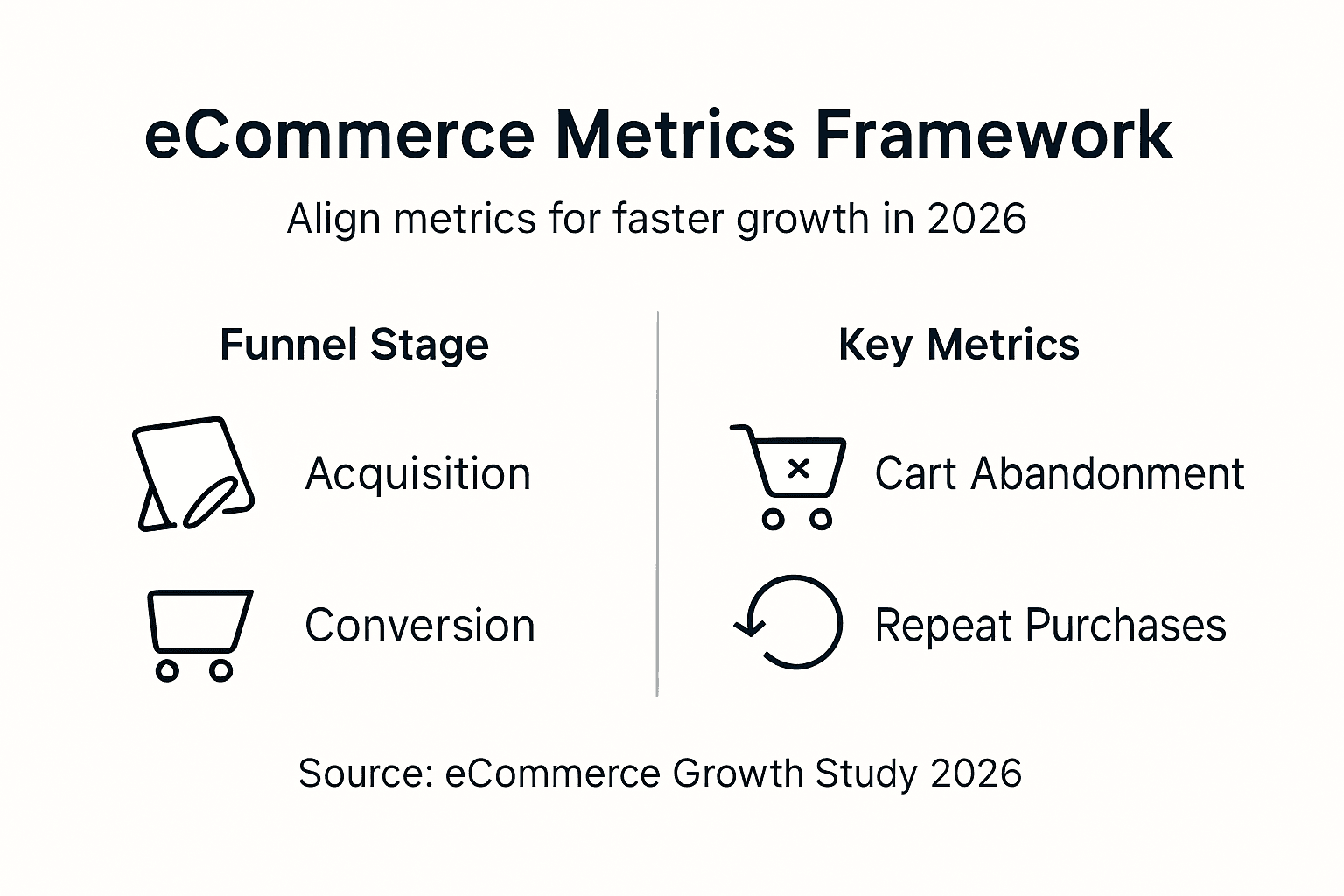
Align KPIs and automation triggers to respective funnel stages for focused action. An acquisition-stage prospect needs different messaging than a retention-stage customer. Your metrics should inform these distinctions and trigger appropriately personalized responses.
Prioritize metrics that directly enable scalable growth. Not every number deserves equal attention. Focus measurement and optimization efforts on the 3-5 metrics with the strongest correlation to revenue growth in your specific business model.
Integrate data across web analytics and email platforms for real-time actionable insights. Siloed metrics miss the connected customer journey. Creating a clear path to purchase requires visibility across all touchpoints where metrics reveal behavior patterns.
Pro Tip: Review your metric framework quarterly. As your business evolves, the metrics that matter most will shift. What drives growth at $500K annual revenue differs from what drives growth at $5M.
Structured metric alignment reduces decision-making complexity. Instead of drowning in dozens of data points, you focus on the specific numbers that inform your next strategic move. This clarity accelerates optimization cycles and improves resource allocation.
Case Studies: Real World Benefits of Tracking eCommerce Metrics
Concrete examples demonstrate how metric-focused strategies translate into measurable financial improvements. These outcomes validate the frameworks and approaches covered earlier.
One home goods brand implemented cart abandonment tracking and automated recovery sequences. Within 30 days, they recaptured $47,000 in otherwise lost revenue. The three-email sequence triggered by cart abandonment achieved a 12% conversion rate, proving that timely, metric-driven automation directly impacts the bottom line.
A fashion retailer focused on CLV tracking discovered their repeat customers generated 3.2x more revenue than one-time buyers. They restructured their entire email strategy around retention, creating personalized flows based on purchase history and browsing behavior. Six months later, repeat purchase rates increased by 34% while customer acquisition costs dropped 18%.
Documented improvements from metric-based optimization:
- Beauty brand reduced wasted ad spend by 28% by tracking funnel drop-off points and eliminating underperforming campaigns
- Electronics retailer increased average order value 19% through upsell automation triggered by basket composition metrics
- Supplement company improved email revenue contribution from 18% to 31% by optimizing send timing based on engagement data
- Home decor brand cut cart abandonment rate from 73% to 58% by addressing checkout friction identified through funnel analysis
These results share a common pattern. Each brand identified specific metrics revealing opportunity, implemented targeted automation responding to those metrics, and measured the financial impact systematically. The cycle of measurement, action, and validation created compound improvements over time.
Another compelling example involves a pet supply company that tracked customer segments by purchase frequency. They discovered customers buying within 45 days of their first purchase had 5x higher lifetime value. This insight drove a specialized 45-day nurture sequence that increased second-purchase conversions by 41%, fundamentally changing their retention economics.
The financial lift from metric tracking isn’t theoretical. Brands implementing systematic measurement and metric-driven automation consistently achieve 20-30% revenue increases within their first year. These improvements come from eliminating waste, capturing opportunities, and personalizing experiences based on actual behavior data rather than assumptions.
Applying Metric Tracking to Optimize Marketing Automation and Paid Ads
Translating metric insights into tactical improvements requires specific integration strategies for your automation platforms and advertising channels. Here’s how to make your data work harder.
Integrate real-time data into your email automation platform to personalize triggers effectively. When a customer abandons a cart, your system should know the exact products, their browsing history, and their previous purchase behavior. This context enables highly relevant recovery messages that convert at 3-4x higher rates than generic reminders.
Boosting Klaviyo ROI starts with feeding behavioral metrics into flow logic. Create conditional splits based on engagement metrics, purchase frequency, and customer lifetime value. High-value customers deserve different treatment than bargain hunters. Your automation should reflect these distinctions automatically.
Practical applications for metric-driven optimization:
- Adjust paid ad targeting based on which demographics and interests show the strongest conversion rates rather than just click rates
- Modify email send times by analyzing open rate patterns across customer segments
- Personalize product recommendations using browsing behavior and purchase history metrics
- Scale winning ad campaigns while eliminating underperformers identified through ROAS tracking
- Trigger win-back campaigns when engagement metrics indicate declining customer interest
Use segmentation strategies informed by behavioral and transactional metrics to refine email flows. A customer who browses but never purchases needs education. A customer who purchases once but doesn’t return needs reactivation. A loyal repeat customer deserves VIP treatment. Your metrics reveal which segment each contact belongs to, enabling appropriately tailored automation.
Paid ad optimization requires continuous metric monitoring and rapid adjustment. Track not just cost per click but cost per acquisition and return on ad spend by campaign, ad set, and creative. Pause underperformers quickly and scale winners aggressively. This responsive approach based on real-time metrics prevents budget waste.
Pro Tip: Set up automated alerts when key metrics fall outside acceptable ranges. If cart abandonment suddenly spikes or email engagement drops, you need to know immediately rather than discovering it in weekly reports.
Automate personalized retention strategies informed by customer lifetime value metrics. Your highest-value customers warrant exclusive offers, early access, and special attention. Identify them through CLV tracking and create automation that reinforces their loyalty while encouraging increased purchase frequency.
Continual metric analysis drives iterative improvements. Review campaign performance weekly, identify patterns, hypothesize improvements, test changes, and measure results. This cycle of optimization compounds over time, with each iteration building on insights from previous efforts. Brands that embrace this approach see sustained growth rather than temporary spikes.
Scale Your eCommerce Growth with Expert Automation & Design
Transforming metric insights into scalable revenue requires expertise in both strategy and execution. While tracking the right metrics provides direction, implementing sophisticated automation and conversion-optimized design demands specialized skills.
Swyft Interactive specializes in eCommerce growth strategies that integrate metric tracking with powerful automation systems. Our approach combines data analysis, Klaviyo email automation, and conversion-focused design to create measurable, sustainable growth for online brands.
We’ve helped dozens of eCommerce companies increase revenue 30-50% by implementing the exact frameworks covered in this article. Our Klaviyo automation services create sophisticated flows that respond to customer behavior in real time, capturing revenue opportunities competitors miss. Combined with design strategies that reduce friction and enhance conversions, we build complete growth engines tailored to your specific business model.
Whether you need help identifying which metrics matter most for your brand, implementing automation that actually drives results, or designing experiences that convert traffic into customers, we bring proven expertise to every project. Visit Swyft Interactive to explore how we can help you unlock your eCommerce growth potential through systematic, metric-driven strategies.
Frequently Asked Questions About Tracking eCommerce Metrics
What is the most important eCommerce metric to track?
Conversion rate by traffic source provides the clearest insight into which marketing efforts actually generate revenue. While other metrics matter, understanding what percentage of visitors from each channel become customers reveals where to focus resources for profitable scaling.
How often should I review my eCommerce metrics?
Review critical metrics like conversion rate, cart abandonment, and ROAS weekly to catch issues quickly and capitalize on opportunities. Conduct deeper analysis of trends, segmentation, and customer lifetime value monthly to inform strategic adjustments.
Can tracking metrics really improve marketing automation?
Absolutely. Marketing automation effectiveness depends entirely on accurate behavioral data triggering appropriate responses. Brands that integrate real-time metrics into their automation platforms see 25-40% higher engagement and conversion rates compared to generic, non-personalized campaigns.
What tools integrate best for real-time eCommerce metric tracking?
Google Analytics 4 combined with your eCommerce platform’s native analytics and Klaviyo for email metrics creates comprehensive visibility. Ensure these systems share data through proper integration so customer behavior tracked in one platform informs actions in another for true omnichannel personalization.