

Ecommerce brand managers face unprecedented challenges in 2026. Customer acquisition costs have surged 222% since 2013, yet 68% of marketing leaders distrust their attribution data. The pressure to prove ROI while scaling profitably has never been more intense. This guide reveals how modern analytics frameworks transform fragmented data into actionable growth strategies, empowering you to enhance customer engagement, optimize marketing spend, and drive sustainable revenue growth through proven, data-driven approaches.
Table of Contents
- The Challenges Of Marketing Analytics In Ecommerce
- How Modern Analytics Frameworks Solve Ecommerce Data Challenges
- Leveraging Customer Segmentation And Predictive Insights For Growth
- E-Commerce Analytics 2.0: Predictive And Real-Time Decision Making
- Unlock Ecommerce Growth With Expert Analytics Solutions
- Frequently Asked Questions
Key takeaways
| Point | Details |
|---|---|
| Acquisition costs demand smarter analytics | Customer acquisition costs have grown 222% since 2013, making precise targeting and retention critical for profitability. |
| Trust gaps hinder decision-making | 68% of CMOs distrust marketing attribution data, and 73% say tools fail to connect spend to profitability. |
| Segmentation reveals revenue concentration | Champions represent 12% of customers but generate 40% of revenue, while At Risk customers carry 78% churn rates. |
| Predictive analytics enable proactive strategies | Real-time insights and forecasting drive personalized experiences, inventory optimization, and automated marketing workflows. |
| Unified data architectures build confidence | Three-layer frameworks with consistent KPIs eliminate fragmentation and empower teams with reliable business intelligence. |
The challenges of marketing analytics in ecommerce
Ecommerce marketers operate in a data paradox. You collect massive volumes of customer interactions, transactions, and engagement metrics, yet struggle to extract reliable insights that drive confident decisions. The fundamental problem isn’t data scarcity but data chaos.
68% of ecommerce CMOs report distrust in marketing attribution, and 73% say their tools fail to connect marketing spend to actual profitability. This trust deficit paralyzes strategic planning and budget allocation. You’re left guessing which channels truly drive growth and which merely appear successful due to flawed measurement.
The fragmentation problem runs deep. Most ecommerce operations rely on disconnected tools: Google Analytics for web traffic, Shopify for transactions, email platforms for campaign performance, and social media dashboards for engagement. Each system measures different metrics with inconsistent definitions. Your marketing team reports a 5% conversion rate while finance calculates 3.2%, creating confusion in strategy discussions.
Manual aggregation delays insights by days or weeks. By the time you compile reports from scattered sources, market conditions have shifted. Unclear KPIs create decision-making bottlenecks, as teams debate metric definitions instead of optimizing performance. A $100M retailer faced exactly this challenge, spending countless hours reconciling conflicting data rather than acting on opportunities.
Traditional analytics focus on activity metrics like page views, clicks, and impressions. These vanity metrics feel productive but don’t connect to business outcomes. You need to understand which customers drive lifetime value, which segments risk churning, and which marketing investments generate profitable returns. Understanding the role of analytics in ecommerce requires shifting from activity tracking to outcome measurement.
The cost of this confusion compounds daily:
- Marketing budgets allocated to underperforming channels based on incomplete attribution
- Retention opportunities missed because you can’t identify At Risk customers in time
- Personalization efforts failing due to fragmented customer profiles across systems
- Executive teams making strategic decisions with contradictory data presentations
“When every department uses different tools with inconsistent metrics, you lose the ability to speak a common business language. Analytics becomes a barrier to alignment rather than an enabler of growth.”
This dysfunction isn’t inevitable. Modern analytics architectures solve these challenges by unifying data sources, establishing consistent definitions, and delivering insights that connect directly to revenue outcomes. Learn more about the future of ecommerce analytics and how leading brands are overcoming these obstacles.
How modern analytics frameworks solve ecommerce data challenges
Advanced data architectures eliminate fragmentation through systematic engineering principles that prioritize clarity, speed, and reliability. These frameworks transform chaotic data sprawl into trustworthy business intelligence.

Dimensional modeling separates facts from dimensions, creating a structured foundation for analysis. Facts represent measurable events like purchases, clicks, or shipments. Dimensions provide context like customer demographics, product categories, or campaign sources. This separation enables analysts to slice data across any combination of attributes using straightforward SQL queries, empowering marketing teams to answer complex questions without technical bottlenecks.
The ELT (Extract, Load, Transform) approach loads raw data into modern warehouses before transformation. Unlike traditional ETL, this method preserves complete source data while leveraging powerful warehouse compute engines like Snowflake or BigQuery for transformations. You gain flexibility to reprocess historical data as business requirements evolve, without re-extracting from source systems.
A three-layer architecture protects data integrity while preparing business-ready datasets:
- Raw layer: Stores unmodified data exactly as received from source systems, preserving an audit trail and enabling reprocessing if transformation logic changes.
- Intermediate layer: Applies cleaning, deduplication, and standardization rules to create consistent foundational datasets that correct source system inconsistencies.
- Marts layer: Builds business-specific datasets optimized for analytics use cases like customer segmentation, product performance, or marketing attribution with pre-calculated metrics and aggregations.
This separation ensures that business logic errors in the marts layer never corrupt source data. Teams can experiment with new metrics and models confidently, knowing they can always rebuild from clean intermediate datasets.
| Architecture Component | Purpose | Business Impact |
|---|---|---|
| Dimensional modeling | Structured facts and dimensions | Fast, flexible SQL analysis |
| ELT processing | Raw data preservation | Historical reprocessing capability |
| Three-layer design | Separation of concerns | Data integrity and agility |
| Unified warehouse | Single source of truth | Consistent KPIs across teams |
Consistent KPIs emerge naturally from this unified data architecture. When every department queries the same customer dimension table and order fact table, conversion rate calculations align automatically. Marketing, finance, and operations speak a common language, eliminating hours of reconciliation meetings.
SQL and modern warehouse compute power democratize analytics. Marketing managers write simple queries to segment customers by behavior, test hypothesis about campaign performance, or forecast demand trends. You’re no longer dependent on overburdened data teams for routine insights.
Pro Tip: Start with a single business process like order fulfillment or email campaign performance. Build end-to-end pipelines for that domain before expanding. This focused approach delivers quick wins while establishing patterns you’ll replicate across other processes. Discover more about end-to-end ecommerce analytics implementation strategies.
Leveraging customer segmentation and predictive insights for growth
Customer segmentation transforms aggregate metrics into actionable strategies by revealing which groups drive profitability and which require intervention. Predictive models amplify this power, enabling proactive engagement before opportunities slip away.
The revenue concentration reality is stark. Champions comprise 12% of customers yet generate approximately 40% of revenue. These high-value buyers purchase frequently, spend significantly above average, and demonstrate strong brand loyalty. Losing even a small percentage of Champions devastates revenue. Your retention strategies must prioritize keeping this segment engaged through VIP programs, exclusive access, and personalized communication.
The At Risk segment represents your most urgent challenge. 135,000 high-value At Risk customers carry $330 million in revenue at stake, with a 78% churn rate. These previously engaged buyers have stopped purchasing despite high historical value. Predictive models identify them early through declining engagement signals like reduced email opens, abandoned browsing sessions, or increased time between purchases. Proactive win-back campaigns, special incentives, or personalized outreach can recover these relationships before they’re permanently lost.
Returning customers convert at 4x the rate of first-time buyers, making retention far more profitable than acquisition. Yet many brands allocate disproportionate budgets to attracting new customers while neglecting existing relationships. Segmentation exposes this imbalance, enabling smarter resource allocation.
| Segment | Customer Share | Revenue Contribution | Conversion Rate | Strategic Priority |
|---|---|---|---|---|
| Champions | 12% | 40% | Highest | Retention and VIP programs |
| At Risk | Variable | High | Declining | Proactive win-back campaigns |
| Returning | Variable | Substantial | 4x new customers | Re-engagement and loyalty |
| New | Variable | Lower per customer | Baseline | Efficient acquisition |
Predictive analytics identify customers needing attention to maximize average order value. Machine learning models analyze purchase history, browsing behavior, and engagement patterns to forecast which customers are likely to:
- Purchase within the next 30 days, enabling perfectly timed promotional outreach
- Respond to upsell offers based on complementary product affinities
- Churn without intervention, triggering automated retention workflows
- Become high-value Champions with nurturing, justifying premium service investments
Segmentation helps prioritize marketing resources between retention and acquisition. When Champions and At Risk customers together represent 60% of revenue, allocating 70-80% of retention budgets to these groups makes financial sense. New customer acquisition remains important but shouldn’t consume resources at the expense of existing customer relationships. Explore proven ecommerce retention strategies to maximize lifetime value.
Pro Tip: Create automated workflows that trigger based on segment transitions. When a Champion shows declining engagement and moves to At Risk status, immediately deploy personalized re-engagement campaigns. Speed matters because every day of inaction increases churn probability. Review detailed ecommerce customer segmentation data to benchmark your approach.
E-commerce analytics 2.0: predictive and real-time decision making
The analytics landscape is undergoing a fundamental transformation. E-Commerce Analytics 2.0 marks a shift from descriptive reporting to predictive and prescriptive intelligence that drives competitive advantage through speed and precision.
Traditional analytics told you what happened last week or last quarter. Analytics 2.0 tells you what will happen next month and recommends optimal actions. This evolution enables real-time decision making across marketing, inventory, and customer engagement, compressing decision cycles from weeks to minutes.
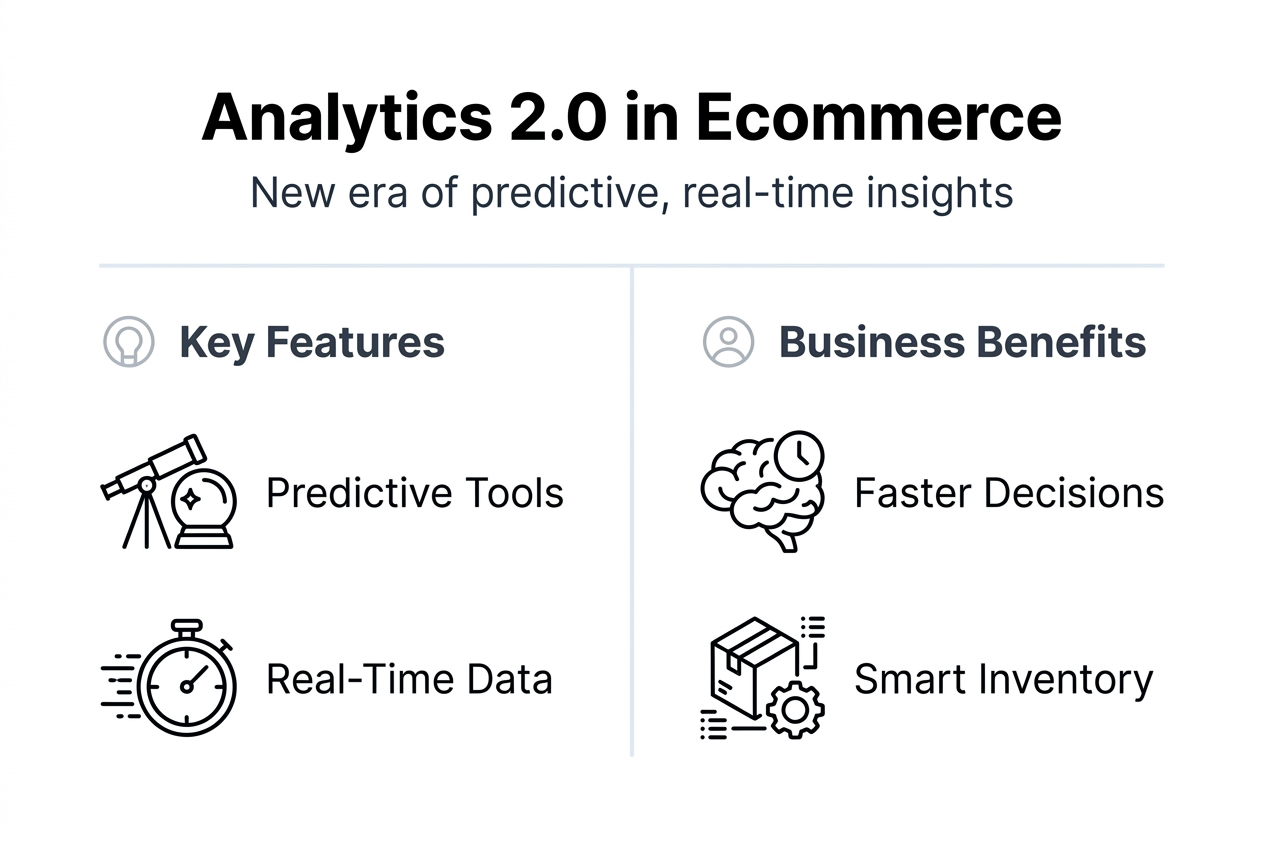
Predictive inventory management eliminates stockouts and overstock simultaneously. Machine learning models forecast demand at SKU level based on seasonality, promotion calendars, and customer segment behavior. You order precisely what you’ll sell, improving cash flow while maintaining product availability. This capability becomes critical as supply chain lead times extend and carrying costs rise.
Hyper-personalized customer experiences scale one-to-one marketing across thousands of customers. Real-time recommendation engines analyze current browsing session behavior, purchase history, and similar customer patterns to surface products each visitor is most likely to buy. Email campaigns dynamically adjust content, timing, and offers based on predictive models of individual customer preferences and purchase probability.
Automated marketing workflows execute without manual intervention. When a high-value customer abandons a cart, the system automatically determines optimal discount levels, send timing, and channel mix to maximize conversion while preserving margin. Data-driven marketing benefits compound as algorithms continuously learn and optimize.
Omnichannel analytics integrate data from web, mobile, social, email, and physical stores into a holistic 360-degree customer view. You understand complete customer journeys rather than fragmented touchpoint interactions. This visibility reveals how channels work together, enabling sophisticated attribution that credits assists appropriately rather than over-valuing last-click interactions.
Real-time operational intelligence accelerates response to emerging opportunities and threats:
- Flash sales performance monitoring enables mid-campaign adjustments to maximize revenue
- Social sentiment tracking identifies product issues or viral trends before they escalate
- Competitive price monitoring triggers dynamic repricing to maintain market position
- Supply chain disruption alerts enable proactive customer communication and alternative sourcing
The competitive advantage stems from agility. While competitors analyze last month’s results and plan next quarter’s initiatives, you’re optimizing in real time based on current conditions. Markets move fast in 2026, and delayed insights mean missed opportunities.
“The brands winning in 2026 don’t just collect data. They operationalize insights through automated systems that act faster than human decision cycles allow. Speed and precision together create sustainable competitive moats.”
Implementing Analytics 2.0 requires technical infrastructure, analytical talent, and organizational willingness to trust algorithmic recommendations. The investment pays dividends through improved margins, higher customer satisfaction, and accelerated growth rates. Learn how ecommerce analytics 2.0 frameworks can transform your retail intelligence.
Unlock ecommerce growth with expert analytics solutions
Building sophisticated analytics capabilities in-house demands specialized expertise, infrastructure investments, and months of development time. Most ecommerce brands lack the resources or technical depth to implement these frameworks independently. Swyft Interactive bridges this gap.
We specialize in driving ecommerce growth through analytics and automation that transforms how you understand and engage customers. Our tailored strategies increase retention, boost conversions, and accelerate revenue by implementing the exact frameworks outlined in this guide. We empower marketing teams with data-driven insights and proven techniques that deliver measurable results.
Our ecommerce growth strategy automation services handle the heavy lifting. We build unified data architectures, implement customer segmentation models, and deploy predictive analytics that identify high-value opportunities. You gain clarity and confidence without diverting internal resources from core business operations. Discover why data-driven marketing separates thriving ecommerce brands from struggling competitors, and follow our 7-step ecommerce marketing checklist to accelerate your success.
Frequently asked questions
What is the role of analytics in ecommerce growth?
Analytics transforms raw customer data into actionable insights that drive strategic decisions across marketing, retention, and product development. It identifies high-value customer segments, predicts churn risks, optimizes marketing spend allocation, and personalizes experiences at scale. Modern analytics connects marketing activities directly to revenue outcomes, enabling confident resource allocation and continuous optimization that compounds growth over time.
How can ecommerce brands trust their marketing analytics data?
Data unification across tools into a single warehouse with consistent definitions builds trust by eliminating contradictory reports. Implementing dimensional modeling and three-layer architectures ensures data integrity through clear audit trails and separation of concerns. Advanced attribution models that account for multi-touch journeys improve accuracy beyond last-click attribution, while regular validation against financial systems confirms analytics align with actual business results.
What customer segments should ecommerce marketers focus on?
Champions generate disproportionate revenue and require retention focus through VIP programs and exclusive engagement to maintain loyalty. At Risk customers represent urgent intervention opportunities since their 78% churn rate threatens substantial revenue. Returning customers show 4x higher conversion rates than new buyers, making re-engagement campaigns exceptionally profitable. Prioritize retention budgets toward these high-impact segments before allocating resources to new customer acquisition.
What are the benefits of adopting E-Commerce Analytics 2.0?
Predictive analytics improves forecasting accuracy for inventory, demand, and customer behavior, reducing stockouts and overstock simultaneously. Hyper-personalization boosts engagement and conversion by delivering individually relevant experiences across thousands of customers automatically. Real-time insights accelerate decision cycles from weeks to minutes, enabling proactive responses to opportunities and threats. This combination of speed, precision, and automation creates sustainable competitive advantages in fast-moving markets.