
TL;DR:
- Genuine personalized marketing uses behavioral, transactional, and engagement data to craft relevant messages.
- Effective personalization significantly increases engagement, conversion rates, and customer loyalty.
- Implementing ongoing automation, testing, and data analysis is essential for sustained success.
Most ecommerce brands think personalization means dropping a customer’s first name into a subject line. That’s not personalization. That’s mail merge. Real personalized marketing uses behavioral data, purchase history, and browsing patterns to deliver messages that feel individually crafted for each shopper. When done right, it transforms your store from a generic catalog into a responsive, relevant experience that keeps customers coming back. This article covers what personalized marketing actually is, how it works in practice, the measurable benefits it delivers, and the best tools and tactics to implement it effectively in your ecommerce operation.
Table of Contents
- What is personalized marketing? Core concepts explained
- How does personalized marketing work for ecommerce?
- Benefits of personalized marketing for ecommerce stores
- Best practices: Implementing personalized marketing with automation tools
- Our take: Why most ecommerce stores fail at personalization (and how to fix it)
- Take your ecommerce personalization to the next level
- Frequently asked questions
Key Takeaways
| Point | Details |
|---|---|
| Deep personalization boosts sales | Moving beyond basic tactics, true personalization can increase ecommerce conversion rates significantly. |
| Customer data drives results | Using behavioral and purchase insights is critical for crafting relevant, high-performing marketing campaigns. |
| Automation tools enable scaling | Platforms like Klaviyo make it easier to deliver 1:1 experiences to thousands of customers with less manual effort. |
| Continuous testing is crucial | Regularly reviewing and iterating on campaigns keeps your personalization strategies effective and relevant. |
What is personalized marketing? Core concepts explained
Personalized marketing means crafting messages, offers, and experiences that reflect what a specific customer actually wants, based on real data about their behavior and preferences. It goes far beyond a name in a subject line. It means showing a returning buyer a recommendation for products related to their last purchase, or sending a discount on the exact category they browsed three times without buying.
At its core, personalized marketing relies on four types of customer data:
- Behavioral data: Pages visited, products clicked, time spent browsing
- Transactional data: Purchase history, order frequency, average spend
- Preference data: Wishlist items, saved searches, category affinity
- Engagement data: Email open rates, click patterns, response to past offers
When you combine these signals, you get a detailed picture of each customer’s intent. That picture powers everything from personalized emails for ecommerce to on-site product recommendations and retargeting ads that show items a shopper actually considered.
“Personalization is not a feature. It’s a business strategy that aligns every customer touchpoint with individual intent.”
Personalized marketing also applies across channels. Your website can surface different homepage banners for first-time visitors versus loyal customers. Your paid retargeting can show dynamic ads featuring the exact product someone left in their cart. Your SMS campaigns can trigger based on in-store or app behavior.
The business case is strong. Personalized marketing increases engagement and conversion rates significantly for ecommerce brands. Customers respond to relevance. When a message matches their current need or interest, they act on it. When it doesn’t, they ignore it or unsubscribe.
The shift from broadcast to personalized marketing is not just a trend. It’s a fundamental change in how ecommerce brands build relationships with their audience. Brands that treat every customer the same are leaving revenue on the table.
How does personalized marketing work for ecommerce?
Personalized marketing follows a repeatable process. Here’s how ecommerce brands put it into action:
- Collect data: Pull behavioral, transactional, and engagement data from your store, email platform, and analytics tools.
- Segment your audience: Group customers by behavior, lifecycle stage, or purchase pattern. Examples: first-time buyers, cart abandoners, VIP customers, lapsed shoppers.
- Craft tailored messages: Write copy and design offers that speak directly to each segment’s context. A cart abandoner needs urgency. A VIP customer needs exclusivity.
- Automate delivery: Use a platform like Klaviyo to trigger messages at the right moment, whether that’s 30 minutes after cart abandonment or one week after a purchase.
- Measure and iterate: Track open rates, click-through rates, and revenue per email. Use email analytics for ROI to identify what’s working and what needs adjustment.
Here’s a quick look at how common personalized triggers perform compared to standard batch emails:
| Trigger type | Avg. open rate | Avg. conversion rate |
|---|---|---|
| Cart abandonment email | 41% | 5-8% |
| Browse abandonment email | 35% | 3-5% |
| Post-purchase follow-up | 38% | 4-6% |
| Generic promotional blast | 18% | 1-2% |
The gap is significant. Data-driven marketing consistently shows that using customer data to tailor messages results in higher ROI and customer satisfaction compared to one-size-fits-all campaigns.
Real-time data integration matters here. If your email platform doesn’t sync with your store in real time, you risk sending a “you left something behind” email to someone who already bought. That erodes trust fast. Tools like Klaviyo connect directly to Shopify personalization techniques and pull live data so your triggers fire accurately.
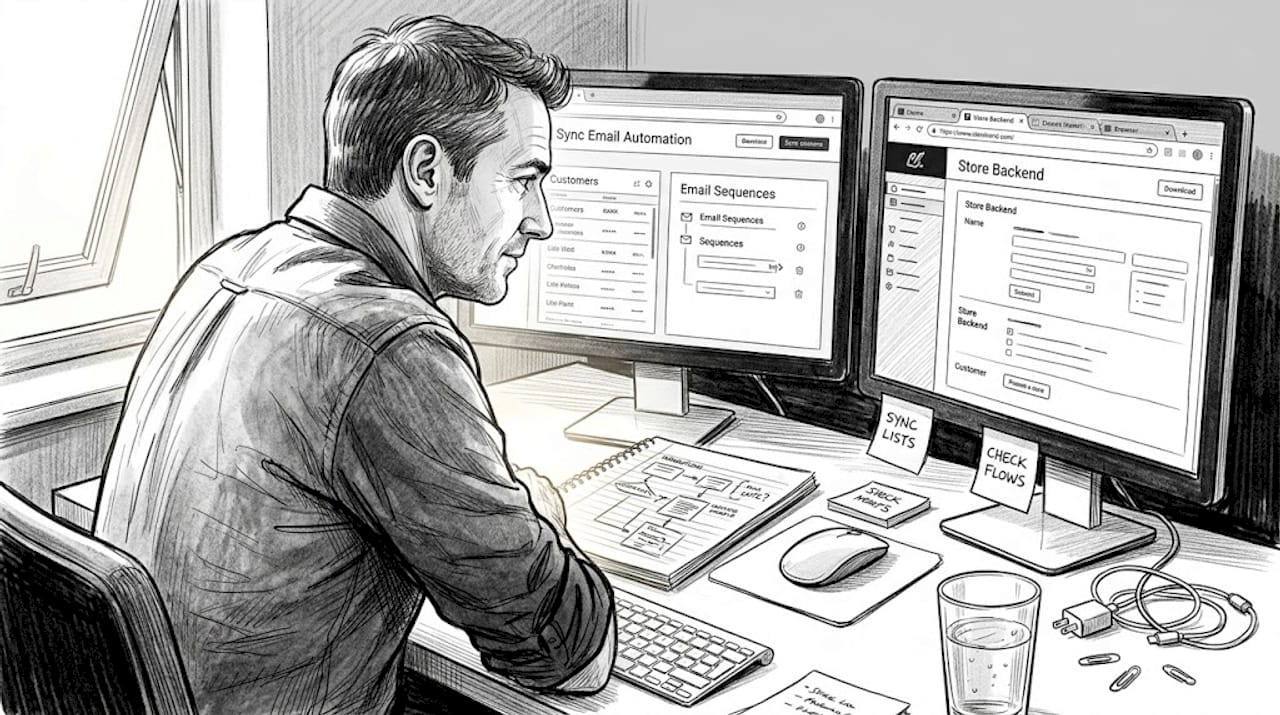
Pro Tip: Automate your foundational flows first, such as cart abandonment, welcome series, and post-purchase. Then schedule monthly reviews to check performance and run A/B tests on subject lines, send times, and offer types. Automation saves time, but iteration is what drives results.
Benefits of personalized marketing for ecommerce stores
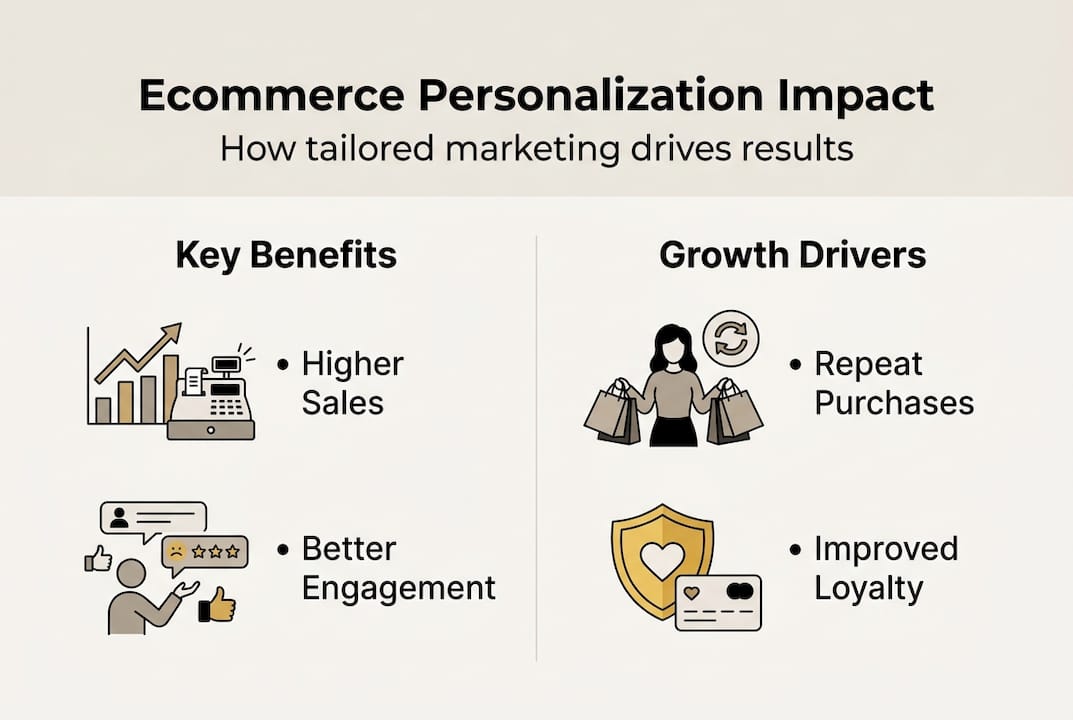
The numbers behind personalization are hard to ignore. Personalization can lift conversions by as much as 80% compared to generic marketing. That’s not a marginal improvement. That’s a fundamentally different revenue trajectory.
Here’s how generic and personalized email campaigns compare on key metrics:
| Metric | Generic email | Personalized email |
|---|---|---|
| Average open rate | 18-20% | 29-35% |
| Click-through rate | 2-3% | 5-8% |
| Conversion rate | 1-2% | 4-8% |
| Unsubscribe rate | 0.5-1% | 0.1-0.3% |
Beyond the inbox, the personalized email benefits extend across the entire customer relationship:
- Higher average order value: Personalized product recommendations encourage customers to add more to their cart.
- Stronger retention: Customers who feel understood return more often and stay loyal longer.
- Reduced churn: Targeted win-back campaigns re-engage lapsed customers before they’re gone for good.
- More referrals: Satisfied, engaged customers are far more likely to recommend your store to others.
- Lower acquisition costs: Retaining and upselling existing customers costs significantly less than acquiring new ones.
Salesforce research on personalization confirms that customers are more likely to make repeat purchases from brands that recognize them and offer relevant recommendations. The data is consistent: relevance drives revenue.
One often overlooked benefit is deliverability. When your emails are relevant, engagement rates go up. Higher engagement signals to inbox providers like Gmail that your emails are wanted, which improves your sender reputation and keeps you out of the spam folder. Generic blasts do the opposite.
Personalization also compounds over time. The more data you collect, the more precise your segmentation becomes, and the more effective your campaigns get. It’s a flywheel that rewards consistent effort.
Best practices: Implementing personalized marketing with automation tools
Knowing the benefits is one thing. Building the system is another. Here’s a practical process for launching personalized campaigns using automation tools like Klaviyo:
- Audit your data sources: Confirm your ecommerce platform, email tool, and analytics are connected and syncing correctly.
- Define your core segments: Start with high-impact groups: new subscribers, active buyers, cart abandoners, and customers who haven’t purchased in 90 days.
- Build your foundational flows: Welcome series, cart abandonment, browse abandonment, post-purchase, and win-back are the five flows every store needs.
- Personalize beyond the subject line: Use dynamic content blocks to change product images, offer copy, and CTAs based on each recipient’s segment or behavior.
- Set up performance tracking: Monitor revenue per recipient, not just open rates. That’s the metric that tells you if personalization is actually working.
Automation platforms like Klaviyo streamline personalization efforts for ecommerce brands by connecting store data directly to campaign logic. You can build flows that trigger based on specific product views, purchase frequency, or even predicted lifetime value.
Best practices to keep in mind as you scale:
- Test one variable at a time in A/B experiments so you know what actually moved the needle
- Review your segments quarterly to make sure they still reflect current customer behavior
- Comply with privacy regulations like CAN-SPAM and GDPR by honoring opt-outs and being transparent about data use
- Use personalized campaign examples from your industry to benchmark your approach
- Don’t over-automate. Some moments, like a high-value customer’s anniversary, deserve a human touch
For deeper guidance on building these flows, explore how to personalize email campaigns with step-by-step strategy. Also, Klaviyo personalization examples offer real-world inspiration for what’s working across ecommerce categories.
Pro Tip: Use Klaviyo’s dynamic content feature to swap out product recommendations, offer amounts, and even hero images based on each customer’s segment. A VIP buyer and a first-time visitor should see completely different emails, even if they’re in the same campaign.
Our take: Why most ecommerce stores fail at personalization (and how to fix it)
Here’s the uncomfortable truth: most ecommerce brands are running personalization theater. They set up a cart abandonment flow, add a first-name token to their welcome email, and call it done. Then they wonder why results plateau.
Real personalization requires ongoing attention. The “set and forget” approach is the single biggest mistake we see. Customer behavior changes. Seasonal patterns shift. A segment that responded well to urgency-based messaging in Q4 may need a completely different angle in Q1. If you’re not reviewing your flows every 30 to 60 days, you’re flying blind.
The brands that win at personalization treat it like a product, not a campaign. They test segments, follow the data, and make decisions based on what customers actually do, not what they assume customers want. They also focus on lifecycle triggers rather than promotional blasts, meeting customers at meaningful moments in the relationship.
The fix is simpler than most brands think. Start by auditing your existing personalized email strategies for relevance. Ask: does this message reflect where this customer actually is in their journey? If the answer is no, rebuild it.
Pro Tip: Schedule a quarterly personalization audit. Review your top five flows, check segment accuracy, and retire any message that no longer reflects your current customer data or brand voice.
Take your ecommerce personalization to the next level
Understanding personalized marketing is the first step. Building a system that runs it consistently and improves over time is where real growth happens.
At Swyft Interactive, we help ecommerce brands move from basic email blasts to fully automated, data-driven personalization engines. Whether you’re starting from scratch or optimizing an existing setup, our team specializes in Klaviyo strategy, segmentation, and flow development that drives measurable revenue. Explore the Klaviyo automation advantages we build for clients, walk through our step by step email automation process, or learn more about our Klaviyo services for ecommerce and see how we can build your personalization system.
Frequently asked questions
What is personalized marketing in ecommerce?
Personalized marketing in ecommerce means delivering tailored messages, offers, and experiences to customers based on their preferences, behaviors, and purchase history. It goes well beyond using a customer’s name and involves real-time data to match each message to individual intent.
How does personalized marketing improve ecommerce results?
It increases open and conversion rates by making customers feel recognized and valued, which motivates more purchases. Personalization can lift conversions by as much as 80% compared to generic campaigns.
What data is needed for effective personalized marketing?
Ecommerce brands typically use purchase history, browsing data, and email engagement to power personalized campaigns. Using customer data to tailor messages results in higher ROI and stronger customer satisfaction over time.
What tools can help automate personalized marketing?
Platforms like Klaviyo, combined with ecommerce analytics, allow brands to automate segmentation, messaging, and performance tracking. Automation platforms streamline ecommerce personalization by connecting live store data directly to campaign logic.
How can ecommerce stores start with personalization best practices?
Begin by segmenting your audience, automating basic campaigns like cart abandonment and welcome flows, and regularly testing and improving your approach. Ongoing optimization and testing are what separate high-performing personalization programs from stagnant ones.