

Global ecommerce reached $7 trillion in 2026, transforming how retail brands connect with customers and drive revenue. Many marketing managers believe AI is simply a cost-cutting tool, but this misconception misses its true power as a strategic revenue driver. The reality is far more exciting: AI and automation now fuel personalization, dynamic pricing, and operational excellence that directly impact your bottom line. This article explores the most impactful ecommerce trends shaping success in 2026, from inventory accuracy and fulfillment optimization to agentic commerce and composable architectures. You’ll discover how leading brands leverage these innovations to break through growth ceilings, reduce fraud losses, and create shopping experiences that convert at unprecedented rates.
Table of Contents
- Ecommerce Market Landscape And Operational Priorities In 2026
- The Transformative Impact Of AI And Automation On Ecommerce Growth
- Strategic Pricing And Channel Diversification For Optimized Revenue In 2026
- Explore How Swyft Interactive Drives Ecommerce Success In 2026
Key takeaways
| Point | Details |
|---|---|
| AI personalization drives conversions | Personalized shopping experiences powered by AI boost conversion rates by 65% and increase revenue by 35%. |
| Operational excellence unlocks growth | Inventory accuracy and seamless fulfillment prevent costly overselling and build customer trust for repeat purchases. |
| Dynamic pricing requires balance | Strategic pricing can raise revenue 12.3% but must be managed carefully to avoid 8.7% abandonment increases. |
| Channel diversification builds resilience | Multi-channel strategies and composable architectures protect against disruptions and enable agile technology integration. |
| AI fraud prevention saves billions | Automated fraud detection systems save retailers $3.7 billion annually while protecting profit margins. |
Ecommerce market landscape and operational priorities in 2026
The ecommerce industry has reached an inflection point where scale creates both opportunity and complexity. With global retail ecommerce hitting $7 trillion, brands face unprecedented challenges in managing inventory, fulfillment, and customer expectations across multiple channels. The sheer volume of transactions exposes operational weaknesses that were manageable at smaller scales but now threaten growth and profitability.
Inventory accuracy has emerged as a critical foundation for sustainable growth. Inaccurate inventory leads to overselling and cancellations, eroding customer trust and creating costly operational headaches. When your systems show products in stock but fulfillment centers can’t locate them, you’re not just losing a sale. You’re damaging relationships and forcing customers toward competitors. The brands winning in 2026 treat inventory data as a strategic asset, investing in real-time tracking systems that prevent these cascading failures.
Returns management has evolved from a necessary cost center into a strategic revenue lever. Smart brands recognize that a seamless returns experience drives repeat purchases and builds loyalty. The key operational priorities that separate growth leaders from laggards include:
- Real-time inventory synchronization across all sales channels to prevent stockouts and overselling
- Automated fulfillment workflows that reduce picking errors and accelerate shipping times
- Proactive returns processing that turns potential losses into opportunities for customer retention
- Data integration systems that provide instant visibility into order status and inventory levels
These operational fundamentals create the stable platform necessary for advanced growth strategies. When you eliminate the friction caused by poor fulfillment and inventory mishaps, you free up resources to focus on revenue-generating activities. Tracking ecommerce metrics becomes exponentially more valuable when your operational data is accurate and actionable.
Pro Tip: Audit your inventory accuracy weekly rather than monthly. The faster you catch discrepancies, the less damage they cause to customer satisfaction and revenue.
The transformative impact of AI and automation on ecommerce growth
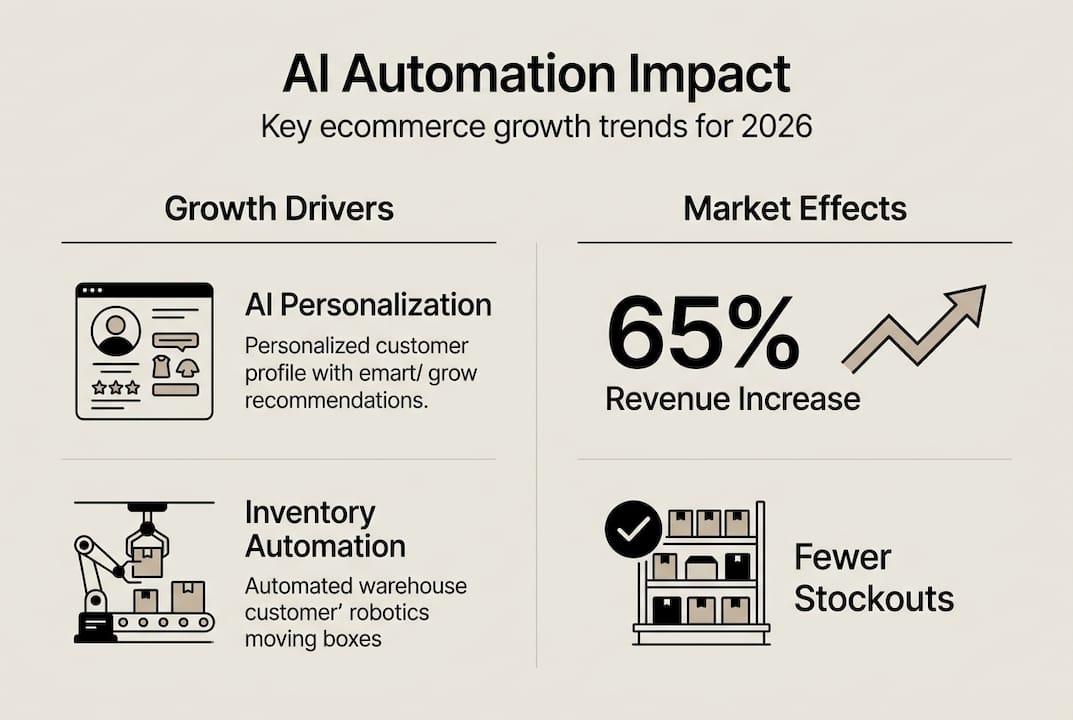
Artificial intelligence has moved beyond experimental status to become the primary driver of competitive advantage in ecommerce. The numbers tell a compelling story: AI-driven personalization and automation boost conversion rates by 65%, fundamentally changing how customers interact with online stores. This isn’t incremental improvement. It’s a complete reimagining of the shopping experience built on understanding individual preferences and behaviors at scale.

The AI market for ecommerce reached $8.65 billion, reducing stockouts 65% while cutting forecast errors by 20 to 50%. These improvements cascade through your entire operation. When you accurately predict demand, you optimize inventory levels, reduce carrying costs, and ensure products are available when customers want to buy. The financial impact extends far beyond avoiding stockouts, touching everything from warehouse efficiency to customer lifetime value.
Personalization powered by AI creates shopping experiences that feel custom-built for each visitor. AI-driven recommendations increase revenue by 35% by surfacing products customers actually want rather than generic bestsellers. The technology analyzes browsing patterns, purchase history, and contextual signals to predict intent with remarkable accuracy. This level of personalization in ecommerce transforms casual browsers into committed buyers.
Agentic AI represents the next evolution beyond basic automation. These systems don’t just respond to commands; they proactively identify opportunities and execute strategies. Imagine AI that notices a customer abandoned their cart, analyzes their browsing behavior, adjusts the email timing based on their engagement patterns, and personalizes the offer to match their price sensitivity. That’s agentic commerce in action.
Fraud detection powered by AI delivers fraud savings reaching $3.7 billion annually, protecting margins while maintaining smooth checkout experiences for legitimate customers. The systems learn from millions of transactions, identifying suspicious patterns humans would miss. Key applications of AI and automation that drive measurable growth include:
- Predictive analytics that optimize inventory allocation across fulfillment centers
- Dynamic content personalization that adapts product recommendations in real time
- Automated customer service that resolves common issues instantly while escalating complex problems
- Intelligent email marketing that determines optimal send times and content for each subscriber
The strategic advantage comes from viewing AI as more than an efficiency tool. When you leverage ecommerce automation to free your team from repetitive tasks, they can focus on creative strategy and customer relationships that machines can’t replicate.
Pro Tip: Start with one high-impact AI application like personalized product recommendations rather than trying to automate everything at once. Master the fundamentals before expanding.
Strategic pricing and channel diversification for optimized revenue in 2026
Dynamic pricing has become a double-edged sword that requires careful calibration. Research shows dynamic pricing raises revenue 12.3% but increases abandonment 8.7%, creating a delicate balance between maximizing transaction value and maintaining customer trust. The key lies in understanding price elasticity varies dramatically across product categories and customer segments.
Consumers have grown accustomed to price fluctuations in categories like travel and entertainment but react negatively when everyday products change prices too frequently. The winning strategy involves segmenting your catalog based on elasticity and adjusting pricing rhythms accordingly. Commodity items with high price sensitivity require stable pricing, while unique or time-sensitive products can support more aggressive dynamic strategies.
Channel diversification has shifted from optional to essential as brands face geopolitical uncertainties and technology fragmentation. Diversifying channels builds resilience against tariffs and platform changes that could otherwise devastate businesses dependent on a single sales channel. The brands thriving in 2026 maintain a balanced portfolio across owned websites, major marketplaces, social commerce, and emerging platforms.
Composable commerce architectures enable this multi-channel approach by allowing you to integrate best-of-breed technologies without massive platform migrations. Instead of being locked into a monolithic system, you can swap components as better solutions emerge. This agility becomes crucial when new AI tools or payment methods gain traction and you need to implement them quickly to stay competitive.
Implementing an effective pricing and channel strategy requires a structured approach:
- Analyze price elasticity across your product catalog to identify which items can support dynamic pricing
- Establish pricing guardrails that prevent customer alienation while capturing revenue opportunities
- Map your customer journey across all channels to identify gaps and redundancies
- Invest in unified commerce systems that synchronize inventory and customer data in real time
- Test new channels with limited product sets before committing significant resources
- Monitor channel performance metrics weekly to catch declining ROI before it becomes critical
The following table compares key considerations for different channel strategies:
| Channel Approach | Revenue Potential | Operational Complexity | Customer Control |
| — | — | — |
| Owned website only | Moderate | Low | High |
| Marketplace dominant | High | Moderate | Low |
| Balanced multi-channel | Highest | High | Moderate |
| Social commerce focus | Moderate | Moderate | Low |
Your ecommerce growth strategy must account for the reality that customers expect to find you wherever they shop. Meeting them across multiple touchpoints while maintaining consistent pricing and inventory data requires sophisticated systems and careful planning.
Pro Tip: Test pricing changes on a small product subset first and measure both conversion rate and customer feedback before rolling out broadly. The data will reveal optimal pricing frequencies for each category.
Explore how Swyft Interactive drives ecommerce success in 2026
Implementing the trends and strategies outlined in this article requires both technical expertise and strategic vision. Swyft Interactive specializes in translating cutting-edge ecommerce innovations into practical, revenue-generating systems for retail brands. Our approach combines high-converting website development with sophisticated email marketing automation, specifically leveraging Klaviyo to create personalized customer journeys that drive repeat purchases.

We’ve helped dozens of ecommerce brands break through growth plateaus by optimizing their website performance and implementing AI-powered personalization that converts browsers into buyers. Our 7-step ecommerce marketing checklist provides a proven framework for building scalable growth engines that leverage automation without sacrificing the human touch customers crave. When you partner with experts who understand both the technology and the strategy, you accelerate implementation and avoid costly mistakes that derail growth initiatives.
Frequently asked questions
What are the most impactful ecommerce trends in 2026?
AI-driven personalization and automation lead the pack, boosting conversion rates by 65% while reducing operational costs. Inventory accuracy and seamless fulfillment have become table stakes, as customers expect real-time visibility and flawless execution. Dynamic pricing strategies, when implemented thoughtfully, can raise revenue by over 12% without alienating customers.
How does AI improve ecommerce operations beyond marketing?
AI reduces stockouts by 65% and cuts forecast errors by 20 to 50% through predictive analytics that optimize inventory allocation. Fraud detection systems powered by AI save retailers $3.7 billion annually while maintaining smooth checkout experiences. These operational improvements free up capital and resources that can be redirected toward growth initiatives.
Should small ecommerce brands invest in dynamic pricing?
Start with category-specific testing rather than blanket dynamic pricing across your catalog. Products with low price sensitivity or unique value propositions support more aggressive pricing strategies, while commodity items require stable pricing to maintain trust. Monitor both revenue changes and cart abandonment rates to find the optimal balance for your customer base.
What does channel diversification mean for ecommerce brands?
Diversification means maintaining a balanced presence across owned websites, major marketplaces, social commerce platforms, and emerging channels. This approach protects against disruptions like algorithm changes, tariffs, or platform policy shifts that could devastate single-channel businesses. Unified commerce systems that synchronize inventory and customer data across channels are essential for executing this strategy effectively.
How can brands prepare for agentic AI in ecommerce?
Build strong data foundations now by ensuring your customer data, inventory systems, and marketing platforms integrate seamlessly. Agentic AI requires clean, accessible data to make proactive decisions on your behalf. Start with basic automation in email marketing and customer service, then gradually expand as you see results and build confidence in the technology.
Why is inventory accuracy suddenly a top priority?
At the scale ecommerce has reached in 2026, even small inventory discrepancies create massive problems. Overselling damages customer trust and creates expensive fulfillment nightmares, while understocking means lost revenue. Real-time inventory synchronization across all channels prevents these issues and enables the fast, reliable fulfillment customers now expect as a baseline.