

TL;DR:
- Modern website architecture is a modular framework using server-first rendering and domain-driven design to build fast, maintainable sites. Teams under eight developers benefit most from a modular monolith, avoiding unnecessary microservice costs until thresholds are met. Leveraging React Server Components and Islands Architecture, combined with performance budgets, enhances site speed and Core Web Vitals compliance.
Modern website architecture is defined as a composable, modular framework that combines server-first rendering, hybrid deployment patterns, and domain-driven design to build fast, maintainable websites. Understanding web architecture at this level matters because missed Core Web Vitals targets increase bounce rates by 20–35% and cut conversions by 15% per second of delay. The 2026 standards set clear thresholds: INP ≤ 200 ms, LCP ≤ 2.5 s, and CLS ≤ 0.1. These numbers are not aspirational. They are the baseline every architecture decision must protect. This article covers the patterns, rendering models, and best practices that make modern web design trends work in production.
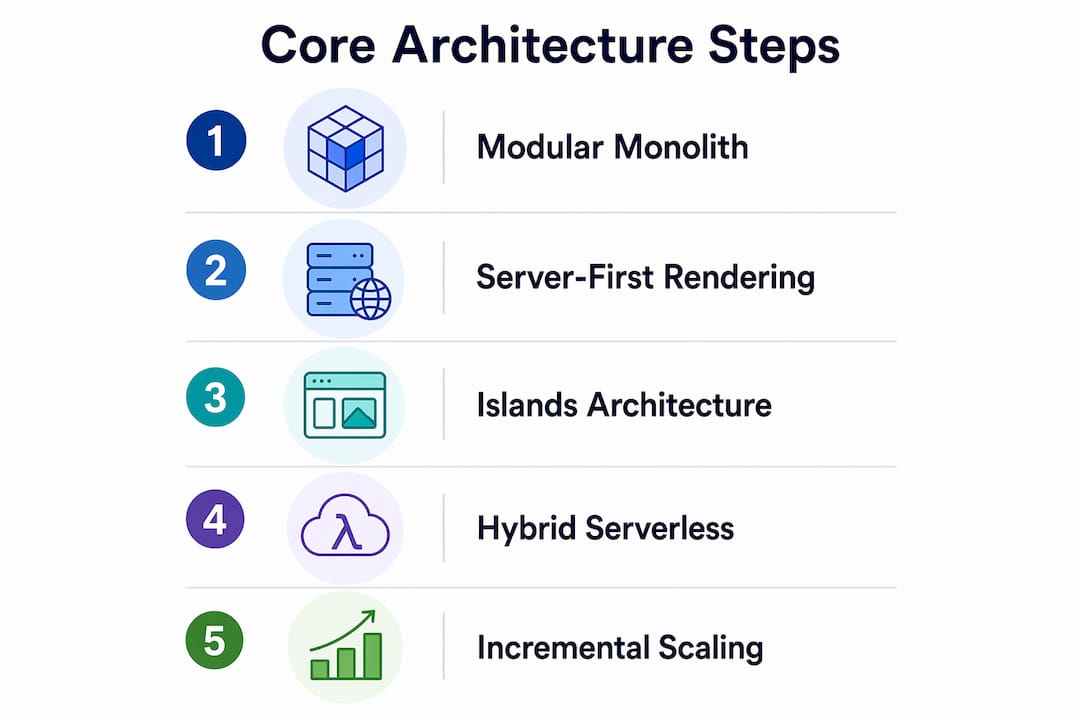
What are the key principles of modern website architecture?
The foundational pattern for most teams is the modular monolith: a single deployable unit where code is organized into clearly bounded domains. This approach keeps deployment simple while enforcing the separation of concerns that microservices promise but rarely deliver cheaply. Microservices are justified only when deployment time exceeds 15 minutes, a single module consumes 60% of resources, or the team grows beyond eight developers. Before those thresholds, microservices add cost without adding value.
The cost difference is concrete. Premature microservices adoption inflates infrastructure costs by 3–4x compared to a modular monolith. Early-stage teams save roughly $18,900 per year by staying with a modular monolith until the thresholds above are genuinely met. That money goes toward product development instead of DevOps overhead.
Three architectural patterns cover most real-world needs:
- Modular monolith. One deployable unit, multiple internal modules with strict domain boundaries. Best for teams under eight developers and products still finding product-market fit.
- Microservices. Independent services deployed separately. Justified only after hitting the deployment time, resource, or team-size thresholds above.
- Hybrid architecture. A monolith handles core transactional logic while serverless functions manage event-driven workloads. This is the most practical pattern for growing ecommerce and SaaS products.
Pro Tip: Before choosing microservices, map your deployment pipeline. If a single engineer can deploy the full app in under 15 minutes, you do not need microservices yet.
How does server-first rendering improve performance?
Server-first rendering is the practice of generating HTML on the server before sending it to the browser, reducing the amount of JavaScript the client must parse and execute. The difference between rendering models is significant in production. Client-side rendering (CSR) ships a near-empty HTML shell and relies on JavaScript to build the page. Server-side rendering (SSR) generates full HTML per request. Static site generation (SSG) pre-builds HTML at deploy time. Incremental static regeneration (ISR) rebuilds individual pages on a schedule. React Server Components (RSC) go further by running components entirely on the server and shipping zero JavaScript for those components to the client.

RSC is the most impactful shift in modern web design trends. React Server Components reduce client JavaScript by 40–70%, which directly improves INP and LCP scores. Smaller JavaScript bundles mean the browser reaches interactive state faster. That improvement shows up in Core Web Vitals measurements and in real user behavior.
| Rendering model | HTML delivery | JS sent to client | Best use case |
|---|---|---|---|
| CSR | Empty shell | Full app bundle | Highly interactive dashboards |
| SSR | Full HTML per request | Hydration bundle | Dynamic, personalized pages |
| SSG | Pre-built HTML | Minimal | Marketing pages, blogs |
| ISR | Pre-built, refreshed | Minimal | Product catalogs with periodic updates |
| RSC | Server-rendered components | Zero for server components | Content-heavy ecommerce pages |
Hydration costs cause INP failures when entire pages are hydrated regardless of whether the user interacts with every component. Islands Architecture solves this by isolating interactive components and hydrating only those elements. A product page might hydrate the cart button and image carousel while leaving the description and reviews as static HTML. The result is a dramatically smaller JavaScript execution budget and a faster time to interaction.
Pro Tip: Use Islands Architecture as your default mental model. Ask “does this component need to be interactive on the client?” before adding any hydration.
Modern browsers also support Speculation Rules and View Transitions APIs, which allow developers to declare navigation intent so the browser can prerender the next page before the user clicks. This produces near-zero LCP on subsequent page loads and a navigation experience that feels native rather than web-based.
What are best practices for modular, scalable web architecture in 2026?
Scalable website structure starts with enforcing domain boundaries inside your codebase before you ever think about splitting services. A distributed monolith, which is the worst outcome in web development best practices, occurs when teams split a codebase into services without mature DevOps, clear service contracts, or distributed tracing. Distributed monoliths cause cascading failures and negate every benefit microservices were supposed to provide. The fix is not more services. The fix is better boundaries.
Four practices prevent this outcome:
- API-first design. Define service contracts before writing implementation code. Every module communicates through a versioned API, not direct function calls across domain boundaries.
- Performance budgeting. Set explicit limits on JavaScript bundle size, third-party script weight, and hydration scope. Treat a budget breach as a build failure, not a suggestion.
- Bundle splitting. Load only the code each route needs. A checkout page should not carry the JavaScript for the account dashboard.
- Third-party script governance. Every analytics tag, chat widget, and pixel adds to your INP and LCP budget. Audit and defer all non-critical scripts.
The website optimization checklist for 2026 from Swyftinteractive covers these performance controls in detail for ecommerce contexts. Architecture decisions that ignore performance budgets create technical debt that compounds with every new feature.
Incremental scaling is the correct path. Start with a modular monolith. Extract a service only when a specific module hits the justified thresholds. This approach keeps the team focused on product value rather than infrastructure management. Systems thinking and graceful degradation planning ensures that when one component fails, the rest of the system continues to serve users. That resilience must be designed in from the start, not retrofitted later.
How do you apply hybrid architecture with serverless functions?
Hybrid architecture is the practical answer to a real tension: monoliths handle transactions reliably, but they are expensive to scale for bursty, event-driven workloads. Serverless functions reduce management overhead for tasks like notifications, webhooks, and file processing. The monolith stays responsible for the data that must be consistent. Serverless handles the work that can tolerate eventual consistency.
The most common hybrid use cases follow a clear pattern:
- Email and push notifications. A user places an order in the monolith. The monolith publishes an event. A serverless function picks up the event and sends the confirmation email. The monolith never waits for the email to send.
- Webhook processing. Payment providers, shipping carriers, and third-party APIs send webhooks. A serverless function receives, validates, and queues the payload. The monolith processes the queue on its own schedule.
- File processing. A user uploads a product image. A serverless function resizes, compresses, and stores the image in a CDN. The monolith records the final URL after the function completes.
- Scheduled jobs. Inventory sync, report generation, and cache warming run as serverless cron jobs. They consume no resources between runs.
The key constraint is transactionality. Any operation that requires a database transaction, such as charging a card or updating inventory, must stay inside the monolith. Serverless functions are stateless by design. Mixing transactional logic into serverless creates consistency problems that are difficult to debug and expensive to fix. Scalable web solutions that combine monolith reliability with serverless flexibility follow this boundary strictly.
The operational benefit is real. Serverless functions scale to zero between events, so you pay only for execution time. A notification service that sends 10,000 emails per day costs a fraction of a dedicated server running 24 hours to handle the same load.
Key Takeaways
Modern website architecture succeeds when teams match their architectural pattern to their actual scale, enforce domain boundaries before splitting services, and treat Core Web Vitals as non-negotiable constraints built into every design decision.
| Point | Details |
|---|---|
| Start with a modular monolith | Teams under eight developers build faster and cheaper with one deployable unit and clear domain boundaries. |
| Use server-first rendering | React Server Components cut client JavaScript by 40–70%, directly improving INP and LCP scores. |
| Apply Islands Architecture | Hydrate only interactive components to avoid INP failures caused by over-hydrating entire pages. |
| Defer serverless to specific workloads | Use serverless for notifications, webhooks, and file processing, not for transactional core logic. |
| Enforce performance budgets | Treat bundle size and hydration scope as build constraints, not suggestions, to protect Core Web Vitals. |
Architecture is a lifecycle, not a launch decision
The most expensive mistake I see developers make is treating architecture as a one-time choice made before the first line of code. Architecture is a living system. It should change as your team grows, your traffic patterns shift, and your product matures. The teams that get this right are the ones who revisit their architectural decisions on a regular cadence, not just when something breaks.
Premature microservices is the single most common trap. I have watched teams spend months building service meshes, distributed tracing, and CI/CD pipelines for a product with fewer than 1,000 daily active users. The infrastructure became the product. The actual user-facing features stalled. A modular monolith with clear domain boundaries would have shipped the same features in a third of the time.
Performance deserves the same lifecycle thinking. Overhydration is a hidden cost that accumulates silently. Every new React component added to a page without asking “does this need to run on the client?” adds to the hydration budget. Six months later, the INP score has drifted above 200 ms and no single change caused it. The fix requires auditing every component, which is far harder than getting the architecture right from the start. Adopt server-first rendering and Islands Architecture early. The checkout experience is where this matters most for ecommerce. A slow, over-hydrated checkout page costs real revenue.
The developers who build the best systems are not the ones who chose the most sophisticated architecture. They are the ones who chose the right architecture for their current scale and planned a clear path to the next level.
— Leon
How Swyftinteractive builds performance-first ecommerce websites
Swyftinteractive applies these exact architectural principles to ecommerce websites that need to convert, not just load. Every site Swyftinteractive builds targets Core Web Vitals compliance from the first sprint, with server-first rendering, controlled hydration, and performance budgets built into the development process. The result is a website that earns its traffic rather than losing it to slow load times and poor interaction scores.

For ecommerce brands ready to connect fast architecture with revenue growth, the ecommerce website checklist with Klaviyo automation from Swyftinteractive covers both the technical and marketing layers. It pairs website performance with email automation to build a full-funnel growth system. If website design driving conversions is the goal, architecture is where that work begins.
FAQ
What is modern website architecture?
Modern website architecture is a composable, modular framework that uses server-first rendering, domain-driven design, and hybrid deployment patterns to build fast, maintainable websites. It prioritizes Core Web Vitals compliance as a structural constraint, not an afterthought.
When should a team move from a monolith to microservices?
Microservices are justified when deployment time exceeds 15 minutes, a single module consumes 60% of system resources, or the team grows beyond eight developers. Before those thresholds, a modular monolith delivers better results at lower cost.
What is Islands Architecture in web development?
Islands Architecture isolates interactive components on a page and hydrates only those elements, leaving the rest as static HTML. This minimizes JavaScript execution and prevents the INP failures caused by hydrating entire pages unnecessarily.
How do React Server Components improve Core Web Vitals?
React Server Components run entirely on the server and ship zero JavaScript to the client for those components, reducing bundle size by 40–70%. Smaller bundles mean faster interaction readiness, which directly improves INP and LCP scores.
What workloads belong in serverless functions?
Serverless functions are best suited for event-driven, bursty workloads like email notifications, webhook processing, file resizing, and scheduled jobs. Transactional operations that require database consistency must stay inside the core monolith.