
TL;DR:
- Data-driven decision-making leverages both quantitative and qualitative data to enhance organization choices and outpace competitors. It boosts revenue, reduces uncertainty, and improves decision quality by focusing on accuracy, timeliness, relevance, and actionability. Effective implementation depends on clear ownership, decision triggers, governance, organizational culture, and robust data foundations for AI scaling.
Data-driven decision-making (DDDM) is defined as the practice of using quantitative and qualitative data to guide organizational choices, replacing intuition with evidence and increasing the precision of every business move. The role of data-driven decisions has never been more consequential: companies with real-time capabilities outperform competitors by more than 50% in revenue growth and net margins. Tools like Salesforce, platforms built on Klaviyo automation, and frameworks from MIT Sloan Management Review are reshaping how leaders at every level think, act, and measure success. This guide covers the benefits, the decision quality improvements, the real obstacles, and the practical strategies that separate organizations that talk about data from those that profit from it.
What benefits do data-driven decisions offer to businesses?
The most direct benefit of analytics-driven decision making is revenue growth tied to speed. Real-time decision capabilities allow employees and systems to act immediately within governance guardrails, compressing the gap between insight and outcome. That compression is where margin is made.
Beyond revenue, data-driven strategy reduces uncertainty across the entire operation. Salesforce research highlights two concrete examples: predictive churn detection identifies at-risk customers before they cancel, and inventory optimization cuts carrying costs by matching stock levels to actual demand signals. Both outcomes depend on replacing gut feel with quantified probability.
The operational benefits extend further when you break them down:
- Improved accuracy: Decisions grounded in historical and real-time data carry measurably lower error rates than those based on experience alone.
- Reduced risk: Quantitative models surface low-probability, high-impact scenarios that intuition routinely misses.
- Competitive differentiation: Organizations that act on data faster than rivals capture market share before competitors recognize the opportunity.
- Enhanced customer experience: Behavioral data enables personalization in retail that increases conversion rates and repeat purchase frequency.
- Operational efficiency: Real-time dashboards in supply chain, finance, and marketing eliminate redundant processes and surface bottlenecks before they become costly.
Pro Tip: Start measuring the time between when a metric changes and when a decision is made in response. That gap, not your data quality, is usually the first thing to fix.
How does data-driven decision-making improve decision quality?
Decision quality is not a single dimension. A 2025 academic study published through Atlantis Press found that business analytics improves firm performance indirectly by strengthening four specific qualities in every decision: accuracy, timeliness, relevance, and actionability. The indirect path matters. Analytics does not replace the decision. It upgrades the inputs that feed it.

The same research notes that analytics maturity moves managers away from gut-feel choices, but it also introduces new challenges around data ownership and organizational mindset. A team that has never been held accountable to data will resist the shift. That resistance is not a technology problem. It is a culture problem, and it requires deliberate leadership attention.
Success in analytics should be measured at the decision level, not at the model level. A highly accurate predictive model that no one acts on produces zero business value. The table below maps decision quality dimensions to what analytics actually delivers against each one.
| Decision quality dimension | What analytics delivers |
|---|---|
| Accuracy | Replaces assumption with measured probability, reducing decision error rates |
| Timeliness | Real-time data pipelines cut the lag between event occurrence and response |
| Relevance | Segmentation and filtering surface only the data that applies to the specific decision |
| Actionability | Prescriptive models recommend specific actions, not just observations |
The shift from descriptive analytics (what happened) to predictive (what will happen) to prescriptive (what to do) represents a maturity progression that most organizations are still climbing. Descriptive dashboards are table stakes in 2026. Prescriptive systems are where the performance gap widens between leaders and laggards.
What are the challenges and nuances in implementing data-driven decisions?
The most misunderstood challenge in data utilization in business is this: data does not eliminate judgment. It redistributes it. The LSE Business Review argues that better data shifts discretion to the framing, interpretation, and timing stages of a decision rather than removing subjectivity altogether. Leaders who expect data to make decisions for them will be disappointed. Leaders who redesign their decision processes around data will gain a structural advantage.
A second challenge is decision latency. Most organizations focus on reducing data latency, meaning how quickly data is collected and processed. But decision latency is the more damaging constraint. Organizational hierarchies, approval chains, and unclear ownership mean that even real-time data sits unused for hours or days. The insight expires before anyone acts on it.
The “good data, bad decisions” paradox is a real and documented failure mode. Practitioners warn that visible metrics without decision authority produce dashboards that inform but do not change behavior. The fix requires naming who owns each decision, what metric triggers action, and what the response protocol is.
Common implementation pitfalls include:
- No decision ownership: Metrics are tracked but no individual or team is accountable for acting on them.
- Governance gaps: Data access is inconsistent, leading to conflicting numbers and eroded trust in the system.
- Cultural resistance: Teams default to experience-based decisions when data contradicts their expectations.
- Missing decision triggers: Thresholds that should prompt action are never defined, so data is reviewed but not used.
- Ignoring decision provenance: Capturing only the data state and not the reasoning behind a decision makes auditing and learning from past choices unreliable.
Pro Tip: For every key metric on your dashboard, write one sentence that answers: “When this number crosses X, [name] will do Y within Z hours.” If you cannot write that sentence, the metric is decorative, not operational.
How do emerging AI and agentic systems impact data-driven decision-making?
Agentic AI systems, which autonomously execute multi-step workflows based on data inputs, represent the next frontier of analytics-driven decision making. McKinsey’s 2026 research found that many enterprises fail to scale agentic AI not because the models are inadequate, but because their data foundations are. Accessible, governable, and interoperable data is the prerequisite for any AI system that makes or influences decisions at scale.
The practical requirements for scaling AI-enabled decisions follow a clear sequence:
- Data architecture: Build pipelines that support real-time ingestion, transformation, and access across business units without creating siloed repositories.
- Interoperability: Systems must share data in standardized formats so that AI agents can coordinate across functions like marketing, inventory, and customer service simultaneously.
- Governance and accountability: Every automated decision needs a defined owner who can override, audit, or retrain the system when outputs drift from intended behavior.
- Human-AI collaboration: High-stakes decisions require human review at defined checkpoints. Full automation is appropriate for low-risk, high-frequency choices. Critical infrastructure decisions require more oversight.
- Lifecycle management: Models degrade as market conditions change. Continuous monitoring and retraining schedules are non-negotiable for sustained accuracy.
The NIST AI Risk Management Framework addresses the governance dimension directly. NIST’s guidance emphasizes that trustworthy AI in critical infrastructure requires full lifecycle risk management, not just pre-deployment testing. For business leaders, this means governance is not a compliance checkbox. It is the mechanism that keeps AI-enabled decisions aligned with organizational intent over time.
The role of analytics in ecommerce growth illustrates this well. Brands that connect behavioral data, purchase history, and email engagement signals into a unified architecture can deploy AI agents that personalize offers, trigger replenishment reminders, and adjust pricing in real time without manual intervention at each step.
What practical strategies can leaders use to build a data-driven organization?
Data-informed leadership starts with alignment, not technology. The most common mistake organizations make is purchasing analytics platforms before defining the decisions those platforms are meant to improve. Strategy precedes software. Every data initiative should map directly to a business outcome: reduce churn by X%, increase average order value by Y%, cut fulfillment errors by Z%.
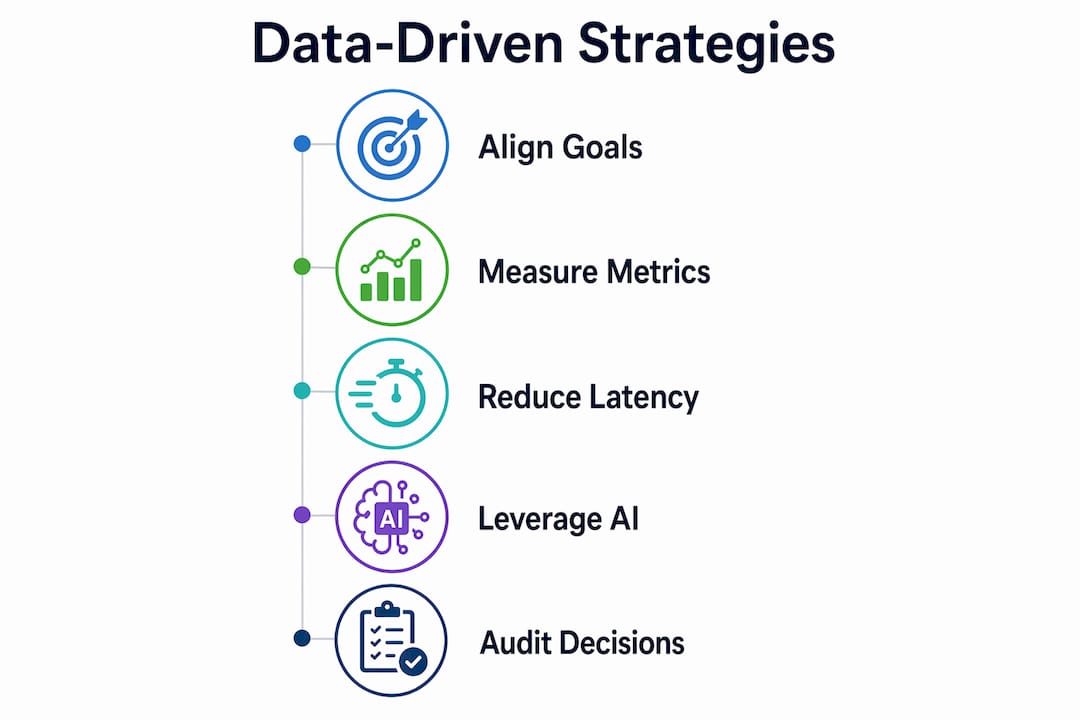
Building a data-centric culture requires distributing both access and accountability. Employees who can see relevant data but have no authority to act on it become frustrated observers. Those who have authority but no data act on instinct. The goal is to give the right people the right data with the clear mandate to use it. Data-driven marketing strategies in ecommerce demonstrate this principle: when merchandising teams own conversion data and email teams own engagement data, each group can optimize independently while contributing to shared revenue goals.
Practical strategies for sustaining data-driven decisions include:
- Define decision triggers: Set explicit thresholds that prompt specific actions, removing ambiguity from the response process.
- Assign decision ownership: Every metric on a dashboard should have a named owner responsible for acting on it.
- Capture decision context: Record not just what the data showed but why a particular action was chosen. This builds institutional memory and improves future decisions.
- Monitor decision outcomes: Track whether decisions produced the expected results and feed that learning back into the model or process.
- Reduce decision latency: Audit your approval chains and identify where insights stall. Real-time data processing loses its value entirely if organizational processes add days of delay before action.
- Integrate across functions: Connect marketing, sales, and operations data into a shared view so that decisions in one function do not create unintended consequences in another.
Pro Tip: Run a quarterly “decision audit.” Pick five significant decisions made in the last 90 days and ask: what data informed it, who owned it, how fast was it made, and what was the outcome? The pattern will tell you exactly where your process breaks down.
Key takeaways
Data-driven decision-making delivers measurable performance gains only when organizations pair quality data with clear decision ownership, defined triggers, and governance structures that keep judgment accountable at every stage.
| Point | Details |
|---|---|
| Revenue impact is real | Companies with real-time data capabilities achieve over 50% higher revenue growth than competitors. |
| Decision quality has four dimensions | Analytics improves accuracy, timeliness, relevance, and actionability, not just data volume. |
| Judgment is redistributed, not removed | Data shifts subjectivity to framing and interpretation, requiring leaders to redesign decision processes. |
| Decision latency is the hidden constraint | Organizational delays in acting on data often negate the value of real-time analytics investments. |
| AI requires data foundations first | Scaling agentic AI depends on accessible, governable data architecture, not model sophistication alone. |
Why data is only as powerful as the people who own it
The conversation around data-driven strategy tends to focus on tools, platforms, and models. After years of working with ecommerce brands on analytics and automation, I find that the technology is rarely the limiting factor. The limiting factor is almost always organizational. Who owns this number? What happens when it moves? Those two questions expose more about a company’s decision-making maturity than any dashboard ever will.
The LSE Business Review’s point about judgment redistribution resonates with me deeply. Leaders who adopt data expecting it to remove the burden of judgment are setting themselves up for disappointment. What data actually does is make judgment more visible and more accountable. That is a good thing, but it requires a different kind of leadership. You cannot hide behind “we didn’t know” when the data was right there. That accountability shift is uncomfortable for many organizations, and it is why cultural change is harder than technical implementation.
The brands I have seen succeed with data-informed leadership share one trait: they treat decision quality as a metric in itself. They ask not just “what does the data say?” but “did our last decision based on this data produce the outcome we expected?” That feedback loop, more than any AI model or analytics platform, is what separates organizations that learn from those that just report.
— Leon
How Swyftinteractive turns data into ecommerce revenue
Swyftinteractive builds ecommerce growth systems that connect data directly to action. From high-converting website architecture to Klaviyo email automation that responds to real customer behavior, every solution is designed around measurable outcomes, not vanity metrics. If your analytics are generating reports but not driving decisions, that is the gap Swyftinteractive closes. Explore the ecommerce growth strategy built around data-driven automation, or see how email marketing automation through Klaviyo turns behavioral signals into revenue at scale.
FAQ
What is data-driven decision-making?
Data-driven decision-making is the practice of using quantitative and qualitative data to guide organizational choices rather than relying on intuition. It improves decision accuracy, reduces risk, and enables faster responses to market changes.
Why does decision latency matter more than data latency?
Decision latency is the delay between receiving an insight and taking action. Even real-time data loses its value when organizational hierarchies or unclear ownership slow the response, making process design as critical as data infrastructure.
How does AI change the role of analytics in decision making?
AI-enabled systems automate high-frequency, low-risk decisions and surface prescriptive recommendations for complex ones. McKinsey’s research shows that scaling agentic AI depends on accessible, governable data foundations rather than model sophistication alone.
Does data eliminate the need for human judgment?
No. The LSE Business Review confirms that data redistributes judgment rather than removing it, shifting subjectivity to the framing and interpretation stages. Leaders still make the calls. Data makes those calls more accountable and better informed.
What is the first step to building a data-driven organization?
Define the specific decisions you want to improve before selecting any technology. Map each data initiative to a measurable business outcome, assign decision ownership, and set explicit thresholds that trigger action on key metrics.