
TL;DR:
- Automation significantly enhances business growth by streamlining workflows and shifting focus from labor costs to output quality. Its benefits are maximized when integrated across entire customer journeys, not isolated tasks, leading to compounding operational gains. Workforce planning and targeted metrics are essential to realize sustainable growth and avoid the pitfalls of automation solely for cost-cutting purposes.
Automation in business is the practice of using technology to execute repeatable tasks, and its role in growth is now a measurable economic force rather than a theoretical promise. Companies using Klaviyo for email sequences, IBM for process automation, and FICO for decisioning workflows have demonstrated that automation shifts capital from labor-intensive tasks to output-generating systems. Automation drives output growth even when per-worker productivity gains appear modest, a pattern confirmed across Japanese manufacturing from 1994 to 2020. For business owners and marketers, understanding this distinction separates the brands that scale from those that stall.
How does automation drive growth through efficiency and workflow redesign?
Automation has moved well beyond saving a few hours per week. Automation now provides consistency, visibility, and scale across workflows, which is a fundamentally different value proposition than time savings alone. Fast Company’s 2026 analysis of 24 companies found that teams redesigning workflows end-to-end spent significantly less time on manual tasks and redirected that capacity toward decision-making and strategy. The shift is structural, not cosmetic.

The mechanism works like this: when manual steps are removed from a process, the remaining steps become more consistent. Consistency reduces errors, errors reduction lowers rework costs, and lower rework costs compound into margin improvement over time. A marketing team that automates lead scoring in a CRM like HubSpot or Salesforce does not just save time. It produces a more reliable pipeline because the scoring criteria apply identically to every lead, every time.
Workflow redesign is the critical phrase here. Automation applied to isolated tasks produces isolated benefits. Automation applied across an end-to-end workflow, from lead capture through purchase confirmation and post-sale follow-up, produces compounding operational gains. This is why embedding automation in lead-to-conversion workflows maximizes growth impact rather than automating individual steps in isolation.
- Map your full workflow before selecting tools. Identify where manual handoffs create delays or inconsistencies.
- Prioritize automating the steps that touch revenue directly: lead routing, follow-up sequences, and order confirmation flows.
- Measure consistency gains, not just time saved. Track error rates and rework frequency as primary indicators.
- Revisit the workflow quarterly. Automation that fit your process six months ago may not fit your current volume or customer journey.
Pro Tip: Audit your current workflow by counting manual handoffs between team members or systems. Each handoff is a delay and an error risk. Automating those transitions first produces the fastest measurable return.
What is the economic and workforce impact of automation on jobs and inequality?
The workforce implications of automation are real, and business owners who ignore them make strategic errors. Goldman Sachs estimates 300 million jobs globally are exposed to AI automation, with 6 to 7 percent of workers potentially displaced over a 10-year horizon and 50 to 55 percent of jobs reshaped in the near term. Reshaping is not elimination. It means the composition of tasks within a role changes, which requires workforce planning, not workforce reduction.
The inequality dimension is where many companies make a costly mistake. An MIT study found that automation accounts for 52% of U.S. income inequality growth from 1980 to 2016. The cause was not automation itself but how firms targeted it. Companies that automated higher-wage roles to suppress labor costs offset up to 90 percent of their productivity gains. The math is straightforward: if you automate to cut payroll rather than to improve output, you eliminate the human judgment that made the output valuable in the first place.
BCG’s 2026 modeling adds a forward-looking dimension that every business owner should internalize:
- AI will reshape 50 to 55 percent of U.S. jobs within the next two to three years, with 10 to 15 percent full elimination possible over a longer horizon.
- Companies that embed workforce strategy into their automation planning outperform those that treat headcount reduction as the primary goal.
- Upskilling programs tied directly to the automation rollout timeline produce faster adoption and lower implementation failure rates.
- Workforce planning is not a separate HR initiative. It is a core component of the automation business case.
The practical implication for a business owner is clear. Before deploying any automation tool, define what your team will do with the time and capacity that automation frees. If the answer is “we will need fewer people,” you are likely targeting the wrong processes or measuring the wrong outcomes.
How do businesses measure and realize ROI from automation?
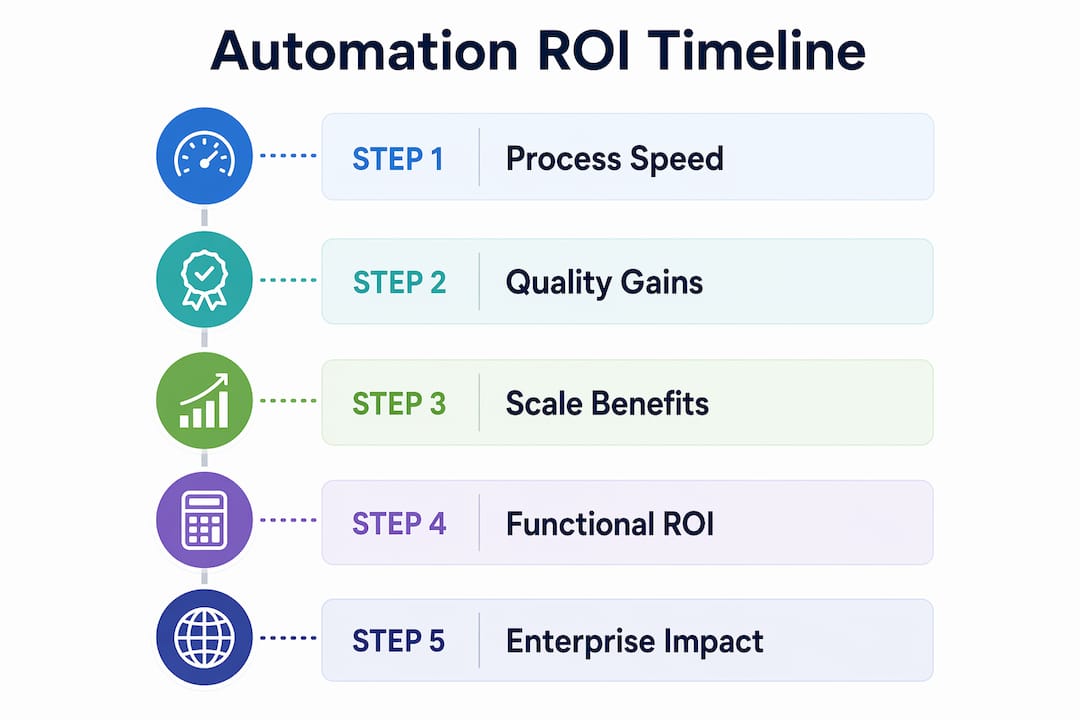
ROI from automation rarely appears where or when companies expect it. Automation ROI first emerges at the functional or subprocess level before it translates into enterprise-wide profitability. A company that automates its email marketing sequences will see open rate and conversion improvements in that channel before those gains show up in total revenue figures. This asymmetry requires patience and precise measurement frameworks.
The most common rollout mistake is measuring automation success by headcount reduction. Focusing automation on workforce reduction can undermine long-term productivity and growth potential, a finding consistent across both MIT’s inequality research and BCG’s workforce modeling. The correct measurement framework tracks output quality, process speed, error rates, and customer experience metrics, not just labor cost.
| Timeframe | Primary ROI indicator | Practical example |
|---|---|---|
| Short-term (0 to 6 months) | Process speed and error reduction | Email sequences deploy in minutes instead of hours; lead routing errors drop to near zero |
| Medium-term (6 to 18 months) | Conversion rate and retention improvement | Automated follow-up sequences increase repeat purchase rates by reducing response lag |
| Long-term (18 months and beyond) | Enterprise-wide margin and output growth | Capital deepening compounds into measurable EBIT improvement across the business |
The table above reflects the asymmetric timeline that economic modeling consistently confirms. Expecting enterprise-wide profit impact in the first quarter of an automation rollout sets unrealistic benchmarks and causes premature abandonment of tools that would have delivered significant returns with more time.
Pro Tip: Set a 90-day measurement sprint focused exclusively on subprocess metrics when you launch any new automation. Track three to five specific process indicators before evaluating broader business impact. This prevents premature conclusions and builds the internal data case for continued investment.
Which automation strategies best support sustainable growth?
Sustainable growth through automation requires prioritizing the workflows that sit closest to revenue. The benefits of marketing automation for ecommerce brands are most pronounced when automation covers the full customer journey from acquisition through retention, not just one touchpoint. Klaviyo’s email automation, for example, drives ecommerce growth by automating lead routing, email sequences, and personalization at scale, producing measurable conversion and retention improvements that isolated campaigns cannot replicate.
For business owners building an automation strategy, the priorities should follow this logic:
- Start with revenue-adjacent workflows. Automate the processes that directly touch your sales pipeline, customer onboarding, and post-purchase experience before addressing back-office functions.
- Pair every automation deployment with a workforce plan. Define what your team will focus on once the automated system handles the repetitive work. Teams that receive clear direction on their new responsibilities adopt automation faster and with less resistance.
- Use personalization as a growth multiplier. Automation tools like Klaviyo allow you to segment customers by behavior, purchase history, and engagement level, then deliver targeted messages at scale. This is not possible manually at any meaningful volume.
- Build upskilling into the rollout timeline. BCG’s research confirms that companies embedding upskilling alongside automation deployment achieve faster adoption and stronger long-term results.
- Measure retention, not just acquisition. Automation’s compounding value shows most clearly in customer lifetime value metrics. A well-built post-purchase email sequence that increases repeat purchase rate by 15 percent delivers more long-term revenue than a one-time conversion campaign.
The ecommerce sector offers the clearest evidence of automation’s growth potential. Brands that integrate AI-driven automation for ecommerce across their website, email, and ad channels create a self-reinforcing growth system where each channel feeds data back into the others, improving targeting and reducing wasted spend over time.
Key takeaways
Automation drives sustainable business growth when it targets workflow consistency and output quality rather than labor cost reduction, and when workforce planning is built into the deployment strategy from day one.
| Point | Details |
|---|---|
| Automate revenue-adjacent workflows first | Lead routing, email sequences, and post-purchase flows deliver the fastest measurable returns. |
| ROI appears asymmetrically | Expect subprocess gains before enterprise-wide profit impact; measure process metrics in the first 90 days. |
| Workforce strategy is non-negotiable | Embedding upskilling into automation rollouts accelerates adoption and prevents productivity loss. |
| Mis-targeted automation destroys value | Automating to suppress wages or cut headcount offsets up to 90% of productivity gains, per MIT research. |
| Personalization at scale is the growth multiplier | Tools like Klaviyo turn behavioral data into targeted sequences that manual teams cannot replicate at volume. |
Why I stopped treating automation as a cost-cutting tool
I have watched business owners approach automation with one question: “How many people can I replace?” That framing produces the worst possible outcomes. The MIT research on income inequality is not just a policy concern. It is a direct warning to operators. When you automate to control costs rather than to improve output, you remove the human judgment that made your process worth automating in the first place.
The companies I have seen get real, compounding growth from automation share one characteristic: they define what their team will do better once the machine handles the repetitive work. They do not reduce headcount. They redirect capacity. A customer success team freed from manual follow-up emails does not sit idle. They handle escalations faster, build relationships with high-value accounts, and generate the kind of qualitative insight that no automation tool can produce.
The other mistake I see constantly is deploying automation in isolation. One automated email sequence does not transform a business. An automated system connecting acquisition, onboarding, purchase, and retention does. That end-to-end thinking is what separates brands that scale from those that just add tools. If you are not mapping the full customer journey before selecting your automation stack, you are optimizing individual steps while leaving the biggest gains on the table.
— Leon
Scale your ecommerce growth with Swyftinteractive
Swyftinteractive specializes in building the kind of end-to-end automation systems that produce compounding ecommerce growth, not one-off campaign wins. Their approach combines high-converting website development with Klaviyo email automation to create a full-funnel growth engine that works across acquisition, retention, and post-purchase revenue.
If you are ready to move from isolated automation tactics to a connected growth system, Swyftinteractive’s ecommerce automation strategy and email marketing automation guide give you the framework and the execution. Their client results, documented in case studies on the site, show what happens when automation is built around the full customer journey rather than a single channel.
FAQ
What is the role of automation in business growth?
Automation drives business growth by replacing manual, repetitive tasks with consistent, scalable processes that free teams for higher-value work. Its impact compounds over time through improved conversion rates, faster lead response, and stronger customer retention.
How does automation affect jobs and the workforce?
Goldman Sachs estimates 50 to 55 percent of jobs will be reshaped by automation in the near term, with full elimination affecting a smaller share over a longer horizon. Companies that pair automation with workforce upskilling outperform those that use it primarily to reduce headcount.
When should a business expect ROI from automation?
Automation ROI typically appears first at the subprocess or functional level within the first six months, before translating into enterprise-wide profitability. Setting 90-day measurement sprints focused on process metrics prevents premature abandonment of tools that need more time to compound.
Is Klaviyo effective for ecommerce automation?
Klaviyo is one of the most widely used ecommerce email automation platforms, enabling behavioral segmentation, automated sequences, and personalized campaigns at scale. Its integration with ecommerce platforms makes it particularly effective for post-purchase retention and repeat revenue growth.
What automation strategies work best for sustainable growth?
Prioritize automating revenue-adjacent workflows first, including lead routing, email sequences, and post-purchase follow-up. Pair every deployment with a workforce plan and measure retention and conversion metrics rather than headcount reduction to track real growth impact.