TL;DR:
- Automated flows generate 41% of email revenue and deliver 13 times higher order rates than campaigns. A scalable online sales engine relies on integration, lifecycle automation, and unified customer data rather than increasing volume. Most brands fail to scale effectively due to fragmented stacks, operational complexity, and poor system architecture, which can be overcome through strategic platform consolidation and collaborative team efforts.
Automated flows make up just 5.3% of all ecommerce email sends, yet they generate 41% of email revenue and deliver 13 times higher placed order rates than standard campaigns. That number should stop most ecommerce brand managers cold. If your growth strategy is built around sending more campaigns, you are likely leaving the majority of your email revenue on the table. A truly scalable online sales engine is not about volume. It is about integration, lifecycle automation, and unified customer data working together as one system.
Table of Contents
- What makes an online sales engine scalable?
- Why integrated systems outperform fragmented stacks
- Lifecycle-driven flows and segmentation: The engine’s heart
- Benchmarking and iteration: Turning data into scalable sales
- The uncomfortable truth: Scaling sales is a systems problem, not a volume problem
- Ready to scale? Your next step: Integrated web and email strategies
- Frequently asked questions
Key Takeaways
| Point | Details |
|---|---|
| Flows outperform campaigns | Automated email flows generate exponentially more revenue per send than traditional campaigns. |
| Integrated platforms drive scalability | Unifying your website, customer data, and email automation removes barriers and enables real growth. |
| Segmentation & orchestration are key | Segmentation and flow orchestration ensure personalized, timely messaging for each customer. |
| Benchmark and iterate for results | Match your KPIs to industry benchmarks and continuously optimize flows for conversion and revenue. |
| Volume doesn’t equal scale | Scaling sales requires system design, integration, and lifecycle-driven strategies, not just sending more campaigns. |
What makes an online sales engine scalable?
Now that we have clarified why most brands miss the real secret to scaling, let’s break down what a scalable online sales engine actually looks like and why integration is so crucial.
A scalable online sales engine is a connected system where your website, email platform, customer data, and post-purchase tools all share information in real time. It does not require you to manually intervene every time a customer browses a product, abandons a cart, or completes a purchase. Instead, the system responds automatically and consistently, regardless of whether you have 500 customers or 500,000.
The contrast with a traditional approach is stark. Most brands build their marketing stack by adding tools one at a time, a separate email platform here, a standalone loyalty app there, a third-party analytics tool bolted on top. Each addition seems logical in isolation. Collectively, they create what ecommerce transformation in 2026 experts describe as a fragmented stack, a setup where data lives in silos and syncing between tools requires constant developer attention.

The real cost of fragmentation is not just technical. It is strategic. When your customer data is split across five platforms, you cannot build accurate segments. You cannot trigger the right message at the right moment. You cannot measure the true revenue impact of your email program. Klaviyo addresses this directly by removing marketing-tech fragmentation in favor of a unified customer platform where behavioral signals, purchase history, and lifecycle stage all live together.
Here is what separates a scalable engine from a fragmented setup:
- Unified customer profiles that pull data from your store, email, SMS, and ads in real time
- Behavior-triggered flows that fire automatically based on actions like browsing, cart additions, or past purchases
- Centralized segmentation that allows precision targeting without manual list exports
- Revenue attribution that connects email sends directly to placed orders, not just clicks
| Metric | Campaign-only approach | Flow-driven engine |
|---|---|---|
| Revenue contribution | Majority of sends, minority of revenue | 5.3% of sends, 41% of revenue |
| Placed order rate | Baseline | 13× higher |
| Personalization | Batch and blast | Behavior and lifecycle |
| Operational demand | High (manual scheduling) | Low (automated triggers) |
The Klaviyo automation advantages for ecommerce brands go beyond convenience. They represent a fundamental shift in how revenue is generated, moving from scheduled pushes to intelligent, always-on triggers that generate revenue far more efficiently than even the best-crafted campaign calendar.
Why integrated systems outperform fragmented stacks
Understanding what defines scalability, it’s clear that integration is more than a buzzword. It is the foundation for real revenue growth and operational efficiency.
Consider what a fragmented mid-market stack actually demands from your team. You have a developer syncing product catalog data between your store and email platform. You have a marketer manually exporting segments and re-importing them into separate tools. You have an analyst trying to reconcile revenue numbers across four dashboards that all measure attribution differently. Mid-market stacks break down precisely because of this fragmentation, requiring constant developer management and creating ongoing risk of sync errors that corrupt your customer data.
The operational drag compounds over time. What starts as a manageable workaround becomes a structural ceiling. Your team spends more time maintaining integrations than building revenue-generating strategies. Every new campaign requires a manual data pull. Every new flow requires a developer to check whether the trigger will fire correctly across connected tools.
“Reliable execution separates coordination from execution and uses orchestration queues to ensure messages fire at the right time without collisions or failures.” This is the operational standard that Klaviyo’s distributed system architecture is built around, and it is what allows automation to scale without breaking.
Integrated platforms solve this by treating all your customer data as a single source of truth. When a customer adds an item to their cart on your website, that signal immediately updates their profile in Klaviyo. The abandoned cart flow fires within minutes, not hours. No developer needed. No sync scheduled for midnight. This is how you examine digital modeling for ecommerce growth and understand why unified platforms consistently outperform their fragmented counterparts on revenue metrics.
The email automation success examples that stand out most are almost always tied to brands that made a deliberate decision to consolidate their tech stack before scaling campaigns. The benefits of email automation compound once the underlying data infrastructure is solid. Trying to layer automation on top of fragmented data is like building a high-rise on sand.
Pro Tip: Before adding any new tool to your stack, ask one question: does this require a custom sync job to keep it updated? If yes, the operational cost will likely outweigh the benefit within 12 months.
Lifecycle-driven flows and segmentation: The engine’s heart
Integration solves for tech complexity, but true scalability happens when flows and segmentation drive personalized messaging that adapts to each customer’s journey.
Think of your email program as a series of conversations, not broadcasts. A broadcast says the same thing to everyone at the same time. A conversation responds to what the other person just did. Lifecycle flows are how you make email feel like the latter. Segmentation and lifecycle flows are the proven, scalable methodology for ecommerce email, with ongoing monitoring and benchmark-based iteration being essential to sustained performance.
The most effective lifecycle flows cover five core stages:
- Welcome series for new subscribers and first-time buyers, introducing your brand and setting expectations
- Browse abandonment for visitors who viewed products without adding to cart, nudging them back with relevant content
- Abandoned cart for shoppers who added items but did not purchase, often the highest-revenue flow you will build
- Post-purchase for customers who just bought, focused on onboarding, cross-sell, and building loyalty
- Win-back for customers who have gone quiet, using targeted offers and re-engagement messaging to recover lapsed buyers
Each of these flows should be built with modular logic. This means you can update one segment or one email within a flow without rebuilding the entire sequence. It also means you can test different versions for different customer segments without creating operational chaos.
Segmentation is what makes flows feel personal at scale. Instead of one abandoned cart email for all shoppers, you send a different version to first-time visitors, a different one to loyalty members, and a different one to customers who have abandoned before. Your email marketing strategies become self-differentiating based on customer behavior rather than requiring manual list management.
One underrated aspect of flow design is orchestration. Flow orchestration prevents offer collisions and ensures customers receive messages sequentially, which is critical when you have a robust flow library running simultaneously. Without orchestration rules, a customer who just purchased could simultaneously receive a win-back email and an abandoned cart reminder, which is both confusing and damaging to brand trust.
The abandoned cart email guide published by our team goes deep on this, and understanding the full range of types of ecommerce emails will help you map out a complete flow architecture that covers every customer lifecycle moment.
Pro Tip: Set flow priority rules inside Klaviyo so that post-purchase flows always suppress win-back and cart abandonment flows for a defined window after a purchase. This single rule prevents dozens of awkward message conflicts as your automation library grows.
Benchmarking and iteration: Turning data into scalable sales
Flows power the engine, but systematic benchmarking and data-driven iteration are what tune it for enduring results.
Most ecommerce brands measure email success by open rates. This is understandable but increasingly misleading. Apple’s Mail Privacy Protection, along with similar features on other platforms, has inflated open rate data significantly. A 45% open rate might look fantastic, but if your click rate and placed order rate are flat, those opens are not converting. The real metrics for scalable email revenue are clicks, placed orders, and revenue per recipient.
Benchmarking requires comparing by both channel type (campaign versus flow) and industry vertical. An abandoned cart flow in the apparel industry will have different benchmark click and conversion rates than one in the home goods space. Applying a generic benchmark to your program leads to poor decisions.
Here is how to approach benchmarking practically:
- Separate your flow metrics from your campaign metrics entirely. They serve different purposes and have vastly different performance profiles.
- Identify your lowest-performing flow by placed order rate, not by open rate. This is where your biggest revenue opportunity lives.
- Compare your flow metrics against industry-specific benchmarks quarterly, not just when something looks wrong.
- Use A/B testing inside individual flows to isolate what drives click and conversion improvements, subject lines, send timing, offer type, or content format.
| Metric | Why it matters |
|---|---|
| Placed order rate | Direct measure of revenue-driving effectiveness |
| Revenue per recipient | Normalizes performance across list size differences |
| Click rate | Leading indicator of content relevance and offer alignment |
| Flow vs campaign split | Identifies whether your automation or manual sends drive more revenue |
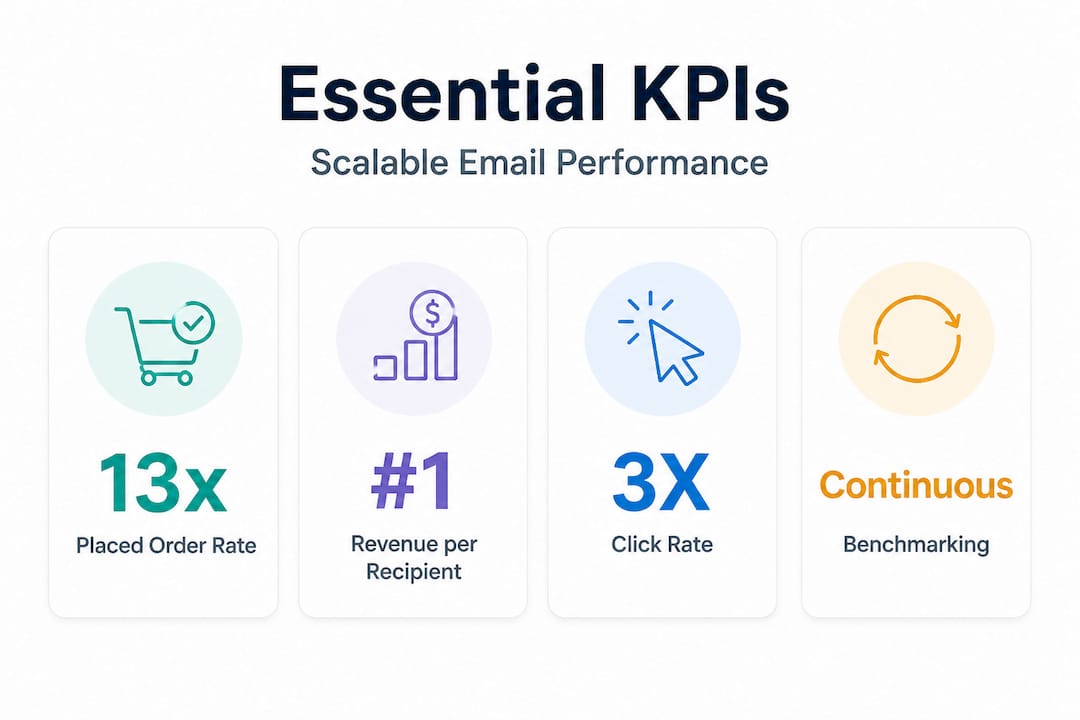
Placed orders and revenue efficiency are the right KPIs for email decision-making in ecommerce. Campaigns have their place for announcements, product launches, and seasonal promotions. But if your flow program is healthy, campaigns should be a complement to automation, not a substitute for it.
The lifecycle marketing strategies that sustain growth over time are the ones that treat benchmarking as a continuous habit. Build a monthly review of your top five flows, compare against your last quarter, and set one specific improvement target per cycle. This cadence is what separates brands that plateau from ones that compound.
The uncomfortable truth: Scaling sales is a systems problem, not a volume problem
Having covered benchmarking and iteration, it is time to reconsider what scaling actually means and why most brands focus on the wrong levers.
We see it repeatedly. A brand hits a growth wall and the immediate instinct is to send more. More campaigns. More promotional emails. More messages to the full list. The logic feels sound: if one email drives some revenue, five emails should drive five times as much. But this thinking collapses when you look at the data. List fatigue increases. Unsubscribe rates climb. Deliverability degrades. Revenue per recipient falls. The brand ends up with more effort, higher costs, and diminishing returns.
The real constraint is almost never volume. It is system design. Fragmented stacks cap marketing velocity due to operational burden. When your team is spending 60% of their time managing integrations, exporting segments, and debugging sync errors, they are not building better flows. They are maintaining infrastructure that a unified platform would eliminate entirely.
What we have learned working with ecommerce brands across multiple verticals is this: the brands that scale fastest are the ones that invest in system architecture before they invest in creative volume. They build a complete flow library first. They establish clean segmentation logic before launching campaigns. They define their orchestration rules before their list grows large enough to make message collisions a daily problem.
This also requires a rethinking of team structure. Scaling is not just a marketing problem. It requires your developers, your operations team, and your marketing strategists to share a common understanding of how customer data flows through your system. When those teams operate in silos, you get fragmented tech stacks. When they collaborate around a unified platform approach, you get compounding results.
The brands that treat scaling as a systems problem, not a volume problem, are the ones who look back two years later and cannot believe how much easier growth became once the infrastructure was right.
Ready to scale? Your next step: Integrated web and email strategies
Reorienting around true scalability is a significant shift, but you do not have to figure it out alone. The resources and expert support to make this transition are already built.
Start with the ecommerce Klaviyo checklist to audit your current setup against best-practice standards for both website performance and email automation. If you want a structured path from setup to scale, the email automation guide walks through platform integration, flow architecture, and segmentation strategy in practical detail. For brands ready to implement immediately, the step-by-step automation workflows give you a build-ready framework you can execute this week. Swyft Interactive specializes in exactly this type of integrated ecommerce growth, from high-converting website builds to full Klaviyo automation strategy.
Frequently asked questions
What is a scalable online sales engine and how does it work?
It is an integrated system that unifies customer data and automates lifecycle flows rather than relying on manual campaign scheduling, allowing revenue generation to run continuously without proportional increases in team effort.
Why not just send more campaigns to scale sales?
Because flows deliver 13 times higher placed order rates than campaigns, meaning smart automation at the right lifecycle moment outperforms volume every time.
How do you avoid email flow overlap or conflicting offers?
Use priority rules and suppression logic to ensure flows fire sequentially and competing offers are paused automatically when a customer is already active in a higher-priority flow.
What metrics matter most for scalable email marketing?
Track placed orders, clicks, and revenue per recipient rather than open rates, which have become unreliable since major email clients introduced privacy protections that auto-open emails.
How does integration affect ecommerce sales scalability?
Unified customer platforms remove the operational ceiling created by syncing siloed tools, allowing your marketing team to scale automation velocity without developer bottlenecks or data accuracy risks.